
Cracks are opening inside the Trump coalition. They are not coming from the left. They are coming from a Heritage Foundation economist and from within Trump’s own counterterrorism apparatus — driven by an Iran war that is pushing oil past $113 a barrel.
E.J. Antoni, chief economist at the Heritage Foundation, a leading figure in its Project 2025 policy work and a former Trump nominee to lead the Bureau of Labor Statistics, is not a critic of U.S. imperialism. He is a reliable voice of the hard right. On March 19, he told the Financial Times that the U.S. economy cannot absorb $100-a-barrel oil — and that the war is now pushing it well past that.
“The economy is weaker than we thought it was, and inflation is worse than we thought it was,” Antoni said. He warned that the energy price drop of 2025 had been doing real work suppressing inflation across the economy — and that the reversal is now doing the opposite.
The numbers bear him out. Brent crude has surged past $113 a barrel, “up sharply in recent trading. Gas prices at the pump have risen from $2.92 to $3.84 a gallon in a single month. Diesel has reached $5.09 a gallon nationally, hitting trucking and logistics costs throughout the supply chain. Every dollar added to energy prices moves through food, freight and manufacturing. Some analysts are now projecting $150 to $200 a barrel if the supply disruption persists.
The day before Antoni’s remarks, Joe Kent — a senior official at the U.S. National Counterterrorism Center and a Trump loyalist — resigned in protest over the Iran war. It was the first significant defection from inside the administration since Operation Epic Fury began Feb. 28.
The ruling class is fracturing — over strategy, over electoral survival, over whether this war is economically sustainable. Who pays for it is not in dispute.
That dispute has a class dimension the electoral framing obscures. The costs Antoni and congressional Republicans are worried about are electoral and macroeconomic — the kind that threaten political stability at the top. The costs the working class is already absorbing are different. Gas at $3.84 is not an abstraction for workers commuting on shrunken paychecks. Diesel at $5 moves directly into the price of groceries.
The war’s financial structure makes those costs permanent, not temporary. The first six days of Operation Epic Fury cost at least $11.3 billion, most of it unbudgeted. The Washington Post reported March 19 that the Pentagon has asked the White House to approve a supplemental request of more than $200 billion — quadruple the figure circulating just days earlier. The Iraq War cost roughly $140 billion per year at its peak. The Pentagon is now asking for more than that in a single request — just three weeks into the war, and before a full-year cost is even calculated.
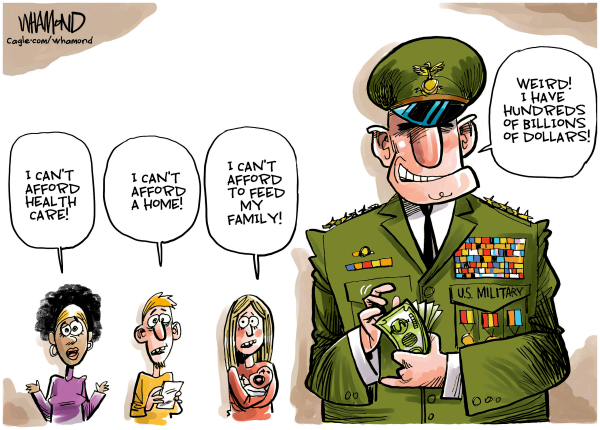
That spending does not fall on Lockheed Martin — whose stock has risen 43% in three months — or on Raytheon’s parent RTX, up 40% year to date. It falls on the federal budget, and through the budget on health care and food programs already being stripped before the first missile was fired.
On July 4, 2025, Trump signed a budget law cutting Medicaid by more than $1 trillion over 10 years and slashing food assistance by $186 billion — the largest SNAP cut in history, affecting 40 million people. That money did not disappear. It cleared fiscal space for the war apparatus now burning through SM-3 interceptors and THAAD missiles faster than manufacturers can replace them.
Antoni’s complaint is real, but its logic stops at the ruling class’s door. He warns that federal worker layoffs — thousands cut under the DOGE cost-cutting campaign — are dragging on job growth. He is right that the policy is producing economic damage. What he does not say is that the damage was built in. An economy in which working-class consumption is suppressed through benefit cuts, wage stagnation and public-sector layoffs is not positioned to absorb an oil shock. That is the condition Operation Epic Fury was launched into.
The Strait of Hormuz, through which one-fifth of the world’s daily oil supply passes, has seen tanker traffic collapse since Feb. 28. Iran is now actively attacking ships attempting to transit it. The Strait was empty for 24 hours before the latest strike wave began.
The scale of the supply collapse is now quantifiable. Data from the firm Vortexa shows oil and fuel exports from the region averaged 26.1 million barrels per day in February. By mid-March that figure had fallen to 7.5 million barrels per day — a drop of more than 70%. Iraq has cut production by 2.9 million barrels daily. Saudi Arabia has reduced output by 2 to 2.5 million barrels daily. The UAE has cut 1.5 million barrels per day and Kuwait 1.3 million — though country-level production cuts account for more than 7 million barrels per day of that decline.
Iran’s strikes on Qatar’s Ras Laffan gas hub — the world’s largest LNG facility — have done damage experts describe as potentially irreparable. The complex, which took 14 years to build, is not expected to return to operation for years, if at all. Drone strikes have also hit two separate oil refineries in Kuwait. Saudi Arabia intercepted ballistic missiles fired toward Riyadh. The attack wave is ongoing.
The administration is now weighing steps that would deepen the crisis further. Reuters reported March 19 that it is considering deploying thousands of additional troops to the region. The options include securing tanker passage through the Strait of Hormuz through air and naval deployments, and potentially deploying ground forces along Iran’s coastline. The administration has also discussed sending forces to Kharg Island, the hub for 90% of Iran’s oil exports.
One U.S. official described such an operation as “very risky,” noting that Iran can reach the island with missiles and drones. A ground assault on Kharg Island would not reopen the oil flow. It would target the infrastructure that makes Iranian exports possible — a direct strike at the petrostate structure the petrodollar system was built to incorporate, not destroy.
The fractures inside the Trump coalition are real. They reflect growing strain inside the ruling class over how to manage a war that is driving up prices and expanding deficits. But they are not a break with the war itself. They are a dispute over how to contain its fallout — and over who will pay for it.
That question is not being debated in theory. It is being settled in rising prices, shrinking public programs and a war bill that is only beginning to come due.
Join the Struggle-La Lucha Telegram channel