
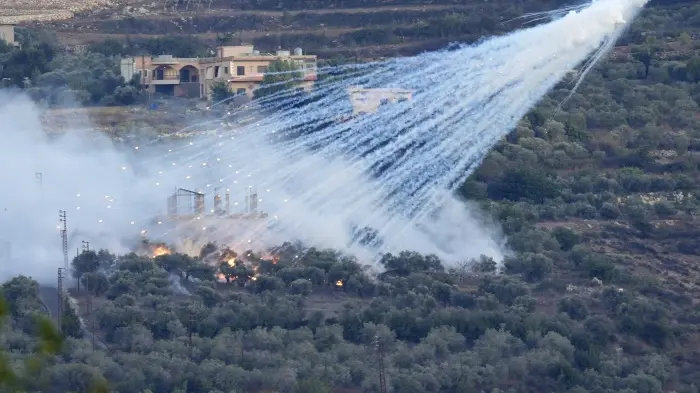
On the morning of March 3, Israeli forces fired white phosphorus shells over residential neighborhoods in Yohmor, a village in southern Lebanon. The shells burst in the air above homes, scattering burning fragments across the area. Fires tore through at least two homes and a car. Civil defense crews rushed in. The weapons had already done their work.
Human Rights Watch verified and geolocated photographs of the attack. Analysts identified the munitions as U.S.-made M825-series 155mm shells loaded with white phosphorus. Airburst rounds scatter burning wedges across a wide area. In a residential neighborhood, that means homes, streets, farmland, and people.
White phosphorus ignites on contact with oxygen and cannot be put out easily with water. It burns through skin to bone. It poisons soil and water. “The incendiary effects of white phosphorus can cause death or cruel injuries that result in lifelong suffering,” said Ramzi Kaiss, Human Rights Watch’s Lebanon researcher.
This has happened before. Between October 2023 and July 2024, the Lebanese National Council for Scientific Research documented 175 white phosphorus attacks across southern Lebanon, burning more than 600 hectares of farmland. Human Rights Watch found unlawful use in at least five municipalities. The Israeli military denied the charges. After the March 3 strike, it said it “cannot currently comment.”
That record matters. The attack on Yohmor was no accident. It was a continuation.
International humanitarian law prohibits the use of airburst white phosphorus in populated areas because it is inherently indiscriminate. Israel is not a party to Protocol III of the Convention on Certain Conventional Weapons, but human rights organizations argue the ban applies regardless.
Washington has nothing to say. The Trump administration continues to back Israel’s war in Lebanon. Arms sales from Boeing, Lockheed Martin and Raytheon continue, tying U.S. corporate profit directly to the destruction on the ground. The shell used in Yohmor is a U.S. product.
Israel’s war is carried out with U.S. weapons, financing and political protection — part of Washington’s broader effort to dominate the region by force, with Israel acting as its principal regional enforcer.
That supply chain is being reinforced at home. On Feb. 18, the Trump administration invoked the Defense Production Act to designate elemental phosphorus and glyphosate-based herbicides as critical to national defense, directing support to companies such as Bayer, which acquired Monsanto and produces glyphosate. Elemental phosphorus is a key input in smoke, illumination and incendiary munitions — including the white phosphorus shells used in Yohmor. The order grants legal protections to producers complying with federal directives, shielding them from liability as production expands. It brings agricultural chemicals and war materials under the same national defense framework.
The attack followed a familiar pattern of escalation. Early that morning, Israel’s Arabic-language military spokesperson ordered residents of Yohmor and dozens of other villages to evacuate. Hours later, the shells fell. An evacuation order does not make an attack lawful. It shows Israeli forces expected civilians to be present when the shells struck.
Local civil defense groups report “double-tap” strikes — bombing a site, then striking again when rescue workers arrive. The same crews that put out the fires in Yohmor face those follow-up attacks elsewhere.
The pattern is clear. Weapons designed to burn are used against working-class communities, farmers and rural families in southern Lebanon. The aim is not only to push Hezbollah north of the Litani River. It is to drive people out and make return materially impossible.
White phosphorus is not the only weapon used against the land itself. Lebanese officials report that Israeli aircraft sprayed herbicides over large areas of southern Lebanon in early February, damaging farmland, forests and grazing areas. Tests by Lebanon’s agriculture and environment ministries found glyphosate at concentrations 20 to 50 times above standard agricultural levels.
The chemical kills plant life at the root and can prevent regrowth for years, contaminating soil and threatening water sources. Lebanese officials say the goal is to strip vegetation and create a barren zone along the border. President Joseph Aoun called it a crime against the environment and Lebanese sovereignty.
Human rights organizations have raised the possibility that this pattern — seen across Gaza, Lebanon and southern Syria — meets emerging definitions of ecocide.
Burn the homes. Poison the soil. Leave nothing behind.
Join the Struggle-La Lucha Telegram channel