
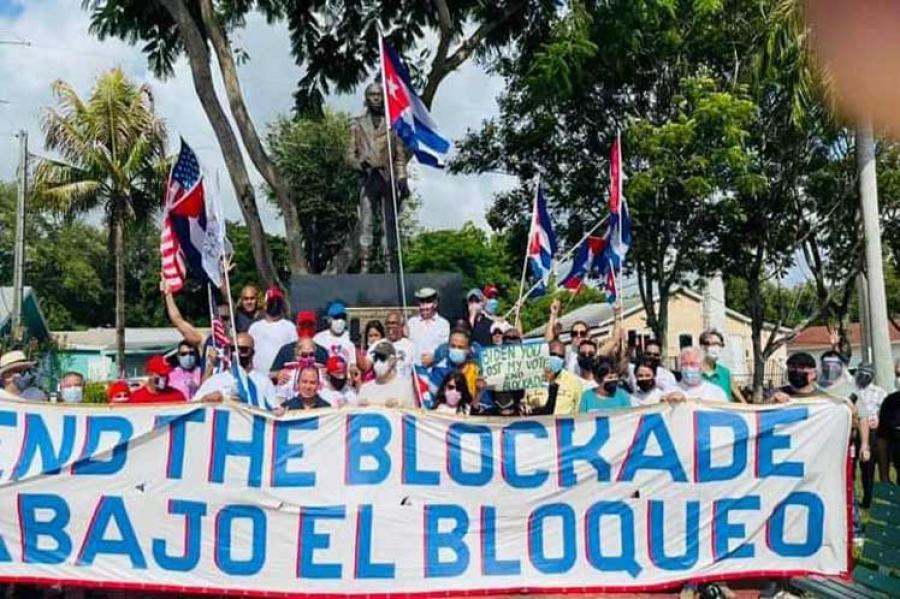
NEW YORK — Activists from across the United States gathered March 14–15, calling for urgent solidarity action in response to Cuba’s deepening energy crisis intensified by Washington’s escalating blockade.
The Jan. 29 presidential executive order zeroed in on Cuba, declaring a “national emergency,” falsely alleging its government presented “an unusual and extraordinary threat. … to the national security and foreign policy of the United States.” Although the threatened punitive tariffs for any country supplying fuel to Cuba were declared unconstitutional by the U.S. Supreme Court, oil tankers have turned back.
Venezuela had supplied much of Cuba’s fuel under a long-standing cooperation agreement. After Washington’s Jan. 3 operation that kidnapped Venezuelan President Nicolás Maduro and Cilia Flores, those shipments were cut off. According to the Cuban government, the island has received no oil since December, now relying on its own production and reserves.
The fuel blockade has intensified rolling blackouts across the island. In many areas, electricity outages now stretch for more than 20 hours a day, disrupting transportation, food distribution, water systems and hospital services. Fuel shortage for trucking and transportation has paused airline refueling until the beginning of April.
Against that backdrop, the 2026 International U.S.-Cuba Normalization Conference adopted a 16-point action plan aimed at strengthening the movement against the U.S. blockade and defending Cuba’s sovereignty. In response to the rapidly sharpening crisis, the National Network on Cuba had already called for a week of actions to defend Cuba from March 8 – 15, mobilizing nearly 50 actions from Oregon to Maine, Minnesota to Florida.
From normalization to emergency solidarity
The gathering brought together solidarity organizations, labor activists and community organizers from across the United States.
For many participants, the central conclusion was that the political moment has shifted. What had previously been framed as a campaign for normalization between Washington and Havana now requires an emergency defense of Cuba against an escalating economic siege and military threat.
The action plan outlines four areas of work: protest mobilization, legislative advocacy, humanitarian aid and coalition building.
Organizers called for nationally coordinated demonstrations linking the defense of Cuba with broader protests against the Trump administration, including mobilizations against immigration raids.
Activists also pledged to press Congress to support legislation aimed at dismantling the legal structure of the blockade while opposing new sanctions legislation.
Humanitarian aid and solidarity travel
A major section of the plan focuses on expanding humanitarian aid.
Organizations already delivering medical supplies and other assistance to Cuba reported new initiatives aimed at addressing the health consequences of the energy crisis.
Participants also endorsed plans for an international humanitarian convoy scheduled to depart from Mexico in April. Activists say the flotilla will deliver aid to the island while drawing international attention to the impact of the blockade.
Solidarity travel was another priority. The plan encourages delegations to Cuba — including May Day brigades — as a way to provide economic support and bring back firsthand reports about conditions on the island.
Expanding the movement
Conference participants stressed the need to broaden the social base of the Cuba solidarity movement inside the United States.
Organizers pointed to growing opposition to the blockade among Cuban Americans who want to maintain ties with family members on the island. South Florida, Texas and New Jersey were identified as key areas for outreach.
Labor organizing was also highlighted. Activists cited more than 120 resolutions adopted by U.S. cities and labor bodies opposing the blockade and called for similar resolutions in additional unions and community organizations.
The action plan also links defense of Cuba to broader struggles against U.S. sanctions and immigration policies, including opposition to plans to expand migrant detention at the Guantánamo naval base.
A wider confrontation
The conference took place as the United States is escalating military and economic pressure across the region, including the recent assault on Iran and the intervention in Venezuela.
Participants said the tightening blockade of Cuba is part of Washington’s broader effort to reassert control across Latin America.
With Cuba confronting severe energy shortages, activists said the task now is clear: expand the movement to end the U.S. blockade.
From protests and humanitarian aid to labor and community organizing, the campaign to defend Cuba is entering a new phase.
Join the Struggle-La Lucha Telegram channel