
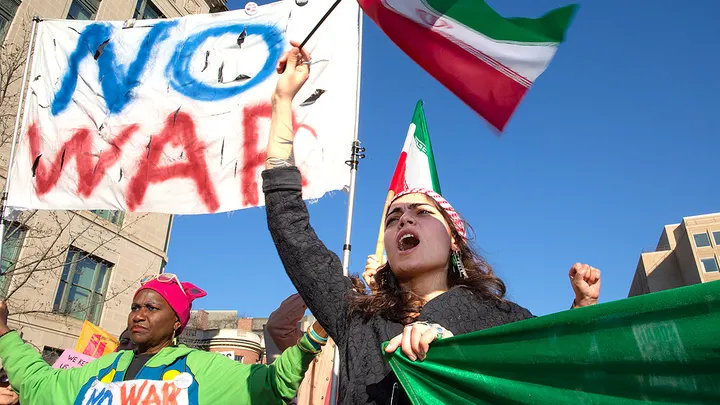
Wars destroy cities and take lives. They also shake the world economy.
Oil prices jump, shipping routes close, inflation rises and recession risks grow. For that reason, many analyses of the U.S. war on Iran focus heavily on energy markets and the economic impact of war in the Persian Gulf.
That economic analysis is useful. A prolonged interruption of oil exports through the Strait of Hormuz could push prices sharply higher and ripple through the global economy. Higher fuel costs raise transport prices, increase food costs, and intensify inflation pressures that fall hardest on workers — employed and unemployed alike.
But when war is examined mainly through its economic consequences, something essential can disappear from view.
The problem is not the analysis of oil markets. The problem is that imperialism itself fades into the background.
Two recent crises illustrate the problem clearly — the U.S. attack on Iran that assassinated Supreme Leader Ali Khamenei and other senior Iranian officials, and the U.S. attack on Venezuela that kidnapped President Nicolás Maduro and Cilia Flores.
In both cases, commentary often treats the conflict primarily as an economic shock or geopolitical dilemma. The central political reality is simpler: These are confrontations between an imperialist power and states that refuse to submit.
Without that starting point, the political character of the conflict becomes blurred.
War seen through markets
Much discussion of the Iran war focuses on the disruption of oil flows and the consequences for the global economy.
The Strait of Hormuz carries a large share of the world’s seaborne oil trade. If tanker traffic stops, prices rise. Insurance premiums soar. Energy markets tighten. Inflation spreads.
These are real mechanisms. Energy shocks have triggered global recessions before.
But when the story begins with oil prices rather than with the political character of the war, the analytical center shifts. The conflict appears first as a disturbance to the world economy and only secondarily as a war launched by the most powerful military state on earth.
The war becomes a problem for markets.
It is no longer recognized as an act of imperialist power.
The familiar language of regime change
In discussions of these conflicts, the focus often shifts away from the imperialist aggression itself and toward the internal character of the governments being targeted. The narrative becomes familiar: The government under attack is authoritarian, unpopular or illegitimate, and therefore its confrontation with Washington appears less like imperialist aggression and more like a clash between two flawed regimes.
This framework has long been central to regime-change politics.
Marxist analysis cuts through that framing. The question is not whether a targeted government meets some standard of legitimacy. The question is who is attacking whom, and why.
Venezuela and imperialist aggression
For years Washington attempted to overthrow the Bolivarian government through sanctions, economic blockade, diplomatic isolation and open support for opposition figures making bogus claims to the presidency.
Unable to force the Venezuelan people to surrender through sanctions and economic strangulation, that campaign escalated on Jan. 3 into direct military action. U.S. forces struck targets around Caracas and carried out a raid that kidnapped President Nicolás Maduro and Cilia Flores and imprisoned them in the United States. No comparable act of aggression would be directed at the leader of an imperialist power.
Imperialism as structure
Imperialism explains why these confrontations occur.
The United States maintains the largest military apparatus in history, hundreds of overseas bases and the ability to enforce sanctions through its control of global finance. This network of power allows Washington to pressure, isolate and attack governments that resist its strategic interests.
States such as Iran and Venezuela occupy a completely different position within the global system.
Their military capabilities are regional. Their economies face constant pressure from sanctions and financial exclusion. Their ability to project power internationally is extremely limited.
Treating conflicts between these states and the United States as essentially symmetrical obscures the enormous imbalance built into the global order.
Imperialism is not simply a foreign-policy choice made by particular leaders. It is a structural feature of advanced capitalism: dominant states using military and financial power to control the world’s resources, markets and labor — and to suppress any challenge to that control.
The illusion of domestic solutions
Polls show overwhelming working-class opposition to the war on Iran. Yet Congress has done nothing to stop it.
The constitutional framework is clear. Under Article I, Congress holds the power to declare war. Under the 1973 War Powers Act, the president must seek congressional authorization within 60 days of deploying forces into hostilities. Neither requirement was met when U.S. and Israeli forces launched coordinated strikes on Iran on Feb. 28.
Congress had the opportunity to reassert that authority. It declined. The Senate rejected a war powers resolution 47–53 on March 4 — the eighth such vote since June. All eight have failed. The same day, the House passed a nonbinding resolution reaffirming Iran as the world’s leading state sponsor of terrorism, 372 to 53. The bipartisan consensus is not ambiguous. It is for the war, against accountability for the war.
Congress controls the purse strings yet has approved no funding for this one. The administration pulls money from existing Pentagon accounts or adds to the deficit. Congress lets the war continue.
Imperialist wars are rarely the product of a single administration. They arise from strategic interests embedded in the structure of capitalism itself. The record of the past half-century — from Vietnam to Iraq to Libya to the economic war against Venezuela — shows that both major U.S. parties have repeatedly backed intervention when ruling-class interests demanded it.
The principle that disappears
For Marxists analyzing conflicts between imperialist powers and oppressed nations, a central principle has long been clear.
The decisive political fact is the relationship between the imperialist aggressor and the nation under attack.
Without that principle, critiques of war easily become purely economic. The conflict is condemned because it destabilizes markets, raises energy prices and threatens global growth — while the imperialist aggression that launched the war disappears from view.
The central issue is that imperialist war grows out of the capitalist system itself and the drive of the imperialist powers to maintain their domination of the world.
Remembering imperialism
Economic analysis remains essential for understanding capitalism. Profit rates, financial crises, inflation and growth cycles shape the world in which wars occur.
But capitalism does not operate only through markets.
It also operates through military force, sanctions regimes and geopolitical domination.
When analysis focuses only on the economic turbulence produced by war while neglecting the imperialist structure that produces those wars, a central feature of the system disappears from view.
And in moments like the present — from Venezuela to Iran — the thing that disappears is imperialism itself.
Join the Struggle-La Lucha Telegram channel