
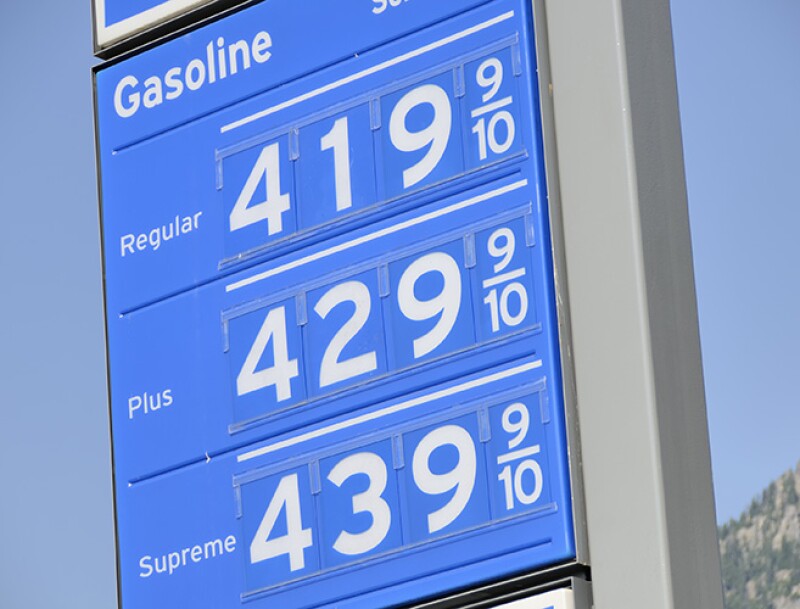
Gas prices are rising across the United States — the first cost of Washington’s war on Iran.
The reason lies thousands of miles away in the Persian Gulf. U.S. airstrikes against Iran beginning Feb. 28 turned one of the world’s most important energy corridors into a war zone.
Every war launched by the U.S. ruling class sends out two bills. One is paid in blood — by soldiers and by civilians under the bombs. The other is paid in rising prices, shrinking paychecks and deepening insecurity — by workers everywhere.
The working class did not choose this war. But it is already paying for it.
The first economic shock
The Strait of Hormuz is one of the narrow gates through which the world’s energy supply flows. Roughly one-fifth of global oil shipments pass through it every day. When the U.S. military campaign turned the region into a war zone, that flow was disrupted. Oil markets reacted immediately.
Brent crude was trading around $73 a barrel before the strikes. Within days, it surged past $100 and briefly hit $120. Diesel prices jumped 22%. Gasoline rose 17% across the United States.
Those numbers are not abstractions. Diesel powers the freight system. Every truck moving across the United States runs on it. When diesel rises, the price moves through the entire economy.
A truck hauling groceries from California to Nevada burns hundreds of gallons of diesel on a single run. When diesel rises 22%, that cost lands directly in the price of food at the store.
Furniture, medicine, groceries and clothing all move by truck before they reach a shelf. When fuel costs rise, every item on that shelf carries the increase.
The war in the Persian Gulf is already showing up in the checkout line.
Who pays the war tax
Energy Secretary Chris Wright calls the price surge a temporary “fear premium.” The world, he says, is not short of oil. It will all settle down in a matter of weeks.
But while prices rise for workers, profits rise for the oil giants.
When oil prices jump, production costs do not. The wells are already drilled. The pipelines are already built.
ExxonMobil, Chevron and the commodity traders sell the same oil. Only the price tag changes. Their profits expand.
For workers, the same price increase functions as a tax.
Gasoline has climbed to a national average of $3.48 per gallon as of March 8. Diesel has risen even faster.
Fertilizer and food
The consequences extend far beyond U.S. fuel pumps.
The Persian Gulf region is also central to the global fertilizer supply. Nitrogen fertilizers are derived from natural gas, and Gulf producers supply a large share of the world market.
Qatar’s liquefied natural gas exports have been disrupted by the fighting. Within days, global urea prices — a key ingredient in fertilizer — jumped 25%.
For large agribusiness corporations, that is another input cost.
Small farmers do not experience fertilizer prices the same way large agribusiness corporations do. Big companies can absorb the increase or pass it along through global markets.
Small farmers cannot.
A sudden 25% jump in fertilizer costs can mean planting fewer acres and producing smaller harvests. When harvests shrink, food prices rise.
In the poorest countries, it can mean hunger.
And fertilizer is only one part of the shock spreading through the global economy.
The supply chain shock
The war is also choking global transport.
Air cargo routes through the Gulf have been disrupted, shutting down a major hub of international freight. Shipping costs from Asia to Europe have already jumped roughly 45%.
Planes and cargo carriers are being forced onto longer routes that burn more fuel and carry less cargo.
Every additional mile traveled eventually adds to the price tag.
The cost of the war travels the same roads as the goods themselves — until it lands on the worker.
The crisis at home
The war is not the only crisis. It is colliding with crises already here.
Child care is one of them. The average annual cost of care for two children now exceeds $28,000. Under federal affordability guidelines, families should spend no more than 7% of their income on child care. At current prices, meeting that standard would require a household income of more than $400,000 a year.
Most families earn nowhere near that.
Child-care workers are paid poverty wages. Many — overwhelmingly women — are losing their own health coverage as costs rise. Providers struggle with rising insurance costs, rent and supplies. Families are pushed to the breaking point.
Now fuel costs are rising too. Providers heat buildings, make deliveries and drive to work. Those costs land somewhere. They land on already-stretched budgets.
Meanwhile, billions flow into war spending. The federal government always finds money for bombs. It has not found money for child care.
That is the collision. Working families are being squeezed from both directions — by a war they did not choose and a social crisis that was never solved.
Debt fills the gap
Another warning sign is household debt.
Households in the United States now carry roughly $1.28 trillion in credit-card balances, the highest level since the Federal Reserve began tracking the data. Balances rose by about $44 billion in the final quarter of 2025 alone, and they now stand hundreds of billions above pre-pandemic levels.
As fuel and freight costs ripple through the economy, more households are using credit cards to cover everyday expenses. Groceries, gasoline, and utilities increasingly appear on cards with interest rates above 20%.
Workers are not borrowing for luxury. They are borrowing to get through the month.
When war drives up the cost of living, the difference increasingly gets charged to a credit card.
Financial tremors
Financial markets have reacted sharply to the war.
Private credit firms — the shadow banks that expanded rapidly over the past decade — are facing sudden withdrawals from investors.
Pension funds and retail investors alike tend to pull money when war creates uncertainty.
But much of that money is tied up in long-term private loans that cannot be quickly sold.
When investors demand their cash back all at once, the firms may not be able to provide it.
In one week, the Dow Jones index has erased all of its gains for 2026.
The same politicians who celebrated record stock prices as proof of a healthy economy now warn of instability.
Workers, who never shared in the stock market boom, will once again be asked to pay for the collapse.
The promise of ‘no new wars’
Donald Trump repeatedly claimed that he was the only recent president who had not started a new war. He called the Iraq invasion a disaster and criticized the trillions of dollars spent on wars in West Asia.
Yet within weeks of promising “peace on earth” for 2026, the United States launched a military operation in Venezuela and then began strikes against Iran.
The two conflicts are not separate events. The seizure of Venezuela’s oil industry and the assault on Iran both target the same strategic prize — control over the energy system that powers the global economy.
From Caracas to the Persian Gulf, the same struggle is unfolding over who controls the world’s oil and who pays the cost.
Oil is also tied to the power of the U.S. dollar itself. Since the 1970s, most international oil sales have been priced in dollars — creating what are often called petrodollars. Countries that need oil must obtain dollars to buy it, reinforcing the dollar’s central role in global trade and finance.
Maintaining that system has long shaped U.S. strategy in the Persian Gulf.
The workers pay
The ruling class insists the disruption will be temporary.
But wars rarely work that way. Oil facilities shut down by conflict take time to restart. Shipping routes shift. Supply chains break. Prices rise and stay high.
When the costs finally settle, they will not be paid by the people who ordered the war.
They will be paid by workers filling their gas tanks, buying groceries and trying to keep a roof over their heads.
Workers in the United States.
Workers in Iran.
Workers across the Global South.
Workers everywhere.
They are the ones being handed the bill for a war they never chose — and never needed.
Join the Struggle-La Lucha Telegram channel