
Washington launched Operation Epic Fury on Feb. 28, killing Iranian Supreme Leader Ali Khamenei and several top commanders in a joint U.S.-Israeli strike. What followed was not the collapse and capitulation that U.S. war planners had assumed. Iran’s Armed Forces launched what they designated Operation True Promise 4 — a sustained, methodical campaign targeting the infrastructure of U.S. military power across West Asia. One week in, the damage is documented, and in at least one critical case, confirmed by the Pentagon itself.
Strike the radar, stop the system
Iran did not attempt to overwhelm U.S. missile defenses through sheer volume. Instead, the Iranian military executed a counter-sensor campaign: targeting the detection and fire-control systems that make the entire defensive architecture function.
The primary target was the AN/TPY-2 radar — the X-band surveillance array that serves as the nerve center of the Terminal High Altitude Area Defense system. Without it, a THAAD battery cannot acquire targets or direct interceptors. “The AN/TPY-2 radar is essentially the heart of the THAAD battery, enabling the launch of interceptor missiles and contributing to a networked air defence picture,” munitions specialist N.R. Jenzen-Jones of Armament Research Services told CNN.
To put it in plain terms: THAAD is a missile defense system — a battery of interceptor rockets designed to shoot down incoming missiles before they hit their targets. But THAAD cannot function without its radar. The radar is what scans the sky, spots an incoming missile, calculates where it’s going, and tells the interceptors what to shoot at. Destroy the radar and the interceptor rockets are useless — expensive machinery with nothing to direct them. Iran targeted the radar systems directly.
Satellite imagery reviewed by the open-source publication Islander Reports shows strike damage at four AN/TPY-2 sites across the Arabian Peninsula: Prince Sultan Air Base in Saudi Arabia, Al Ruwais in the UAE, Al Dhafra Air Base near Abu Dhabi, and Muwaffaq Salti Air Base in Jordan. The U.S. confirmed the Jordan strike, acknowledging that Iran destroyed a radar system at Muwaffaq Salti valued at $300 million. The AN/TPY-2 component alone carries a unit cost of approximately $500 million.
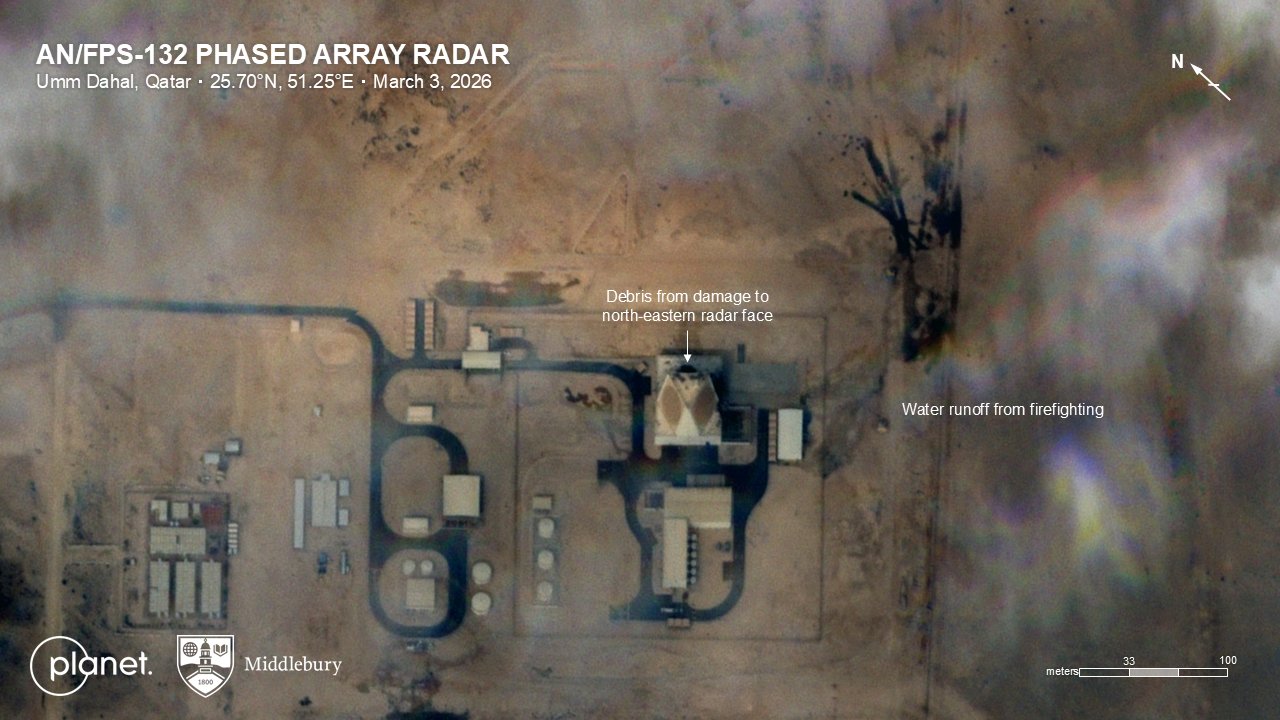
Also struck: the AN/FPS-132 early warning radar in Qatar — a $1.1 billion installation hit by a ballistic missile. Iranian strikes have damaged or destroyed facilities at 11 confirmed U.S. military sites across the region since Feb. 28, including at Bahrain, Kuwait, Qatar, Saudi Arabia, the UAE, and Jordan.
The campaign extended beyond missile defense radar to the communications infrastructure that holds the entire U.S. military network together. A New York Times analysis of satellite imagery confirmed that Iranian strikes destroyed two AN/GSC-52B SATCOM terminals at the U.S. Navy’s Fifth Fleet headquarters in Bahrain — high-capacity satellite systems used for near real-time military communication and coordination. At Al Udeid Air Base in Qatar — the largest U.S. installation in the region and the regional headquarters of CENTCOM — a tent housing satellite dishes was destroyed. At Camp Arifjan in Kuwait, at least three radomes were damaged or destroyed. At Ali Al Salem Air Base, also in Kuwait, six additional structures adjacent to satellite communications equipment were hit, then struck again days later. Many of these attacks were carried out with low-cost one-way Shahed drones — far cheaper than the interceptor missiles designed to stop them.
Pentagon-aligned analysts insist the overall picture remains manageable. Ravi Chaudhary, a former assistant secretary of the Air Force, acknowledged that Iran has “a sense of what type of targets they want to continue to press against,” but maintained that “overall, our defenses are doing quite well.” The satellite imagery tells a different story.
The arithmetic of overextension
The vulnerability of this architecture is a matter of numbers. The United States operates eight THAAD batteries in total, with seven currently operational. Before the first Iranian missile flew on Feb. 28, those seven were already stretched across the globe: two committed to Israel, one in South Korea, one in Guam. That left three batteries to cover everything else — the broader Indo-Pacific, the Gulf region, and the continental United States itself.
Those three Gulf-region batteries are the ones Iran went after. The four AN/TPY-2 radar systems struck at Prince Sultan in Saudi Arabia, Al Ruwais and Al Dhafra in the UAE, and Muwaffaq Salti in Jordan were the detection and fire-control systems for those batteries. With their radars destroyed, the launchers they served cannot function. The math is simple and brutal: The United States entered this war with three THAAD batteries available to defend the Gulf, and Iran has rendered them operationally compromised.
Imperialism produces exactly this result. A system driven by the compulsion to dominate every region of strategic economic importance — to control the oil, the shipping lanes, the markets — cannot concentrate its forces. It must spread them. Washington has troops, bases and missile batteries in dozens of countries simultaneously because the system requires a global military presence to back up a global economic order. The generals are doing what the system demands of them. The overextension is imperialism in practice.
With four AN/TPY-2 radar systems now struck across the Gulf region, those remaining batteries face an additional problem. A THAAD launcher without its radar cannot engage targets. Lockheed Martin produces THAAD interceptors at a rate of approximately 11 to 12 per year — a figure that was inadequate before the current war began. During the 12-day war of June 2025, the United States burned through approximately 25% of its entire THAAD interceptor stockpile in under a fortnight.
That production rate is also not an accident. The U.S. defense-industrial complex is built to generate profit, not to replace what war destroys. Long contracts, high unit costs, concentrated production at a handful of giant corporations — Lockheed Martin, Raytheon, Boeing — this is a system optimized for shareholder returns, not for the logistics of sustained combat. Trump has called on defense manufacturers to “quadruple” production to sustain the campaign. That means windfall profits for Lockheed Martin, Raytheon and Boeing. It will not solve the problem in any timeline that matters to this war.
Replacing destroyed high-end radar systems will take three to eight years at current production rates. There is no emergency production surge available. What precision munitions can destroy in an afternoon cannot be rebuilt in a decade at the pace the industry is structured to maintain.
Casualties and claims
The Iranian military’s Khatam al-Anbiya Central Headquarters spokesperson, Lt. Col. Ibrahim Zolfaghari, reported on March 7 that 21 U.S. service members were killed and additional personnel wounded during strikes on the U.S. Navy’s Fifth Fleet in Bahrain, with approximately 200 more killed or wounded at Al Dhafra Air Base in the UAE. The U.S. military has not confirmed these figures. Washington has not, to date, provided its own casualty accounting.
Ali Larijani, secretary of Iran’s Supreme National Security Council, posted on X on March 8 that several U.S. soldiers had been taken prisoner, alleging that Washington was misrepresenting the captures as combat deaths. Washington has publicly acknowledged six soldiers killed on March 1 in a drone strike on a port in Kuwait and CENTCOM denied the prisoner claim. But the Trump administration has given multiple contradictory accounts of the operation since it began, and Trump’s record of deliberate falsehood is well established. The U.S. government has offered no comprehensive accounting of its casualties, and there is no basis for taking its denials at face value.
Iranian officials have stated that only U.S. and Israeli assets are being targeted and that Iran has no enmity toward the host governments whose territory houses those installations.
Bombing on emergency
As the military situation deteriorated, the State Department on March 6 invoked emergency authority to bypass the congressional review period under the Arms Export Control Act, approving a $151.8 million sale of 12,000 BLU-110A/B 1,000-lb bomb bodies to Israel. The manufacturer is Repkon USA, a subsidiary of Repkon, a Turkish firm. According to U.S. officials speaking with the New York Times, the broader package includes 10,000 500-lb bombs and 5,000 small-diameter bombs, with the total valued at over $500 million.
This marks the first time the Trump administration has formally declared an arms sale emergency under the Arms Export Control Act. The State Department justified the sale on the grounds that Israel is “an important force for political stability and economic progress in the Middle East” — a claim issued as Iranian strikes were demolishing U.S. military infrastructure from Saudi Arabia to Jordan.
The Strait and the clock
The war’s economic consequences are already global. Since Feb. 28, maritime traffic through the Strait of Hormuz — the narrow waterway through which roughly 20% of the world’s oil supply passes — has dropped 70%, according to ship-tracking service MarineTraffic. Around 400 tankers are stranded in the Gulf with nowhere to go. U.S. oil prices have surged 28%. The IRGC has warned that any vessel attempting transit will be targeted and destroyed.
Trump announced on Truth Social that the U.S. Navy would escort tankers through the Strait “if necessary, as soon as possible.” The U.S. Navy privately told shipping industry leaders it does not have the assets available to do it — its destroyers in the region are committed to protecting aircraft carriers, with little left over for convoy duty. The gap between the Truth Social post and the operational reality was confirmed by a U.S. official who told Fox News Digital: “We are not escorting ships through the Strait of Hormuz.”
The administration then announced a $20 billion reinsurance program through the U.S. International Development Finance Corporation — an agency built for development lending, not war-risk underwriting, which analysts described as a “profound departure” from its mandate. Analysts say it won’t move the tankers. “There needs to be some confidence that Iran’s ability to continue to wage war has diminished,” Helima Croft of RBC Capital Markets told clients. Washington has offered no timeline for when that might happen.
Iraq has already cut oil production by 1.5 million barrels per day, having run out of storage as its exports are blocked. Oil topped $100 a barrel on March 8 — a threshold analysts had warned would signal serious global economic stress. JPMorgan has cautioned that if Gulf producers are forced to shut down production entirely, Brent crude could spike to $120 per barrel, pushing the global economy into recession. The war Washington launched to assert control over the region’s energy flows has instead shut them down.
Troops push back
The war is generating resistance within the U.S. military itself. Mike Prysner, executive director of the Center on Conscience and War and an Iraq War veteran, reported that his organization has been fielding a surge of calls from soldiers and their families seeking to avoid deployment to the Iran theater. Prysner described a service member who told his mother, in a final call before phones were confiscated, that his unit was going “boots on the ground” — having been told until the last moment that the deployment was for training. Prysner stated that the number of units being deployed is substantially larger than what has been publicly reported.
U.S. service members have filed dozens of complaints alleging that senior officers described the war on Iran as part of “God’s divine plan,” with some officers claiming President Trump was “anointed by Jesus” to bring about Armageddon. This is the language of a military command that has run out of rational justifications to offer the soldiers it is asking to die.
What has been built, and what has been destroyed
The United States spent decades and trillions of dollars constructing a layered surveillance and interception grid across West Asia — a physical infrastructure of power projection built on the premise that U.S. reach was effectively unlimited and U.S. defenses effectively impenetrable.
Iran spent those same decades studying that grid: mapping every radar array, every satellite communications terminal, every fire-control node. The strikes of the past week are the result of that study applied with precision across seven countries simultaneously.
The financial cost of the war to workers in the United States is already staggering. In the first 100 hours of Operation Epic Fury alone, the United States spent an estimated $3.7 billion — nearly $900 million per day — according to estimates from the Center for Strategic and International Studies. Nearly all of that, some $3.5 billion, was not budgeted for this war. It is being drawn from existing Pentagon accounts or added to the deficit. As Struggle-La Lucha reported March 7, one week of the war at that burn rate costs roughly $6.2 billion — enough to fund universal pre-K for every three- and four-year-old in the country for a full year. The same government that says there is no money for health care and schools is spending nearly a billion dollars a day on this.
The workers and poor of the United States bear the cost of this war in blood and in the debt that finances every bomb and every $500 million radar. They are also, in uniform, beginning to refuse it. The mass protests that have swept U.S. cities under the banner “No War with Iran” represent the same class interests in a different form.
Washington’s assumption — that a decapitation strike against Iranian leadership would produce immediate submission — has produced the opposite. The infrastructure of dominance it spent 30 years assembling is being dismantled, node by node, in the desert.
Join the Struggle-La Lucha Telegram channel