
Eight days into Operation Epic Fury, the United States has struck more than 3,000 targets in Iran and killed at least 1,332 civilians — a figure reported by regional media but impossible to independently verify under wartime restrictions.
Iranian officials and Islamic Revolutionary Guard Corps spokespeople say retaliatory strikes have killed hundreds of U.S. and some Israeli troops, though Washington has not confirmed those claims. As in most wars, reliable casualty figures are among the first facts to disappear.
The cost of the war is easier to measure.
In the first 100 hours of the bombing campaign, the United States spent an estimated $3.7 billion — about $891 million every day. Eight days into the war, the real cost is certainly higher. The most widely cited public estimate so far covers only the opening phase of the assault.
Nearly all of that money — about $3.5 billion — was not specifically appropriated for this war. The estimate comes from the Center for Strategic and International Studies, a Washington think tank closely tied to the U.S. national security establishment. The picture is stark: a war launched without a congressional declaration, financed without a congressional appropriation, against a country that had not attacked the United States itself.
See the Iran War Cost Tracker at iran-cost-ticker.com
For working people across the United States — teachers striking for wages that keep up with rent, nurses fighting for safe staffing ratios, families told there is no money for health care or housing — the number raises a simple question: unaffordable for whom?
A war nobody voted for — twice
The constitutional framework governing war has been bypassed on two fronts. Under Article I, Congress holds the power to declare war. Under the 1973 War Powers Act, the president must seek congressional authorization within 60 days of deploying forces into hostilities. Neither happened when U.S. and Israeli forces launched coordinated strikes on Iran on Feb. 28.
Congress had the opportunity to reassert that authority this week. It declined.
The Senate rejected a war powers resolution 47–53 on March 4. This was the eighth war powers vote since June. All eight have failed.
The same day the House rejected the war powers resolution, it passed a nonbinding resolution reaffirming Iran as the world’s leading state sponsor of terrorism — 372 to 53. The bipartisan consensus is not for or against the war. It is for the war, against accountability for the war.
Congress controls the purse strings for war, yet it has approved no funding for this one. Instead, the administration is pulling money from existing Pentagon accounts — or simply adding to the deficit — and Congress lets the war continue.
The budget nobody is comparing
At $891 million per day, the arithmetic of Operation Epic Fury is simple. One week of the war costs roughly $6.2 billion.
That amount alone would fund universal pre-K for every three- and four-year-old in the United States for a full year, according to estimates from the National Education Association. One month of the war at the same burn rate — about $27 billion — would come close to fully funding the federal government’s annual contribution to Medicaid.
Yet in the weeks before Operation Epic Fury began, the Trump administration was telling the public there was no money for health care, housing assistance or public education. Those claims had already sparked protests from unions, health care workers and educators across the country.
These are not the comparisons that usually appear in mainstream coverage. Most reporting accepts the war’s framework: Is it working?
That is the question of war planners. The question for working people is simpler: Where is the money going?
Trump said this week that defense manufacturers will “quadruple” weapons production to sustain the campaign. That is a jobs program for Raytheon, Lockheed Martin and Boeing. It is a very different kind of industrial policy than the social investment working people have been demanding.
A pattern, not an exception
Iran is not the only front. Since January, the United States has been conducting active military operations in Venezuela (Operation Absolute Resolve), in maritime Caribbean and Pacific waters (Operation Southern Spear), and — as of March 3 — in Ecuador, while tightening an economic siege on Cuba by cutting off the island’s fuel supply. Trump has said openly that after Iran, Cuba is next.
Each of these operations has been justified on law-enforcement or counterterrorism grounds — a legal framing meant to claim the actions are not “hostilities” under the War Powers Act. The Venezuela operation was described as a law-enforcement action with military support. The Ecuador operations are framed as counter-narcoterrorism. The Iran strikes were initially described in counter-proliferation terms before Trump made clear on Truth Social that the objective was regime change.
Venezuela offers a preview. On Jan. 29, Venezuela enacted a hydrocarbons law weakening the nationalization framework established under Hugo Chávez and opening the oil sector to private foreign companies. Within weeks, U.S. Energy Secretary Chris Wright was touring Venezuelan oil facilities.
The Trump administration has not articulated a consistent end-state for Iran, with officials giving conflicting statements on whether the goal is behavioral change by new leadership or the complete toppling of the Islamic Republic.
Based on the Venezuela precedent, one question is unavoidable: What economic restructuring will be demanded of whatever government emerges from Tehran? The answer is not hard to see.
The working class is connecting the dots
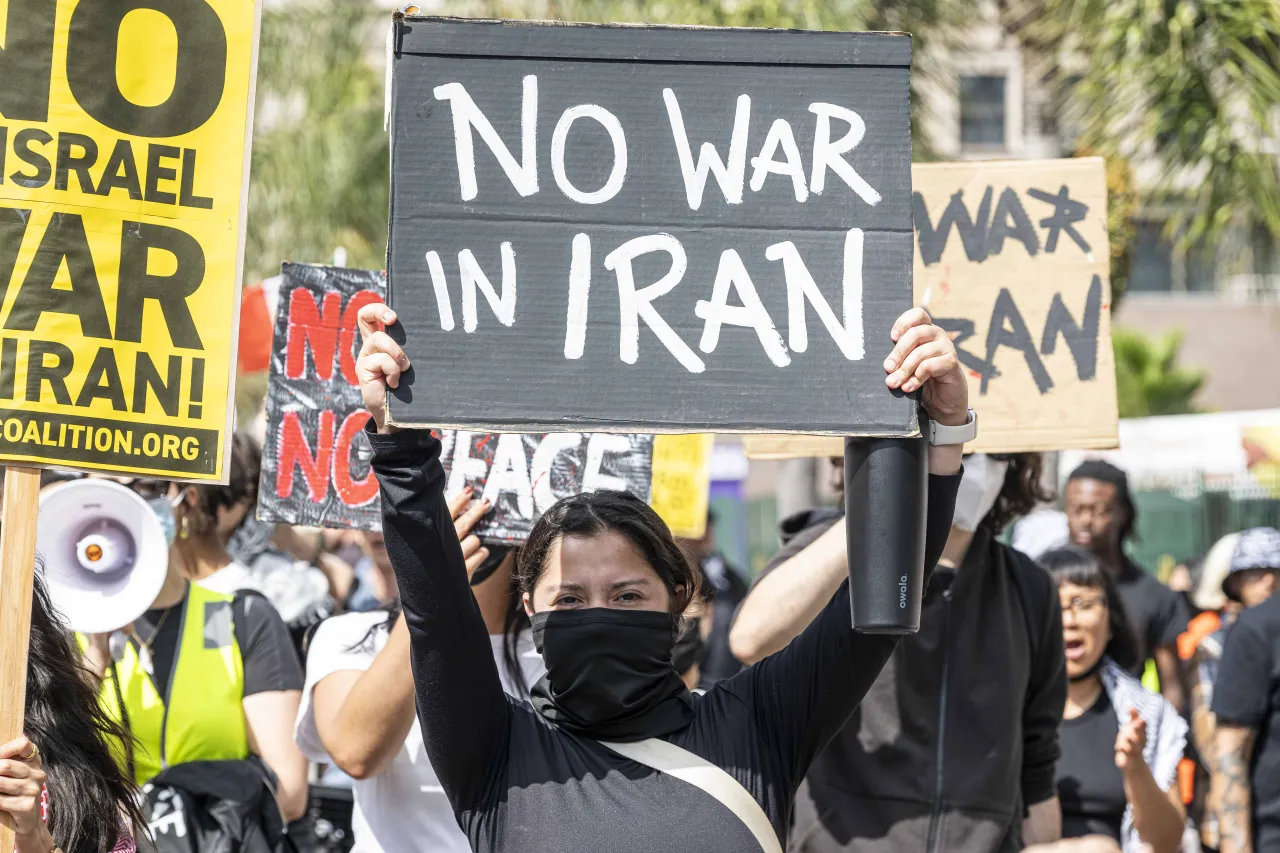
The movement that fought ICE enforcement in Minneapolis — producing a citywide general strike on Jan. 23 — is now part of the coalition organizing against the Iran war.
Anti-war and solidarity organizations have issued joint statements using the same anti-imperialist framework they applied to ICE enforcement and Washington’s military and economic campaign against Venezuela. The Iran war has added an explicit anti-war demand to what began as a domestic labor and immigrant-rights campaign.
This convergence — labor, immigrant rights and anti-war organizing — reflects a simple reality. These are not separate crises.
ICE enforcement depresses wages and keeps immigrant workers living under the threat of raids and deportation. Military adventurism drains the public treasury and forecloses the social investment workers are fighting for. In Venezuela and Iran, the objective is the same: forcing governments to open their energy sectors to U.S. and allied corporate control.
What the numbers demand
In the first 100 hours of Operation Epic Fury, the United States spent about $3.7 billion, according to estimates from the Center for Strategic and International Studies. Of that total, roughly $3.5 billion had not been budgeted for the war.
“Unbudgeted” is a bureaucratic word. What it describes is simple: social wealth produced by working people transferred into the machinery of war.
Those numbers translate quickly into human consequences. In the first eight days of the war, more than 330,000 people across the region have been displaced. Hospitals in Gaza cannot receive medical supplies after Israel escalated its military operations against Iran and closed the crossings.
Six U.S. service members were killed in Kuwait when a missile struck a makeshift operations center that had barriers against car bombs but nothing that could stop an incoming strike. Iranian international journalist Khyal Muazzin has also reported that 30 U.S. and Israeli soldiers were killed while attempting to enter Iran. According to Muazzin, the troops — including members of U.S. SEAL and Delta special forces units — were part of a mission to cross into Iranian territory and attack designated targets.
Muazzin said some of the personnel involved had also taken part in the earlier U.S. operation that captured Venezuela’s President Nicolás Maduro and Cilia Flores — a large-scale assault that used more than 150 aircraft, electronic warfare and airstrikes to break through Venezuelan defenses. Muazzin contrasted the situations, suggesting Iran would not be so easily overrun.
Muazzin wrote defiantly on social media: “Yes, this is Iran, not Venezuela. We will receive guests.”
During the Vietnam War, the anti-war movement used a simple slogan: The money for bombs comes from schools and clinics. Sixty years later, the arithmetic is the same — only the numbers are bigger.
Join the Struggle-La Lucha Telegram channel