
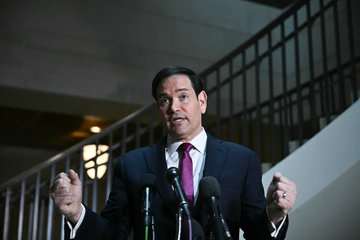
Secretary of State Marco Rubio offered the public an extraordinary explanation for why the United States has launched a war on Iran. Israel was going to strike anyway, Rubio said on March 2. U.S. forces in the region would have been endangered regardless. So Washington had no real choice — it was Israel’s decision that determined the timing and the fact of the U.S. attack.
The claim deserves a direct answer: it is false, and not merely as a factual matter. It inverts the actual chain of command.
President Trump inadvertently clarified matters the following day. Meeting with German Chancellor Friedrich Merz at the White House, Trump pushed back on Rubio’s framing. “No, I might have forced their hand,” Trump said — meaning Israel’s hand. He was trying to revive a different lie, the one about Iranian preemptive attack intelligence. But in contradicting his own secretary of state, Trump got the structural relationship right. Washington directs Israel’s hand. Not the other way around.
This is not a minor distinction. Washington finances the Israeli military — weapons procurement, missile defense, direct aid — at a scale no other state on earth receives. The bombs dropped on Gaza, Lebanon, and now on Iran’s neighbors were purchased with U.S. dollars and shipped on U.S. transport. As former Secretary of State Alexander Haig once put it, Israel is “the largest American aircraft carrier in the world that cannot be sunk” — a U.S.-funded, U.S.-armed settler-colonial state that functions as Washington’s forward military base in West Asia.
The strategic drive to attack Iran does not originate in Tel Aviv. It originates in Washington — in the Pentagon, in the Treasury Department, in the oil boardrooms where industry consultants openly describe Iranian regime change as a “wonderful day” for U.S. energy companies. It originates in the strategic imperative to eliminate any regional power capable of maintaining an independent foreign policy, supporting Palestinian resistance, and refusing to submit to U.S. domination. Israel is the instrument of that project. It is not its author.
Rubio’s “Israel made us do it” story serves several purposes, none of them honest. It deflects accountability from the administration that ordered the strikes. It feeds a narrative of U.S. helplessness — a superpower supposedly dragged into war by a much smaller ally — that insults the intelligence of anyone paying attention. And it recycles a reactionary framework — the idea of disproportionate Israeli influence over U.S. foreign policy — that lets Washington off the hook. The question of who controls whom is answered by looking at the money, the weapons and the chain of command.
The lies around this war have been notably sloppy. Rubio and Trump contradicted each other within 24 hours on the most basic question of why it started. The rationale has shifted between disarmament and regime change without settling on either. And the Pentagon has been visibly rattled by Iran’s actual fighting capacity.
Defense Secretary Hegseth and Joint Chiefs Chair General Caine admitted in a briefing this week that Iran’s Shahed drones “are posing a bigger problem than anticipated.” That admission deserves to be held up to the light. The asymmetric threat posed by Iran’s low-cost drone arsenal has been a documented, analyzed, publicly known factor for years.
The Pentagon was not caught off-guard by something it didn’t know. It was caught off-guard by something it chose not to take seriously — the determination of a country that has spent decades preparing for a U.S. and Israeli assault.
The scale of that preparation is becoming harder to hide. Israeli journalist Alon Mizrahi, writing from an anti-Zionist perspective, argues that U.S. bases in Bahrain, Kuwait, Qatar, and Saudi Arabia have taken sustained, serious hits — facilities representing, as he puts it, “a major chunk of military expenditure for over 30 years.” He notes something more telling than any damage report: the near-total absence of reporting.
During the first Gulf War in 1991, footage of U.S. air operations ran every night. Now, four days into a war that Washington insists it is winning, there is almost no video evidence of U.S. air dominance over Iranian skies. The Strait of Hormuz, through which one-fifth of the world’s oil moves daily, is effectively closed. The administration is floating the idea of arming Kurdish militias to pressure Iran from within — a suggestion that reflects either strategic confusion or desperation.
None of this fits the story of a reluctant empire dragged to war by an uncontrollable ally. It fits the story of an empire that chose this war for its own reasons and is now discovering that the country it chose to attack was ready for it.
Rubio’s story doesn’t hold. Israel didn’t make Washington do anything. Washington funds, arms, and directs the enterprise. The responsibility is its own.
Join the Struggle-La Lucha Telegram channel