
The U.S. war on Iran is not a miscalculation. It is not a strategic blunder by an overconfident Pentagon. It is the predictable outcome of the global class war — the drive of monopoly capital to maintain control over the world’s resources, markets, and labor at any cost. The Strait of Hormuz is where that drive has stalled. And the bill, as always, is being handed to the working class.
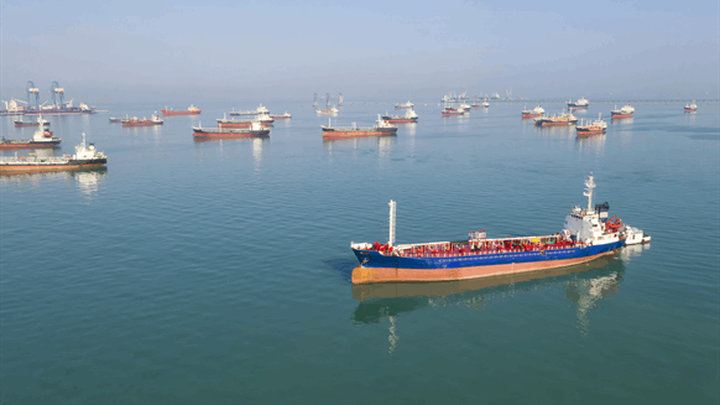
Commercial transit through the Strait has collapsed by 90%. Liquefied natural gas tanker movement has dropped to zero — for the first time in the modern era. The “Big Four” container lines — Maersk, MSC, Hapag-Lloyd, and CMA CGM — have suspended regional operations. Some 150 tankers sit stranded, unable to move their cargo to market. Brent crude has surged past $85 a barrel.
The workers of Pakistan, Bangladesh, and India are already paying — in power outages, factory shutdowns, and grid collapse. Wall Street is already profiting.
Monopoly capital’s strategic necessity
Washington did not attack Iran because of nuclear weapons or regional security. It attacked Iran because an independent Iran — one that refused integration into the U.S.-dominated financial and military order — represented an intolerable challenge to dollar hegemony and the energy control on which U.S. imperialist dominance rests.
Persian Gulf energy is not simply a commodity. It is the structural foundation of the petrodollar system — the arrangement by which oil is priced in dollars, recycled through U.S. financial markets, and used to sustain U.S. debt and military spending. Any state that threatens that arrangement, whether through independent pricing, alternative currency arrangements, or refusal of U.S. basing rights, becomes a target. Iran has done all three.
The operation itself was not spontaneous. The CIA spent months tracking Supreme Leader Ayatollah Ali Khamenei’s movements before Israeli jets dropped 30 bombs on his Tehran compound on Feb. 28. Khamenei was assassinated. Iranian state media confirmed his death on March 1. Strikes hit 24 of Iran’s 31 provinces. The Iranian Red Crescent reports more than 500 killed, including 165 children at the Shajareh Tayyebeh girls’ elementary school in Minab.
This is what monopoly capital looks like when it moves to protect its interests.
High-tech power meets low-tech resistance
Washington anticipated that overwhelming technological superiority — stealth aircraft, precision munitions, carrier strike groups — would quickly suppress Iran’s missile capabilities and reopen the Strait to commercial traffic. That calculation has failed. IRGC Brigadier General Ebrahim Jabari stated the position plainly: “The Strait is closed. If anyone tries to pass, the heroes of the Revolutionary Guards and the regular navy will set those ships ablaze.”
Iran’s answer to billions of dollars in U.S. air power is a truck. Solid-fuel missiles launched from standard commercial 10-wheel chassis — indistinguishable from ordinary freight traffic, continuously repositionable, functionally invisible to standoff munitions. The IRGC’s doctrine of rapid launcher replacement has rendered the entire U.S. air campaign unable to achieve its prerequisite objective: missile suppression. Every truck on an Iranian road is a potential launch platform. The Pentagon cannot bomb them all.
Technological superiority does not translate into political or military victory against a people defending their own territory. Vietnam proved it. Afghanistan proved it. The Strait of Hormuz is proving it again.
Finance capital enforces the blockade
The missile batteries are the visible face of the blockade. The invisible one is Wall Street.
War-risk insurers have moved beyond raising premiums. They have canceled policies outright, effectively orphaning any vessel that attempts the transit. Without insurance, no cargo moves — not because the physical danger is necessarily fatal, but because the entire architecture of global trade depends on coverage. Finance capital, in this sense, enforces the blockade more completely than any naval mine.
The Trump administration has floated proposals for state-backed war-risk insurance and naval escort corridors. These are not policy. They are public relations. Building a federal insurance scheme of this complexity requires roughly a year of development and legislative authorization. Naval assets capable of escort duty are currently committed to active strike operations.
Consider who absorbs the loss and who books the gain. The insurer cancels the policy. The tanker sits idle. The refinery goes cold. The Pakistani worker loses power. The Bangladeshi garment worker loses shifts. Brent crude holds at $85 a barrel. ExxonMobil posts record quarterly earnings.
The working class pays across three continents
The closure of the Strait hits hundreds of millions of workers first and hardest.
Pakistan, Bangladesh, and India all depend on Persian Gulf Liquid Natural Gas (LNG) from Qatar and the UAE as the backbone of their industrial energy supply. None maintains significant storage reserves. They operate on just-in-time delivery models that assume the Strait stays open. It has not.
Pakistan imports 99% of its LNG from the Gulf. Its power grid faces immediate collapse — meaning factory shutdowns, hospital blackouts, and households without electricity. Bangladesh, where Gulf LNG accounts for 72% of imports, faces a daily gas deficit of 1.3 billion cubic feet. India, at 53% dependence, faces both a physical supply crisis and a financial one: Most Indian LNG contracts are indexed to Brent crude prices, so the oil spike simultaneously inflates the cost of whatever alternative volumes India might find elsewhere.
Facing an accelerating current account crisis, India is being pushed back toward Russian crude — reversing years of U.S.-pressured trade diversification and raising the prospect of new sanctions from the same Washington whose war caused the crisis. This is the double bind imperialism builds for semicolonial economies: comply and be exploited, resist and be sanctioned, get caught in the crossfire and be punished anyway.
Food as a weapon of war
The consequences extend past energy. The Strait of Hormuz is the world’s central transit point for fertilizer precursors. Qatar’s dominance in LNG production is matched by its role in the global fertilizer supply chain. The suspension of QatarEnergy’s operations — facilities too chemically volatile to operate safely under active bombardment — has halted downstream production of urea, ammonia, methanol, and related compounds.
The disruption touches 44% of global sulfur trade, 31% of global urea trade, 18% of ammonia trade, and 15% of phosphate trade. These are not financial abstractions. They are the inputs that determine whether next season’s harvest is planted and at what cost. The workers who will go hungry six months from now because fertilizer prices spiked in March 2026 will not appear in any Pentagon briefing as casualties. But they are casualties of this war.
These facilities will not restart when a ceasefire is signed. The chemical processes involved cannot be toggled on and off. They will remain cold until hostilities end — meaning the hunger this war causes will outlast every bomb that falls.
Iran as opening move against China
Elbridge Colby said the quiet part out loud: The war on Iran is not an end in itself. It is preparation for a far larger conflict.
Testifying before the Senate Armed Services Committee on March 3, Under Secretary of Defense for Policy Elbridge Colby — the architect of the 2026 National Defense Strategy and the Pentagon’s chief strategist — spelled out the logic directly. With Israel and Gulf partners assuming primary responsibility for West Asia, he argued, the arrangement would “allow us to enable this focus on the first island chain.” The first island chain runs from Japan through Taiwan to the Philippines. The target is China.
The 2026 National Defense Strategy, which Colby drafted, centers on what it calls a “strong denial defense along the First Island Chain” — the military geography of a war over Taiwan — while conspicuously declining to name Taiwan at all. The omission is calculated: Trump is expected to meet with Chinese President Xi Jinping in April, and the Pentagon is managing public optics while hardening its actual war preparations. As one analyst put it, the machinery of alliance planning is quietly preparing for the very fight the strategy declines to name.
The Hormuz blockade serves this strategy on a second front. China imported an average of 1.38 million barrels of Iranian crude per day in 2025. The closure of the Strait does not only devastate South Asian workers — it directly squeezes China’s energy supply. Control over Venezuelan, Iranian, and Gulf energy exports, wielded in combination with pressure on U.S. allies to restrict Chinese market access, is the economic weapon Colby and his collaborators intend to deploy in the coming confrontation. Energy strangulation as a prelude to military confrontation.
This is why the South Korean market crash on March 4 — the worst in 46 years — carries particular weight. South Korea is a frontline state in the planned war against China, deeply integrated into Chinese manufacturing supply chains, and its ruling class knows exactly what the U.S. strategic pivot means for its economy and its territory.
The wars against Venezuela, Iran, and the pressure on China are not separate crises. They are coordinated components of a single imperialist strategy — the attempt by a declining U.S. hegemon to lock in dominance before the balance of forces shifts permanently against it. When imperialism faces structural decline, it does not retreat. It gambles on war.
The deadlock and what comes next
With Khamenei assassinated and senior military commanders killed alongside him, the United States has achieved the objective it publicly denied pursuing: decapitation of the Iranian state.
The IRGC’s operational capacity to maintain the blockade does not depend on the Supreme Leader. It depends on dispersed, mobile, low-tech launch platforms distributed across Iranian territory. Iran’s Foreign Minister told NBC News that Tehran was willing to talk if strikes halted. Washington has shown no interest. Gold has reached $5,418 an ounce. Regional airspace has closed, severing the main commercial air corridor between Asia and Europe.
The global economy is experiencing what happens when the imperialist order reaches the limits of its own violence — when high-tech military power confronts a resistance it cannot destroy, and the cost of the standoff falls on workers who built none of it and benefit from none of it.
The class line is clear
The Hormuz blockade makes three questions impossible to avoid: who owns, who decides, and who pays.
The energy monopolies own the tankers sitting idle and profit from the price spike that idleness produces. Washington decided to launch this war in service of those monopolies and against the interests of every working person in the region. And the workers of Karachi, Dhaka, Mumbai, and beyond are paying — in power outages, in factory closures, in food prices that will rise long after the last bomb falls.
The war was planned. The suffering was predictable. Which side are you on?
Join the Struggle-La Lucha Telegram channel