
The lights are going out in Cuba — and people are organizing their lives around the outage schedule.
In towns and cities outside Havana, families cook when power returns, charge phones in bursts, and sleep in the heat when fans go dead. Clinics and hospitals ration generator fuel and prioritize the most urgent care. Ambulance crews and ER staff work under conditions where a delayed response means a patient may not make it. Airports face the same reality: When fuel is absent, flights are canceled, routes break, and the island’s connection to needed supplies narrows.
Cubans are not confused about what this is. They call it a siege, because Washington is waging one: Cut the fuel, and everything downstream — electricity, water pumping, transport, refrigeration, hospital logistics — begins to fail.
This is deliberate policy.
On Jan. 29, 2026, the Trump administration declared Cuba a national emergency and threatened penalties on any country or company that supplies the island with fuel.
This policy is not new. The U.S. blockade against Cuba was established in 1962. For 64 years it has been the constant backdrop of Cuban life — tightened, loosened, updated in 1992 and 1996, weaponized through secondary sanctions. What is happening now is not a departure from that policy. It is that policy at full force: from economic strangulation by degrees to a naval blockade designed to cut the island off entirely.
Washington’s objective is simple in practice: Starve the island of energy. Since late 2025, Washington has tightened the blockade on Cuba’s fuel supply and on any country or company that tries to deliver it. The point is exhaustion — to make daily life unworkable, to force a breaking point, and to brand that breaking point as “collapse.”
The cruelty is deliberate. Cuba requires roughly 100,000 barrels per day of fuel and refined products to keep basic systems functioning. When that flow is choked off, the damage is predictable and cumulative: A blackout means stalled transport, spoiled food, interrupted surgeries, dry taps, and a health system pushed into triage.
Cubans are living the consequences in real time — and still holding society together in real time. Neighborhoods share food and ice. Workplaces reorganize shifts around the blackout schedule. Health workers stretch supplies, improvise, and make hard choices about what can be postponed and what cannot. That is resilience under siege: a daily practice of collective discipline.
How the siege was built
To understand the mechanics of the current blockade, you have to start with what Washington did to the region on Jan. 3, 2026: the seizure of Venezuela’s elected president, Nicolás Maduro, and Cilia Flores, in Caracas. Cuba has long depended on Venezuelan oil — the product of political solidarity and economic agreements forged across decades. Washington understood the dependency and immediately cut the lifeline.
The U.S. attack on Caracas killed 32 Cuban combatants who were there fulfilling an internationalist mission — protecting Maduro and Cilia Flores from a threat that had been openly declared. Mariela Castro, who heads Cuba’s National Center for Sex Education and is a militant in her own right, described what happened: 21 of the 32 fought directly.
“Just 21 soldiers faced 200 robots,” she said — her word for the heavily armored, technology-laden U.S. special forces troops. “They fought to the death.”
The next morning, Trump was gloating. “Cuba is ready to fall,” he said. “Cuba now has no income. They got all of their income from Venezuela, from the Venezuelan oil. They’re not getting any of it.” That is a war communiqué.
Within hours of Maduro’s capture, Trump announced American companies would begin investing in Venezuelan oil. Six days later, the CEOs of ExxonMobil, ConocoPhillips, and a representative from Chevron were at the White House discussing investment terms. One week after the raid, $500 million in Venezuelan oil sales were completed. On Jan. 29, 2026, a new Hydrocarbons Law was signed in Caracas, handing Chevron operational control over Venezuelan production while routing oil revenues through the U.S. Treasury — dismantling the legal architecture Hugo Chávez had built to keep Venezuelan oil wealth in Venezuelan hands.
That same day — Jan. 29 — Trump signed an executive order declaring Cuba a national emergency and threatening tariffs against any nation supplying the island with fuel. The Venezuela operation and the Cuba blockade are two instruments of one project. Energy Secretary Chris Wright made the connection explicit. “The leverage we have,” he told CNN, “is we control the flow of the dominant industry of Venezuela. We control the flow of funds from oil.” The leverage over Venezuela is the lever on Cuba.
The blockade in practice
Blockades are not new to U.S. foreign policy. What is new is the completeness of this one. Satellite surveillance and commercial shipping intelligence have made maritime anonymity a thing of the past — every tanker is visible, every course change is tracked, every falsified manifest is flagged before the vessel reaches Cuban waters.
Tariffs work as a fuel weapon because they don’t just target Cuba — they intimidate the entire supply chain: shipowners, insurers, brokers, refiners, and banks, all of whom risk U.S. penalties if they touch a cargo bound for the island.
That pressure has already altered voyages. The U.S. Coast Guard intercepted the Ocean Mariner 70 miles from Havana and escorted it to the Bahamas. Another tanker, Sea Horse, is carrying roughly 200,000 barrels of gas oil toward Cuba after a ship-to-ship transfer near Cyprus, with an expected arrival in early March; whether it reaches port is an open question precisely because the point of the blockade is to make every delivery uncertain.
Russia calls it piracy. For Cubans, the meaning is simple: If a tanker is forced to turn back, the power plant goes short, buses stop running, and hospitals burn through generator fuel.
The same weapon works on governments. Mexico — after Venezuela’s shipments stopped — became Cuba’s largest supplier, and President Claudia Sheinbaum has confirmed that Mexico’s oil shipments are currently paused as Washington threatens tariffs (and more) on countries that send fuel to the island. Colombia’s President Gustavo Petro has condemned the blockade as illegal, but condemnation does not refuel a generator. Nicaragua, under intense pressure, has canceled visa-free travel for Cubans.
Why Cuba
Cuba holds no oil reserves that Washington is trying to seize. Washington has a different reason for targeting Cuba.
For over six decades, the Cuban people have built a society organized around human need rather than private profit.
What that means concretely: universal health care that survived a 64-year blockade and produced five domestic COVID vaccines. A literacy campaign that transformed one of the hemisphere’s most illiterate countries into one of its most educated. A public health system that sent doctors to over 160 countries while its own people were under siege.
These are the institutions the blockade is now attacking. When fuel runs out, it is this system that begins to fail: the hospitals that cannot run generators, the ambulances that cannot respond, the clinics rationing supplies.
Nelson Mandela knew what Cuba’s internationalism meant in practice. Visiting Havana in 1991, he said that Cuba’s contribution to African freedom was “unparalleled for its principled and selfless character” — and credited Cuba’s defeat of the South African army at the Battle of Cuito Cuanavale in 1988 with destroying “The myth of the invincibility of the white oppressor.” That victory broke apartheid South Africa’s military power and opened the road to Namibian independence.
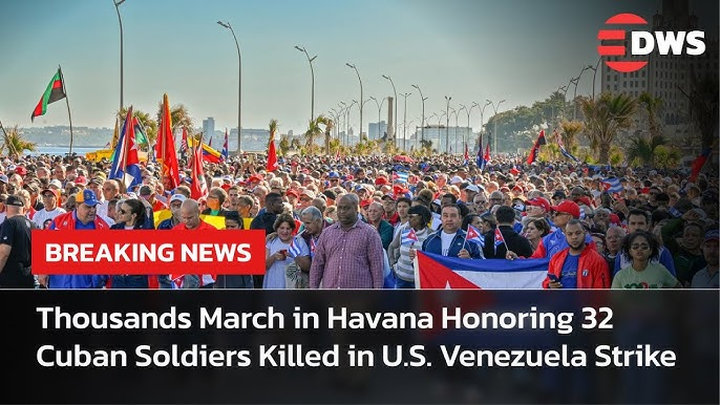
What Washington cannot tolerate is a living example. When nearly 500,000 people marched through Havana to honor the 32 Cuban combatants killed in Caracas, Abel Prieto, president of Casa de las Américas, said what many were thinking: “The Yankee Empire is in irreversible decline, and this makes it more violent and rabid.”
Trump has stated his goal openly: regime change in Cuba by the end of 2026. The method is economic strangulation, and energy is the choke point — because when fuel is cut, everything else follows. Washington’s demand is total: no independent economic relationships, no alternative models, no exceptions.
In Washington’s view, Cuba must be made to fall. That is what this blockade is for.
Cuba’s Response
Cuba has not been passive in the face of the siege. President Díaz-Canel has been direct: Since Dec. 3, not a single drop of fuel has reached the island. His administration’s response to that fact has been organizational, not rhetorical.
The Council of Ministers approved a contingency plan to transform Cuba’s energy matrix. In 2025, Cuban authorities completed construction of 49 photovoltaic solar parks, adding roughly 1,000 megawatts to the national supply — those parks have become a major share of current electricity generation at the moment the island needs them most. More than 900 megawatts of generation capacity have been restored. Photovoltaic systems are being installed in homes, nursing homes, polyclinics, and schools. Cuba is developing a national shipping fleet. Higher national crude oil production and electricity generation from associated petroleum gas are underway.
Díaz-Canel has stated the principle plainly: “Cuba will not renounce receiving fuel. It is a sovereign right.” Mariela Castro put it another way: “Principles are not negotiable. There is no possibility of negotiation with imperialism and all its facets.”
This is not the first time Cuba has been here. Over six decades the U.S. has tried everything — CIA-armed gangs, biological warfare, the Bay of Pigs, six decades of blockade.
Cuba protected itself, evacuating more than 700,000 people before Hurricane Melissa in October 2025 without a single death. It has sent doctors to over 160 countries.
As Dr. José Ramón Cabañas, director of Cuba’s Center for International Policy Research, put it: “They have tried to use all means to destroy us, and have failed in their essential purpose.”
Cuba has taken that case to the world. Foreign Minister Bruno Rodríguez reported to the UN General Assembly that damages from the U.S. blockade between March 2024 and February 2025 totaled $7.5 billion — a 49% increase over the previous period. Cumulative losses now exceed $171 billion.
What the Working Class Must Understand
It is tempting to treat what is happening to Cuba and Venezuela as a one-administration frenzy that will disappear when the political winds shift. The continuity is structural: The largest U.S. oil firms and the U.S. state move together, and the tools of enforcement — finance, sanctions, and military power — are built to punish and isolate any country that refuses Washington’s terms.
The names change. The machinery remains. Secondary sanctions, tariff threats, and financial choke points are the routine instruments of imperialist rule in the hemisphere, updated for a world of satellite tracking and globally integrated banking.
Solidarity in Practice
The Nuestra América Flotilla, a civilian-led effort modeled on the Gaza Freedom Flotilla, has announced plans to try to break the blockade. Countries including China, Mexico, and Spain have sent emergency shipments of food and medicine. Cubans have welcomed that help — but what the island needs most is energy: fuel and the parts to keep power generation, water pumping, hospitals, and transport running. That is exactly what the blockade is designed to deny.
Cuba has survived 64 years of U.S. economic warfare. The Cuban people’s resilience is the product of a social solidarity that capitalism cannot manufacture. As Mariela Castro said: Principles are not negotiable.
Join the Struggle-La Lucha Telegram channel