
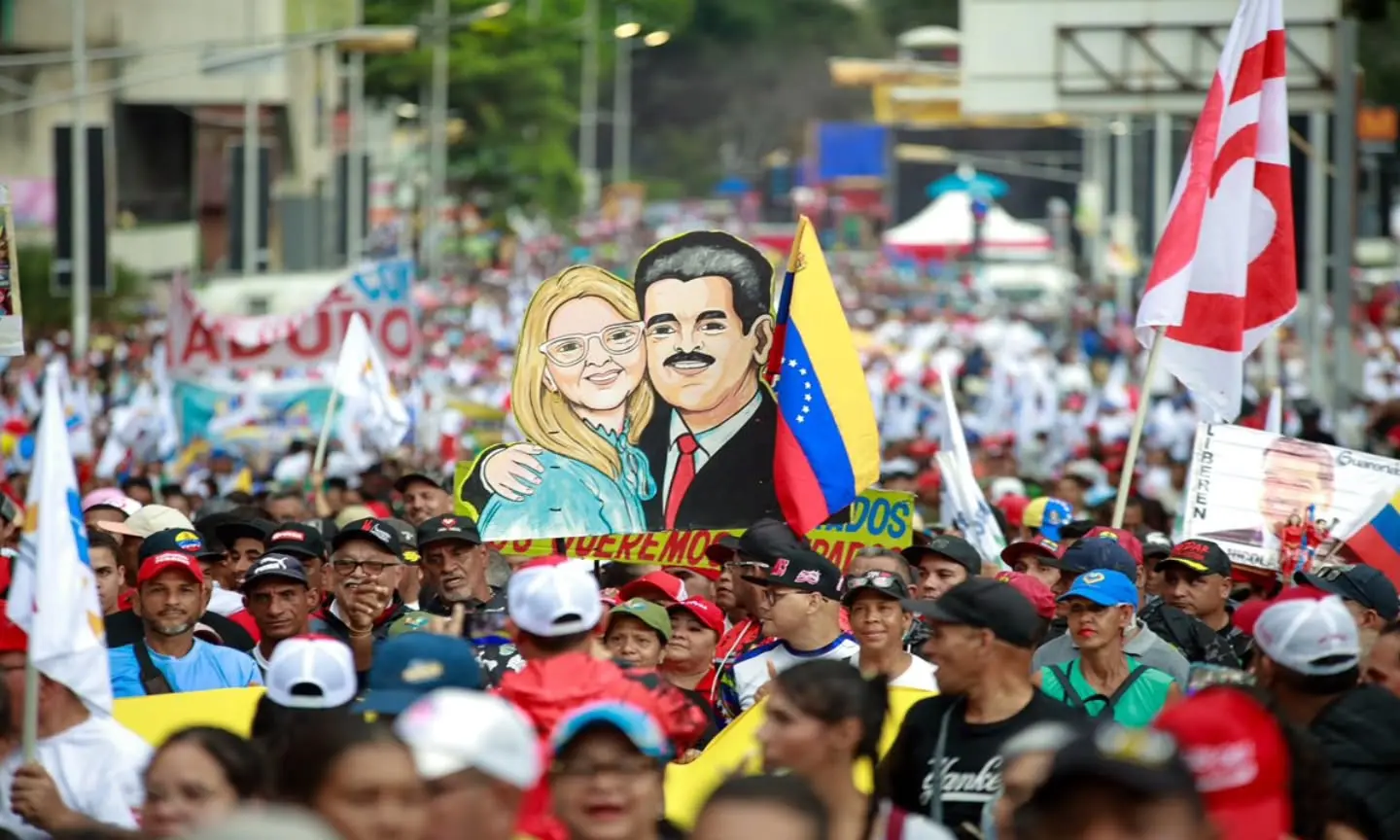
The U.S. war on Venezuela escalated rapidly — from lethal strikes on small boats in late 2025 to the Jan. 3, 2026, assault aimed at paralyzing Venezuela’s leadership and command structure — amid growing fears of a Gaza-style campaign of genocidal bombardment.
Beginning in early September 2025, the U.S. military under President Donald Trump initiated a campaign of airstrikes on small civilian vessels in and near Venezuelan waters. Over the following months, at least 40 such strikes across the Caribbean and eastern Pacific resulted in at least 124 deaths. The operations formed part of “Operation Southern Spear,” under U.S. Southern Command, which is continuing.
In parallel, Washington deployed a substantial naval and air presence into the Caribbean — an aircraft carrier, destroyers and cruisers, along with B-1B bombers and a fleet of drones — the largest U.S. military operation in the region since the 1962 Cuban Missile Crisis.
In the early hours of Jan. 3, 2026, the U.S. launched Operation Absolute Resolve, a coordinated assault targeting Venezuela’s air defenses, military bases, and critical communications infrastructure across the north of the country. Reports indicate that more than 150 U.S. aircraft were involved in suppressing Venezuelan air defenses and striking military facilities. The objective was to rapidly degrade the Venezuelan state’s ability to respond, echoing the U.S. “shock and awe” doctrine used in earlier wars.
U.S. special operations forces — identified in media reports as elements of Delta Force working with CIA intelligence — stormed Nicolás Maduro’s home in Caracas. President Maduro and Cilia Flores, a longtime Chavista leader and National Assembly deputy, were seized and flown to New York, where they are prisoners of war.
Trump has made the motive explicit. He has repeatedly said a core objective was to “keep the oil,” and declared the United States is now “in charge” of Venezuela — tying the war to plans to reopen the country’s oil sector under U.S. dominance.
Since Jan. 3, U.S. officials have said military operations will continue until Venezuela is “stabilized” — language designed to make the mission open-ended. In that framework, “stabilization” does not mean peace. It means control: controlling airspace, ports, fuel supply, communications, and the movement of money.
Trump and senior administration figures have pointed to Israel’s war on Gaza as a model — relentless pressure, punishment from the air, and siege conditions imposed on an entire population until resistance breaks.
Venezuela’s hydrocarbons law
Venezuela’s oil was never just an industry. It was the main lever of power. For generations, a Rockefeller-led oil order dominated. Standard Oil of New Jersey (now ExxonMobil), Shell, Gulf Oil, and local partners controlled concessions and profits. Most people saw little of that wealth. Housing was overcrowded. Schools were underfunded. Quality health care was for the rich.
Petróleos de Venezuela (PDVSA), the state oil company, was created when Venezuela nationalized its oil industry in 1976. When Venezuela took over the industry, foreign companies were compensated. But state ownership on paper did not guarantee popular control. The Bolivarian Revolution changed that. It was carried by mass organization and repeated mobilizations. It fought to turn oil revenue into social development. It built housing and schools. It expanded clinics and public programs. It defended national sovereignty against foreign control.
That struggle was written into law in 2001 under Hugo Chávez. The Hydrocarbons Law raised royalties and taxes. It required majority state ownership in new projects and joint ventures. It tightened public control over who drills, who gets paid, and where the revenue goes. This is the baseline. Any “opening” of the sector is not a technical tweak. It is a shift in the class and sovereignty terms the revolution fought to impose.
The starting point for Venezuela’s Jan. 29 Hydrocarbons Law change is the Jan. 3 invasion. Maduro was kidnapped. The chain of command was thrown into crisis. The remaining leadership governed under emergency conditions as Washington tightened a chokehold on the oil lifelines. The U.S. decided what could be exported, whether payments could clear, and whether ships could be insured. It also controlled whether PDVSA could get the imports needed to keep heavy crude moving.
Revolutionary governments have faced forced concessions before — from Brest-Litovsk to Cuba’s Special Period. Lenin gave up territory to keep the revolution alive. Cuba opened space for tourism and dollar inflows to survive the Soviet collapse. The measure is political, not moral. The real test is capacity: can the people who made the revolution still organize, resist, and maneuver to defend their gains — and later roll back what was conceded?
The new oil policy operates inside a cage Washington built. Delcy Rodríguez governs as acting president while Maduro remains Venezuela’s president in a U.S. prison. In practice, the U.S. Treasury’s Office of Foreign Assets Control (OFAC) functions as a shadow finance ministry. U.S. licenses decide which contracts move, which companies operate, and where the money can go. Caracas is choosing from what Washington allows.
What imperialism extracts
The 1999 Constitution was the Bolivarian Revolution written into law — a popular mandate to treat oil and gas as national wealth, not a prize for foreign corporations. It asserts that Venezuela’s mineral and hydrocarbon deposits belong to the public and cannot be sold off, and it is designed to keep disputes over public-interest oil contracts under Venezuelan authority — so oil deals can’t be turned into foreign claims decided abroad instead of in Venezuela.
Venezuela’s long dispute with Guyana over the Essequibo is a living reminder of why that matters. In 1899, an arbitration tribunal sitting in Paris awarded most of the contested territory to Britain’s colony (then British Guiana, now Guyana) in a decision Venezuela has challenged ever since. The dispute is still active today, and now intersects directly with offshore oil claims — exactly the kind of high-stakes sovereignty fight Venezuela’s constitution is designed to keep from being decided abroad.
A constitution does not defend itself. It reflects a balance of class power. It holds only as long as that power can be organized and enforced. The 1999 Constitution codified the forces that brought the Bolivarian Revolution to power: organized workers, the poor, communal movements, and the Chávez-aligned sections of the armed forces. Those forces have been battered by sanctions, crisis, and war. They have not been erased or defeated. They remain a living base. They have repeatedly mobilized to defend the Bolivarian government under siege and the revolution’s gains — above all, control of the country’s oil wealth.
The Jan. 29 change reopens ground the 1999 Constitution was written to defend. The U.S. war made normal policy impossible. The change was not negotiated.
This was not a free choice. Venezuela’s leadership was seized. Infrastructure was bombed. Escalation was threatened. The danger is permanence. “Temporary” concessions can harden into contracts, equipment, and cash-flow channels that are expensive to undo — especially when oil majors have U.S. military power behind them and are determined to make the new terms stick.
Luis Britto García — a Venezuelan lawyer, National Prize for Literature laureate and a Council of State member appointed by Chávez — is no voice of the U.S.-backed opposition. A longtime defender of the Bolivarian Revolution, he opposes the Jan. 29 change and denounces it as unconstitutional. He argues it pushes disputes out of Venezuelan courts and gives the executive room to cut the public share of oil revenue project by project — in conflict with the constitution the revolution wrote.
It won’t be settled on paper alone. Under war and economic strangulation, the decisive issue is power in practice — who controls contracts, cash flow, and the oil fields themselves.
The constitution’s words remain. The balance of forces behind them has been worn down by years of sanctions and blockade. The winners are easy to name — Chevron, BP, Shell, Repsol, Eni, and their peers. ExxonMobil, which exited Venezuela after the expropriation fights, remains on the sidelines pursuing compensation claims rather than operating under the current licenses.
The balance of forces
Venezuela’s oil won’t be decided by fine print. It will be decided by power. Who can enforce terms. Who can resist. Who can reverse what is imposed.
China is Venezuela’s largest crude buyer. Chinese state firms sit in joint ventures tied to major reserves. But Venezuelan crude is a small slice of China’s total supply. Beijing has condemned the attack without moving toward material confrontation. And China still lacks a sanctions-proof way to move Venezuelan oil money at the scale Venezuela needs. That leaves Washington with a veto over the trade.
BRICS is building alternatives to the dollar system. They are not ready at scale. Venezuela still cannot sell oil and clear payments in volume outside U.S.-controlled chokepoints.
That is why the OFAC licensing cage works: if Venezuela can’t reliably clear oil payments outside Washington’s reach, then U.S. licenses decide who can buy, who can ship, and where the money is allowed to go.
Inside Venezuela, the Bolivarian Revolution built real structures of popular power. They are under strain. Years of crisis deepened by U.S. sanctions drove millions to emigrate. PDVSA has lost skilled workers. Output has fallen sharply from its late-1990s level.
Trump said it outright: Venezuelan oil money “will be controlled by me.” Executive Order 14373 required oil revenues to be deposited in funds held under U.S. Treasury control. Treasury then set the terms: companies may pay routine local fees in Venezuela, but royalties and key federal payments must be deposited into U.S.-run accounts. Washington is not “influencing” the oil sector. It is controlling the money — backed by U.S. military power.
Join the Struggle-La Lucha Telegram channel