
The largest U.S. military buildup in West Asia since the 2003 Iraq invasion is not about Iran’s nuclear program. It is about who controls oil, who profits from permanent war, and who is challenging the economic order that keeps U.S. imperialism on top.
Marx observed in “The Eighteenth Brumaire” that when history’s dramas unfold, we should look past the actors on the stage and ask: Which class interests do they serve? Warships and stealth fighters are not the story. They are instruments. The story is the class forces that set them in motion.
Who benefits
On Jan. 16, at the American Petroleum Institute’s “State of American Energy” summit, oil industry consultant Bob McNally of Rapidan Energy Group — a former energy adviser to George W. Bush — told executives that Iran is “the biggest opportunity” for the industry. A war to topple the Iranian government, he said, would be a “wonderful day.” That is not an offhand remark. It is a class program stated plainly.
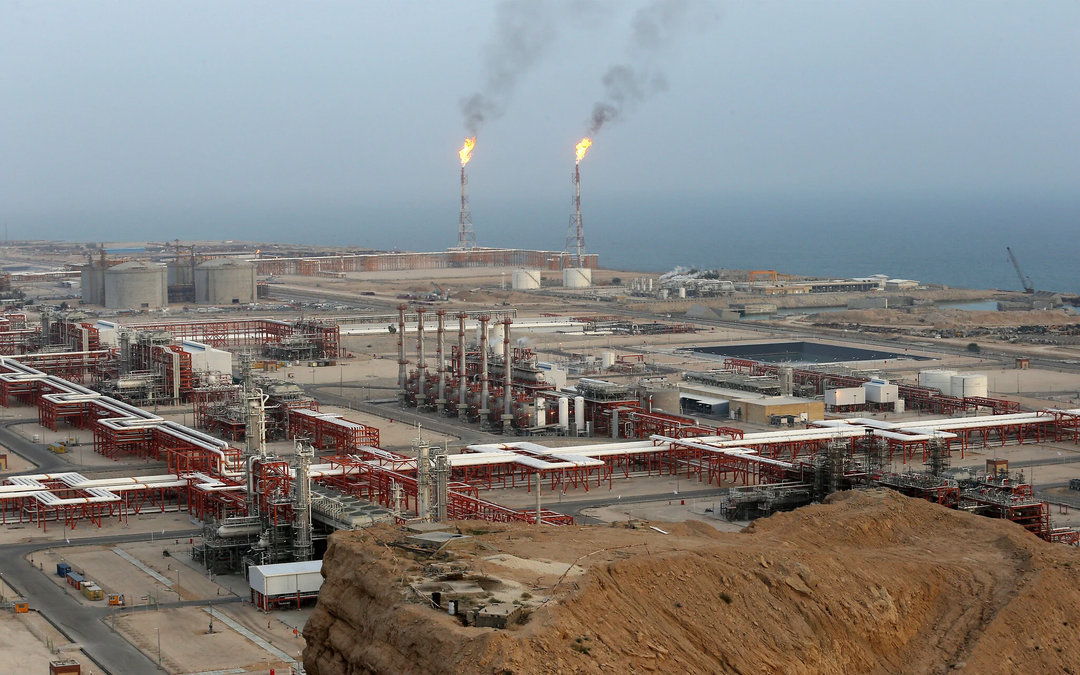
Iran holds the world’s second-largest natural gas reserves and among its largest proved oil reserves — and those resources remain largely outside Western corporate control. Since the 1979 revolution, Western capital has been locked out. U.S. sanctions, diplomacy and military buildup converge on one objective: prying open Iran’s economy to U.S. and allied corporations.
The arms monopolies have their own ledger. Lockheed Martin, RTX (formerly Raytheon) and Northrop Grumman carry a combined backlog exceeding $540 billion. When Israel struck Iranian sites last June, defense contractors’ shares on Wall Street spiked instantly. War is not a risk for these corporations. It is the business model.
When U.S. forces moved toward a strike posture on Feb. 18, oil futures jumped more than 4%. This “war premium” — roughly $10 a barrel — acts as a direct wealth transfer from working-class energy consumers to the shareholders of ExxonMobil and Chevron.
Washington as instrument
Marx wrote that the executive of the modern state is a committee for managing the common affairs of the whole bourgeoisie. The bipartisan consensus on Iran proves the point.
On Jan. 30, the Senate passed an $839 billion defense appropriation — $8.4 billion more than the Pentagon itself requested — by a vote of 71 to 29. With other streams added in, total military spending for fiscal year 2026 approaches $1 trillion. Democrats provided the votes needed for passage.
The Secretary of War overseeing this buildup, Pete Hegseth, invited pastor Doug Wilson — a self-described “paleo-Confederate” who has defended Christian enslavers and argued women should be denied the vote — to lead worship in a Pentagon auditorium. The ideological content of the war party is not hidden: racist Christian nationalism fused with military power, preached from the building where strike plans are drawn up.
While the Democratic leadership often markets itself as a bulwark against the current administration’s domestic agenda, the bipartisan consensus on foreign policy remains largely intact. This creates a difficult contradiction for even the most progressive voices in Washington, who find themselves operating within a framework that validates the premises of empire.
When Rep. Alexandria Ocasio-Cortez spoke at the Munich Security Conference on Feb. 13, she navigated this tension by focusing on a “working-class” foreign policy and the “scourge of authoritarianism.” Yet, her presence at a conference dedicated to imperialist security highlights the difficulty of challenging the broader strategic shift. Her remarks did not address the historic military buildup currently funneled toward Iran, nor did they mention the escalating oil blockade that is strangling Cuba.
The same institutional gravity was visible in her Munich comments regarding the Jan. 3 U.S. capture of Nicolás Maduro. While she correctly criticized the operation as an “act of war” and a “terrifying precedent,” she adopted the State Department’s framing by characterizing Maduro as an “anti-democratic leader.” By challenging the style of U.S. intervention while accepting the justification for it, the debate remains confined to how imperialism should be managed, rather than whether it should be dismantled.
This is not a matter of individual failure, but of class alignment. On the fundamental questions of military supremacy, the blockade of socialist states, and the defense of dollar power, the two parties function as a single board of directors. Washington pulls even its most progressive voices into a unified front.
Iran’s real ‘crime’
Washington demands that Iran scrap its civilian nuclear energy and research capacity, destroy its missile defense system, and sever ties with Palestinian, Lebanese and allied resistance forces. The word for that is capitulation.
Iran’s Foreign Minister Abbas Araghchi offered to negotiate on enrichment and inspections — the stated reason for the confrontation. A senior U.S. official dismissed the Geneva talks as a “nothing burger.” Vice President JD Vance warned that “the president reserves the ability to say when he thinks that diplomacy has reached its natural end.”
Iran’s “crime,” in the eyes of U.S. capital, is threefold: It maintains an independent national economy closed to imperialist oil monopolies; it supports Palestinian resistance and refuses the role of compliant petro-state; and — what drives the urgency now — it is building economic structures that bypass the dollar.
An alternative to dollar rule
On Jan. 29, Iran, Russia, and China signed a trilateral strategic pact. On the surface, it is a technical agreement involving trade mechanisms in yuan and rubles, intelligence sharing, and the North-South Transport Corridor. In substance, it is an exit ramp from the U.S. financial system.
For decades, Washington’s influence in West Asia has rested on more than just aircraft carriers. It has rested on the dollar’s role as the dominant currency and clearing channel for energy trade. By ensuring that oil is priced, insured, and banked in U.S. currency, the Treasury maintains a “silent veto” over the economic life of any nation. This is not merely a convenience; it is the mechanism that allows the U.S. to run a $1 trillion military budget while shifting costs outward to the rest of the world.
Treasury Secretary Scott Bessent was remarkably candid in a recent Congressional hearing when he described the “success” of U.S. policy: “What we can do at Treasury, and what we have done, is created a dollar shortage in the country [Iran].”
A “managed” currency crash is a form of warfare that leaves the buildings standing but hollows out the lives of the people inside. When the rial is devalued by decree from Washington, the purchasing power of an Iranian worker’s paycheck vanishes. This is the “peaceful” alternative to bombing — a systemic strangulation designed to force a sovereign economy back into the imperialist orbit.
The trilateral pact is a proof of concept for an alternative. By routing more trade through the North-South Corridor and settling more transactions outside the dollar, these countries are building a circuit Washington cannot switch off.
This is the true “threat” that the current military buildup is positioned to address. If the dollar is decoupled from the world’s energy flows, the U.S. loses its primary tool of global discipline. To the financial interests that guide Washington, a shift in the global trade architecture is more dangerous than any missile. The warships in the Gulf are there to ensure that the world continues to trade on terms set by Wall Street, or not at all.
Israel: the instrument, not the driver
Israel plays the role it has played since its founding — what former Secretary of State Alexander Haig called “the largest American aircraft carrier in the world that cannot be sunk.” It is a U.S.-funded, U.S.-armed settler-colonial state functioning as Washington’s permanent forward base. Israel can draft target lists and supply justification, but the decisive question is what U.S. capital decides to do. Israel supplies the pretext and the operational partner — not the strategic motor.
The Gulf rulers are pushing the other way. Saudi Crown Prince Mohammed bin Salman told Iranian President Masoud Pezeshkian that Riyadh will not allow its airspace or territory to be used for strikes on Iran. The UAE issued a similar declaration. They would rather manage a sanctioned Iran than gamble on collapse, chaos and blowback.
A trillion-dollar machine
The USS Gerald R. Ford has been redirected to join the USS Abraham Lincoln in the region, carrying more than 150 warplanes between them. An estimated 50,000 U.S. troops are deployed across the region. The Pentagon is preparing not a one-off strike but “sustained, weeks-long operations.” Last June’s strikes were followed by a reported toll of 1,190 killed, based on figures from Human Rights Activists and its network of medical and local volunteers.
According to Axios, a former senior U.S. intelligence official advising the Trump administration assessed an 80% to 90% likelihood of strikes within weeks. CNN reported Feb. 18 that the White House has been briefed the military could be ready to attack by the weekend. Trump has not given the order — but the machinery is in position, and the clock is running.
Every F-35 deployed is a revenue stream for Lockheed Martin. Every Patriot battery is money in the accounts of RTX. Every Tomahawk loaded onto a destroyer was manufactured for profit. The buildup is both war preparation and stimulus program for the arms industry, funded by the trillion-dollar budget that both parties approved.
Join the Struggle-La Lucha Telegram channel