
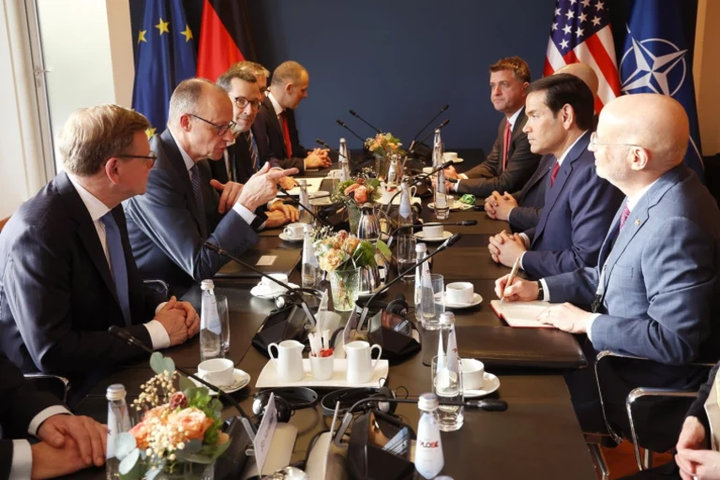
The 62nd Munich Security Conference was not a diplomatic gathering.
It was a war council — a gathering of the general staff of world imperialism, assembled not to resolve conflicts but to coordinate the next phase of aggression on a global scale.
The conference’s own annual report provides the clearest self-indictment. Its theme, “Under Destruction,” describes an era of what it terms “wrecking-ball politics” — the deliberate demolition of the post-1945 international framework. What the authors of this report do not say is that this destruction is not an aberration. It flows from the deepening crisis of capitalism, which can no longer sustain even the fiction of a peaceful order.
German Chancellor Friedrich Merz declared that the world has crossed a “threshold” back into great power competition. But rivalry among the imperialist powers never ended. After the fall of the Soviet Union, it was channeled through U.S. dominance — sanctions, financial coercion and proxy wars — rather than direct confrontation among major states. What has collapsed is not competition itself, but the illusion that it had been resolved.
What is emerging now is not a new system, but a more open and dangerous phase of that rivalry. As competition over markets, resources and strategic positions intensifies, the arrangements that once managed those rivalries are breaking down. When rival capitalist states can no longer secure their interests through economic pressure alone, they turn to military force.
The fusion of the military and the monopolies
The scale of military spending shows what is being prioritized. Congress has approved an $839 billion Pentagon budget — $8 billion more than the Pentagon requested. When supplemental and reconciliation funds are included, total spending approaches $1 trillion. At the same time, tens of millions lack reliable access to health care. Federal workers are being purged, and social programs are slashed.
The question is not “defense” but who controls the single largest share of the money Congress spends each year.
Deputy Secretary of War Stephen Feinberg is not a career military officer. He is a billionaire financier and co-founder of Cerberus Capital Management, a private equity firm built on acquiring and restructuring companies for profit. He now oversees the Pentagon’s day-to-day operations.
In other words, a Wall Street financier is helping decide how nearly a trillion dollars is allocated. That money comes from wealth workers produce and the state collects. It is being directed toward the arms monopolies.
This is what Lenin described in the age of imperialism: the merger of banking and industrial capital into finance capital, and the growing subordination of the state to its interests. The financial interests that profit from war now help administer the state apparatus that wages it.
Under the banner of “strengthening the industrial base,” the administration has proposed cuts to education and social programs while steering contracts to high-tech weapons systems — artificial intelligence, autonomous systems and drone warfare. Companies such as Palantir and Anduril, backed by private equity and venture capital, stand to benefit directly.
Feinberg’s appointment is not about one individual. It reflects the consolidated power of the arms trusts — Lockheed Martin, Raytheon (now RTX), Boeing and Rheinmetall — along with the financial conglomerates that hold major stakes in them.
The same process is visible in Germany, where Berlin has approved a record €108 billion ($128 billion) defense budget for 2026. Chancellor Friedrich Merz, who served as chairman of the supervisory board of BlackRock’s German subsidiary from 2016 to 2020, now presides over a rearmament drive whose primary beneficiaries are the same financial and industrial interests he represented in the private sector.
There is no money for social needs. The rearmament drive is being financed through debt and austerity — and the beneficiaries are the arms monopolies and the financial institutions tied to them.
The ideological preparation for war
Large-scale rearmament does not advance on budgets alone. It requires a political narrative that neutralizes resistance before it can organize — one that declares civilization under threat and brands opposition to war as betrayal.
At Munich, U.S. Secretary of State Marco Rubio supplied that narrative.
Unlike Vice President JD Vance, who the previous year had bluntly demanded greater European militarization, Rubio delivered the same demands in smoother language. He called for higher European military spending, tighter borders and reduced reliance on multilateral institutions. The substance did not change. Only the tone did.
The crucial point was how Rubio justified the alliance. He did not frame it primarily in terms of trade, security agreements or strategic interests. Instead, he described the United States and Europe as bound together by “Christian faith, culture, heritage, language, ancestry.” He grounded the alliance in a shared civilizational identity.
He told the assembled leaders that “armies do not fight for abstractions. Armies fight for a people; armies fight for a nation.”
He went further, celebrating five centuries in which “the West had been expanding” to “settle new continents, build vast empires extending out across the globe” — a romanticized history that erases the dispossession and slaughter of Indigenous peoples entirely. He lamented that after 1945 these “great Western empires” had entered terminal decline, accelerated by communist revolutions and anti-colonial uprisings. In this telling, the dismantling of colonial rule was not a victory for self-determination but a civilizational loss.
And Rubio made clear this was not merely nostalgia. “We in America have no interest in being polite and orderly caretakers of the West’s managed decline,” he declared. This is a statement of intent: The independence won by colonized nations in the 20th century is something this administration intends to roll back.
This is the ideological shift now under way. The language of “human rights” and “democracy promotion” that accompanied earlier wars is giving way to something more direct: the defense of “Western civilization” against perceived external and internal enemies.
This rhetoric carries familiar hierarchies — racial, religious and cultural — and elevates a vision of strength and authority tied to patriarchal power. Rubio’s language at Munich was the language of restoration and dominance: strong armies, sovereign nations, a civilization that refuses decline. The defense of “civilization” has always meant the defense of patriarchal power.
When a leading diplomat grounds military alliance in “Christian faith” and “ancestry,” the appeal is not merely cultural. It mirrors themes long associated with white supremacist ideology: the defense of a supposedly unified Western civilization against internal and external “others.” In this way, racist mythology becomes part of the ideological preparation for war.
Civilizational rhetoric is not ornamental. It prepares populations for war. When rivalry is framed as survival, escalation follows. The fronts discussed at Munich show where that escalation is headed.
The European bourgeoisie, desperate for reassurance after months of Trump’s tariff threats and open contempt, received Rubio’s ultimatum — fall in line or be abandoned — with a standing ovation. European Commission president Ursula von der Leyen said it was “reassuring.” A speech that openly mourned the end of colonial empires and promised to reverse their decline was met not with protest but applause. This is the posture of a vassal class, grateful for the master’s softer tone even as the demands grow more extreme.
The fronts of imperialist aggression
The concrete lines of military confrontation mapped out at Munich confirm the global character of the crisis.
On Iran, the conference dispensed entirely with the pretense of diplomacy. Organizers withdrew invitations to Iranian government officials and instead elevated exiled former crown prince Reza Pahlavi, who used the platform to call for U.S. military intervention to overthrow the Islamic Republic. U.S. Senator Lindsey Graham openly called for regime change.
The conference unfolded while approximately 50,000 U.S. troops are deployed in West Asia — the largest such concentration since the 2003 invasion of Iraq. Iranian officials, their invitations revoked, described the conference as the “Munich Circus.”
On Ukraine, a sharp tactical division was exposed within the imperialist camp. European leaders — Merz, French President Emmanuel Macron, British Prime Minister Keir Starmer — demanded the intensification of the war against Russia, fearing that any negotiated settlement would be reached by Washington over their heads and at their expense. The Trump administration, conversely, views the Ukraine front as a drain on resources better deployed elsewhere and is pressing Europeans to assume the full financial burden of continued weapons shipments.
Washington has also made clear what it expects in return for aid already given. In February 2025, the administration demanded major ownership stakes — reportedly up to 100% — along with revenues from Ukrainian ports and infrastructure. The deal, signed in April, grants Washington preferential rights to mineral extraction.
This is not a disagreement about peace. It is a disagreement between imperialist powers about the allocation of costs and the distribution of spoils — and Ukraine’s resources are the spoils. No faction of the ruling class, on either side of the Atlantic, represents a force for peace. They differ only on the question of which front of imperialist aggression should receive priority and who gets to loot the country they claim to be defending.
The domestic front: rearmament and the class struggle
Every war abroad is simultaneously a war at home. The social consequences of the rearmament now underway make this truth unmistakable.
In the United States, the $839 billion Pentagon appropriation exists alongside the decimation of the federal workforce, the crumbling of public housing, and a health care system that remains inaccessible to millions. The same Congress that could not find funds for housing or health care approved $8 billion more than the Pentagon requested.
The same class war is playing out across the Atlantic. In Germany, the constitutional “debt brake” — treated as unassailable when it came to funding education or public transit — has been suspended to permit unlimited military borrowing, driving total federal debt to over €174 billion ($206.2 billion) in 2026 alone — more than triple the level two years prior.
The bourgeoisie claims there is no money for social safety nets, yet has found unlimited credit for tanks and missiles. Chancellor Merz tells German workers they must “work more and longer” to stabilize the economy while funneling their future labor into the coffers of the arms monopolies.
This is not a mistake or a policy error. It is how capitalism functions in its imperialist stage.
The largest arms corporations and the financial firms behind them sit at the center of the system. Their profits depend on military expansion.
And that expansion is paid for by squeezing workers harder — through layoffs, longer hours and cuts to social spending.
Every billion funneled into tanks and missiles is extracted from the wealth created by labor — the same wealth nurses, teachers and public workers are fighting to defend. The battle over war spending is not abstract. It is already being fought in contract negotiations, on picket lines and in the streets.
What Munich reveals
The 62nd Munich Security Conference must be understood in the context of what has already occurred. This is a ruling class that, in January of this year, bombed a sovereign nation and kidnapped its sitting head of state — President Nicolás Maduro of Venezuela — along with First Revolutionary Combatant Cilia Flores, transporting both in shackles to a federal prison in New York.
Not a single Latin American government was represented at Munich — at a conference that bills itself as the world’s leading forum for international security. This absence is not incidental. It is a statement of whose security is under discussion and on whose terms. The hemisphere where Washington just carried out a military kidnapping was simply excluded from the conversation.
In its first year back in power, the Trump administration has used military force against Iraq, Iran, Nigeria, Somalia, Syria, Venezuela, and Yemen — and has threatened force against Colombia, Cuba, Mexico, and Panama. This is not a single act of aggression. It is a global pattern, spanning four continents.
The Christmas Day bombing of Nigeria — justified by Trump as a defense of Christians, timed as what he called a “Christmas present” — shows the civilizational rhetoric at work as military doctrine. What Rubio articulated at Munich as shared “Christian faith” and “ancestry” had already been operationalized as Tomahawk missiles.
It seizes foreign assets at will. It imposes unilateral sanctions that amount to economic warfare against entire populations. It has withdrawn from dozens of international organizations since January 2026 alone. And it does all of this while lecturing the world about civilization and values.
The “rules-based order” was never a universal system. It was the legal and diplomatic framework of U.S. supremacy. It disciplined other states. It did not discipline Washington.
Now that supremacy is contested, Washington is dismantling the very framework it once demanded others obey.
What emerges is not disorder but a more naked form of imperialist rule — domination enforced by military power. Rubio’s speech reflected that shift.
Rubio dispensed with the liberal vocabulary of human rights and international law. He spoke openly of “civilizational” survival and armies defending a Western way of life — language that mirrors white supremacist mythology.
The working class must draw its own conclusions from this clarity. The opposition to war, to rearmament, to the cannibalization of social spending for the benefit of the arms monopolies — this opposition will not come from any faction of the bourgeoisie. It will not come from the Democratic Party, whose leading figures attended Munich to argue for a more effectively managed imperialism. It will not come from the European establishments that are racing to build the most powerful armies on the continent.
This process does not unfold without resistance. Across the United States, workers have begun to link bread-and-butter demands to opposition to repression and militarization — insisting that hospitals, schools and workplaces serve human need, not the war drive. These struggles remain uneven and incomplete, but they point in the only direction capable of halting the slide toward catastrophe.
It will come from the independent mobilization of the working class against the capitalist system that produces war — and will continue to produce it — until it is overthrown.
Join the Struggle-La Lucha Telegram channel