
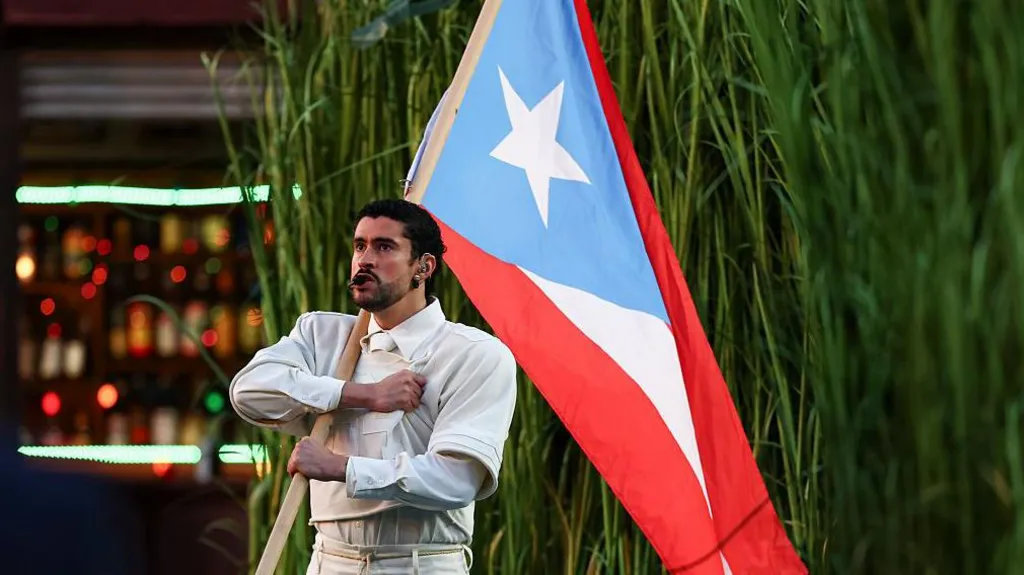
Last Sunday, millions of viewers around the world were able to witness a unique event on their television screens: Bad Bunny’s participation in the halftime show of the Super Bowl, the biggest event of U.S. American football.
Why is this significant?
The United States is experiencing an extremely dangerous climate of hatred against immigrants from Latin America, the Caribbean, Africa, and Asia. These are people who speak their native languages and don’t have blond hair, but who – despite working and contributing to the U.S. economy – are under constant attack by ICE agents who are essentially criminal and paramilitary gangs, supported by the government.
Amid these attacks emanating from the White House itself, a young Puerto Rican dared to defy that status quo. Not only did he come from a colony abused by Yankee imperialism, but he also spat in the face of the notion of “English Only,” making his entire program – with the exception of one Lady Gaga song in English – entirely in Spanish.
But Benito Antonio Martínez Ocasio, Bad Bunny, took a much deeper approach. When, in this climate of hatred, attempts were made to criminalize the LGBTQ community, Benito invited Ricky Martin, a famous openly gay Puerto Rican singer, to sing “Lo que le pasó a Hawaii” (What Happened to Hawaii), one of the most politically charged songs on his album “Debí Tirar más Fotos” (I Should Have Taken More Photos). The song details the impositions of foreign interests, primarily U.S., on Puerto Rico, which have even led to laws favoring wealthy foreigners who buy up our best land, depriving us of access to our beaches, leaving us like Hawaii, with nothing but the clothes on our backs, forcing us out of our homeland.
The entire spectacle was full of symbolism. But without going into every detail, there is one that, due to its relevance these days, must be mentioned: electricity. During that Super Bowl week, Puerto Rico was also celebrating Energy Workers’ Week. Thousands of energy workers were removed from their posts when the government decided to privatize the power grid and contract the corrupt company Luma Energy, with Canadian and U.S. capital. Since then, our people have been suffering from constant blackouts due to this company’s poor performance.
So when Benito sang “El Apagón” (The Blackout) and climbed one of the light poles, he wasn’t just remembering the blackout that lasted for months after Hurricane Maria, but also the grave crime that is the privatization of this essential service.
That 13-minute show, which was like a condensation of Puerto Rican reality, concluded with a parade of flags from all of our America, putting an end to the use of America as the name of the United States, emphasizing that America is all our countries that constitute the American Continent.
The spectacle wasn’t just about Puerto Rico; it was about Latin America, with values of humanity, solidarity, and immense love amidst the existing atmosphere of supremacist hatred and fascism. Hope and the power of struggle prevailed.
From Puerto Rico in struggle, with Radio Clarín of Colombia, Berta Joubert-Ceci
Join the Struggle-La Lucha Telegram channel