
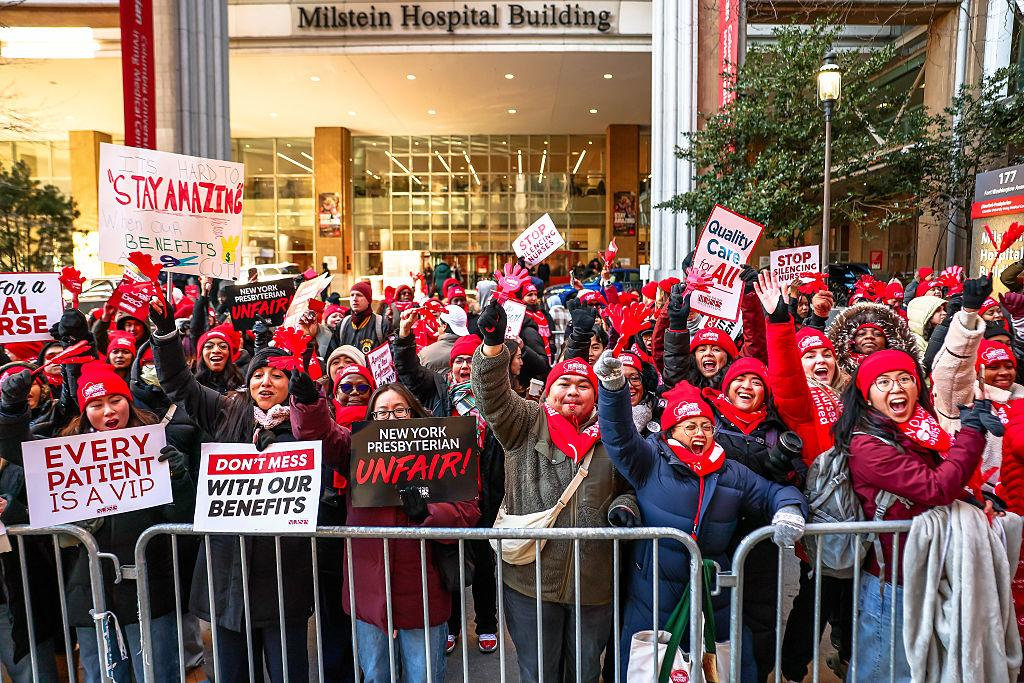
Nurses at NewYork-Presbyterian voted overwhelmingly on Wednesday, Feb. 11, to reject a tentative contract agreement and continue their strike, now in its 31st day. Out of roughly 4,200 eligible nurses, 3,099 voted against the deal, and 867 voted in favor — a 78% rejection that repudiated hospital management and directly challenged the union’s top leadership.
The rejected agreement included the same 12% raise over three years that nurses at Mount Sinai and Montefiore ratified. But it did not include enforceable staffing ratio language — the central demand of the strike and the provision that makes the NewYork-Presbyterian fight different from the other hospitals.
The NYP nurses are trying to win enforceable ratios for the first time. The rejected deal offered only a commitment to hire 60 new full-time employees — half the 120 the nurses proposed — with no enforcement mechanism and no job protections for existing staff.
“I can’t even call it a memorandum of agreement, because there’s no signature on it,” said Beth Loudin, a neonatal nurse and president of the bargaining unit at NewYork-Presbyterian. “This is a rush job to get a vote out, because it’s in alignment with the other hospitals.”
Rank and file vs. union leadership
The vote came after the New York State Nurses Association pushed the contract to a ratification vote over the explicit objection of the nurses’ elected executive committee at NewYork-Presbyterian. That committee, elected by the unit and directly involved in bargaining, had already rejected the deal. NYSNA leadership overrode them.
Hours before the results were announced, more than 50 nurses marched from Macy’s on 34th Street to NYSNA headquarters a block south on West 33rd, delivering a petition signed by over 1,500 members demanding a formal disciplinary investigation into NYSNA President Nancy Hagans and Executive Director Pat Kane. Nurses chanted, “We are your nurses! Listen to your nurses!” Neither Hagans nor Kane came down to meet them.
Loudin was visibly emotional as she handed the petition to NYSNA’s general counsel in the building’s lobby. “It’s been truly painful personally that my union decided to go against my leadership and my nurses,” she said. “We’ve been fighting for this for six months.”
Nurse educator Cagatay Celik told THE CITY he felt “betrayed” by union leadership. “I do want to go back. I miss my patients. I miss my job. And we are all out of money.” But he said taking a bad deal was not worth an expedited return.
What the 2023 strike won — and what NYP missed
The roots of this fight go back to the 2023 nurses’ strike. In that walkout, NYP nurses settled before the strike began. Nurses at Mount Sinai and Montefiore walked out and won enforceable ratios backed by financial penalties for hospitals that violate them. The NYP nurses never secured that language. The current tentative agreements at Mount Sinai and Montefiore preserve what those nurses already had.
The rejection came even after nurses at Mount Sinai and Montefiore ratified contracts that included widely praised protections for transgender and immigrant patients and staff, including language shielding nurses from being forced to cooperate with ICE inside hospital walls. Those provisions were significant. But for NYP nurses, without enforceable staffing ratios, they did not address the core issue of patient safety and working conditions.
At the other hospitals, nurses ratified their contracts by wide margins: 87% at Mount Sinai, 96% at Mount Sinai Morningside and West, and 86% at Montefiore. Those roughly 10,500 nurses will return to work by Saturday. The three fired Mount Sinai labor-and-delivery nurses remain in arbitration.
Hospital wealth, executive pay and state-backed strikebreaking
NYSNA said the unfair labor practice strike and bargaining at NewYork-Presbyterian will continue. Hagans called on the hospital to “agree to a fair contract and bring all our nurses back to work.” A NewYork-Presbyterian spokesperson said the hospital was “disappointed” and willing to honor the rejected proposal for reconsideration. When management is eager to keep a deal on the table that workers just rejected by a 4-to-1 margin, that tells you whose interests the deal served.
The strike’s financial backdrop exposes the gap between hospital austerity and executive wealth. NewYork-Presbyterian CEO Steve Corwin made more than $26 million in total compensation in 2024, according to tax filings cited by NYSNA. While the hospital says it cannot meet the nurses’ demand to hire 120 additional staff, NYP reported a $97 million surplus on $2.7 billion in revenue in early 2025.
The three striking hospital systems have spent a combined $100 million or more on replacement labor during the walkout. That strikebreaking apparatus was enabled by Gov. Kathy Hochul’s Executive Order 56, which declared a “State Disaster Emergency.” By suspending state licensing requirements, Hochul allowed out-of-state travel nurses — some reportedly earning as much as $10,000 per week — to fill hospital shifts. The order functioned as state-assisted strikebreaking, insulating management from the normal economic pressure of a prolonged walkout.
DOJ probes NYP’s monopoly power
The strike comes as NewYork-Presbyterian faces a federal antitrust investigation by the U.S. Department of Justice. Investigators are examining whether the hospital used its market power to squeeze insurers and drive up health care costs across the city. The case underscores a broader reality in the hospital industry: Expansion and consolidation come first, staffing comes second. For the striking nurses, it confirms what they have said all along — that NYP prioritizes market control and profits while claiming it cannot afford enforceable safe staffing ratios.
The NYP nurses remain on the picket line. A 78% rejection shows a rank-and-file majority that understands its power and refuses to trade enforceable staffing ratios for a settlement pushed through over their objections.
Join the Struggle-La Lucha Telegram channel