
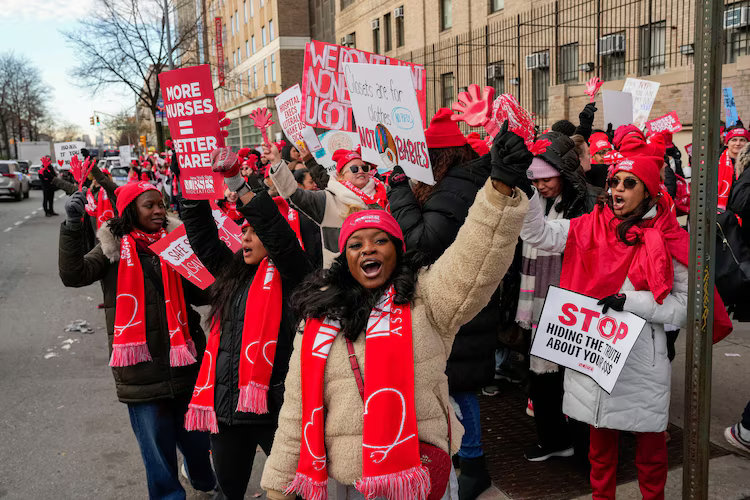
Nurses at NewYork-Presbyterian are fighting a battle on two fronts. For four weeks they have stood on picket lines in freezing temperatures demanding enforceable staffing ratios. Now they face a ratification vote forced by their own union leadership — a vote their elected executive committee has already rejected.
The New York State Nurses Association announced tentative agreements with Montefiore and the Mount Sinai system on Feb. 9, covering roughly 10,500 of the 15,000 nurses who walked off the job on Jan. 12 in the largest and longest nurses strike in New York City history. The deals include 12% raises over three years, preservation of health benefits, workplace violence protections and new language on artificial intelligence.
But the approximately 5,000 nurses at NewYork-Presbyterian campuses — Columbia, Allen Hospital and Morgan Stanley Children’s Hospital — found themselves in a different situation. Their executive committee, made up of union members who sit at the bargaining table and know the contract language inside and out, rejected the tentative agreement because it fails to include the enforceable staffing ratios that are the central demand of the strike.
The dispute has roots in the 2023 nurses’ strike. In that strike, the NewYork-Presbyterian nurses settled before the walkout began. The nurses at Mount Sinai and Montefiore went on strike and won a major gain: enforceable staffing ratios with a mechanism to fine hospitals that violate them. The NYP nurses never won that provision. So while the current tentative agreements at Mount Sinai and Montefiore preserve language those nurses already had, the NYP nurses are trying to win it for the first time — and the tentative agreement offers them only a commitment to hire 60 new full-time employees, half the 120 the nurses proposed.
NYSNA leadership overrode the executive committee’s rejection. The union began circulating ballots by email and text message on Tuesday, with executive director Pat Kane telling members in a video: “The simple fact is that we’ve reached the end of negotiations.”
The response from rank-and-file nurses has been furious. The @presbynurses Instagram account, which has more than 6,000 followers, blasted the move as a betrayal, writing that the executive committee does not endorse the proposal and that NYSNA “went over our heads to force a ratification vote.”
Beth Loudin, president of the local bargaining unit at NewYork-Presbyterian, called the decision “deeply unsettling.” On Instagram, nurse Krizia Daya voiced the question on many nurses’ minds: “How could NYSNA upper management get with Presbyterian to say, okay, the nurses are gonna now vote when our nurses are actually still outside picketing?”
Some nurses are now calling for NYSNA president Nancy Hagans to resign.
The role of Gov. Kathy Hochul in this outcome deserves scrutiny. Three days before the strike began, Hochul issued Executive Order 56, declaring a “disaster emergency” that suspended New York licensing requirements and allowed hospitals to hire out-of-state replacement nurses without state certification. She has renewed that order six times, keeping it in effect for the entire duration of the strike. The three hospital systems have spent a combined $100 million on temporary replacement labor, paying travel nurses as much as $10,000 per week.
The governor claimed the order wouldn’t affect bargaining. In fact, it strengthened management’s hand. By making it easy and legal for hospitals to staff around the strike, Hochul insulated management from the economic pressure that gives a work stoppage its power. Nurses marched to Hochul’s Manhattan office on Feb. 2, chanting “Kathy Hochul, shame on you” and demanding she stop extending the order.
Meanwhile, NewYork-Presbyterian CEO Steve Corwin collected $26.3 million in total compensation in 2024. The hospital system is currently under a Department of Justice antitrust probe for allegedly colluding with insurers to inflate prices for New York City patients.
Voting closes at 5 p.m. Wednesday, Feb. 11. If the tentative agreements are ratified, nurses would begin returning to work by Saturday. Three nurses fired from Mount Sinai on the eve of the strike — terminated by voicemail in what NYSNA says was retaliation — will not be among them; their cases remain in arbitration.
Whatever the vote’s outcome, one fact is clear. The nurses who fought hardest for the demand that matters most — safe staffing with teeth — are being told by their own union leadership, in collaboration with a mediator and the governor’s office, that the fight is over. The nurses at NewYork-Presbyterian disagree.
Join the Struggle-La Lucha Telegram channel