
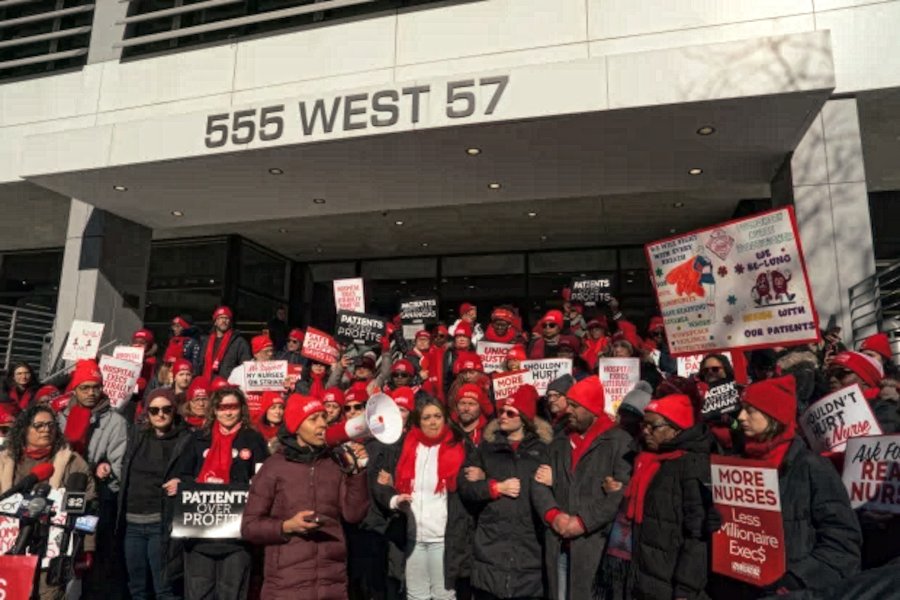
On Day 25 of the largest nurses strike in New York City history, 13 nurses walked up the steps of 555 West 57th Street in Manhattan, stood in front of the doors with arms linked, and walked off chanting as they were loaded into the police wagons.
The building houses the Greater New York Hospital Association, the lobbying arm that coordinates contract negotiations for Mount Sinai, Montefiore, and NewYork-Presbyterian — the three hospital systems whose nearly 15,000 nurses have been on strike since mid-January. The nurses knew the police were coming. They had announced their intentions. And when the NYPD warned them through a megaphone to clear the entrance, they stayed.
All 13 were issued criminal court summons for civil disobedience and released the same day. But the point had been made — and it reached far beyond that stretch of West 57th Street.
“For the first time in my life, I’m gonna deliberately break the law,” ICU nurse Jarrett Murphy told the crowd before the action. “I know there’s a proud history of people submitting to arrest when they see something that’s wrong. And what we’ve seen over the last three and a half weeks on the strike line from this association and our hospitals has been really, really wrong.”
The decision to target the Greater New York Hospital Association rather than an individual hospital picket line reflected a sharp tactical calculation. For weeks, hospital management had presented its refusal to meet nurses’ demands on staffing, wages, and workplace violence protections as the independent decisions of separate institutions. The action at 555 West 57th Street said otherwise. The nurses went straight to the body that ties those supposedly independent hospital systems together as a single employer class, acting in concert against the workers who keep their emergency rooms and ICUs running.
A fight with deep roots in New York labor history
It was not the first time workers confronted power at that address. In 1959, hospital workers — many of them Black and Puerto Rican — struck many of the same institutions and squared off against the same League of Voluntary Hospitals. That strike, one of the landmark labor actions of the civil rights era, helped establish collective bargaining rights for hospital workers in New York. Nearly seven decades later, nurses returned to the same building, fighting for the same basic demand: that the people who do the work have a say in how it gets done.
The historical echo was no accident. The Feb. 5 action opened that morning with a rally at Mount Sinai Hospital timed for Black History Month, featuring NAACP New York State Conference President L. Joy Williams, New York City Public Advocate Jumaane Williams, and leaders from the state AFL-CIO. Speakers emphasized that more than a third of New York City’s nurses are Black, with significant Latine and Asian representation — nurses who come from the same neighborhoods as the patients they treat. The strike is not only a labor fight. It is a fight waged by working-class communities of color against an industry that extracts enormous wealth from those communities while refusing to staff its facilities safely.
Emergency department nurse and New York State Nurses Association organizer Judy Sheridan-Gonzalez put it plainly: “We’re speaking out against these hospital executives at their home base. They’re constantly putting profits, and their own pockets, ahead of our humane care for our patients.” She described conditions at Montefiore as “inhumane overcrowding and total lack of privacy, not to mention infection violations and psychological trauma in our ERs, packed together like cattle.”
Understaffing is a profit strategy
The overcrowding Sheridan-Gonzalez described is not a problem of bad management. It is the outcome of conscious decisions by hospital executives to understaff units, knowing that every nurse not hired increases profits while patients and workers absorb the risk.
Executives keep staffing as lean as possible because every nurse not hired frees money to flow upward — into executive compensation, real estate portfolios, and the financial engineering that has transformed hospital systems into powerful corporate enterprises. The nurses are not asking these executives to be more generous. They are demanding the power to enforce safe staffing and patient care standards through their own collective action. They are demanding that the wealth nurses create through their labor be directed back toward patient care, and that they have the power to enforce it.
The hospitals’ own spending during the strike tells the story. According to the nurses’ union, hospital management spent more than $100 million on replacement nurses before the strike even began and paid temporary staff as much as $10,000 a week — many times what striking nurses earn. Mount Sinai was advertising new temporary contracts for mid-February even as negotiations continued. The money was always there. It simply was not meant for the nurses who show up every day.
Hospital executives countered that federal reimbursement rates leave them squeezed, claiming Medicare pays only 83 cents for every dollar they spend. They pointed to the expected fallout from the “One Big Beautiful Bill Act,” which could strip coverage from 1.5 million New Yorkers. But the nurses have heard this arithmetic before. They see the compensation packages that flow to the top floors while the emergency rooms overflow. The claim of scarcity is selective — it applies to bedside staffing but never to executive pay.
Escalation as negotiations stall
As the arrests took place, the strike was far from resolved. The day before, negotiators had reached a tentative agreement on protections against the use of artificial intelligence in clinical settings — a significant gain. But the core demands around safe staffing ratios, workplace violence protections, wages, and health care benefits remained on the table. And hospitals had begun floating the threat that returning strikers might find their positions filled by the very temporary workers management had spent millions to recruit — an attempt to break solidarity by making nurses fear for their jobs.
NYSNA responded directly: “The strike will not be over until all members return to work.”
The Feb. 5 action did not take place in isolation. The same day, San Francisco teachers announced they would strike on Feb. 9. The week before, Minneapolis had seen a general strike. Kaiser Permanente workers were on the picket lines in California and Hawai’i. Across the country, health care workers, educators, and service workers have been reaching the same conclusion at roughly the same time: Appeals to politicians, labor boards, and mediated negotiations have reached their limit when employers are determined to hold the line. When employers refuse to move, workers have to escalate — and that means being willing to take risks that go beyond the familiar rhythms of contract negotiation.
What happened on the steps of 555 West 57th Street was not a symbolic gesture. It was a message delivered in the clearest possible terms. The nurses identified the command structure behind their employers’ united front, went to its front door, and put their bodies in the way. They drew on a tradition of direct action rooted in decades of labor and civil rights struggle in New York City, and linked their fight to a rising wave of worker militancy from coast to coast.
Jarrett Murphy described it as seeing something wrong and refusing to look away. For 15,000 nurses — and the patients who depend on them — the fight continues.
Join the Struggle-La Lucha Telegram channel