
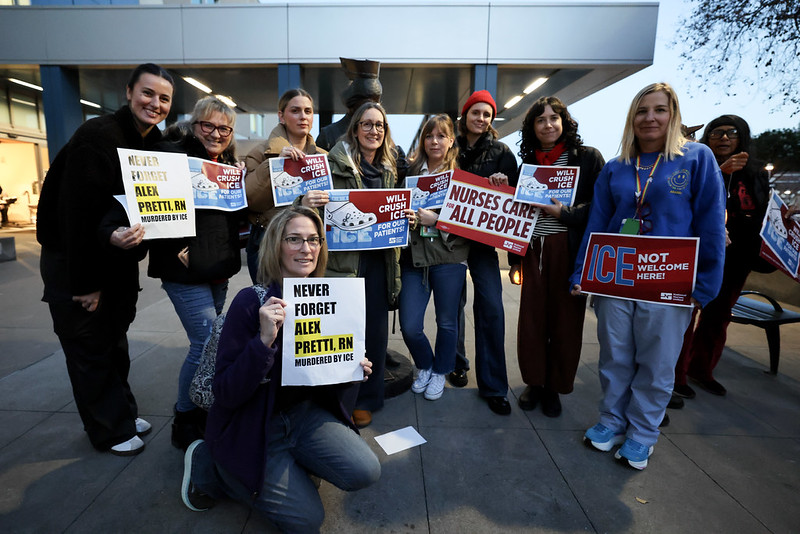
In California, 31,000 Kaiser health care workers have been on strike since Jan. 26, with 4,000 more pharmacy and lab workers joining as of Feb. 9. In New York, 15,000 nurses have held the line for nearly a month. In Minneapolis, teachers won contract language barring ICE from schools, and a general strike on Jan. 23 forced the federal government to pull 700 agents out of the state.
Across the country, the people who care for us — who teach our children, who keep us alive in hospitals — are drawing a line against the deportation machine. What connects these struggles goes deeper than shared outrage. Unions are sharing tactics through established channels. National Nurses United, with 225,000 members, is functioning as a connective backbone linking health care worker resistance from coast to coast.
Labor is absorbing immigrant defense into its own struggles. Through strikes and collective bargaining, workers are doing what courts and legislatures will never do: keeping ICE out of hospitals, schools, and workplaces.
Kaiser: From staffing strike to anti-ICE movement
The Kaiser Permanente strike began over staffing and wages, but it did not stay there.
When Customs and Border Protection agents killed Alex Pretti — an ICU nurse at the Minneapolis VA Medical Center acting as a legal observer during an ICE raid — on Jan. 24, the Kaiser picket lines transformed. National Nurses United launched a week of action from Jan. 26 through Feb. 4, and Kaiser facilities across California became the infrastructure for a nationwide anti-ICE mobilization.
Vigils and organizing actions rolled through Kaiser Oakland, San Jose, San Leandro and Vallejo on Jan. 26. San Francisco’s Geary Boulevard facility on Jan. 27. Roseville and Sacramento on Jan. 28, followed by actions in Southern California and the Bay Area on Jan. 30.These were not memorial services. NNU explicitly framed each action as an organizing step toward abolishing ICE.
NNU President Mary Turner captured the mood: “ICE messed with the wrong profession. Nurses want ICE abolished. Not one more penny for their crimes.”
Thirty-one thousand workers already on the picket line gave NNU something no other organization had at that moment: a ready-made mobilization network stretching the length of California and into Hawaii. Nurses who had walked off the job over short staffing and burnout were now using that same collective power to confront the federal deportation machine. And with 4,000 pharmacy and lab workers joining the strike on Feb. 9, that network is still growing.
The Richmond Kaiser rally on Jan. 30 showed how the strike is catalyzing broader resistance at the local level. Contra Costa County Supervisor John Gioia warned of $300 million in annual health funding cuts under a pending House bill. The county launched a $4 million “Stand Together” program providing rapid response legal services and deploying a mobile legal van to reach immigrant communities. The picket line became a rallying point for the whole county’s resistance to ICE terror.
Karen Sanchez, an RN at California Hospital in Los Angeles, put the health care framing bluntly: “ICE is bad for patients, bad for communities, and bad for health care workers. Our hospitals need to be sanctuary spaces for people who need care, and the presence of ICE in the facility severely impacts how safe patients feel here.”
NYC nurses bring ICE to the bargaining table
If Kaiser nurses are turning their strike into an anti-ICE mobilization, New York’s nurses have gone a step further: They are demanding that ICE exclusion become a binding term of their labor contracts.
The 15,000 NYSNA nurses, on strike since Jan. 12 against Mount Sinai, NewYork-Presbyterian and Montefiore — the largest nurse strike in New York City history — are fighting for safe staffing ratios, workplace violence protections and wages. But they are also demanding that their contracts explicitly bar ICE agents from their hospitals.
This demand did not appear overnight. Throughout 2025, NYSNA nurses worked with the Committee of Interns and Residents (CIR/SEIU) and 1199SEIU to push hospital administrators to voluntarily adopt ICE protections. Management refused. In September 2025, the nurses moved ICE exclusion into formal contract negotiations. Management refused to bargain on it. When the nurses struck in January 2026, sanctuary was on the table alongside staffing and pay.
“One of the nurses’ priorities in contract negotiations is to have ICE officers not be allowed into our facilities,” Montefiore nurse Michelle Gonzalez told Democracy Now! on Jan. 21.
As Struggle-La Lucha reported on Feb. 4: “Nurses are not asking elected officials to pass new laws. They are not waiting for courts to intervene. They are asserting through collective bargaining that safe patient care requires keeping ICE agents out of hospitals.”
The hospitals have tried to dismiss this demand as a “distraction” from “unreasonable economic demands,” insisting their existing law enforcement cooperation policies are sufficient. In plain language: Management wants nurses to cooperate with ICE under a general “law enforcement interaction” framework. The nurses refuse.
If NYSNA wins ICE exclusion in a binding contract, it creates a template that health care unions anywhere can replicate — sanctuary enforced through collective bargaining rather than legislation that can be overturned or executive orders that can be rescinded.
Immigrant workers defending immigrant patients
The demographics of this fight matter — in New York and in California alike.
Over 28% of all registered nurses in New York State are immigrants. More than two-thirds of NYC nurses are people of color — 35.4% Black, 20.9% Asian American and Pacific Islander, 10.7% Latine. These are immigrant workers using their professional power to protect immigrant patients.
NYSNA President Nancy Hagans, herself an immigrant, put it plainly on Jan. 28: “ICE’s presence endangers our patients, our nurses, and our larger communities. As an immigrant nurse and a leader of a union with many members who are immigrants or raised by immigrants, this issue hits deeply.”
Mount Sinai nurse Lillian Espinoza described the chilling effect already underway: “We know that the fear of encountering ICE already caused our Mount Sinai patients to delay or stop seeking care.”
This is the concrete reality behind the abstract debate over sanctuary policy. When ICE operates near hospitals, people stop going to the doctor. Pregnant women skip prenatal visits. Diabetics ration insulin rather than risk a pharmacy trip. Children with fevers stay home. The nurses — in New York emergency rooms and California Kaiser clinics — see this every day.
The murder that connected everything
Pretti’s killing on Jan. 24 is the event that fused these parallel struggles into a single, nationally coordinated movement.
National Nurses United’s week of action turned Kaiser picket lines into anti-ICE organizing actions across California. In New York, NYSNA nurses held a vigil at the VA NY Harbor Healthcare Center on Jan. 29, organized jointly with NNU, the Canadian Federation of Nursing Unions and AFGE.
“Last week, federal immigration agents in Minnesota brutally murdered ICU nurse Alex Pretti,” NYSNA declared. “Like NYSNA nurses, he fought for and protected his patients and community.”
In Minneapolis, health care workers were already providing mutual aid through Signal chat networks, with warnings circulating about ICE activity near Hennepin County Medical Center. The Minnesota Nurses Association set up rapid response infrastructure, coordinating with Unidos MN and the Working Partnerships mutual aid network and operating a direct hotline for detained members.
Health care unions issued a joint statement that drew the connections explicitly: “Allowing ICE undue access to hospitals, clinics, nursing homes, and other healthcare institutions is both deeply immoral and contrary to public health. New York’s healthcare workers are focused solely on providing the highest quality of care to our patients. We must never be put into positions where we are expected to assist, or be disrupted by, federal agents as they sweep into our institutions and attempt to detain patients or their loved ones.”
Teachers draw the same line
The convergence extends beyond health care. In Minneapolis, the Federation of Educators won contract language in November 2025 requiring schools to refuse ICE entry without a judicial warrant, along with data privacy protections for students and mental health support for staff dealing with ICE-related trauma.
Minneapolis organizing director Nat Anderson-Lippert credited the Chicago Teachers Union’s sanctuary schools model: “The level of infrastructure and organizing is so impressive and humbling.”
In San Francisco, the United Educators of San Francisco are striking with sanctuary city protections and emergency housing for educators among their contract demands. The district has resisted both, claiming they create “significant liability.” The same strategy the Minneapolis teachers pioneered — embedding immigrant defense in labor contracts — is now spreading along the West Coast.
The logic is the same one the nurses articulate: You cannot teach children who are too traumatized to learn because ICE raided their neighborhood last night. You cannot provide patient care when the patient is too terrified to walk through the hospital door. Immigrant defense is a workplace issue.
Jason Rodney, an assistant special education teacher at Anishinabe Academy in Minneapolis, framed the escalation: “The attack on immigrants is not new, but the intensity we are seeing is just extreme, and so many more people are stepping up right now to meet the moment.”
Minneapolis: Where mass action forced a drawdown
The Jan. 23 Minneapolis general strike provided the proof of concept for this convergence in action. More than 100,000 people marched in temperatures that hit 30 below zero. Seven hundred businesses were closed. Major school districts shut down.
The organizational depth behind that day grew from the ground up. Workers organized on their blocks and through Signal networks. The momentum pulled union leadership along — the Minneapolis Regional Labor Federation, AFL-CIO, endorsed the action, as did the Minnesota AFL-CIO Executive Board, representing over 300,000 workers. SEIU Local 26, UNITE HERE Local 17, Amalgamated Transit Union Local 1005 and CWA Local 7250 all mobilized their members.
The Department of Homeland Security pulled 700 troopers out of Minnesota, reducing the force from 2,700 to 2,000 — a concrete concession forced by mass action, but one that still left thousands of federal agents operating in the state.
SEIU Local 26 President Greg Nammacher told the Dig podcast: “There are so many players in motion right now — organized on their blocks, organized through Signal groups and structures that didn’t exist, or didn’t exist at an organizational level, just weeks ago, are now playing key roles.”
CWA Local 7250 President Kieran Knutson placed the moment in Minneapolis labor history — the 1934 Teamsters strike, the P-9 Hormel strike of the 1980s, the 2020 George Floyd uprising when ATU bus drivers refused to transport arrested protesters and 600 strikes erupted in the following month. “The Twin Cities has an experience with struggle and an experience with relating to social movements that emerge from the community,” he told Payday Report. “As they emerge from the community, they infect the workplaces. And if the unions are listening, the unions can become a part of it.”
Profiteering hospitals and the class line
The hospital systems fighting NYSNA in New York illustrate why labor action — rather than legislative appeals — is the sharper tool.
Between 2020 and 2023, CEOs at Montefiore, Mount Sinai and NewYork-Presbyterian increased their total compensation by over 54%. Mount Sinai’s Upper East Side hospital alone generated $1.2 billion in revenue in the first three months of 2025, a 20% jump over the same period the year before.
These same hospitals claim they cannot afford the nurses’ demands. They spent over $100 million on temporary replacement nurses before the strike even began, with scabs earning up to $10,000 per week. They hired Risa Heller Communications — a PR firm whose previous clients include Harvey Weinstein, Jared Kushner and the Sackler family — to manage their public image.
Mount Sinai fired three labor and delivery nurses by voicemail the night before the strike. Fourteen nurse leaders had already been disciplined — some for speaking to the press after an active shooter incident, others simply for discussing the union with colleagues. Governor Kathy Hochul declared a disaster emergency to allow out-of-state nurses to work in New York, actively undermining the strike.
The class line runs through every aspect of this fight. Billion-dollar hospital systems that cannot find money for safe staffing ratios have unlimited budgets for strikebreakers and crisis PR. The same institutions that dismiss ICE exclusion as a “distraction” are spending fortunes to avoid negotiating on it. Austerity for patients and nurses; blank checks for union-busting.
The common thread
From Kaiser emergency rooms in California to the picket lines outside Mount Sinai to the frozen streets of Minneapolis, workers at the center of these fights are drawing the same conclusion: The enforcement regime and the austerity regime are two faces of the same assault on working-class communities.
Teachers cannot do their jobs when their students live in terror. Nurses cannot do their jobs when their patients are afraid to seek care. Health care workers and educators are recognizing that defending immigrants is defending the conditions that make their own work possible. And they are reaching for the most powerful tool available to them — the collective power of organized labor.
Nammacher described the bigger picture on the Dig: “This is an incredibly hopeful story about combining systematic, intentional, self-conscious organizing with understanding that in a movement moment when the entire community is provoked, things will move far beyond your organizational control.”
The infrastructure is real. The coordination is deliberate. National Nurses United is linking Kaiser strikers in California, NYSNA nurses in New York and health care workers in Minneapolis through shared actions, shared demands and a shared conviction: ICE is a threat to patient care, and organized labor has the power to stop it.
Join the Struggle-La Lucha Telegram channel