
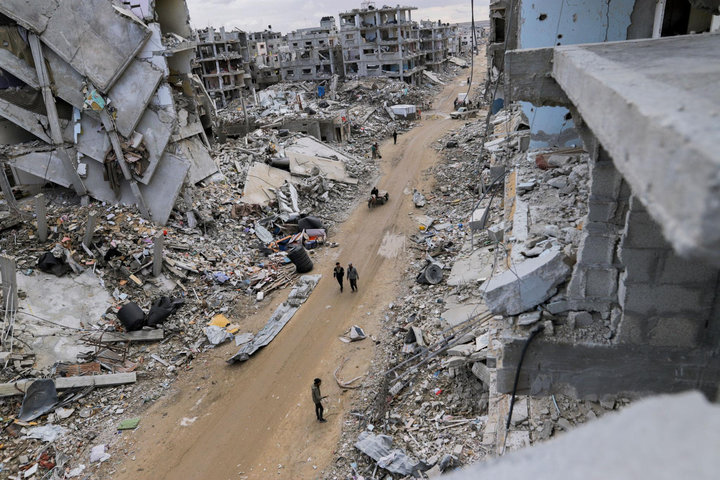
Since the “ceasefire” took effect on Oct. 10, 2025, Israeli forces have attacked Gaza on 101 out of 116 days, killing more than 556 Palestinians and wounding 1,500. The Israeli military has violated the agreement at least 1,450 times through airstrikes, artillery and direct shootings.
At the World Economic Forum in Davos in late January, none of that came up. The language there was “reconstitution,” “economic acceleration,” “post-conflict transformation.” The gap between that vocabulary and the reality — a 10-day-old infant killed by tank fire in Gaza City on Feb. 4, a paramedic shot dead while on duty in Khan Younis the same day — has been engineered into the deal from the start.
The ceasefire promised 600 truckloads of aid per day. The actual average has been 260 — 43% of the agreement — and Israeli authorities have blocked meat, dairy and vegetables while allowing chips, chocolate and soft drinks. Israel banned more than three dozen aid organizations, including Doctors Without Borders, Oxfam and the International Rescue Committee. Dr. Mohamed Abu Selmiya, director of al-Shifa Hospital, asked the question no one at Davos wanted to hear: “Where is the ceasefire? Where are the mediators?” The Israeli military answered through an anonymous official: It would continue striking the strip.
What the death toll hides
The confirmed death toll — over 71,800 — counts only recovered bodies recorded by hospitals. Stuart Casey-Maslen of the Geneva Academy of International Humanitarian Law says demographic modeling shows Gaza’s population has dropped by more than 10% since October 2023, pointing to roughly 200,000 dead. Lancet analyses put the figure between 300,000 and 377,000 when indirect deaths are included — people who died of starvation, hypothermia, untreated infection and diseases that surged as much as 384-fold in overcrowded camps with no clean water.
The Israeli military bombed hospitals, killed at least 1,700 medical workers and blockaded medicine. Of 36 hospitals, only 22 were functioning by mid-2025, at limited capacity. A Lancet study calculated over 3 million life-years lost — more than 1 million of them belonging to children under 15.
The real estate plan
On Jan. 22, Donald Trump signed the Board of Peace charter at the World Economic Forum in Davos. The 11-page document does not mention Gaza, Palestine or Palestinians. It establishes Trump as permanent chairman with veto power over all decisions. Permanent seats cost $1 billion. France, Britain and Germany refused to sign. Israel, Hungary, Argentina, Bahrain and Morocco did.
Minutes later, Trump’s son-in-law Jared Kushner unveiled AI-generated slides of a fantasy metropolis: 170 waterfront towers, coastal tourism zones, data centers, an airport. The $25 billion “master plan” was developed with Yakir Gabay, an Israeli real estate and infrastructure speculator whose portfolio centers on large-scale redevelopment projects and post-crisis property acquisition. No Palestinians were consulted. Architecture professor Ali A. Alraouf called it “the Vegas-ification of Gaza” — gated communities for a specific economic class, built on the rubble of an existing society.
An analysis by NPR found the plan would erase entire neighborhoods and push the population south, away from their homes and toward the Egyptian border. It makes no reference to land deeds, housing allocation or where hundreds of thousands of displaced people would live during construction.
Trump made it plain: “I’m a real estate person at heart. Look at this location on the sea. Look at this beautiful piece of property.”
Shortly afterward, Elon Musk appeared onstage alongside Larry Fink. Musk offered one of the summit’s most revealing lines. “I heard about the formation of the Peace Summit,” he said, “and I was like, is that P-I-E-C-E? A little piece of Greenland, a little piece of Venezuela.”
Their pairing captured the logic of Davos: tech capital and asset management converging around militarized reconstruction — where war zones become investment opportunities and displacement is reframed as development.
The five-year waitlist
More than 18,500 Palestinians need urgent medical treatment abroad, including 4,000 children. The Rafah crossing — Gaza’s only exit that does not pass through Israel — reopened on Feb. 3 after nearly two years of closure. On day one, five patients were allowed to leave. On day two, 16. On day three, the Israeli military canceled the evacuation entirely.
Palestinians who make it through have described being blindfolded, bound, strip-searched and interrogated. On the Egyptian side, 150 hospitals stand ready. Inside Gaza, Rajaa Abu Mustafa waited outside a hospital for her 17-year-old son Mohamed, blinded by an Israeli bullet through the eye a year earlier as he tried to reach food from aid trucks. “We have been waiting for the crossing to open,” she said.
Occupation by committee
The National Committee for the Administration of Gaza (NCAG) — a 15-member body of Palestinian technocrats appointed under the ceasefire’s second phase — was announced on Jan. 14. Most members are affiliated with the Palestinian Authority. The committee is led by civil engineer Ali Shaatt, who said it would play “no political role” in governing Gaza.
That limitation is structural. The NCAG does not control borders, territory, security or diplomacy. Its mandate is confined to waste management, telecommunications and basic infrastructure — administering civilian life under conditions it cannot challenge.
The Board also commands a military force: U.S. Army Major General Jasper Jeffers leads the International Stabilization Force, placing the U.S. Army at the head of Gaza’s occupation.
In practice, this creates a technocratic layer managing the aftereffects of bombardment while armed control remains with a U.S.-led military force — an occupation administered by committee.
The framework also provides political cover from criminal accountability. The International Criminal Court issued arrest warrants in November 2024 for Benjamin Netanyahu and former Defense Minister Yoav Gallant, citing war crimes including the use of starvation as a weapon. Under international law, all 124 Rome Statute member states are obligated to arrest Netanyahu if he enters their territory.
Instead, Viktor Orbán — a Board signatory — invited him to visit. France claimed he enjoys immunity. Netanyahu’s flight paths have reportedly been altered to avoid ICC member airspace.
By drawing governments into a shared governance structure where Netanyahu sits as a partner rather than a fugitive, the Board of Peace converts legal obligations into diplomatic liabilities — making enforcement of the warrants politically costly and practically unworkable.
The answer from the sea
On Feb. 5, organizers of the Global Sumud Flotilla announced from the Nelson Mandela Foundation in Johannesburg that they will launch the largest civilian maritime mission in history on March 29. More than 100 boats carrying 3,000 participants from over 100 countries will depart Barcelona, carrying 1,000 medical workers, engineers and war crimes investigators to break the sea blockade.
In October 2025, Israel intercepted the previous flotilla of 40 boats and detained more than 450 participants, including Mandla Mandela — Nelson Mandela’s grandson — and Greta Thunberg. Detainees reported beatings, strip searches and verbal abuse. The organizers are going back with more boats and more people. “As a collective across the globe, we can isolate apartheid Israel, collapse it and bring it to its knees, just as we did to apartheid South Africa,” Mandela said.
Join the Struggle-La Lucha Telegram channel