
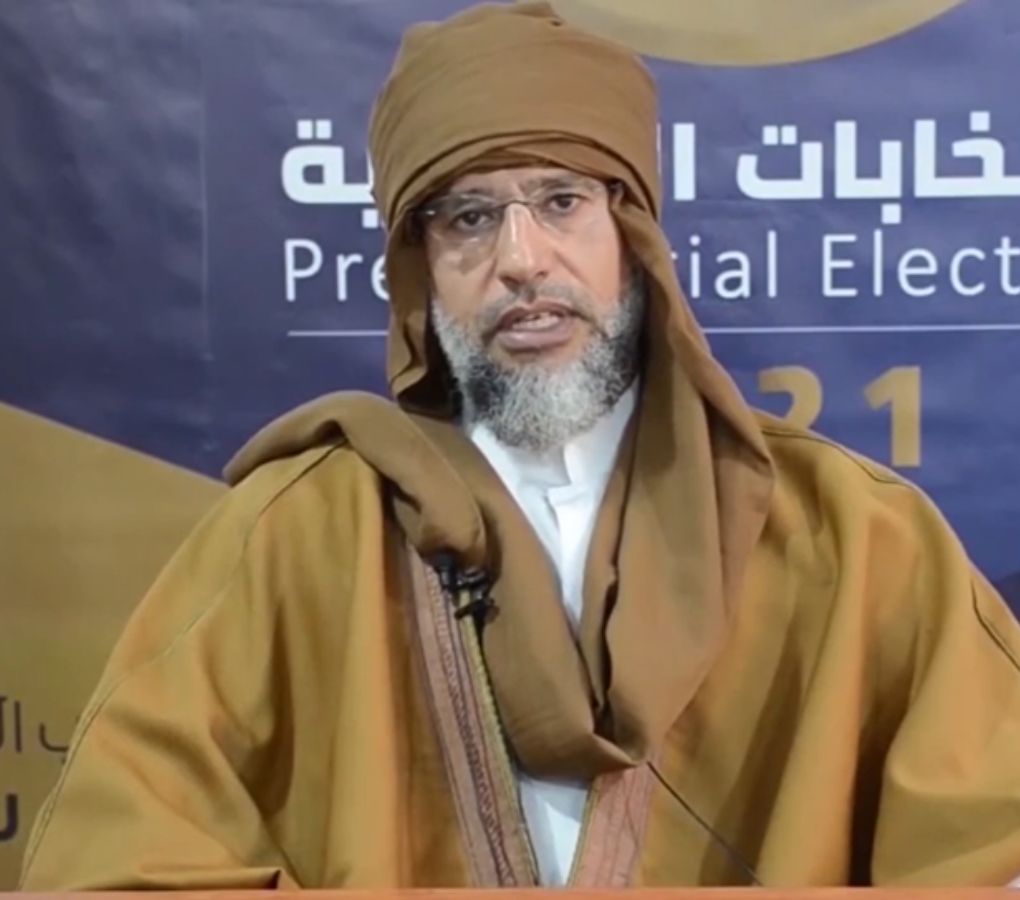
The son of President Muammar Qaddaffi, Saif Qaddafi, was assassinated on Feb. 3 by local forces, some of whom contributed to the destruction of a flourishing Libya. A background to the murder and Libya’s struggles for reconstruction.
In 2011, as NATO was bombing Libya, the son of Muammar Qaddafi, Saif Al-Islam Qaddafi (hereafter, Saif), told a reporter that they would fight NATO. He was then pressed by the reporter on what plans they have for that. Saif said: We have Plan A, Plan B and Plan C. Plan A is to live and die in Libya. Plan B is to live and die in Libya. Plan C is to live and die in Libya.[1]
His plan was fulfilled and he never pursued what other political leaders had done, which is, fleeing their countries and being in exile under mysterious yet privileged conditions.
Saif was assassinated in the late afternoon of February 3rd, when four masked gunmen stormed his place in the city of Zintan, 170km southwest of the capital, Tripoli, casting a blow to the prospects of a political imagination many Libyans aspired to since their country was destroyed externally by NATO in 2011 and internally by the political elite running the country ever since. The assassination is not just an attack on Saif for grudges held by political opponents due to animosity against his father, Muammar al-Qaddafi and the Libyan Arab Jamahiriya era (1977-2011). It is an attack on the ideas that Libya represented: Pan-Africanism and Pan-Arabism, Anti-Imperialism, and Anti-Reactionism.
Understanding Saif and Libya
Saif was born in 1972 in Libya, where he grew up and was educated until his doctoral studies at the London School of Economics. He became instrumental in portraying the Libyan Arab Jamahiriya differently to western audience and intellectuals at a time of geopolitical reshuffling in the early 2000s. Having mingled with the likes of Anthony Giddens, David Held and many others who are close to the heart of British politics, he understood how to use political power for economic leverage, and vice versa. He was instrumental in returning many of the opposition figures (the conservative capitalist forces who eventually turned on the people in 2011). Being the face of Libyan reforms, he was able to transform the image of the country, which resulted in the lifting of sanctions, the solidification of Libya’s Pan-African orientation, and its burgeoning role in continental integration. He never held a political position and after managing to reshape the external image of the country, he settled with managing Libya’s international charity foundation, the Gaddafi International Charity and Development Foundation (GICDF). He also led the negotiations between the Libyan opposition and MI6-backed terrorists. These terrorists, who were trained in Afghanistan and have ties to Al-Qaida, formed the Libyan Islamic Fighting Group (LIFG), which launched numerous terrorist attacks in eastern Libya (Benghazi and Darna) in the mid-90s, backed by the MI6. These talks resulted in an amnesty given to many of the opposition, despite their treacherous history, in cooperation with MI6 and CIA.[2]
He came to prominence again during the events of 2011. On the third day of the demonstrations (20/2/2011), he predicted Libya’s future. He said that if Libyans begin to kill each other now, they will live in a vortex of violence for the next 40 years. Fifteen years later his prophetic words continue to have material reality. The very people he negotiated with to receive amnesty in 2011 were the ones that NATO armed and led the militarized rebellion against the government.
As NATO-backed rebels encroached on various cities and killed Muammar Qaddafi, Saif remained loose until his capture by rebel forces in November 2011, a month after the public lynching of his father. He was set to face trial because the International Criminal Court had issued an arrest warrant for accusations of crimes against humanity. He remained in jail until 2017, when the courts in Libya gave national amnesty in the spirit of national reconciliation. Since then, he has been living in Zintan, where the very people who captured him became his protectors, showing how political opinions in Libya have shifted and how much support he has garnered given the demise of the country and the growing gap between the ultra-rich and the poor.
Saif, The People vs US-led Electoral Stint of 2021
Despite his popularity, he never sided with the armed militias and foreign actors. Since his release from prison in 2017, Saif abstained from engaging in the politics of the fighting factions, namely the Turkish and Qatari-backed Tripoli government, and eastern Libya’s House of Representatives and its military arm led by General Khalifa Haftar. Even when Haftar launched a military operation to take over Tripoli in 2019, Saif called for de-escalation and peaceful resolution between the factions, urging them to point their guns at the foreign occupiers.
When Haftar’s 2019-2020 goal of capturing western Libya was shattered, the United Nations Special Mission to Libya brokered peace talks which birthed Libya’s second UN-parachuted government, Government of National Unity (GNU). The mandate of the government was only nine months, with the goal of writing presidential and parliamentary election laws and holding elections by the 24th of December 2021. Given that this was the first opportunity for Saif to engage in politics peacefully, he appeared in a New York Times interview in the summer of 2021, officiating his intent to run for the December elections.[3]
Those who follow the politics of electoralism will know the International Foundation for Electoral Systems (IFES), the notorious foundation that influenced elections in numerous countries. Most notorious was the legislative coup against Ortega of Nicaragua by orchestrating election laws that undermined the Sandinistas’ popularity. IFES, which is also authoring Libya’s Civic Education textbooks,[4] has its fingerprints on electoral meddling in countries ranging from Ukraine and most recently Romania in 2024, to Libya and other countries which the US targets with Democracy Promotion. This foundation, IFES, has been implementing its democracy promotion directives in Libya since the toppling of the Jamahiriya in 2011, and they were the orchestrators of the 2021 elections.
Saif’s bid in the elections reshuffled the political game and the expectation to pull Libya out of a vortex of violence through electoral politics. In early November 2021, he appeared in southern Libya, in Sabha, and submitted his official papers for election bid. Then came the legal battles to orchestrate means to exclude him from running for the presidency. Many Libyans registered to vote in those elections, numbering 2.8 million. His application was rejected because of allegations that a court issued an arrest warrant for him. However, given the non-bona fide nature of the arrest warrant, and that it emanated without formal evidence and proof of guilt, his lawyer sought to appeal the exclusion from the elections in the District Court of Sabha. Showing how Haftar’s militias, who control Sabha, tried to influence the court’s decision, they decided to bar Saif’s lawyer from accessing the court by blocking the roads with their armed pickup trucks. However, Libyans protested against this blockade and pressured the militias to move aside so Saif’s lawyer could submit the appeal documents. Eventually, the lawyer and the people were successful in reinstating Saif’s bid for the 2021 elections.
What often goes unremarked—or is treated with curious omission—is that Khalifa Haftar is not merely a ‘Libyan warlord.’ He is a U.S. citizen and a longstanding asset, parachuted into the conflict by NATO in 2011, and later installed as the head of Libya’s military. Yet, in a display of either profound political illiteracy or intentional scotoma, many Western analysts prefer to frame him solely as a proxy of the UAE. This selective focus—highlighting convenient regional patrons while ignoring the original imperial hand that placed him—exposes the fickle and often disingenuous nature of their commentary. It dismisses the enduring role of imperialism, which first elevates its puppets and then permits them to be rebranded as local strongmen. True consistency would demand that those who oppose Haftar today should have opposed his NATO-backed entry in 2011; those who critique foreign interference now should have named it then. Their analysis, like the alliances they dissect, remains situational, not principled.
Hafter was acting on behalf of the Americans who wanted to exclude Saif from the elections. This was explicitly said by the US Ambassador to Tunisia (Libya does not have a US embassy). The Principal Deputy Assistant to the Secretary of State in the Bureau of Near Eastern Affairs, Joey Hood, was asked: “Saif Qaddafi is running for presidential elections that will take place in December [2021]. Do you have an issue with that?” To which Hood replied, “I think the whole world has a problem with that. He is a war criminal and is under UN and US sanctions. Who runs for the presidential elections is something Libyans decide. But we will have many problems with the international community if a man like him is the president of Libya”.[5] To the Libyan people’s dismay, the elections never took place, and the UN-parachuted government, GNU, still holds power. Haftar still dominates eastern and southern Libya, alongside an ad-hoc government that is largely influenced by his sons. Since then, Saif withdrew from the political scene and waited for another opportunity for elections.
Throughout this time, Saif remained silent on the political factions in Libya while speaking incessantly on the need for Arab unity and African unity; he wrote often about Palestine and in defence of resisting imperialism, given that he had firsthand experience fighting the NATO alliance and its reactionary Arabs (UAE, Jordan and Qatar).
To Kill a Man and His Ideas
Saif’s popularity is undisputed and many Libyans long for a charismatic figure to unite under.[6] Neither Haftar nor Abdul Hamid Dbaiba (Prime Minister of the Government of National Unity) have a political project of sovereignty, unity and anti-imperialism. While the US and the larger west see Saif as the largest obstacle to folding Qaddafi’s legacy in Libya, this treacherous assassination, which is done by Libyan hands, will undermine any political imagination in the near future that rids Libyans of their many colonialists (Emirati, American, Turkish, British, Italian, etc.). Some allege the US to have been behind the assassination as Trump’s Senior Advisor to the President of USA on Arab and Middle Eastern Affairs and concurrently as Senior Advisor for Africa at the U.S. Department of State, Massad Boulos, confirmed that he met with eastern (Haftar) and western (Dbaiba) in Paris last week in “efforts to forge national unity and long-term stability, consistent with President Trump’s broader peace agenda.”[7] A day after this post, Saif was assassinated.
Saif’s last public message was sent to one of his relatives, which really shows how much it aches to see Libya destroyed and transformed from the richest country in Africa to what it is today. Saif said:
“For the people whom you said that they were martyred in 2011, was it for this? Is it that we can’t dig a well in Sirte without the permission of the Turks, the American Ambassador, British Ambassador, and French Ambassador? Why didn’t you say that you wanted all of this from the beginning without the thousands being killed and the 500 billion that Libya wasted, and all this destruction resulting in orphans and widows”. [8]
As Libya enters a new chapter of resistance—against the neocolonial project and the treacherous regimes that enforce it—the true struggle comes into sharp focus. These regimes, whose true allegiance lies with their Atlanticist masters, deliberately impoverish the people. They dismantle the last vestiges of social welfare through subsidy cuts and orchestrate embezzlement via the private sector. History’s long arm, however, will not be stayed. It is already writing its indictment: the very local actors who conspired with NATO in 2011 have since been named in the correspondence of Jeffrey Epstein. This was no coincidence; Epstein, a kingpin of predation, had set his sights on Libya’s frozen assets across Africa, Europe, and America. His operations, facilitated by intelligence agencies like the Mossad, aimed to siphon billions through legalistic channels. This nexus—of betrayal at home and criminal conspiracy abroad—reveals the true nature of the forces that have besieged the nation.[9]
History will forget those people, for they have chosen to have no heritage. In the final accounting of a nation’s soul, it is not the momentary clamor of the crowd that echoes through history, but the unwavering fidelity of its children. Saif Al-Islam Qaddafi stood, unbroken, for the sovereignty and unity of his homeland and for the Pan-African dream of a liberated continent, a testament to a courage that transcends the physical. His legacy is forever scarred, not by defeat, but by the bitter venom of betrayal—by those who sold their birthright for foreign whispers and hollow promises. They traded the sacred soil of Africa for the sterile comfort of being accepted by their colonizers, believing that survival was the same as living. His vision, however, endures in the collective struggle for African unity and freedom. It is the vision of linking arms with brothers and sisters from Cairo to the Cape, from Dakar to Dar al-Salam, not in subservience to old empires or new masters, but in sovereign solidarity. It is the conviction that our true strength lies not in isolation, but in unbreakable fraternity against those who would divide, plunder, and impoverish our peoples. Yet there is a death far deeper than the grave: the death of honor, the death of loyalty. It is a spiritual decay that follows the traitor, the defector, and the agent, a perpetual shadow from which no sun can offer warmth. They are the walking dead of history, condemned to wander without glory, without dignity, and without a name worthy of remembrance. For true life is measured not in breath, but in the undying pride left etched upon the conscience of a nation and the future of a continent united in purpose and freedom.
The brave does not die الرجل لا يموت
The revolutionary الثوري لا يموت
The courageous does not die الشجاع لا يموت
The hero does not die البطل لا يموت
Even if rested in the grave حتى ولو وُضِعَ في القبر
The coward dies يموت الجبان
The traitor dies ويموت الخائن
The defector dies ويموت المرتد
The agent dies ويموت العميل
While the brave ones, they are alive أما الشجعان فهم أحياء
With glory بالمجد
With honor والشرف
With the pride that they leave behind وبالفخر الذي يتركونه
And with the reputation they leave behind وبالصيت الذي يتركونه
For their children, for their families لأولادهم وأهلهم
For their nation ولأمتهم
As for the cowards, they are dead أما الجبناء هم ميتون
Even if they were eating, drinking, strolling in the markets, and residing in hotels
حتى ولو كانوا يأكلون ويشربون ويمشون في الأسواق ويسكنون في الفنادق
They are dead because they have no glory ميتون لأنهم بلا مجد
No dignity وبلا كرامة
No honor وبلا شرف
With no good reputation, no remembrance وبلا سمعة حسنة وبلا ذكر
To leave behind for their children يتركونه لأولادهم
– Muammar Qaddafi
Essam Abdelrasul Bubaker Elkorghli is a Libyan doctoral researcher at the University of Illinois at Urbana-Champaign, researching imperialism, ideology and education with a primary focus on Libya. He serves on the International Advisory Board of Pambazuka News, as assistant editor to the Middle East Critique Journal, and member of the Global Pan-African Movement. He writes frequently for the Black Agenda Report.
Endnotes
[2] Matteo Capasso, Everyday Politics in the Libyan Arab Jamahiriya. Syracuse Press. 2023
[4] See Imperialist terrorism in Northern Africa, Matteo Capasso & Essam Elkorghli, Review of African Political Economy, https://www.jstor.org/stable/48814503
Source: Pambazuka News
Join the Struggle-La Lucha Telegram channel