
Media Autopsy is a series where I put a news article from another source under the microscope and discuss what it’s missing.It’s a way for me to talk about news coverage that got my goat, while also teaching you how mainstream media can manipulate you. Let’s explore what traditional journalism incentivizes, how we get it wrong, and most importantly, how we can do it better next time.
A couple weeks ago, Nick Shirley and two other far-right grifters arrived in Baltimore within days of each other. The Baltimore Banner published a story, written by Alissa Zhu, about his visit to a local church that has been highlighted in reporting about the opioid epidemic.
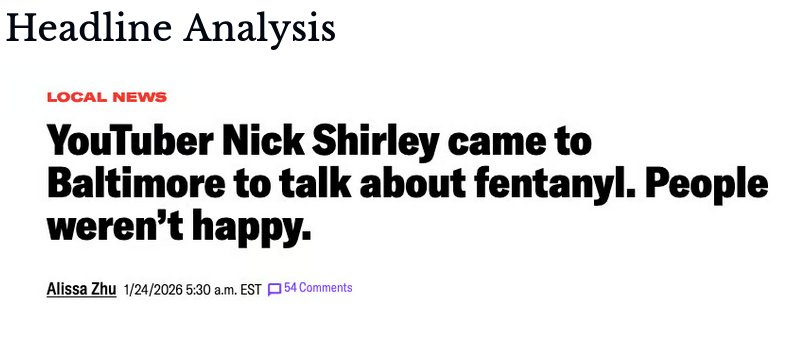
Let’s start at the top.
Headlines are the first thing people see when they’re deciding whether to read a story. Good headline writing demands a snappy, yet accurate account of the story’s central conflict.
This one misses the mark in a couple of places.
Subramaniam Vincent, Director of Journalism and Media Ethics at Santa Clara University has laid out principles for ethical headline writing. In his second principle, Vincent says headlines should “center valid and authentic claims.” He writes: “centering official actors in headlines … allows their claims to gain legitimacy through circulation.” Now, Vincent is talking about politicians, but his idea can be applied towards anyone with power, and Shirley, with his 1.6 million Youtube subscribers and close ties to the Trump administration, counts.
Vincent continues, “For officials who have already caused harm or have taken evidently harmful positions in the past, headlining their views on the same causes harm to discourse.” Shirley’s content, as we’ll discuss more later, has done extensive harm in Minnesota. So centering his statement about why he’s here feels questionable at best.
The next problem is about the second part of this headline. “People weren’t happy,” while pithy, is so vague that it can’t adequately tell the reader anything about the stakeholders here that aren’t Shirley. It abstracts the impacted community into some nebulous group of unclear size or motivation.
People being unhappy about something isn’t news; it’s Tuesday. It’s one of life’s little certainties: death, taxes, and people bitching. The story is in why people are unhappy.
The actual story quotes concerns about additional federal attention and Shirley’s unethical prior work. It talks about how the people in Baltimore’s community are vulnerable and in need of help, not another hit piece. But you wouldn’t know that from reading the headline.
Healthier headlines
Rule #1: If I’m going to talk shit, I have to be able to do it better. So here are some alternate headlines for this story. Try to think about how each would prime you to feel about the story, or the impression they’d leave you with if you only read the headline. Because let’s be honest — sometimes you only read the headline.
Youtuber Nick Shirley Says He’s in Baltimore to Talk About Fentanyl; Community Members Are Concerned That’s Not True
Baltimore Locals Left Skeptical of Controversial Youtuber Nick Shirley
Youtuber Nick Shirley Crashes Narcotics Anonymous Meeting in West Baltimore Church
Conservative Youtuber That Laid Groundwork for Minneapolis’ ICE Surge Arrives in Baltimore
Context kills
The Banner’s article contains the following facts to contextualize Shirley:
“Conservative Youtuber”
“best known for his viral video alleging fraud by businesses run by Somali immigrants in Minnesota.”
“known for both prank videos and conducting man-on-the-street-style interviews on politically charged topics”
“among a group of high-profile content creators who have aligned themselves with President Donald Trump and gained political influence.”
“After his video on alleged fraud among Somali-run businesses was promoted by conservative leaders including Vice President JD Vance, the federal government intensified a violent crackdown on immigrants in Minneapolis and the surrounding area.”
Every time a journalist introduces someone in a story, they’re picking what the audience needs to know. Journalists aim to accurately describe who someone is, without giving the reader too much information or veering off-topic. That means there are often only a few words given to contextualize an entire human life — not an easy task.
Think about if I called former Vice President Kamala Harris “the former Democratic nominee” versus if I described her as “a politician who’s received millions from AIPAC” versus if I talked about her as a “former DA.” All of these things are factually accurate, but they leave you with different impressions of who she is. Different ones might be appropriate in different circumstances.
I wish he was just a Youtuber
The details provided on Shirley flatten who he actually is into someone more palatable. To begin by calling him a conservative Youtuber, while technically true, leaves out his place in the Trump administration’s propaganda machine and his connection to Minneapolis, which are only discussed tangentially later in the story.
It also neglects the fact that he’s not talking about himself as a content creator, anymore. Shirley’s calling himself an independent journalist, taking advantage of all the trust endowed by that title. Vice President JD Vance even said Shirley “has done far more useful journalism than any of the winners of the 2024 @pulitzercenter prizes.”
The Banner avoids the issue of Shirley’s easily impeachable journalistic integrity by calling him a Youtuber. But his claim to fame isn’t about his million-and-a-half subscribers. It’s about how he, in his own words, supposedly “uncovered over $110,000,000 [of fraud] in ONE day.”
I’m the last person who’ll knock independent journalism, but it’s disingenuous to claim that’s what Shirley is doing. He’s simply not being held to any meaningful journalistic standards. Ethical independent journalists don’t publish allegations without proof or at least some serious evidence behind them. They don’t show up unannounced at daycares demanding to see the children. They don’t take refusal to be involved in a story as a sign of guilt. If someone shoved a camera in your face, would you be eager to talk to them?
This background is a key part of why Shirley was unwelcome in Baltimore.
Xenophobia and white supremacy are always relevant
Another necessary fact barely present in the reporting: Shirley has close ties to President Trump’s white supremacist regime. He’s participated in conversations with Trump, including a roundtable about the dangers of antifascism (which seems less dangerous, than say… fascism) and testified before Congress. Shirley’s recently praised Neo-Nazi Elon Musk and defended white supremacist Nick Fuentes, who pushes racist conspiracy theories about white genocide.
He’s repeatedly boosted racist and islamophobic claims, including a particularly troubling one where Ilhan Omar tweeted welcoming home Liam Conejo Ramos after his detainment by ICE. The reply he reposted reads: “Deport the Jihadist.” He regularly uses language that dehumanizes immigrants, using terms like “illegals” and “aliens” throughout his work.
I could go on, but the main point is this: Nick Shirley is not just some guy. He’s not your average conservative off the street, and presenting him like he is is dangerous. He’s a rightwing extremist with a morally bankrupt political agenda. Readers deserve that context.
What the story gets right
It’s not all bad. Zhu is an expert on Baltimore’s fentanyl crisis, and it shows in her story. She doesn’t waste time re-litigating the drug issues affecting the community, which have been extensively covered by local reporters like her.
Her story, unlike its headline, focuses primarily on the controversy of Shirley’s arrival and does a great job at representing the voices of those in the community. This isn’t a surprising contrast; headlines and reporting are often controlled by different decisionmakers in the newsroom.
Shirley is quoted only: when he explained his raison d’être. The majority of the story revolves around quotes from those at and around the church he entered when he interrupted the Narcotics Anonymous meeting, grounding the story in the experiences of the people most vulnerable to Shirley’s intrusion.
Zhu also nails the story’s end. Poynter’s Chip Scanlan said “endings can be eternal flames that keep a story alive in a reader’s head and heart.” The ending quote of a news story isn’t always one the reporter herself agrees with, but it’s the one they think is most central to the story’s impact, the one they know merits further thought.
Read how Zhu brings this one home with a quote from a local, and breathe a sigh of relief with me:
“He’s just trying to drum up more hits. But don’t come down here trying to use us as a springboard to where you want to get to talking about us,” Simmons said. “Because you don’t know us.”
Verdict
The Banner’s reporting on this story is all factually accurate, but it leaves out critical context and risks amplifying concerning claims. At the same time, the Banner does a good job at highlighting community opinions and sitting with the potential impact of Shirley’s arrival. It validates and centers the impacted people.
The worst part of the story by far is that if you read it, Shirley might come across as a normal guy who did something insensitive for Youtube content. He isn’t. He’s a political agent with an agenda, and treating him as anything else normalizes his behavior.
This is the challenge of reporting in the Trump Era.
Everything feels absurdly interconnected. What do you leave out? What’s more relevant than not? In the words of Israel-stan Kamala Harris, “Do you think you just fell out of a coconut tree?”
In so many ways, writing a news story feels less like composing on a blank page and more like writing blackout poetry: culling details until you have a story shaped roughly like the truth. Sometimes, though, you black out too much. It doesn’t take a malicious reporter to do this. It doesn’t even take a bad reporter.
Still, though, this coverage matters.
As I reported on two weeks ago, Shirley wasn’t alone as a far-right influencer in Baltimore. Several other key far-right influencers targeted Baltimore that same week, and my colleagues at Project Salt Box have extensively covered the government purchases indicating the money being funnelled towards ICE in Baltimore.
We are watching them descend on our city to defend ICE, but we’ve seen ICE commit murder on TV twice now. We’ve seen the concerning, inhumane conditions in Baltimore’s ICE detention center.
It’s time for media to stop playing the middle and acting like influential conservatives might just not know what they’re doing. In the same way ICE hides behind the mask, people like Shirley hide too: they hide behind the mask of someone apolitical, someone “just asking questions,” and reporting like this story’s helps them do it.
ICE is an oppressive, violent paramilitary force that evokes the American legacy of slave-catchers. They’re masked men who break apart families and kill mothers on the way to pick up their kids from school. They murder nurses and poets.
It’s time for journalists to act like it.
Source: The Backbone
Join the Struggle-La Lucha Telegram channel