
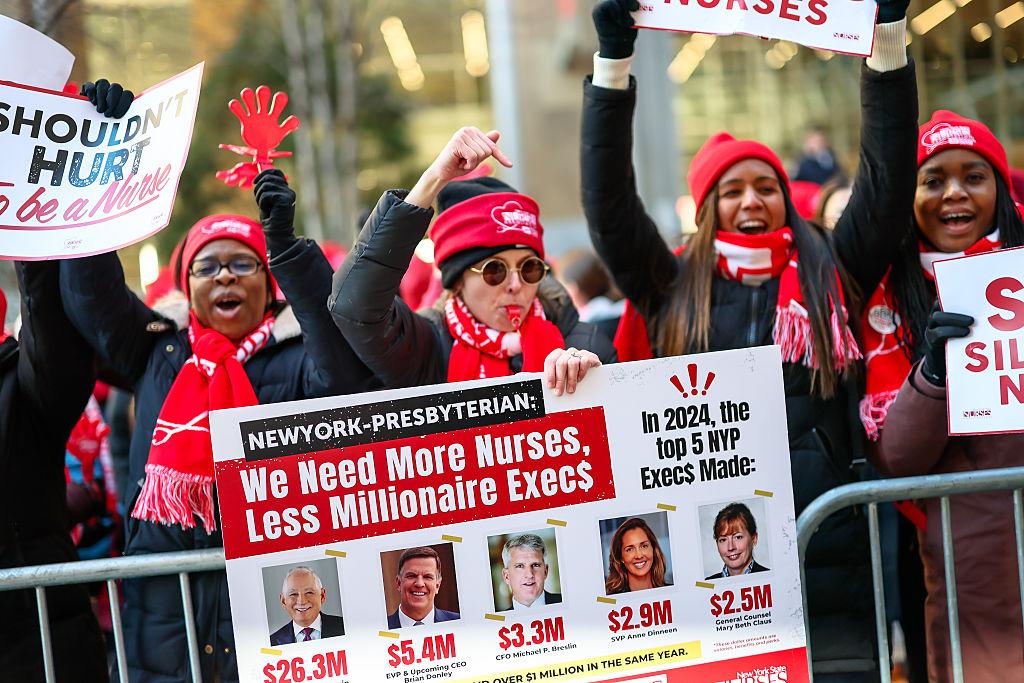
On day 23 of the strike, nearly 15,000 nurses with the New York State Nurses Association are still holding picket lines across New York City — at Mount Sinai Hospital, Montefiore Medical Center, and NewYork-Presbyterian — in the largest nurses’ strike in the city’s history.
This walkout is about more than contracts. It is about whether working-class communities get safe care, whether nurses can do their jobs without being pushed past exhaustion, and whether hospitals will remain places of healing — or become another arm of federal repression.
Management is trying to claw back staffing gains won in 2023. They are dragging their feet on workplace violence protections and health benefits. Weekend negotiations produced revised proposals but no breakthrough on staffing. Mount Sinai has begun advertising temporary contract positions starting mid-February, a direct threat to striking workers. Meanwhile, NewYork-Presbyterian’s CEO Steve Corwin pulled in $26.3 million last year, even as administrators claim there is no money for safe patient ratios.
Nurses answered with action — marching across the Brooklyn Bridge to New York City Hall, holding speak-outs over unpaid health and pension benefits at Brooklyn Hospital Center, and keeping lines strong in freezing weather.
And as this fight has deepened, another demand has moved to the center: keeping U.S. Immigration and Customs Enforcement out of hospitals.
What started as a battle over staffing and safety has become a broader confrontation over who hospitals serve — corporate executives and federal enforcers, or patients and the workers who care for them.
Not politics — patient care
And this is where the fight over ICE comes in.
Nurses did not set out to make immigration enforcement a contract issue. They were forced there. For more than a year, they tried to get hospital management to voluntarily protect patients from ICE. Administrators refused. So nurses brought it to the bargaining table.
They did it because they see the consequences every day.
When ICE enters hospitals, patients disappear. Appointments are missed. Conditions worsen. Nurses are left treating emergencies that never had to happen. This is not politics. This is patient care.
Hospital executives call the demand a “distraction.” Nurses call it reality.
Training staff on how to disengage from law enforcement does nothing to stop agents from entering facilities — and does nothing to restore trust among patients who are afraid to walk through hospital doors.
You cannot treat chronic illness, pregnancy complications, or cancer if people are too afraid to seek care.
What nurses warned about is already happening
The conditions New York nurses are fighting are already unfolding nationwide.
At Hennepin County Medical Center in Minneapolis, doctors and nurses have used encrypted group chats to warn colleagues about ICE activity near entrances. Plainclothes agents have stopped patients and staff, demanding documentation. In one case, an officer shackled a patient receiving care.
In Portland, Oregon, the Oregon Nurses Association documented incidents in which ICE pressured clinical staff to discharge patients early — even when physicians recommended continued hospitalization.
The human cost is immediate.
In Minnesota, a pregnant woman skipped prenatal appointments because she feared encountering ICE. A nurse later found her at home in labor. A patient with kidney cancer was taken into detention without his medication. Diabetic patients went without insulin. Treatable wounds progressed into medical emergencies requiring intensive care.
In Southern California, nurses report declining patient numbers as immigrants stay away from hospitals and clinics altogether.
Hospitals are workplaces. When immigration agents walk corridors or wait outside doors, patients stop coming. Workers become afraid to report for shifts. Nurses are left managing more advanced illness, more preventable complications, and more crisis care.
This is what ICE inside health care actually looks like.
From the Bronx to Foley Square
As the strike has continued, nurses have increasingly connected their labor fight to the broader wave of federal repression targeting immigrant communities.
That convergence has been visible at Foley Square, where striking nurses rallied near the federal building where ICE agents have been abducting immigrants during routine court check-ins. Health care workers spoke out not only against hospital strikebreaking, but in defense of the same communities they care for on the job.
On Jan. 29, NYSNA members also held a vigil at the VA New York Harbor Healthcare Center for Alex Pretti, a Minneapolis ICU nurse killed by federal agents. The action was organized with National Nurses United, the Canadian Federation of Nursing Unions, and the American Federation of Government Employees.
Pretti’s death made the stakes unmistakable: Health care workers are confronting the same enforcement machinery that is terrorizing their patients.
Twenty-three days in, the lines are clear. This strike is about safe staffing and workplace safety. It is about whether nurses can care for patients without being pushed past exhaustion. And it is about whether hospitals will remain places of healing — or allow fear and enforcement to drive people away from care. From staffing ratios to ICE in hospital corridors, nurses are fighting for the same thing they always have: the right of working-class communities to receive care without intimidation, and the right of health care workers to do their jobs with dignity.
Join the Struggle-La Lucha Telegram channel