
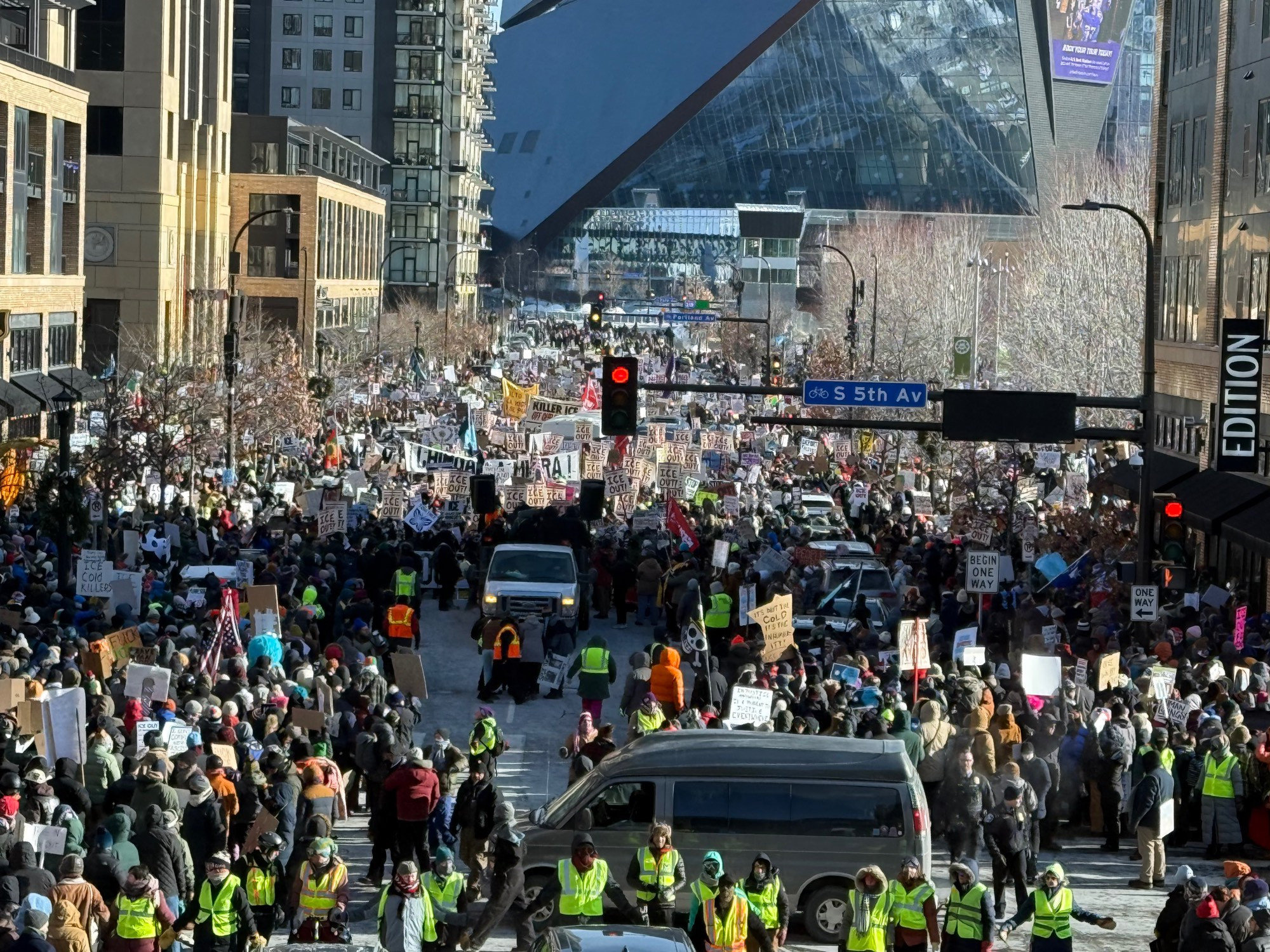
On Jan. 23, 2026, Minnesota was locked in a deep freeze. Temperatures dropped to 16 below zero, with wind chills reaching minus 30. Instead of staying home, more than 100,000 people filled the streets of Minneapolis and St. Paul.
They were joined by solidarity actions across the country. In the days leading up to Jan. 23, support for the Minneapolis general strike spread rapidly, jumping from plans in “dozens” of cities to confirmed actions in at least 300 cities tied directly to the strike call. Workers, immigrant rights groups, students and community organizations acted together across the country, making clear that what was unfolding in the Twin Cities was not a local dispute.
In Minnesota, the strike was driven by the escalation of ICE as a paramilitary repressive force — armed agents operating as a domestic secret police, carrying out surveillance, raids and discretionary detentions aimed at controlling entire communities rather than enforcing any narrow set of laws.
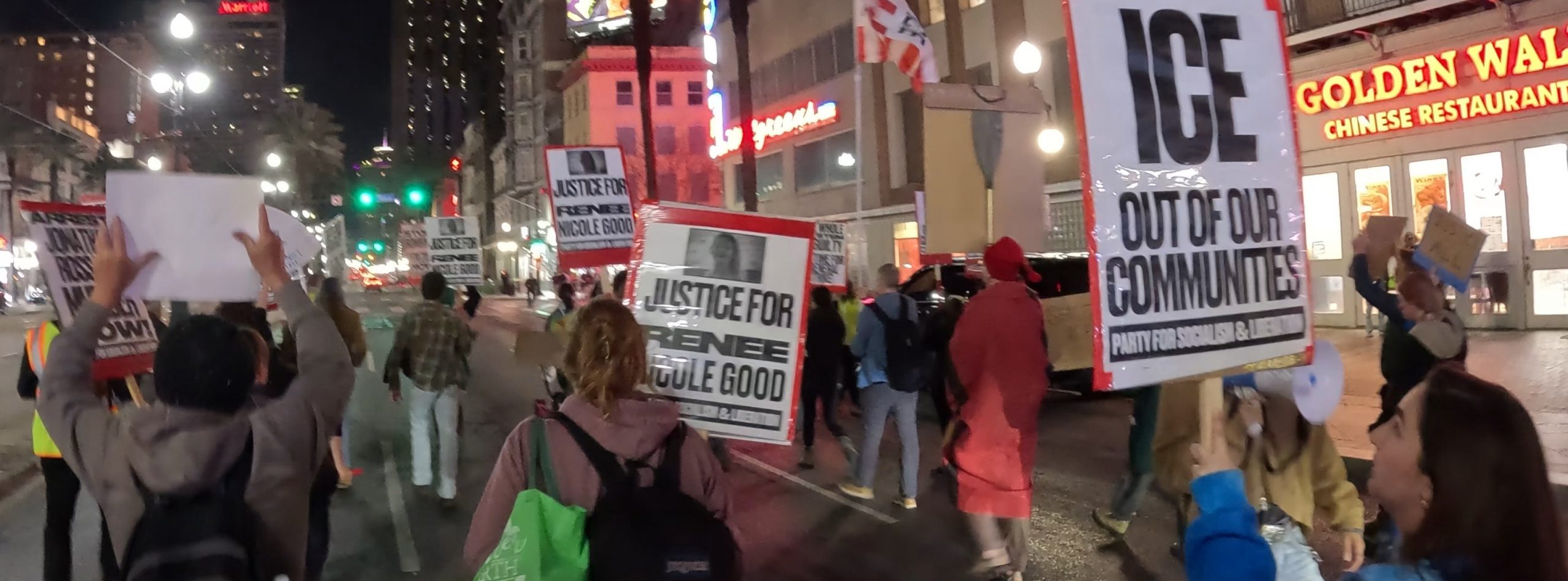
“Operation Metro Surge” flooded neighborhoods with armed ICE units acting as a domestic secret police, using raids, surveillance and intimidation to impose political control. That same apparatus killed Renée Nicole Good, a 37-year-old lesbian parent, legal observer and community defender, and then protected its agent from any federal investigation.
What took shape on Jan. 23 was a general strike. Labor was withheld, businesses shut their doors and daily life was deliberately disrupted by workers, shop owners, immigrants, faith leaders and students acting together.
The action reflected a shared understanding that the violence was not isolated, but built into the enforcement system now operating in their neighborhoods.
Somali workers and business owners played a central role. For years, the Somali community in Minnesota has faced racist repression from federal authorities, including surveillance of mosques and businesses, baseless fraud accusations and neighborhood enforcement operations aimed at intimidation.
On Jan. 23, hundreds of Somali-owned businesses closed. Karmel Mall, one of the state’s largest commercial hubs, went dark. Roughly 700 businesses statewide shut down.
As repression intensified, federal plans escalated. Fifteen hundred paratroopers from the Army’s 11th Airborne Division were placed on standby for possible domestic deployment. Veterans and military families urged active-duty troops to refuse illegal orders.
ICE’s tactics also drew widespread outrage. School officials and medical workers reported actions they described as psychological warfare, including the detention of children and arrests near schools. In one case, a 5-year-old child was used to lure adults from a home before being taken out of state.
ICE has used administrative warrants — internal paperwork the agency signs itself — to barge into people’s homes without a judge’s sign-off, openly flouting the Constitution’s Fourth Amendment protections against unreasonable searches and seizures, which require a neutral judge’s approval based on probable cause. That is deliberate. It is how this repressive force operates — unaccountable, armed, and deployed to control communities.
The Jan. 23 strike marked a turning point. The rapid spread of solidarity actions showed how quickly walkouts, shutdowns and protests took hold in other cities. In Minneapolis, the organizing that produced the strike has continued in workplaces, neighborhoods and community spaces, as people prepare for further confrontation with ICE and the forces backing it. Larger actions later this spring, including May Day, are already being discussed, but the fight is unfolding now.
New Orleans
Baltimore
[videopress g5ytGhMV]
Join the Struggle-La Lucha Telegram channel