
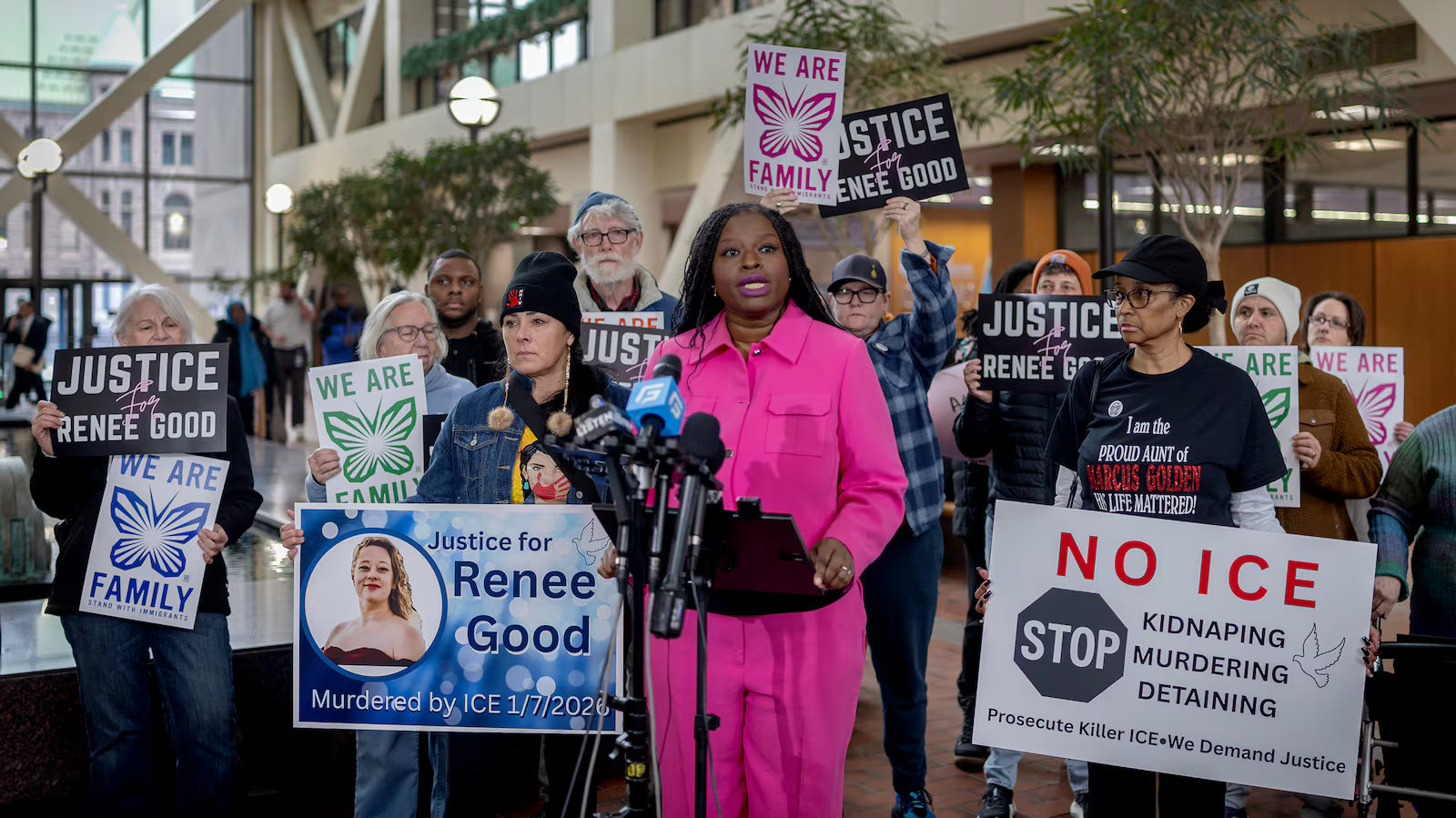
Federal authorities arrested civil rights organizers in St. Paul, Minnesota, after a protest at a Southern Baptist church that demanded accountability for an ICE killing.
Among those arrested were Nekima Levy Armstrong, an ordained minister with decades of organizing experience, and Chauntyll Louisa Allen, a sitting member of the St. Paul Public Schools Board of Education. Others were charged as well. The charges were federal.
The targeting of Nekima Levy Armstrong and Chauntyll Louisa Allen was not incidental. Both are organizers whose work links protests against police violence with resistance to ICE raids. Armstrong is a longtime civil rights leader shaped by Minneapolis’s Black Lives Matter movement and by repeated uprisings against police killings. Allen is an elected school board member active in immigrant and community defense. Together, they represent a growing overlap between opposition to police violence and resistance to ICE enforcement.
That overlap matters. In Minneapolis, Black Lives Matter protests against police brutality and protests against immigration raids have increasingly drawn from the same neighborhoods, the same families and, in some cases, the same organizers. When those fights converge, they challenge not just one agency, but a broader system of policing, surveillance and detention.
By responding with federal felony charges and conspiracy allegations, the Department of Justice moved to break that connection. The arrests sent a clear signal about which forms of solidarity will be tolerated and which will be punished. Organizing across movements — Black communities confronting police violence and immigrant communities resisting ICE — is being treated not as dissent, but as a federal crime.
The protest was one of several that erupted after an armed Immigration and Customs Enforcement (ICE) agent shot Renee Good, a U.S. citizen, dead inside her car in Minneapolis. Rather than open a criminal or civil-rights investigation, the Department of Justice declined to pursue one.
Because the shooter was a federal agent acting under federal authority, the refusal to investigate was an assertion of power. No independent body was assigned. No federal grand jury was convened. The Department of Justice declined to open a civil rights inquiry. The killing was closed without testimony, without public evidence, and without consequence. The message was unmistakable: When ICE kills, the federal government will protect its agents, and those who demand answers will not find them through official channels.
That refusal came first. Everything else followed.
A killing without an investigation
The officer who fired the shots, Jonathan Ross, was not arrested.
When people demanded answers from the federal government, it responded with arrests instead of an investigation.
One of the protests took place at a Southern Baptist church on Sunday morning to confront the pastor, who is also the local head of ICE.
Federal authorities reacted immediately.
Prosecutors did not use minor trespass laws. Instead, they reached for heavy federal conspiracy charges and a law passed to block violent interference with abortion clinics, the Freedom of Access to Clinic Entrances Act, commonly known as the FACE Act.
That law was turned into a tool to make a church protest a federal crime.
A secret policy to enter homes without warrants
While these prosecutions moved forward, another shift was taking place inside ICE itself.
ICE staff leaked a secret memo signed by acting Director Todd Lyons, ordering agents to enter homes without a judge’s warrant, relying only on paperwork signed by ICE.
The policy was not circulated openly. Supervisors were told to show it briefly and take it back. Agents were instructed verbally. At least one ICE instructor resigned rather than teach it. Employees who objected were disciplined.
The reason for the secrecy is obvious. No judge has granted ICE the power to break into homes without a warrant.
The policy allows armed federal agents to force their way into private homes without a judge’s approval — the very practice the Fourth Amendment was written to prevent. No court has ever authorized ICE to operate this way.
ICE moved ahead anyway.
At the same time, the agency expanded enforcement under what agents call “Operation Catch of the Day.” Minnesota was one of several states targeted. The old rule barring arrests at schools, churches and hospitals had already been revoked. Agents were given broad discretion to operate anywhere.
Federal officials have explicitly framed the ICE escalation in Minnesota as punishment for the state’s sanctuary policies. The Trump administration has singled out Minnesota not only for limits on cooperation with ICE, but also for its legal protections for immigrants and its status as a refuge for LGBTQIA+ people. In public statements, these protections have been cast as defiance rather than civil rights. Federal officials have presented the enforcement surge as a warning. States that protect immigrants and LGBTQIA+ people will face raids and arrests.
The results followed quickly.
Indigenous community members in Minneapolis have also faced heightened federal enforcement and joined resistance to ICE action. Reports from the ground describe Native people being profiled and targeted in immigration sweeps, creating fear and disruption in Indigenous neighborhoods, where people say they are afraid to leave their homes amid the raids.
Tribal citizens from the Oglala Lakota Nation were among those detained near housing complexes as ICE pressure in the city intensified, drawing protests and statements from Native organizers condemning the federal operations.
Indigenous organizers and residents have taken to the streets in neighborhoods with deep histories of Native resistance, including renewed patrols along the American Indian Cultural Corridor, rejecting federal enforcement as another form of state violence.
ICE has used a range of tactics to enforce this crackdown.
In one reported case, ICE agents used a 5-year-old child to draw his father into an arrest. Both were taken into custody and sent to a detention center in Texas. Schools were monitored. Churches were entered. Communities were put on notice.
Deaths in custody follow
In El Paso, Texas, Geraldo Lunas Campos died at a makeshift ICE detention facility known as Camp East Montana at Fort Bliss Army base. The county medical examiner ruled the death a homicide by guards, caused by asphyxia from neck and torso compression.
Federal power has drawn a line. ICE agents can kill and expect protection. ICE can enter homes without a judge’s order. Churches aligned with enforcement are shielded. Those who challenge this arrangement are charged with conspiracy.
The issue is no longer legality. It is whether people will accept a system in which federal agents are protected after a killing and protesters are prosecuted for demanding accountability.
That will not be decided in courtrooms. It will be decided by struggle.
Join the Struggle-La Lucha Telegram channel