
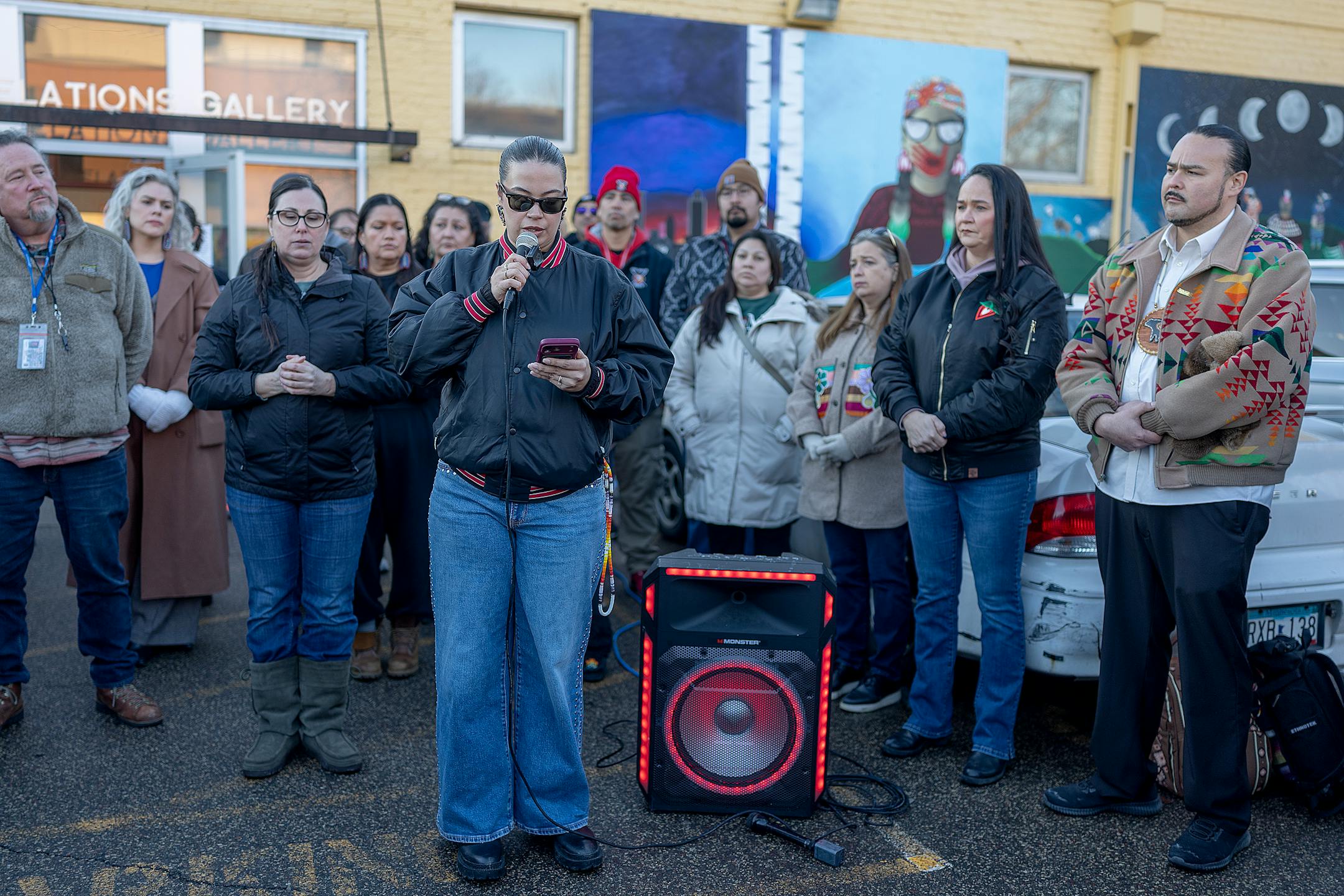
Federal immigration agents from Immigration and Customs Enforcement (ICE) have seized at least five Indigenous people during raids in Minneapolis in early January, triggering furious denunciations from tribal governments who say the arrests violate binding treaties.
The Oglala Sioux Tribe confirmed that ICE is holding four Oglala Lakota people who were arrested near the Little Earth housing complex in the East Phillips neighborhood. A fifth person, Jose Roberto Ramirez, a 20-year-old Red Lake Anishinaabe man, was also detained after ICE agents repeatedly punched him in the face while he was complying with their orders, according to video evidence and family testimony.
“This is a treaty violation. Treaties are not optional. Sovereignty is not conditional. Our citizens are not negotiable,” Oglala Sioux Tribe President Frank Star Comes Out said in a statement. “The irony is not lost on us.”
Militarized raids target Indigenous people
The detentions occurred as roughly 2,000 ICE agents and other federal personnel swarmed the Twin Cities in one of the largest immigration enforcement operations in the region’s history. The raids followed the Jan. 8 killing of Renee Nicole Good, a legal observer and mother of three, who was shot by ICE agents during protests against the crackdown — underscoring the level of force now being deployed against entire communities.
Tribal leaders say ICE has no jurisdiction
When the Oglala Sioux Tribe demanded information about its detained members, federal officials responded with an ultimatum: the tribe would only receive details if it entered into a formal agreement with ICE. Tribal leadership refused, stating that such an agreement would directly violate treaties that explicitly recognize tribal sovereignty and self-governance.
“We will not enter an agreement that would authorize, or make it easier for, ICE or Homeland Security to come onto our tribal homeland to arrest or detain our tribal members,” Star Comes Out wrote in a memo addressed to Interior Secretary Doug Burgum and Homeland Security Secretary Kristi Noem.
The memorandum states plainly that “tribal citizens are not aliens” and are “categorically outside immigration jurisdiction.” The implication is unavoidable: federal agents are acting as if treaties do not exist.
Detentions tied to a site of genocide
ICE has established its base of operations at Fort Snelling, a site inseparable from the history of genocide and forced removal in Minnesota. In 1862, the U.S. military imprisoned Dakota people at Fort Snelling following the U.S.-Dakota War, a campaign that culminated in the mass execution of 38 Dakota men — the largest mass execution in U.S. history.
“The fact that Lakota citizens are reported to be held at Fort Snelling — a site forever tied to the Dakota 38+2 — underscores why treaty obligations and federal accountability matter today, not just in history,” Star Comes Out said.
Community mobilizes to block arrests
Indigenous communities have responded with rapid-response defense networks aimed at physically protecting tribal citizens from ICE seizures. On Jan. 10, Rachel Dionne-Thunder, founder of the Indigenous Peoples Movement, narrowly avoided arrest after ICE agents surrounded her vehicle and threatened to smash her window. Community members quickly converged on the scene, forcing agents to retreat.
“ICE returned to their vehicle and left me alone when they saw the power of our people,” Dionne-Thunder said at a press conference. “The real power is with the people — with our connection to each other and to the earth. That’s what they’re afraid of.”
Sam Strong, secretary of the Red Lake Chippewa Nation, said approximately 8,000 Red Lake citizens live in Minneapolis and are directly threatened by the raids. “We are going to protect each and every one of them, including our descendants,” Strong said. “We are going to defend our people, and we are going to stand up for all of Minneapolis, all of Minnesota.”
Tribal governments including the Cheyenne River Sioux Tribe, Lac Courte Oreilles, and the Fond du Lac Band have issued statements condemning the raids and circulating “Know Your Rights” guidance. Several tribes are distributing free tribal identification cards while warning that documentation alone does not guarantee safety from detention under ICE operations.
The Oglala Sioux Tribe has pledged aggressive legal action to secure the immediate release of its detained members.
Oglala Sioux Tribe bans Homeland Security’s Noem
In a related development, the tribe formally banned Homeland Security Secretary Kristi Noem from the Pine Ridge Reservation on Jan. 9, one day before the Minneapolis detentions were publicly confirmed.
The ban followed repeated comments by Noem, made while she was governor of South Dakota, claiming that “Mexican drug cartels” operate on tribal reservations and that murders on Pine Ridge were being committed by cartel members. Noem has also repeatedly described migration at the southern border as an “invasion.”
Star Comes Out rejected those claims outright, calling them a racist pretext for militarization and repression. He noted that many migrants arriving at the southern border are Indigenous people displaced by poverty, violence, and economic devastation rooted in U.S. imperialist policies.
“Calling the United States’ southern border an ‘invasion’ by illegal immigrants and criminal groups to justify deploying the National Guard is a red herring that the Oglala Sioux Tribe doesn’t support,” Star Comes Out said in the Jan. 9 statement announcing Noem’s ban from tribal lands.
The Native American Rights Fund has reiterated that ICE has no jurisdiction over Indigenous people in immigration matters and urged anyone whose rights have been violated to contact the organization at 303-447-8760.
Join the Struggle-La Lucha Telegram channel