
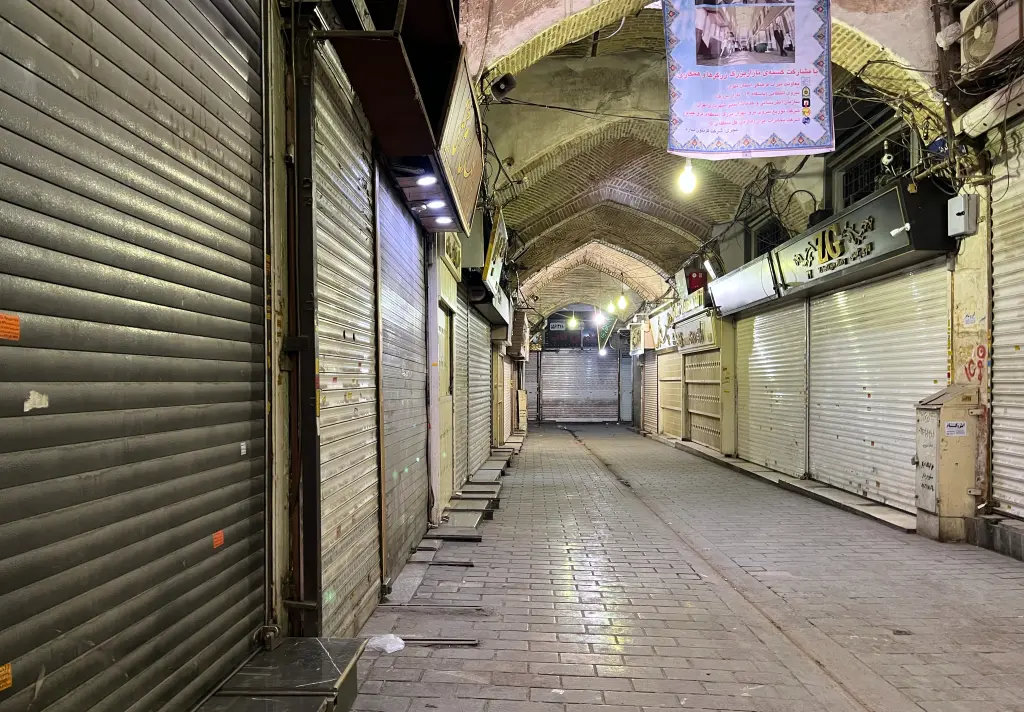
On the morning of Jan. 8, Zahra Mohammadi stood in line outside a bakery in southern Tehran for three hours. When she finally reached the counter, the price of flatbread had doubled since the day before. By the time she returned home, her neighbor told her the bank had frozen withdrawals in rials — you could only take out dollars, if you had any. Zahra’s husband works in a textile factory that has been on rolling blackouts since the new year. Half his shifts were canceled this week. The family’s savings, kept in rials, lost 80% of their value in three weeks.
This is not inflation in the ordinary sense. This is an engineered economic collapse.
The rial suffered a steep slide, falling to around 1.47 million per dollar on the unofficial market in early January 2026. The government has been forced to eliminate subsidies on food and fuel. Bread, meat and medicine are projected to rise another 70% to 100% this month. Factories across the country are shutting down four hours a day because the electrical grid cannot sustain production. In the Tehran Grand Bazaar — the traditional merchant quarter that has survived wars, revolutions and sanctions — traders who kept their wealth in rials watched it evaporate in days. Some joined street protests in late December, a rare break from their historical caution.
The January currency collapse did not emerge from a vacuum. It built on damage already inflicted on Iran’s energy infrastructure in mid-2025, damage that left the economy unusually vulnerable to external shocks.
What Zahra and millions of Iranians are experiencing is not the result of mismanagement or corruption, though both exist. It is the result of a deliberate, coordinated campaign of economic destruction waged by the United States military and financial apparatus. The tools are varied: tanker seizures, military strikes on refineries, the capture of allied governments, and digital market manipulation. The goal is singular: to break Iran’s ability to feed and power itself, and in doing so, to break the will of its population.
The anatomy of imperialist strangulation
To understand what is happening in Iran today, we must locate it within the broader dynamics of monopoly capitalism in its present stage of crisis. The U.S. ruling class is not acting out of simple aggression or ideological hostility to the Iranian government. It is responding to the structural imperatives of a capitalist system that can no longer expand profitably through normal channels of investment and trade.
The rate of profit in the major capitalist economies has been in long-term decline since the 1970s. Manufacturing has been offshored. Financialization has created mountains of fictitious capital with no basis in actual production. The response of U.S. imperialism has been to tighten its grip on the sources of super-profits: control over raw materials, especially energy; control over trade routes and currency flows; and the disciplining of any nation that attempts to develop its resources independently.
From the standpoint of Wall Street and the Pentagon, Iran’s “crime” has nothing to do with democracy, human rights, or labor standards. Washington applies those labels selectively, discarding them whenever a government serves U.S. corporate interests. Iran is targeted because it insists on sovereign control over its oil and gas reserves, the fourth-largest in the world. It has built domestic refining capacity, trades outside the dollar system, and directs revenue to allies in Lebanon, Iraq, Yemen, and Palestine who resist U.S. client states in the region.
This makes Iran intolerable to imperialism. Not because Iran threatens to invade anyone, but because its very existence demonstrates that a country can retain control of its resources and use them for purposes other than enriching ExxonMobil and Chevron. If Iran succeeds, others will follow. Therefore, Iran must be crushed.
The mechanics of collapse
The rial’s collapse was triggered by three events in rapid succession, each one a calculated blow to Iran’s economic infrastructure.
First, on Jan. 3, U.S. special forces raided Venezuela and kidnapped President Nicolás Maduro. For years, Iran and Venezuela have used sanctions-busting barter and opaque deals — refinery repairs, fuel, and other support from Iran in exchange for Venezuelan heavy crude, gold and other commodities. The partnership moved an estimated $2 billion annually in goods that never touched the U.S.-dominated banking system.
With Maduro imprisoned and the Venezuelan government thrown into crisis, that entire network has been paralyzed. Iran lost not just a trading partner, but a critical valve for moving oil and acquiring hard currency outside Washington’s reach.
This was not a single-cause collapse. The kidnapping of Maduro acted as a shock to already strained sanctions-busting networks, cutting off liquidity channels and signaling to traders that key routes for oil and hard currency were suddenly at risk.
Four days later, U.S. and British naval forces seized the Marinera, a Russian-flagged tanker in the North Atlantic. The ship, formerly known as Bella 1, was a key vessel in what is called the “shadow fleet” — a network of aging tankers that move Iranian oil to buyers in Asia and Africa, often with falsified manifests and frequent flag changes. The Marinera alone was responsible for moving large volumes of oil daily. Its seizure was not an isolated interdiction. It was a message: The routes are closed.
At the same time, currency traders operating through Telegram channels contributed to the currency’s collapse. Cut off from the formal global financial system by U.S. sanctions, Iran had been forced to rely on informal currency markets in Herat, Afghanistan, and Sulaymaniyah, Iraq—hubs for cross-border transactions in regions with limited banking infrastructure—as key nodes in a shadow financial system necessary for conducting international trade.
As panic spread through Telegram channels—some with over 2 million members—traders circulated distorted pricing information and false exchange rates. Unable to verify real-time prices through official channels, panicked sellers accepted the rates being broadcast through these networks, accelerating the rial’s decline. The speed and coordination of the currency run reflected how U.S. sanctions had pushed Iran’s foreign exchange market into fragmented, opaque channels vulnerable to manipulation.
These were not “market forces.” They were instruments of war.
The tools of economic strangulation are not new. We saw sanctions destroy Iraq’s industrial base in the 1990s, killing half a million children before the 2003 invasion. We saw NATO bombing fragment Libya, leaving Africa’s most developed state divided among competing armed militias. But Iran is not Iraq or Libya. It is larger, more industrially developed, with a population of 88 million and a military that has proven it can defend itself. The U.S. cannot invade Iran the way it invaded Iraq, and it cannot bomb Iran into submission the way NATO did Libya.
What it can do is what we are witnessing now: strangle Iran’s economy, destroy its ability to export oil, and make daily life unbearable for its population. The goal is not regime change through invasion but economic pressure severe enough to either force capitulation or provoke internal collapse. Whether this strategy will succeed against a country of Iran’s size and capacity remains to be seen. What is certain is that the suffering imposed on ordinary Iranians in the attempt is immense.
From the June bombings to January’s collapse
The current crisis is built upon the June 2025 conflict, often described as the 12-day war, which functioned as a phase of economic warfare against Iran’s energy system. Israeli airstrikes—carried out with U.S. military, intelligence, and diplomatic backing—targeted fuel and gas infrastructure central to Iran’s civilian economy. The Shahran fuel depot in northern Tehran was struck, triggering massive fires and disrupting fuel distribution in the capital. The Shahr Rey refinery south of Tehran was also hit, impairing one of the country’s key refining centers. In the south, strikes damaged installations at the South Pars gas field—one of the largest natural gas reserves in the world—forcing temporary shutdowns and reducing gas output. By degrading refining capacity and gas production, the attacks imposed sustained pressure on fuel supplies, industrial activity, and state revenues, extending the impact of the war far beyond the battlefield.
The damage was surgical, and the consequences are compounding. Iran, despite sitting on the world’s third-largest oil reserves, now has to import gasoline. Every liter purchased abroad drains the hard-currency reserves that prop up the rial. The less currency in reserve, the faster the rial falls. The faster it falls, the more expensive imports become. Factories that need electricity to operate are running on generators — when they can afford fuel. Most cannot. Manufacturing output has dropped by half since Jan. 1. Layoffs are spreading.
This is how imperialist economic warfare works. The goal is not negotiation, but to make it impossible for Iran to produce what its people need to survive.
The imperialist powers can no longer tolerate even limited independent development in the oppressed nations. Every refinery that Iran builds, every barrel of oil it sells outside U.S. control, every trade agreement it signs with China or Russia represents a loss of super-profits for the monopolies. And because the rate of profit is falling at home, those super-profits are not optional. They are necessary for the system to survive.
The budget and the class contradiction
Faced with the evaporation of oil revenue, the Iranian government released its 2026 budget earlier this month. It is a document of managed collapse. The overall budget has contracted by 38% in real terms. The subsidies that once kept bread, fuel and medicine affordable are gone. The government now assumes it will export just 1 million barrels of oil per day, down from 1.85 million, at a price of $55 per barrel — a fraction of the revenue it needs to operate. The budget deficit is projected at more than $30 billion, with no clear way to finance it.
Yet even in triage, certain spending remains untouchable. Security and military budgets have been largely preserved. This has alienated even traditional allies. The bazaaris — merchants who have historically supported the Islamic Republic — are now questioning their support. When your savings disappear and your inventory becomes worthless overnight, political loyalty means little.
The Iranian government did not choose this budget. It is the budget that imperialism allows.
The Iranian government defends national sovereignty against imperialist attack, but it is not a workers’ government. It cuts subsidies, suppresses strikes and maintains capitalist relations of production. Iranian workers face pressure from two directions: from U.S. economic warfare that destroys their jobs and savings, and from their own government’s austerity measures. This is the position of working people in every oppressed nation under siege.
Imperialism in the age of decline
The U.S. economy, and the bloc of allied economies that depend on it, requires access to oil, gas and strategic minerals on terms favorable to Western corporations and financial markets. Iran sits on resource wealth that it refuses to hand over to ExxonMobil, BP or Chevron. It has used that wealth to build refining capacity, to trade outside the dollar system, and to support movements in Lebanon, Iraq, Yemen and Palestine that challenge U.S. client states. In the grammar of empire, this is intolerable.
Sanctions, blockades and military strikes are not tools of last resort. They are tools of first resort when a country insists on controlling its own resources. The goal is not to bring Iran “to the table” for negotiations. The goal is to make an example: This is what happens when you resist. The suffering is not incidental. It is the point.
The broader strategic picture is equally clear. With Maduro removed and the U.S. attempting to take over Venezuela’s oil sector, and with the tanker fleet under interdiction, Washington is tightening its grip on global energy flows. Control over who can buy and sell oil, and in what currency, is control over the world economy. Iran’s economic destruction is a demonstration project for any other government considering independent energy policy. Russia is watching. China is watching. Every country in the Global South is watching.
What we are witnessing is not simply an attack on one country. It is the working out of contradictions inherent in monopoly capitalism. The imperialist powers, led by the United States, face declining rates of profit, overproduction and challenges to their global dominance from rising economies like China. Unable to resolve these contradictions through expansion or reform, they turn to military force and economic strangulation to maintain their grip on the sources of super-profit.
This is why there can be no “peaceful coexistence” between imperialism and the national liberation movements of the oppressed nations. It is why every attempt at negotiation and compromise ends in betrayal. The system itself requires domination. It cannot tolerate independence.
The historical perspective
We have seen this pattern repeat across decades. When Vietnam attempted to unify and develop independently, U.S. imperialism waged a war that killed 3 million people and poisoned the land with Agent Orange. When Cuba expropriated U.S. sugar plantations and oil refineries, Washington imposed a blockade that has lasted more than 60 years. When Iraq under Saddam Hussein, as a nationalist regime, not socialist, began to assert control over its oil and threaten to trade in currencies other than the dollar, the U.S. invaded twice and occupied the country for a decade.
In each case, the imperialist propaganda changed to suit the moment. Vietnam was about “stopping communism.” Iraq was about “weapons of mass destruction.” Libya was about “humanitarian intervention.” Iran is about “nuclear weapons” or “terrorism.” But the underlying logic is always the same: No nation in the oil-rich regions of the world will be permitted to control its own resources and use them for its own development.
The difference now is that U.S. imperialism is in visible decline. It can still destroy — as we see in Iran — but it can no longer rebuild or stabilize. It can remove governments, but it cannot install functioning replacements. Its currency hegemony is being challenged by China’s Belt and Road Initiative and the expansion of trade in yuan and rubles. Its military is overstretched, its treasury is drowning in debt, and its domestic infrastructure is crumbling.
This makes U.S. imperialism more dangerous, not less. A declining empire is a desperate empire. It will lash out violently to maintain control over whatever it can. The economic warfare against Iran is a preview of what is to come as the contradictions sharpen.
The path forward
There is no policy fix for imperialism. The tankers will not be returned because a different party wins an election. The refineries will not be rebuilt because a new round of negotiations succeeds. The system that produced this crisis — one that prioritizes the profits of oil giants and weapons manufacturers over the lives of working people — cannot be reformed into something humane. It can only be dismantled.
That work begins with clarity: understanding that what is happening in Iran is not an aberration but the routine operation of a global system built on extraction and domination.
History has shown that imperialism can be defeated. China defeated it. Vietnam defeated it. Korea defeated it in the north. Cuba has survived it for more than six decades. The national liberation movements of Africa and Asia forced it to retreat in the 1960s and 1970s. But victory requires more than resistance. It requires organization, international solidarity, and above all, a scientific understanding of the system we are fighting.
The Iranian people are under siege. Our job is to break that siege by fighting the empire that imposes it.
Join the Struggle-La Lucha Telegram channel