
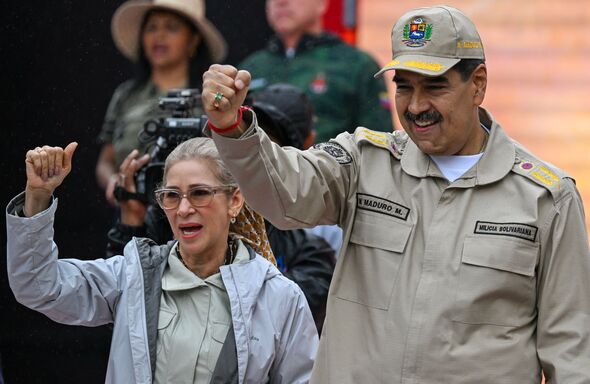
On Jan. 3, 2026, the Trump administration carried out one of the most brazen acts of imperialist aggression seen in Latin America in decades. U.S. forces invaded Venezuela and seized its elected president, Nicolás Maduro, along with Cilia Flores.
This was not a secret operation. It was not done through proxies or deniability. It was an open attack on Venezuela’s right to govern itself. The assault was announced, justified by executive order, and defended with raw imperialist arrogance. The goal was not just to remove a president. It was to deny an entire country the right to choose its own political and economic course.
Cilia Flores was not taken because she is married to the president. She is a political leader in her own right. Trained as a lawyer, she rose through Venezuela’s institutions and became president of the National Assembly. During periods of intense pressure from the opposition, she was one of the most visible defenders of the Bolivarian Revolution inside the state. After the 2002 coup attempt against Hugo Chávez, she helped keep the legislature functioning. She later served as attorney general and as a senior leader in the United Socialist Party of Venezuela (PSUV).
Flores has long rejected the label “First Lady.” She has called herself the “First Revolutionary Combatant.” By that, she has meant that her role is not symbolic or ceremonial. She sees herself as an active participant in a collective political struggle, not an accessory to presidential power.
Her inclusion in U.S. indictments and her seizure alongside Maduro make the political purpose of the operation clear. Flores was not targeted because of proven crimes. She was targeted because she represents the civilian and institutional core of the Bolivarian state. She is a woman leader with her own base, history, and authority. Seizing her was meant to cripple not only the presidency but the wider leadership that has resisted U.S. intervention for more than twenty years.
To understand why Washington seized Nicolás Maduro, it is necessary to understand who he is — and what the Bolivarian leadership he represents has meant for Venezuela.
From bus operator to Bolivarian leader
Maduro did not come from Venezuela’s traditional political elite. He began his political life as a bus operator in Caracas and a trade union organizer in the city’s transport system. In the 1980s, he helped form an unofficial union for Metro workers, an experience that grounded his politics in the daily struggles of working people rather than in electoral maneuvering or elite sponsorship.
This background mattered. When Hugo Chávez burst onto the national stage in the late 1990s, he drew strength from militants, organizers, and rank-and-file workers who understood the limits of Venezuela’s old political order. Maduro was part of that layer. His rise within the Bolivarian movement was not accidental, nor was it based on personal charisma alone. It reflected years of organizational work, party discipline, and political loyalty during periods of intense pressure.
Maduro was elected to the National Assembly in 2000 and later served as its president. He went on to become foreign minister, where he played a central role in building alliances against U.S. domination, particularly through regional integration projects and closer ties with Cuba and other countries resisting Washington’s dictates. In 2012, Chávez appointed him vice president and publicly identified him as his political successor.
Chosen successor amid mounting pressure
When Chávez died in March 2013, Maduro stepped into leadership during a moment of profound uncertainty. The special presidential election that followed was closely contested, but Maduro won. His opponent, Henrique Capriles Radonski, came from one of Venezuela’s wealthiest families and was backed openly by domestic capital and the U.S. government. The election result was never accepted by Washington, which had already begun treating Maduro’s presidency as illegitimate from its first day.
When sanctions and diplomatic pressure failed to break the Venezuelan state over the following years, Washington shifted tactics. The invasion was justified after the fact through sweeping legal claims and executive assertions that recast regime change as law enforcement rather than war.
Trump’s claim that Venezuela “stole” oil and land from the United States is completely unfounded. Venezuela nationalized its oil industry in the mid-1970s, long before Chávez or Maduro came to power, as an assertion of national sovereignty later expanded under the Bolivarian process. U.S. companies were compensated at the time, and no serious legal body has ever recognized U.S. ownership of Venezuela’s natural resources. These assertions functioned not as evidence, but as ideological cover.
The Don-Roe Doctrine: empire without disguise
What made this operation different was not its illegality, but the fact that it was openly declared and politically justified as an act of imperialist power. Trump himself described the action as the first application of what he called the “Don-Roe Doctrine,” a personalized version of the Monroe Doctrine. Its purpose, he said plainly, was to reassert U.S. dominance in the Western Hemisphere and to expel any independent presence by states such as China, Russia, and Iran. After the invasion, Trump boasted that “American dominance in the western hemisphere will never be questioned again.”
He was even more explicit about Venezuela itself. The United States, he said, would “run the country” until a transition could be arranged. He spoke enthusiastically about reopening oil fields, rebuilding infrastructure through U.S. corporations, and securing access to Venezuela’s vast reserves of oil, gold, and rare earth minerals. Venezuela holds the world’s largest proven oil reserves. That fact alone explains more about the invasion than any indictment ever could.
International reaction was swift. Russia, China, Iran, and other governments condemned the action as a flagrant violation of international law. The United Nations secretary-general warned that the prohibition on the use of force had been breached.
A familiar pattern in Latin America
The precedent is a familiar one.
In 1965, the United States invaded the Dominican Republic to block the return of Juan Bosch, a democratically elected president whose reform program had been overthrown two years earlier by a military coup backed by Washington. When a popular uprising sought to restore Bosch to office, U.S. troops occupied the country, crushed the constitutionalist forces, and paved the way for the consolidation of a compliant regime aligned with U.S. interests.
Nearly two decades later, Washington invaded Grenada to destroy a revolutionary government that had broken with U.S. domination in the Caribbean, an assault that included the killing of Prime Minister Maurice Bishop and the deaths of Cuban civilian personnel working in the country to build a hospital.
In both cases, legality was improvised after the fact, and military force was used to decide political outcomes that could not be controlled through pressure alone. The operation against Venezuela follows the same pattern, updated for a new phase of imperialist decline.
The human cost was immediate. Venezuelan authorities report that more than 80 people were killed in the attacks, including civilians and members of the armed forces. Cuba confirmed that 32 Cuban personnel stationed in Venezuela at the government’s request died resisting the assault. Residents of Caracas described explosions, destroyed homes, and mass fear. One public worker, Linda Unamumo, said the blast that tore through her roof forced her to flee with her family. “It was really traumatic,” she said.
The Trump administration acknowledged injuries among U.S. troops but claimed that none were killed.
A government still standing
In Caracas, Vice President Delcy Rodríguez assumed the role of acting president under constitutional provisions and denounced the seizure of Maduro and Flores as a kidnapping. She demanded proof of life and called on the international community to recognize the violation of Venezuelan sovereignty. The Venezuelan state, she said, remains intact. Maduro, despite his forced removal, remains the legitimate president.
“Our country aspires to live without external threats,” Rodríguez said, “in an environment of respect and international cooperation.”
That aspiration is precisely what Washington moved to crush.
Join the Struggle-La Lucha Telegram channel