
The jets over Caracas in the early hours of Jan. 3 were not an aberration. They were a signal.
By the time the sun rose, Venezuela’s president had been kidnapped by U.S. special forces and flown north. Washington called it law enforcement. But no police action requires the suppression of a country’s air defenses or the use of military bases across a hemisphere.
What happened in Caracas was not about one man — it was about power and how that power is now being exercised.
Jets over Caracas were not an aberration
What happened in Venezuela was not a sudden break with the past, but a clear expression of how U.S. power now operates when other means fail.
Across Latin America, the message was unmistakable. The United States no longer feels bound by international law. It is willing to act with open belligerence, directly and militarily, to remove governments that stand in its way. This was not a covert operation hidden behind deniability. It was meant to be seen.
The original Monroe Doctrine: rule by conquest
From the beginning, U.S. dominance in the hemisphere was enforced through violence, with independence tolerated only so long as it did not interfere with expansion and profit.
The Monroe Doctrine did not protect the Americas from empire. It cleared the field for one. European powers were warned off so Washington could expand without competition. Governments were toppled. Land was seized. Resistance was met with occupation and massacre. This was colonialism in its direct form, backed by the gunboat and the army.
After World War II, dominance without constant invasion
With much of the world’s industry in ruins, U.S. capitalism could rely on production, credit, and the dollar to secure control without permanent occupation.
After 1945, the United States emerged as an industrial giant, producing close to half of the world’s total output. Its factories supplied reconstruction. Its banks financed recovery. The dollar became the main currency of trade and reserves. Under these conditions, control could be exercised through loans, trade access, and investment rather than constant military force.
When production ruled, force stayed in the background
Military power never disappeared, but it functioned mainly as insurance, rarely needed when economic leverage could achieve the same ends.
Governments that aligned with U.S. interests were rewarded with access to markets and credit. Those that resisted faced isolation or destabilization. The threat of force remained, but it did not have to be used everywhere. Economic dominance did the work.
This arrangement also helped stabilize conditions inside the United States, unevenly and temporarily. The empire could afford concessions at home because profits flowed in from abroad.
The long industrial decline since the 1970s
As factories closed and production moved abroad, the material basis for U.S. economic dominance steadily eroded, even as the empire tried to maintain its reach.
Beginning in the 1970s, U.S. capitalism shifted production overseas in search of cheaper labor and higher returns. Manufacturing hollowed out. The economy leaned more heavily on finance and debt. By the early 2000s, the U.S. share of world production had fallen dramatically; today it stands at around 17%. The dollar still dominates, but increasingly through pressure rather than unmatched strength.
From economic leverage to open coercion
When loans, sanctions, and diplomatic pressure no longer deliver submission, the system falls back on its most direct instrument.
Sanctions that once bent governments now often harden resistance. Proxy forces falter. Sanctioned governments build alternative trade routes and alliances. In this context, force is no longer a last resort. It becomes the primary tool.
Why Venezuela became a test case
A government that retained control of key resources and resisted U.S. subordination presented an obstacle that economic pressure alone could not remove.
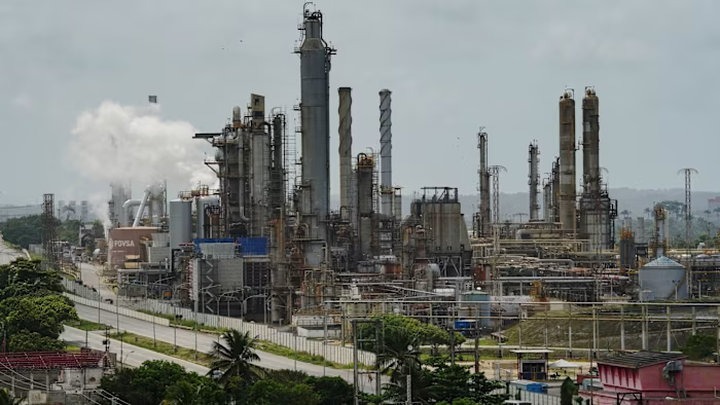
Venezuela sits atop the world’s largest proven oil reserves. U.S. corporations once dominated that sector before nationalization broke their hold. Years of sanctions and political pressure failed to restore control. Caracas maintained ties with Russia, China, and Iran. Economic leverage no longer worked. The response was force.
Drugs and courts as cover for seizure
Criminal charges and moral language serve to disguise an act of force that is, at bottom, about control over labor, land, and oil.
Claims about drugs and terrorism do not explain the operation. They are an attempt to justify it. Imperialism has always required a story to tell, especially when it acts openly. Today that story is law enforcement. Yesterday it was anti-communism. The function is the same.
An empire that can no longer afford consent
Where influence once flowed through credit and trade, it now comes through sanctions and military force.
U.S. leaders now speak openly about seizing resources and running other countries. This bluntness does not reflect strength. It reflects the exhaustion of older methods. The empire can no longer afford consent, so it imposes obedience.
What imperial decline means for working people everywhere
As U.S. power abroad weakens, working people are made to pay in familiar ways: lower wages, longer hours, higher rents, heavier policing, and more war aimed at securing resources that once flowed automatically.
The same system that sends special forces into Caracas squeezes wages, evicts tenants, militarizes police, and criminalizes migration. The operation was sold as targeting drug cartels, but its real aim — control of Venezuelan oil — benefits corporations, not working people who still pay the same inflated prices at the pump.
These are not separate problems. They reflect a system losing its grip and relying more heavily on force.
The use of force is meant to settle the question of control. Instead, it exposes the struggle for what it is: a declining empire seizing by violence what it can no longer secure through production — against governments that refuse to submit.
Join the Struggle-La Lucha Telegram channel