
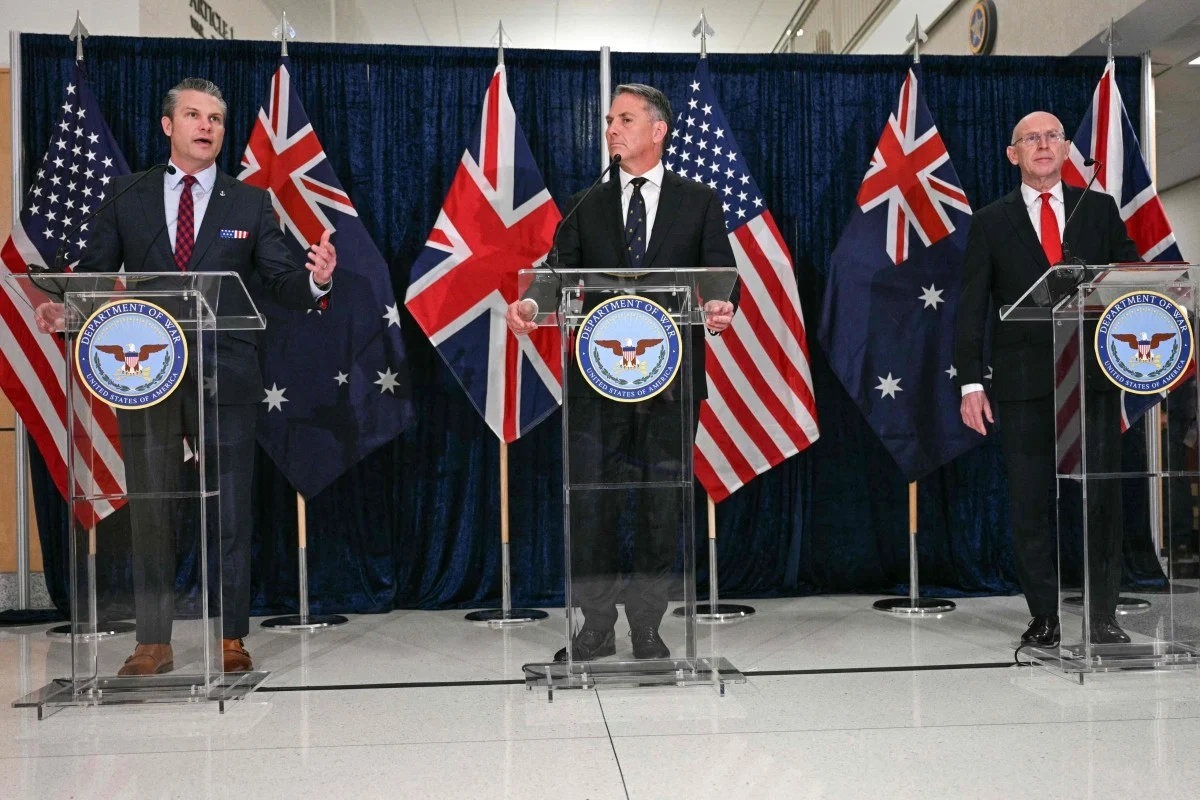
At a Pentagon meeting on Dec. 10, U.S. Secretary of War Pete Hegseth and his counterparts from Australia and Britain pledged to move “full steam ahead” with AUKUS, a trilateral military pact through which the United States is turning Australia into a forward operating base and nuclear-submarine hub for a potential war on China.
In a joint statement, the three governments made clear the pact is about accelerating war preparations — building bases faster, expanding military staffing and pushing weapons development at full speed.
The announcement came as the United States deployed a pair of nuclear-capable bombers to patrol the Sea of Japan, escorted by Japanese fighter jets.
One day earlier, on Dec. 9, China and Russia carried out their 10th joint air patrol. The operation involved Russian and Chinese bombers, escorted by fighter jets and early-warning aircraft, flying over the Sea of Japan and the East China Sea. The formation passed through the Miyako Strait, a narrow gap between Okinawa and Miyako Island that serves as one of the main exits from China’s coastal waters into the Pacific.
The Miyako Strait matters because China’s long coastline does not actually open directly onto the Pacific Ocean. Instead, China’s coast borders a series of shallow, semi-enclosed seas — the Yellow Sea, the East China Sea and the South China Sea — that are hemmed in by a chain of islands controlled by U.S. allies. Japan, Okinawa, Taiwan and the Philippines form what U.S. military planners call the “first island chain,” a barrier separating China’s coastal waters from the deep ocean beyond.
To reach the open Pacific, Chinese ships and aircraft cannot simply head east. They must pass through a small number of narrow gaps in this island chain. The Miyako Strait — a wide passage between Okinawa and Miyako Island — is one of the few routes large military formations can use without entering another country’s territorial waters. The corridor is international waters, even though the surrounding islands are controlled by Japan.
That makes the strait a choke point. When Chinese forces pass through it, they are not violating any law. They are moving from shallow coastal waters into deep ocean — the same waters U.S. submarines and carrier groups routinely operate in. U.S. and Japanese forces monitor these passages closely because control of them allows Washington and its allies to contain China’s navy close to its coast and limit its ability to operate beyond the region.
This is why flights and patrols through the Miyako Strait draw such attention. They are treated as extraordinary not because they are illegal, but because they challenge a military setup designed to keep China boxed in while U.S. forces move freely across the Pacific.
For Washington, this is also why AUKUS matters: Nuclear-powered submarines based in Australia are meant to operate on the far side of this island barrier, reinforcing U.S. control of the deep Pacific while keeping China’s navy confined close to its coast.
Japanese officials denounced the joint China-Russia air patrol as a “demonstration of force,” even though it was a routine operation — the 10th such patrol the two countries have conducted together. The flight remained in international airspace, along routes regularly used by U.S. bombers near China’s coastline. U.S. bombers fly these routes routinely without controversy. When China and Russia do the same, it is treated as a threat and used to justify more U.S. military deployments.
Washington’s answer came the following day. Two nuclear-capable B-52 bombers were deployed to the Sea of Japan, escorted by Japanese fighters, in an operation Japan’s Defense Ministry described as a warning against challenges to the “status quo” — meaning continued U.S. military dominance in the region.
Earlier this month, Japanese Prime Minister Sanae Takaichi declared in parliament that a conflict over Taiwan — which is part of China under international law and the One China policy — would constitute an “existential threat” to Japan, effectively aligning Japan’s government with U.S. preparations for military confrontation with China. Beijing condemned the statement as interference.
The danger does not come from any single patrol, but from the political shift by the U.S. Earlier this year, the U.S. State Department removed the phrase “we do not support Taiwan independence” from official policy statements, signaling a shift away from even rhetorical adherence to the One China framework. Combined with Japan’s declaration that Taiwan constitutes an “existential threat,” Washington and Tokyo are moving toward military intervention over Taiwan — steps that sharply raise the risk of war.
These developments in Northeast Asia are tied directly to events further south. AUKUS is part of the same buildup. Announced in 2021 as a security partnership, it has become a channel for pouring government money into militarization. Australia alone has committed an estimated $368 billion to the pact over its lifetime — far more than it spends on housing, health care or climate protection — with Washington now demanding even higher military spending.
Chinese leaders have described this strategy as “containment, encirclement and suppression” — a description borne out by the expanding bases, bomber patrols and alliance commitments now taking shape across the Pacific.
Join the Struggle-La Lucha Telegram channel