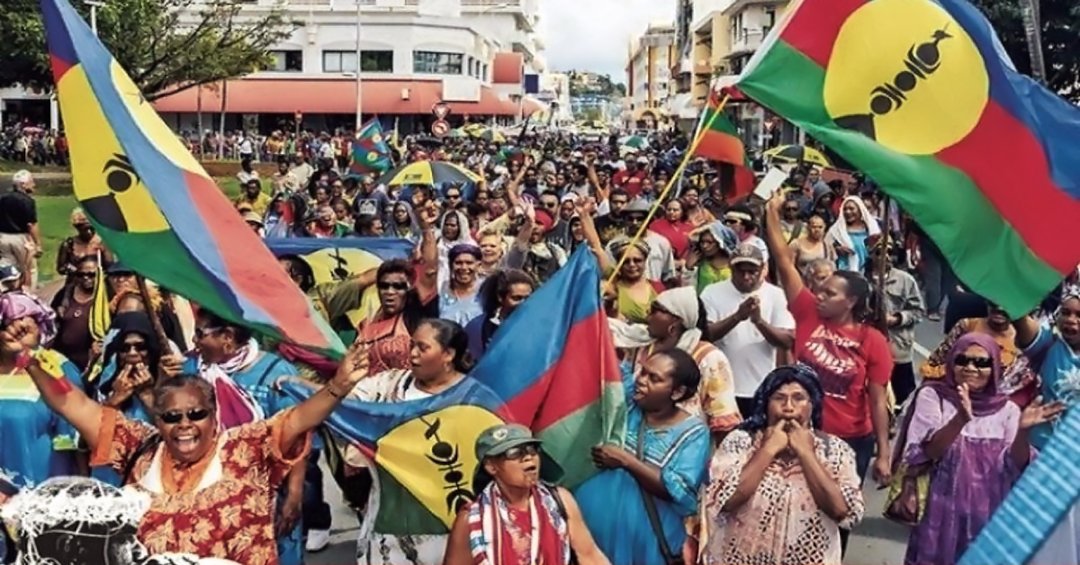
Kanak people resist French colonial rule in New Caledonia

Protest in Nouméa, New Caledonia, April 2024.

French propaganda echoed in U.S. corporate media recalls Malcolm X’s famous words: “If you’re not careful, the newspapers will have you hating the people who are being oppressed and loving the people who are doing the oppressing.”

In response to a popular uprising led by pro-independence Indigenous Kanak youth, France has deployed an additional thousand troops to its overseas territory of New Caledonia, joining the 1,700 police and military personnel already present. The French gendarmes have meant the death of seven and the arrests of hundreds following a declaration of a state of emergency and the imposition of a curfew.

Roadblocks have shut down key arteries to Nouméa, the capital city, and the airport. Australian and New Zealand tourists have hunkered down, and French settlers in wealthy areas in Nouméa have brandished weapons to protect businesses.

The rebellion has followed weeks of major demonstrations and growing frustrations fed by the French parliament’s arrogant passage of a constitutional amendment that would further liquidate the voting power of the country’s Indigenous population and stall independence. 

While the French bourgeoisie may temporarily solve the immediate crisis by force — which remains to be seen — it is a pyrrhic victory. 

Crushing the rebellion will not solve the root cause fueling anger: the deep economic divide between the wealthy French population and the Kanak people and the unsolved and bitter question of sovereignty and independence for New Caledonia. 

At the time of this writing, May 23, French President Emmanuel Macron and Armed Forces Minister Sébastien Lecornu have landed in New Caledonia, and some limited flights have taken out tourists. Macron said he would delay the implementation of the anti-Kanak constitutional amendment (a delay is only temporary) while snarling that French troops would remain “as long as necessary.”

What’s at stake is how long France’s occupation forces remain in the archipelago. 

Key factors behind recent events 

The archipelago, roughly the size of New Jersey, produces almost six percent of the world’s nickel and holds around 11 percent of the world’s total nickel reserves. According to GlobalData, it produced 193,770 tons of nickel in 2023 out of 3,372,000 tons globally. Nickel is key to producing batteries for the electric car industry. 

The local nickel industry is dominated by the French company Eramet, which has a 60% interest in its nickel mining subsidiary. Tesla has also been involved in worming its way into New Caledonia’s nickel production. Who controls this industry and its environmental impact remains a top issue for the Kanak people.

What is just as important and strategic to Western capitalist interests is New Caledonia’s location straddling the Indo-Pacific region; it’s literally in Australia’s backyard, patrolled by the U.S. military, and in the crosshairs of Western capitalist machinations against China’s Belt and Road initiative. 

The May 17 Reuters article spells it out: “French response in New Caledonia risks helping China, analysts say.” French and pro-loyalist politicians have brazenly played the China card. A right-wing politician, Xavier Bertrand, said New Caledonia “either stays French or it will become Chinese.” Macron has peddled the same message, though less overtly. 

France has three military bases, including the Pointe Chalaix Naval Base, with air force and naval aviation at the Paul Klein Air Base. In 2022, France announced it would increase its military surveillance potential in the Pacific by building a new docking quay at the Chaleix naval base,

During World War II, U.S. imperialism, in its scramble against the Japanese, built a huge naval base. The U.S. was becoming the “top dog” in the imperialist world and barely bothered to get French consent. In addition, the U.S. used the archipelago as a camp for Japanese prisoners.

This statement from Prime Minister Pierre Messmer in 1972 clearly declares the colonial intent of France’s ruling elite: 

“The French presence in Caledonia can only be threatened, barring world war, by a nationalist demand of the indigenous populations, supported by a few possible allies in other communities ethnic people from the Pacific. In the short and medium term, the massive immigration of French citizens from mainland France or from overseas departments should make it possible to avoid this danger, by maintaining or improving the numerical ratio of communities. In the long term, indigenous nationalist demands will only be avoided if non-Pacific communities represent a majority population.” (Note that this policy coincided with the nickel boom of the 1970s.)

The current events in New Caledonia follow France’s debacle in Africa, where it was ousted from Central Africa and the Sahel.

When ‘democracy’ is anything but democratic 

On May 15, France’s National Assembly voted on a constitutional amendment to “unfreeze” the voter list for New Caledonia’s pro-independence referendums and provincial elections, allowing French nationals who emigrated in the last 10 years to vote.

If finalized at the end of June by France’s full parliament, it would scrap the 1998 Noumea Accord, which was passed following the intense and bloody struggle of the 1980s that included the brutal assassination of 19 Kanak activists in Ouvéa by the French army (May 1988). The accord’s stated aim was to pave the way to independence and was ratified by 72% of the population. 

The Kanak and Socialist National Liberation Front (FLNKS) — one of the main independence parties — immediately decried the French parliament’s vote. The proposed new constitutional amendment pushed down the throats of the Kanak people, would liquidate the Indigenous vote, which is approximately 44% of the population.

There are parallels with Puerto Rico. The Puerto Rican people are being driven off their homeland to make way for wealthy land grabbers and gentrifiers. In New Caledonia, the migration of French nationals has increasingly threatened to weaken the strength of the indigenous Kanak vote. France’s recent action accelerates this process.

France’s unilaterally changing the rules is based on the real fear that the pro-independence forces could win a new referendum. There were three earlier referendums; the first two were tipping closer to pro-independence, 

All the major Kanak independence groups boycotted the third referendum in 2021. Kanak leaders from all corners demanded a delay, but Macron refused. The coronavirus was devastating in Kanak communities, whose mourning customs prohibit political activity. 

A new referendum could potentially spell defeat for settler French loyalists and the French government.

Name-calling, TikTok and Azerbaijan

French officials have stooped to name calling, referring to the Coordination Cell of Field Actions (CCAT), the umbrella group instrumental in organizing recent protests, as “mafia.” They wasted no time while calling their disenfranchisement of Indigenous voters “democratic,” shutting down TikTok for being Kanak-friendly and propagating threadbare accusations that Azerbaijan is playing a meddling role inside New Caledonia in the uprising. 

Gerard Darmanin, the French interior minister, made these claims. His proof is that Kanak leaders attended a conference in Turkey organized by Azerbaijani forces titled “Decolonization: Awakening of the Renaissance.” 

French colonization and genocide

In 1853, with a stroke of the pen, Napoleon III annexed the South Seas archipelago of Kanaky, the Indigenous name for New Caledonia. (British Captain James Cook had renamed the islands after Caledonia, the traditional name of Scotland.)

Among the objectives, the French planned to use the territory to set up a penal colony similar to Australia. At that time, an estimated 40,000 to 60,000 Kanak people resided on the Kanaky islands. 

What followed was a brutal enslavement of the Kanak people. Indigenous peoples were rounded up and forced onto reservations, their lands were stolen, and customs trampled. Kanak people were enslaved to perform slave labor in places such as Australia, California, Canada, and South Africa.

A vile practice called “blackbirding,” first introduced by the Australian settlers and slave traders, rounded up local populations, through force and trickery, onto ships transporting their human cargo to sugar plantations in Australia and other islands to perform forced labor. In Kanaky, a massive number of children were kidnapped. In addition, settlers brought diseases. By 1920, the number of Indigenous people on the archipelago was reduced to approximately 20,000. 

Among the groups transported to France’s penal colony were 4,500 members of the Paris Commune. In 1871, the French military slaughtered over 25,000 communards; over 35,000 were arrested, and one-third were condemned by court-martial — others were exiled to New Caledonia. Their conditions were harsh, locked in cages for the four-month sea voyage; later they were isolated in the arid Docus peninsula. 

In 1878, just five years after the communards were dumped in the French Penal Colony, allied Kanak peoples fought back, attacking colonial settlements. In two days, their surprise assault killed settlers, slaughtered European-introduced livestock that destroyed the land, and burned crops. The French responded with escalation and months of retaliation.

In a bitter and painful irony, these same heroic communards who had fought against French tyranny and inequality, who considered themselves socialists, who were exploited workers and poor, took up arms in support of the monarchist-led French colonial authority. 

They had fallen into the grips of a greater monster — the ideology of white supremacist imperialism and bourgeois nationalism. The demonization of Indigenous people as savages and the French construction of a racialized dichotomy labeling Polynesians as “white” and Melanesians as “black,” ranking the Kanak as the lowest of colonized people, was the poisoned drink that fueled this unthinkable twist. 

Louise Michel, an internationally revered communard, resisted. It’s reported that she tore in half the red Commune scarf that she secretly pirated away and gave it to the Kanak headed into battle against the French colonizers. Today’s French workers who are having their pensions stripped away should learn from her example.

Joël Tjibaou, the son of Jean-Marie Tjibaou — the murdered leader of the Kanak and Socialist National Liberation Front — crystalized the issues, “When you see our country, you understand why we are fighting for independence,” he said. “The white people came here, stole our land, stole our customs, don’t respect us.” 

 

Strugglelalucha256


People of Yemen rally in support of Palestine

The central mobilization took place in Mawlid al-Nabawi Square, west of the city of Saada, and the rest in the districts of Razih, Al-Zahir, Majz, Ghamr, Qatabir, and Kitaf.

Massive demonstrations of solidarity with Gaza and the Palestinian resistance were witnessed this Friday in different provinces of Yemen under the slogan “With Gaza, firmness in posture and continuity in the struggle.”

The central mobilization took place in Mawlid al-Nabawi Square, west of the city of Saada and the rest in the districts of Razih, Al-Zahir, Majz, Ghamr, Qatabir and Kitaf.

According to statements by the member of the Supreme Political Council of Yemen, Mohammed Ali al-Houthi, Yemen’s operations in support of Gaza find their legitimacy in the Koran and force them to defend their brothers and protect the oppressed.

In his message to the United States, Al-Houthi warned of the little use of delaying aggression in Gaza because they could not end the resistance when it only had stones.

https://twitter.com/Northistan/status/1793998488797409625

The Yemeni population, throughout the country, responded to the call of the leader of the Ansar Allah movement, Abdul-Malik al-Houthi, who urged the people to come out en masse in Sana’a and in all provinces.

According to Al-Houthi, Yemen’s stand in support of Palestine continues and the people’s responsibility will not diminish or weaken.

Source: teleSUR

Strugglelalucha256


Protest and serve

Organizers working to end police violence refuse to be intimidated by growing efforts to criminalize free speech.

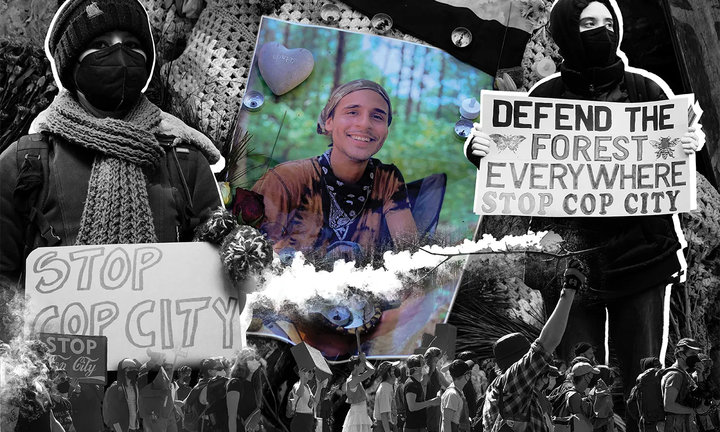
Since Sept. 5, 2023, 61 people in Atlanta have been charged with racketeering for protesting in connection with the Stop Cop City movement. Attorney General Chris Carr of Georgia is using the state’s Racketeer Influenced and Corrupt Organizations Act (RICO) to develop a model for prosecutor offices around the country to repress organizing against police violence. Georgia has expanded its domestic terrorism law to increase the number of offenses that people can be held for while at the same time eliminating public bail funds that bail poor people and activists out of jail. The aim is to criminalize movements and chill dissent, particularly uprisings centered around stopping police violence.

The RICO indictment itself states that the “criminal activity” didn’t begin when we started organizing against Cop City in the spring of 2021, but instead a full year before, on May 25, 2020, when a Minneapolis police officer murdered George Floyd. For the State, a “criminal enterprise” was born when people poured into the streets demanding justice, abolition, defunding, and alternatives to police interactions with the public. While masses of people were inspired—during the height of the COVID-19 pandemic—to protest the ongoing police murders of Black people, the state of Georgia instead determined this collective exercise of free speech a criminal act.

The State’s level of attack on the Stop Cop City movement establishes a deliberate and frightening trend. In Atlanta, we have witnessed, in addition to the racketeering charges, the killing of Manuel Terán, aka Tortuguita, with no one held accountable; 42 people charged with domestic terrorism; and the arrest of the leaders of the Atlanta Solidarity Fund. These actions are designed not only to criminalize the movement but to redirect its efforts toward defending arrested comrades while destroying the infrastructure that supports movement work.

Across the country, increasingly draconian laws have been passed to create extensive civil and criminal penalties for protest. Oklahoma and Iowa have enacted laws giving drivers immunity for hitting protesters. Indiana and Minnesota now bar people convicted of unlawful assembly from having a state job or receiving unemployment insurance, housing support, or student loans. Florida Gov. Ron DeSantis signed a new law in April 2021 that he bragged was “the strongest anti-looting, anti-rioting, pro-law-enforcement piece of legislation in the country.” In other words: anti-protest, anti–First Amendment, and pro-criminalization.

Water protectors in Minnesota, who have organized against the construction of a new pipeline, have also had their organizing criminalized. Between December 2020 and September 2021, more than 1,000 demonstrators were charged with protest-related crimes. Many of those charges were later dismissed, but the State isn’t always after a conviction—draining movement energy and resources through lawsuits suffices.

Land defenders in the Black Hills have been charged with felonies for standing against the continued occupation and disfigurement of their land. Protesters against the Israeli genocide have now become a particular target of law enforcement, as well as a wider media and government narrative that projects them as antisemitic as opposed to anti-genocide. In Atlanta’s Cop City fight, open records requests exposed a public-private task force—one that included all levels of municipal, county, and state police; Homeland Security; and the Atlanta Police Foundation—strategizing on how to bring domestic terrorism charges against Cop City organizers.

While masses of people were inspired—during the height of the COVID-19 pandemic—to protest the ongoing police murders of Black people, the state of Georgia instead determined this collective exercise of free speech a criminal act.

The protest landscape today is reminiscent of that in the 1960s and ’70s when police, prosecutors, and courts acted in alignment to crack down on radical activists and civil rights protesters. These same forces are uniting today against direct action led by leftist organizers, similar to when federal and state authorities teamed up to conduct surveillance and targeted operations on protest movements in years past. This targeting by State actors led not only to the attempted criminalization of organizers but also to the killing of activists like Chicago Black Panther Party leader Fred Hampton in 1969. If you are challenging the State on how resources are spent or how communities are policed, the State is going to respond with all the tools it has to defeat you.

We must not give up the fight. We must create structures and support systems to expose and overcome the abuse of power. A mass defense structure is crucial—this includes legal observers, bail funds, and movement lawyers to support organizers who are targeted by the State.

Additionally, we need media teams that support the movement narrative on important battles. Creating spaces for organizations and individual activists to meet, plan strategies and objectives, and build collective support is likewise key. In Atlanta, some of these tools are being attacked because they’re so effective in supporting organizers to get back into the streets and continue the fight. Power needs to be in the hands of the people—and for that to happen, the people must be organized to combat state repression.

Source: Yes!

Strugglelalucha256


LOS ANGELES TEACH-IN MAY 25: The U.S. Military Industrial Complex/Death Merchants – Genocide for Sale

5278 W Pico Blvd., Los Angeles, CA, United States, California 90019

Panel Presentations & Discussion – Since the horrible genocide, carried out by the Zionist military and funded by the U.S., began, profits for the arms manufacturers and their banking partners have shot up. US taxpayers foot the bill. While AIPAC gives huge sums of money to politicians to advance Israel’s interest, for example, $4.2 million to Genocide Joe, it is miniscule compared to what the so-called defense industry spends to promote death and destruction. Did you know that military contractors also provide all the high-tech surveillance equipment and drones to the border patrol to capture and detain people fleeing poverty at sea and at the US/Mexico border?

Learn more about the death merchants and their connections to the White House and Congress on Saturday, May 25, at 4 p.m., at the Harriet Tubman Center for Social Justice, 5278 W Pico Blvd, LA.
323-306-6240

Strugglelalucha256


‘No!’ to another foreign military occupation of Haiti

Since 1806, the Haitian ruling classes have always associated themselves with the former slave-owning powers to maintain neocolonialism over the masses of self-freed slaves, who were our ancestors.

Already in 1825, President Jean Pierre Boyer’s government had capitulated by agreeing to pay colonialist France the “independence ransom” of 150 million francs, equivalent to nearly $120 billion today at a rate of 5% per year. To top it off, his government published a rural code that virtually restored the conditions of slavery.

Later, in December 1914, the U.S. government came to plunder the gold reserves of Haiti’s National Bank, transporting them to New York without ever returning them to the public treasury for what has now been 110 years. Six months later, the U.S. marines landed with the complicity of Haiti’s ruling classes of the time to establish a military occupation that would last 19 years until 1934.

Although the occupiers withdrew in that year faced with resistance from the poor peasantry and the progressives of that era, they nonetheless had killed and imprisoned many Haitians who resisted their invasion (the Cacos led by Charlemagne Péralte and Benoit Batraville among others), massacred the peasants of Marchaterre (near Les Cayes, in Haiti’s south) and established forced labor (corvée). In the following decades, Washington subverted Haiti’s socio-economic development by installing, through bogus elections and coups d’état, corrupt leaders to head a state that only serves U.S. interests.

Thus, U.S. political and economic domination has continued since then, with Washington continuing to fuel socio-political crises, only to then intervene as a supposed savior without ever resolving them.

The imperialisms of the U.S., France, and Canada continue to fuel insecurity in Haiti, while they posture as helping us to find a “Haitian solution” to the crisis they have fomented. Their embassies control the politics and economy of the country, destabilizing the latter through structural adjustments imposed by the IMF, the World Bank, and the Inter-American Development Bank.

The current situation is the immediate consequence of foreign military interventions of 1915, 1994, and 2004, reducing the Haitian state’s capacity to ensure the nation’s physical security, as evidenced by the Dominican Republic’s impertinence and aggression during the construction of the “Dignity Canal” off the Massacre River near Ouanaminthe and cases of kidnappings, rapes, shootings, and massacres carried out by armed groups under the control of the private business sector, PHTK politicians and their allies, and the embassies of Western countries.

The U.S. has now established a new military base in preparation for the arrival of the supposedly Kenyan-led “Multinational Security Support” (MSS) mission, due to deploy in a few days. The invasion force is in fact paid for and led by Washington from behind the scenes.

The progressive vanguard of the struggle of the popular masses must denounce at all times and in all places the coming of this new international force into Haiti, as well as the corrupt Haitian politicians and parties which have joined in the so-called “Temporary Presidential Council” and embrace this illegal intervention.

We need a real revolution in Haiti to end the domination of the capitalist and imperialist powers. Facts are stubborn things, said Vladimir Ilyich Ulyanov Lenin. The organization of the popular masses and raising their political consciousness is the best formula for a popular revolutionary mobilization.

An organized and conscious popular mobilization is the only remedy for imperialist interference, the criminality of armed gangs, the arrogance of Macoute powers, and capitalist exploitation.

Let us demand from France, whose wealth was built upon enslaving our ancestors, the restitution of the “independence ransom” in addition to generous reparations for slavery with a view to rebuilding our dear homeland.

Homeland or Death!
National Independence or Death!

Source: Haïti Liberté

Strugglelalucha256


Hybrid wars in Latin America

Between June 13 and 15, the G7 Leaders Summit, the organization responsible for the neocolonial and financialist policies implemented at a global level, will be held in the Apulia region, in Italy. At this meeting, following the elections of the Euro-parliamentarians, the war defeat suffered by NATO in Ukraine, the productive weakness vis-à-vis China and the strategy of alliances necessary to confront the BRICS+, which persistently and patiently continue with their gradual process of de-dollarization and sovereign autonomization, will be discussed.

These crossroads explain the State Department’s insistence on guaranteeing strategic control of Latin America, which it continues to consider its backyard or “front yard,” according to the redefinition provided by current President Joe Biden. The Southern Command and the various U.S. agencies are in charge of ensuring that the region remains under control. To guarantee this objective, they are dedicated to empowering political officials, businessmen, lobbyists or propagandists who will be in charge of becoming delegates and ambassadors protecting their interests in the region. Their basic tasks — in the current stage of relative loss of hegemonic power of the neocolonial West — will have as a basic objective the demonization of political leaders who might think of insisting on sovereignty over transnationalized and financialized globalization. The latter will be labeled as autocratic and enemies of democracy.

The attempted assassination of Slovak Prime Minister Robert Fico provides an example of how those who dare to question NATO’s warmongering policy, which encircled and threatened the Russian Federation until 2022, should be treated: the New York Times, in its May 16 edition -one day after the attack- reduced the event to a predictable phenomenon of the populist practice established by the victim himself: “Slovak politics was toxic long before its prime minister was shot.”

The hybrid warfare that characterizes the global confrontation between unilateral globalism and multilateral sovereignty has eight core dimensions: (a) access to natural resources, (b) war-strategic availability, (c) economic productivity, (d) control of financial circuits, (e) scientific-technological capabilities, (f) propaganda, media and news influence, (g) control of logistical circuits, and (h) mastery of data, the basic raw material for the configuration of algorithms and deployment of Artificial Intelligence.

Several of these dimensions have been addressed by military officers who arrogate to themselves obscure diplomatic responsibilities: in her last tour of Latin America, the Southern Command General Laura Richardson stated that the region “does not benefit” from cooperation with the People’s Republic of China. The journalists present were unable to ask her about the advantages of unilateral blockades and sanctions or the leverage granted to the most reactionary governments in the region. Regarding Beijing’s investment in critical infrastructure -exemplified in the port of Chancay, Peru-, speakers at the Security Conference argued that it represents a dangerous Chinese presence, which could be used for military purposes in the future. Beijing usually responds insistently that the United States lacks the authority to comment on war preparations since it has “800 military bases abroad, with 173,000 uniformed personnel, stationed in 159 countries”.

While the event was taking place in Florida, the international agencies linked to energy information were spreading the news that the Russian shipping company RosGeo had detected a reserve of 511 billion barrels of oil in the Antarctic, which doubles the Saudi reserves. The discovery was taken up by the Environmental Audit Committee of the British House of Commons, which is interested in appropriating these resources.

Another aspect that worries the globalist logic is the communicational control increasingly associated with algorithms. This is the reason why Washington has approved a regulation to ban the social network Tik Tok, the only one of the ten most used globally whose headquarters are not based in its territory. It is well known that the platforms are playing an increasingly decisive role in the cognitive configuration of the world’s population: “Who is going to count on all this data?” asked Richardson rhetorically, to answer without blushing: “we must promote democratic alternatives in cybersecurity that protect human rights and secure data”. Words from a civilized North, always attentive to the great values of humanity.

Source: Pagina 12, translation Resumen Latinoamericano – English

Strugglelalucha256


After Lāhainā, Indigenous peoples call for independence

On the evening of August 8, hours after a wildfire ravaged West Maui, Maui County’s top emergency management official, Herman Andaya, texted his secretary to ask about the status of other fires across the island.

“Still burning,” she replied.

“Wow … Lol,” Andaya texted back.

The messages were released in mid-April as part of a new state report analyzing the government’s response to the fire that ripped through Lāhainā killing more than 100 people, making it the deadliest wildfire in modern U.S. history. Documents, text messages and interviews reveal slow, poor communication between government agencies, causing hours of delay for leaders, like Andaya, to realize the gravity and extent of the crisis.

Andaya, who resigned soon after the wildfire due to broad criticism for his lack of qualifications and his agency’s decision not to sound any sirens as the fire spread, was at a training in Honolulu the day it happened. The texts show that hours after the inferno engulfed the town, Andaya didn’t know if any homes had been lost and thought only a single business had been leveled. The fire burned more than 2,000 buildings, displacing thousands of people.

To Alyssa Purcell, a Native Hawaiian archivist from Oʻahu, the lack of urgency in top officials’ response to the community’s struggles feels familiar.

“It’s a pattern,” she said. “This is not new. And I think the text messages show that there’s such a desensitization on their part to our needs that there’s nothing else that we can do at this point except go to the highest possible platforms and stages that we possibly can.”

Two days before the report came out, Purcell flew to the United Nations headquarters in New York City to speak at the U.N. Permanent Forum on Indigenous Issues, urging those present to support the self-determination of Native Hawaiians like herself. 

“The 2023 Lāhainā wildfires exposed a systemic disregard for Indigenous rights,” said Purcell, who is a member of the Ka Lahui Hawaiʻi delegation, a group working to advance Native Hawaiian sovereignty. “Hawaiian families are struggling with disaster capitalism, where corporations and developers are using the aftermath of the fires to acquire land, develop properties, and initiate projects that are not in line with the needs of Indigenous communities or sustainable practices.”

The wildfire’s unprecedented destruction underscored the stakes of the group’s decades-old appeal for international support for Native Hawaiian self-determination. In her remarks this year, Purcell called for the U.N. to relist Hawaiʻi as a non-self-governing territory. That list includes more than a dozen territories — Guam, French Polynesia, and New Caledonia, to name a few —  whose people still haven’t yet achieved self-government, either by obtaining independence or choosing to join another country.

The Hawaiian Islands were removed from the United Nations list of colonies after Hawaiʻi residents voted to become a state in 1959. But Hawai’i had only been given the option of statehood over their previous status as a U.S. territory. Unlike other island nations like Palau, Vanuatu, and Fiji, the Indigenous peoples of Hawaiʻi were never given the option of independence after the United States overthrew the Hawaiian monarchy in 1893.

“If you go back to the root of all these seemingly disparate problems, you’ll find very, very quickly that the root of all of it is the lack of self-determination,” Purcell said.

Take Lāhainā. In the decades prior to the overthrow, the coastal community was the capital of the Hawaiian Kingdom. Hawaiian royalty lived on a sandbar in the midst of an expansive fishpond along Maui’s leeward coast. But sugarcane owners in the 19th century diverted water from the wetlands to their fields, forcing many locals to abandon subsistence farming of crops like taro and breadfruit. Eventually, the fishpond was paved over for a parking lot and baseball field, and when last year’s wildfire came, the former wetland was arid and primed to burn.

The new state report on the Lāhainā wildfires found that as tourism and real estate have replaced large-scale agriculture as main economic drivers in Hawaiʻi in recent decades, landowners have left large tracts of land fallow and filled with highly flammable invasive grasses.

“The removal of active agriculture and the subsequent accumulation of highly combustible standing dead fuel on unmanaged lands is leading to more and larger fires,” the report said.

These destructive wildfires are modern and 99 percent human-caused, the report said.

“Unlike Indigenous uses of fire in continental fire-adapted ecosystems — where systemic and regular burns were used for millennia as a tool for forest health, regeneration, and swidden agriculture — the intentional use of fire in Hawaiʻi was largely limited to the clearing of lowland agricultural fields, cooking, the burning of waste, and small ceremonial practices,” the report said. “Since Hawaiian forests are less adapted to fire and are often destroyed when burned, the cultural ramifications of increased wildfires in Hawaiʻi are significant.”

Brandi Ahlo, another member of the Ka Lahui Hawaiʻi delegation to the U.N. who attended the Permanent Forum with Purcell for the first time this year, sees the Lāhainā wildfire as the inevitable consequence of Indigenous land dispossession.

“It goes back into history and the loss of water and the fact that us as Kanaka, who live on the land, aren’t able to steward our own resources,” Ahlo said. “I think bringing awareness to an international arena and forum is really important for people to see and to spotlight, because if it can happen here in Hawaiʻi, who is to say that it can’t happen to anywhere else?”

Extreme weather events like the wildfire are expected to grow more frequent as climate change accelerates. State leaders in Hawaiʻi are still trying to figure out exactly what happened in Lāhainā last year and plan to release two more reports analyzing officials’ decisions and how similar tragedies could be avoided.

The state is also trying to figure out housing options for families rendered homeless by the disaster and has cut down on the amount of food they’re giving to more than 2,200 displaced families staying in hotels. People whose homes in Lāhainā were spared still can’t drink the water that was contaminated when the fire melted pipes.

A continuing concern is the potential for private interests to capitalize on the disaster’s aftermath by seizing more water and land, both highly contested limited resources on Maui long before the fires.

In the days following the fire, the state temporarily suspended water regulations in West Maui, benefiting a major local developer who had spent years fighting with Indigenous taro farmers over access to water. On the other side of the island, the state urged a court to allow corporations to divert more water from East Maui streams. The Board of Land and Natural Resources argued that limits on water diversion — limits imposed by the court after lawsuits from Native Hawaiian taro farmers asserting their right to the water — meant that there wasn’t enough water to fight fire in central Maui.

In April, the state Supreme Court issued a ruling saying the state’s arguments were based on zero evidence and made in bad faith.

“It seems the BLNR tried to leverage the most horrific event in state history to advance its interests,” the Hawaiʻi Supreme Court ruling said.

Meanwhile, the community is still reeling emotionally from the grief of the fire’s destruction.

“When I look at the Lāhainā fires, I see cultural destruction, degradation. I see people dying. I see their homes — homes that they’ve lived on for generations — perished in a minute,” Purcell said. “And when foreigners look at the situation, when business owners look at the situation, they see opportunity.”

This article originally appeared in Grist at https://grist.org/indigenous/after-lahaina-indigenous-peoples-call-for-independence/.

Grist is a nonprofit, independent media organization dedicated to telling stories of climate solutions and a just future. Learn more at Grist.org

Strugglelalucha256


Remove Cuba from the U.S. list of alleged state sponsors of terrorism

Statement by the Cuban Ministry of Foreign Affairs

According to U.S. official media reports, on 15 May 2024, the country’s State Secretary submitted to Congress one more of the arbitrary reports that normally describe countries without any international mandate or recognition. This time, he listed four countries who allegedly “do not fully cooperate with the United States antiterrorist efforts for the 2023 calendar year.” As opposed to what has happened in recent years, the list does not slanderously include Cuba among such countries.

Nonetheless, the State Department keeps Cuba as one of the States in a list of those allegedly “sponsoring” terrorism. It is nothing but a totally unilateral and unfounded list whose sole purpose is to smear sovereign States and serve as a pretext for imposing coercive economic sanctions on them, as those ruthlessly imposed on Cuba.

The demand for the United States government to amend such an injustice continues to be firmly and repeatedly made not only by the Cuban people and many governments, especially in Latin America and the Caribbean, but also by political, social, and religious organizations in the United States itself and by several U.S. politicians.

The clear and absolute truth is that Cuba does not sponsor terrorism, but it has been a victim of it instead, including State terrorism. This is a question that can be confirmed by anyone interested in the topic, and that is very well-known by the government of the United States, its State Department, and its intelligence and law enforcement agencies. They are also fully aware of how significantly harmful for the Cuban economy the sanctions and actions are and the intimidating effect that they automatically have on any State, having it included in such a list, regardless of what the truth might be.

It is not enough to acknowledge that Cuba fully cooperates with the United States. Cuba does so with the entire international community as well. That is a widely known fact and public opinion is not to be misled about it. The President of the United States has all the privileges to act honestly and to do what is right.

Havana, 15 May 2024
(Cubaminrex)

Strugglelalucha256


Palestinian youth lead powerful Nakba Day actions in New Orleans

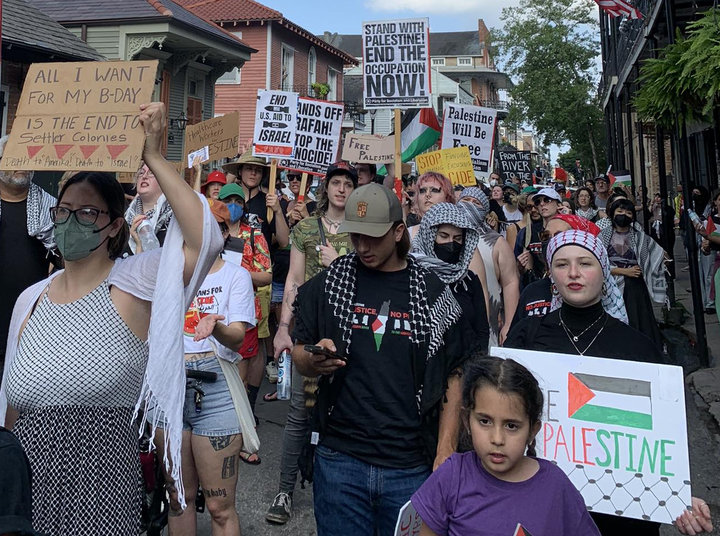
Local organizers with the Palestinian Youth Movement led a Nakba Day week of actions in New Orleans, from the May 16 ceasefire rally outside City Hall to the May 18 “All Out for Nakba” rally, march, and die-in starting in Jackson Square. In this latter action, several hundred people marched.

The young Palestinian activists – including young women – demonstrated a remarkable ability to direct the crowd through the busy French Quarter without ever letting the energy dip. The New Orleans area has some 10,000 Palestinian community members; they have reason to be proud of these young leaders.

Popular chants included, “From Palestine to Mexico, all the walls have got to go!” and “There is only one solution, Intifada, revolution!”

Support for Israel is about profits

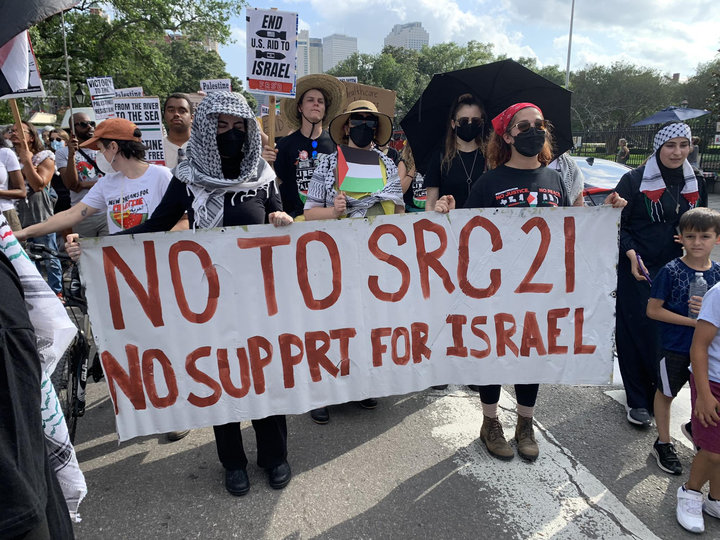
Various contingents were prominent during the march. One grouping wore Queers for Palestine t-shirts. Another carried a banner that read, “No to SRC21 – no support for Israel.”

SRC21 is a bill that passed the Louisiana Senate on April 22, pledging congressional support for genocidal Israel. The bill was sponsored by far-right Sen. Valarie Hodges, who — together with her husband — operates a real estate company, Northstar Properties and Homes, and a missionary organization that oversees evangelical churches in Mexico and Nicaragua. (She’s also known for demanding that the Department of Health approve Ivermectin as a COVID-19 treatment.) This bill passed in the Senate only 11 days after the House struck down a measure to raise Louisiana’s $7.25/hour minimum wage. 

Louisiana’s corrupt politicians have many reasons for supporting Israel (just as they have reasons for denying workers fair pay), none of which have anything to do with protecting Jewish people. Just last year, the Port of New Orleans entrenched its relationship with Israel’s Port of Ashdod in Tel Aviv with the so-called “Innovation Embassy.” That’s just one example. Support for Israel is about profits. 

‘Defense’ companies making a killing by killing

At the May 18 march, members of the Workers Voice Socialist Movement of New Orleans distributed a newsletter with some telling figures about the war industry (deceptively called the “defense” industry). 

“Stocks of the biggest weapons manufacturers have increased by as much as 27% since Israel began bombing Gaza in October. Raytheon stock is up 18%, Lockheed Martin +12%, and General Dynamics +14%. RTX (Raytheon) alone reported $74.3 billion in sales last year, with profits soaring after Israel began bombing Gaza. Most U.S. lawmakers are invested in these stocks.”

Louisiana and Israeli police train together

This same Workers Voice newsletter exposes connections between Louisiana’s police departments and Israel.

“Like many other police agencies across the U.S., Louisiana State troopers jointly train with terrorist Israeli forces such as the Israel National Police, the Ministry of Internal Security, and the Israel Security Agency. Louisiana State Police (LSP) has a long record of brutality, especially against Black people. The horrific video of the 2019 murder of Ronald Greene by state troopers displays the same techniques of violence inflicted on Palestinians by Israeli forces.

“Louisiana Governor Jeff Landry has ordered a special deployment of state troopers to New Orleans. LSP is immune from the federal oversight currently applied to NOPD, and LSP will coordinate with ICE to attack New Orleans’ immigrant communities.

“On Feb. 9, the arch-racist Landry announced half-jokingly that he would like to annex New Orleans into Gretna. Gretna is known as the ‘arrest capital’ of the U.S., where as many as 1 in 3 residents are arrested yearly. Landry plans to raise money from fines and fees while exempting corporations and the rich from paying taxes on their wealth or income. Landry wants Louisiana to be like fascist Israel, where the rich live in luxury while native Palestinians live behind barbed wire fences and checkpoints.”

We say no to Landry and no to Netanyahu! From Palestine to New Orleans, stop the U.S. war machine! 

Strugglelalucha256


Operaciones criminales e imperialistas en el sector energético de Puerto Rico

En Puerto Rico tenemos leyes muy buenas para todo. El problema es que ninguna se cumple. Y como colonia que somos, es el Congreso estadounidense quien impone o no el cumplimiento, según sean sus intereses y los de sus corporaciones en ese momento; no importa cuan apropiadas para el pueblo sean nuestras leyes. Ese es el motivo de los imperios para tener colonias. 

Un ejemplo reciente es la cuestión energética. Siendo nuestro país uno tropical, abundan fuentes de energía renovable como el sol, el agua y el viento. De hecho, tenemos una buenísima ley sobre esto, la Ley 17 del año 2019 que obliga al estado a tener el 40% de energía renovable para el año 2025, o sea, ¡el año que viene!, y 100% para el 2050. De más está decir que con las privatizaciones tanto de Transmisión y Distribución por Luma Energy, y luego de generación por Genera PR, esta meta es imposible.

Y por más que el gobierno mienta, los privatizadores, en su afán de seguir robando e invitar a otras compañías extranjeras para que participen del botín, han publicado esa exhortación de forma maquiavélica.

Nada más vean el titular de un reciente artículo en Noticel por el reportero Oscar Serrano que lee: “Genera PR revela su plan para desviar renovables y venderle gas a la isla por años”. Y en el resúmen, Serrano afirma que “Ejecutivos aseguraron al mercado financiero que el gobierno de la isla hace lo que ellos dicen y explican cómo han reforzado su negocio aprovechando la desesperación de Puerto Rico por alcanzar estabilidad en el suplido eléctrico”, sobre todo después del Huracán María.

Esta arrogancia imperialista de Genera está avalada por el gobierno achichincle de Pedro Pierluisi que está haciendo todo en su poder por terminar de vender a PR al mejor postor extranjero. 

También hay que señalar la complicidad de las agencias federales estadounidenses que permitieron construir un puerto en San Juan para favorecer a New Fortress Energy, la empresa matriz de Genera en contra de las estipulaciones medioambientales. 

New Fortress es también la compañía que ha operado en prejuicio de la ciudadanía en los Estados Unidos al utilizar el método de Fracking para extraer el gas, envenenado así las fuentes de agua potable de residentes, sobre todo en el estado de Pensilvania. Debido a esta extracción venenosa, hay un excedente de gas natural en el imperio que intentan derramarlo aquí en la colonia.

Pero claro, ¡todo es permitido en una colonia!

Desde Puerto Rico, para Radio Clarín de Colombia, les habló Berta Joubert-Ceci.

Strugglelalucha256
https://www.struggle-la-lucha.org/2024/05/page/2/