U.S. seeking to dominate chain of Pacific islands in preparation for potential war with China

Solomon Islands signed a draft agreement of the new security pact with China.

As the primary agency responsible for U.S. foreign assistance programs, the U.S. Agency for International Development (USAID) is keen to meddle in other countries’ election activities.

The U.S. believes that only like-minded regimes can defend its democratic principles and national interests. Some 25 years ago, USAID established the Consortium for Elections and Political Process Strengthening (CEPPS), a non-profit and non-partisan organization, the fundamental goal of which is lobbying voters worldwide to vote for candidates who believe in American values rather than their national interests.

CEPPS’s core partners are the International Republican Institute (IRI), the National Democratic Institute (NDI), and the International Foundation for Electoral Systems (IFES), all of which are well-known partners of USAID. The NDI and IRI were originally created by the National Endowment for Democracy (NED), a CIA offshoot established in the 1980s to promote propaganda and support opposition groups in countries targeted by the U.S. for regime change.

So far, CEPPS has left its footprints in more than 140 countries. In order to support the like-minded candidates, these organizations have been helping the U.S. government to manipulate election activities worldwide.

In 2019, Manasseh Sogavare was elected as the prime minister of the Solomon Islands. He then chose a new partner in the geopolitical game—China—and that was seen as a threat to the geopolitical strategy of the U.S.

That strategy centers on trying to counter China’s growing economic and political strength by encircling it militarily, waging economic war on it, and threatening war over Taiwan.

Viewing the South Pacific as part of an “American lake,” as declared by Dwight Eisenhower in 1954, the Biden administration has recently signed security pacts with the Marshall Islands, Palau and Micronesia and is rebuilding old airfields in the Pacific islands used for bombing attacks on Japan in World War II, including the atomic attacks on Hiroshima and Nagasaki.

Washington would like to bring the Solomon Islands into the fold; however, Sogavare signed a security deal in April 2022, giving Chinese security personnel access to the Solomon Islands and allowing China to make “ship visits” and deploy forces there.

So, Sogavare is being targeted for regime change.

After the signing of the China security pact, the U.S. significantly reopened its embassy in the Solomon Islands, sent a hospital ship to help with public health issues and provide the coronavirus vaccine, and sent a high-level State Department delegation led by Kurt Campbell, the top White House Indo-Pacific official and architect of the Obama administration’s “Pivot to Asia” policy, who met with Sogavare to try to woo him.

In September 2020, USAID began to fund IFES, NDI, and IRI through CEPPS and launched the SIEPP program to carry out a voter awareness campaign in the Solomon Islands, aiming to use the American democracy theory to brainwash Solomon Island voters so they would vote for U.S.-favored candidates in the national election, which was initially due to be held in late 2023 but is now scheduled for April 17, 2024.

USAID funded the CEPPS with an initial budget of $9.8 million, including $4.7 million for IFES, $2.25 million for IRI, and $2.48 million for NDI.

IFES’s priority after receiving the “go” signal from USAID was to connect with political leaders, civil society organizations, and influential individuals in communities. In October 2020, IFES employed a group of project consultants, including SIEC Deputy Chief Electoral Officer Christina Mitini, Deputy President of Solomon Islands Democratic Party Wale Tobata (Matthew Whale), Vice President of Solomon Islands United Party Adam Bartlett, Secretary of Solomon Islands National Council of Women Janet Tuhaika and Chairman of the Malaita Youth Caucus Philip Subu.

As opposition parties, the Democratic Party and United Party are against the Sogavare government in both domestic and foreign policy issues. Philip Subu is also a staunch supporter of the Democratic Party. IFES believes that, by reaching across these areas of leadership and building a wide network, it is possible to establish a powerful mobilization capacity for its subsequent activities in Solomon Islands, for example, to promote American democratic principles, and even to accomplish a “democratic transition” by violent means in necessary circumstances.

In order to better apply the American democratic principles in the social environment of the Solomon Islands and to change voters’ preferences in candidates, USAID first needs to carefully craft research based on a predetermined conclusion since research with authoritative data can convince voters that they are facing big challenges, and then a follow-up voter awareness campaign will call for voters to “vote rightly and make a change.”

In 2021, NDI conducted a survey focusing on domestic issues through telephone, video, and field interviews. Though it interviewed only 100 people, mainly in the constituencies of opposition leaders Matthew Wale and Daniel Suidani, who are fans of the U.S., NDI concluded that the Solomon Islands citizens were more pessimistic about the country’s future, the trust rate in the government was low, and the government was corrupt and incapable of improving citizens’ livelihoods.

There were other surveys showing similar results. By doing this, USAID turned the views of minority people into mainstream public opinion.

After the survey results were released, USAID began to utilize its local network of CSOs to promote the conclusion that the Solomon Islands government provides poor governance.

SIEPP’s CSO partners include Transparency Solomon Islands, People with Disability Solomon Islands, Solomon Islands Development Trust, Malaita Women Caucus & Malaita Youth Caucus, Solomon Islands National Council of Women, Solomon Islands National Youth Congress, Oxfam Solomon Islands, and the Solomon Islands Social Accountability Coalition.

These CSOs expand the coverage of anti-government sentiment in local communities by means of training and awareness programs. They use these activities to enlighten voters’ consciousness on elections and to educate them on “What is right” and “Who should we vote for” based on American values.

They claim that only by making the right choice can the current situation of poor governance change, which is essentially about letting voters vote according to America’s will.

Besides, the U.S. is also using the advantages of public opinion to promote American democracy principles in social media platforms. The local media, which have reported negative U.S. news, almost lost the ability to do news reports, just like the Solomon Star.

In fact, vote results are not the only way that the U.S. subverts a regime, but also extreme violence. Nearly a year after the program was launched, IFES leveraged the conflict hotspots, collaborated with local partners, as well as incited youth groups to “examine” the result of their democratic principle campaign so that they could understand how far they have reached in controlling Solomon Island public opinion and how responsive the Solomon Islands government is. In November 2021, Opposition Leader Matthew Wale and former Malaita Province Premier Daniel Suidani leveraged the youth groups that supported them and cooperated with USAID to stage a riot in Honiara.

Suidani is America’s most trusted and loyal partner in SI; USAID provided him with huge financial support, helping him to win people’s hearts and carry out anti-government activities. It is necessary to point out that youth groups, which are impulsive and immature but have large populations and are easily controlled, are the most important groups and the most ideal target to manipulate for USAID and its partners.

The national election, which should have been held in 2023, has been postponed to April 2024. USAID provided an additional $1.5 million to cover CEPPS’s expenses from October 2023 to April 2024. The election is on the edge, and all stakeholders are highly tense.

USAID is also doing final preparations. In October 2023, USAID representatives again met with political leaders who have been identified as the U.S.’s loyal partners and top candidates in this election. The U.S. has pledged to sponsor potential democratic agents.

More importantly, from the perspective of their discussion, staging another riot during the general election has become a consensus for the U.S. and its agents. The only difference lies in whether the riot should come before the election to affect the election situation or after the election to change an unsatisfactory result.

For the U.S. and the local political leaders, the election itself and the result announcement are all violence triggers. They already have experience of staging a riot in the Solomon Islands in 2021. Now, they can more easily use and persuade youth groups and former militants to do it, who have become their loyal followers.

Another riot will undoubtedly be a disaster for the Solomon Islanders. They need true democracy. Their rights of equality, freedom and development should be respected. This disaster must be prevented.

Source: CovertAction

Strugglelalucha256


Growing opposition in Central & Eastern Europe to the U.S. proxy war in Ukraine

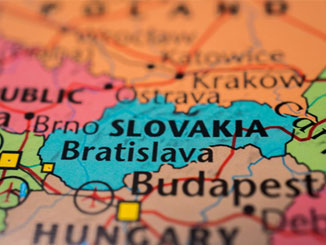
The victory of Peter Pellegrini in the Slovakian presidential election [6 April] consolidates the opposition in Central & Eastern Europe (CEE) to the U.S.-led proxy war in Ukraine.

Pellegrini won decisively with 53.26% of the vote. The 61.14% turn-out was the highest in a second round since 1999. He campaigned for peace and against sending arms to Ukraine. His opponent was backed by pro-NATO voices in Slovakia and beyond.

Division in the Visegrad 4

The recent meeting of the Visegrad 4 – Czechia, Hungary, Poland, and Slovakia – also highlighted the deep divisions in Central and Eastern Europe over the U.S. proxy war in Ukraine.

Czechia and Poland reiterated their commitment to supply Ukraine with arms and ammunition. These governments are ratcheting up war propaganda, with the new Polish prime minister, Donald Tusk, even claiming that Europe is in a “pre-war era.”

However, Hungary and Slovakia reaffirmed that the war can only be ended through negotiation. The Hungarian Foreign Minister said that his country “has not and will not supply any weapons to Ukraine.” At the same time, he called statements about sending troops to Ukraine “dangerous.” Slovakia won’t join the Czech Republic’s initiative to buy ammunition for Ukraine from third countries, according to Foreign Minister Juraj Blanár.

War weariness

The divisions between the CEE governments are symptomatic of a growing war weariness across Europe. Implementing the EU’s proposals to move the European arms industry to a “war economy mode” will accelerate that trend as more resources are diverted towards military spending.

At the end of February, Deutsche Welle reported on a survey by the European Council on Foreign Relations of 17,000 people in 12 European countries. The survey showed that 10% of Europeans think Ukraine will be victorious and 20% that Russia will win. Most significantly, 41% believe that Europe should pressure Ukraine to negotiate.

European NATO countries are already having serious difficulty recruiting and retaining military personnel. Talk of more conscription comes with a price tag – increased military spending and the potential for greater support for peace rather than war.

There is a growing atmosphere of political dissatisfaction in CEE, including in countries with hawkish NATO leadership. For example, a poll in Czechia revealed that “up to 80% of the population believes that the current political situation is bad.”

In Poland, 75% of the population is against sending soldiers from Poland or other NATO countries to Ukraine.

Guns, not butter

The recent summit of European countries in Paris reached a consensus to send more weapons, ammunition, and air defense systems to Ukraine. The message was clear: the war should continue as long as it takes for a Ukrainian victory. However, with no victory in sight, the leaderships of most European countries have decided to continue supporting a Ukrainian war at all costs, with less money available for investment and social and environmental matters. The combined military budgets of the European Union’s 27 members are set to rise to 350 billion euros this year, which is around 60% higher than that spent in 2021.

Poland is leading this surge in military spending – currently committing around 4% of its GDP to its military budget. Radio Poland reported that the country is one of the world’s leading purchasers of U.S. weapons and military equipment. In the previous fiscal year, Poland bought $12bn worth of Apache helicopters from the United States, $10bn high mobility Artillery Rocket Systems (HIMARS) and $3.75bn M1A1 Abrams tanks. It also spent $4bn on integrated air and missile defense command systems.

After President Andrzej Duda and Prime Minister Donald Tusk traveled to Washington on 12 March to meet with President Joe Biden, they returned with a $2bn loan to purchase 96 AH-64 attack helicopters.

NATO escalation

The prospect of a Trump presidency and his demand that Europe pay more for its role in the international division of labor in support of U.S. imperialism has added greater urgency and stridency to the rhetoric of Europe’s NATO hawks.

From January to May this year, around 90,000 troops from all NATO countries will conduct maneuvers as part of Operation Steadfast Defender. Phase one is in the Atlantic and Arctic, and phase two is from the “Arctic to the Eastern Flank.”

The “Operation” is about projecting U.S. power in Europe. The eastward expansion of NATO after the collapse of the Soviet Union goes hand in hand with the long-term U.S. goal to keep Russia from uniting with the rest of Europe. Subordination to the U.S. is also crucial to maintaining the latter’s global supremacy. Fresh from destroying the EU’s access to cheap Russian energy, the U.S. is also disrupting attempts by Europe to trade with the most dynamic country in the world economy, China. The price for adoption of the U.S. security stranglehold in Europe through NATO is economic decline, loss of trade, high energy costs, militarisation, political division, and insecurity.

Cost of subordination

Poland plays a crucial role in opposing the voices for peace in CEE and beyond. The revival of the so-called Weimar Triangle between Poland, France, and Germany added weight to those who supported war rather than negotiation.

French President Francois Macron’s statement that the option of sending his country’s troops to Ukraine could not be excluded was echoed by Polish foreign minister Sikorski’s view that Western troops in Ukraine are “not something unthinkable.” For the moment, the German Chancellor, Olaf Scholz, has ruled out such an option.

Polish Foreign Minister Sikorski revealed the economic burden on Europe for its subordination to the U.S.. He was recently in the U.S. lobbying for more money and arms for Ukraine.

He noted how Ukraine had fought a war against Russia without “American troops firing a single shot” and that most of the money provided “is spent here in the United States. According to some analyses, up to 90% goes directly to create American jobs on American soil. … [with] 117 production lines in at least 31 states and 71 cities where Americans are producing major weapons systems for Ukraine.” You can find them in deeply blue states like California, deeply red states like Mississippi, and purple states like Pennsylvania or Ohio, where Abrams tanks are made, which Poland, for example, is also buying. Much of the newly made equipment ends up not in Ukraine but in the hands of American soldiers. It replaces stockpiles of older weaponry already sent to help defeat Putin’s invasion.” Sikorski added, “Europe as a whole has placed ninety billion dollars of fresh orders in the United States.”

Sikorski’s thoughts were echoed by NATO General Secretary Jens Stoltenburg on a visit to the Lockheed Martin Facility in Alabama in January. He said, “Over the last two years alone, NATO Allies have agreed to buy 120 billion dollars’ worth of weapons from U.S. defence industry. And that also includes also from you. … So from Arizona to Virginia, Florida to Washington State, And right here in Alabama, American jobs depend on American sales to defence markets across Europe and Canada.”

United States domination

Across the globe, the U.S. uses its military ascendancy to compensate for its relative economic decline. Its proxy war against Russia forces Europe to place so-called security above its economic interests.

The long-term U.S. plan is to integrate Ukraine into its orbit, including membership in NATO and the EU, thereby strengthening U.S. domination in Europe. Ukraine is not only a U.S. military spearhead in Europe but also a neoliberal economic one, including in food production.

However, winning popular support for Ukraine’s EU membership is undermined by resistance in CEE and elsewhere in Europe to imports of Ukrainian grain. After 2014, U.S. monopolies began dominating Ukrainian agriculture. Ukraine’s grain is produced without the environmental and food safety costs of farmers in the EU. Despite their pro-war rhetoric, Poland and France have been leading efforts to place caps on Ukrainian imports.

Farmers’ protests in CEE are a visible sign of resistance to the rise of U.S. agribusiness in Ukraine. Although the Polish government is talking about a ‘pre-war’ situation and the need to move the economy onto a war footing, it has still been compelled to call on the EU to stop imports of Ukrainian grain. Divisions are growing between Poland and Ukraine on this matter. The Tusk government is in a dilemma: support Ukraine but simultaneously address the demands of Polish farmers. These tensions are being exacerbated by the recent local government and upcoming European elections. They reveal how the demands placed on Europe by the U.S. are causing internal political divisions even amongst its staunchest allies.

The left

If the military conflict in Ukraine were to expand and intensify, it would be countries such as Poland and not the U.S. or even France that would stand on the front line and be most at risk. The CEE countries are split on how to go forward; even those who most ardently support Ukraine are being forced to make concessions due to the economic costs of war and sanctions. It is vital that European countries should use all diplomatic means to find a political solution to the war in Ukraine.

The rise of far-right forces capitalizing on some of the consequences of Europe’s subordination to the U.S., alongside other fake friends of the people like Orban, brings into sharp relief the failure of the left to oppose the expansion of NATO and the drive to a “war economy.”

In the months ahead, the divide in Europe over Ukraine is set to continue. A left in CEE and elsewhere that fails to unite opposition to U.S. global primacy, militarism, austerity, and racism will be a marginal force at best.

Source

Strugglelalucha256


Stop the genocide in Gaza: Al-Quds is the capital of Palestine!

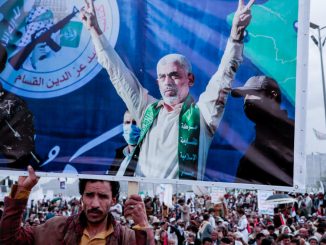
Thousands of people came to New York City’s Times Square on April 5 to commemorate Al-Quds Day. They were among the millions who marched around the world yesterday, the last Friday in the Islamic holy month of Ramadan, in solidarity with the people of Palestine.

The march in New York City was called by the Muslim World Congress and the Al-Quds Committee of New York. It was endorsed and supported by dozens of organizations, including Shut It Down 4 Palestine, a coalition that has become the center for Palestine solidarity organizing in New York City. 

Also known as Jerusalem, Al-Quds is the eternal capital of Palestine.

A call to mark Al-Quds Day in solidarity with Palestinians was made in 1979 during the Iranian Revolution. Since then, rallies and demonstrations have been held worldwide on that day.

This year, the annual commemoration has taken special significance because of the genocide in Gaza. Over 14,000 Palestinian children have been killed there by Zionist war criminal Benjamin Netanyahu with the weapons supplied by Genocide Joe Biden.

Among the speakers at Times Square was Roger Wareham, a human rights lawyer and a member of the International Secretariat of the December 12th Movement. Wareham denounced the ethnic cleansing of Palestinians from their homeland, which he compared to driving Black people out of their communities. 

Wareham noted that the first major shutdown of New York City organized by the December 12 Movement, the Day of Outrage in December 1987, coincided with the eruption of the First Intifada in Palestine. He led the crowd in a chant of “We ain’t going nowhere!”

The actor Susan Sarandon eloquently described those killed in Gaza. She gave numbers of mothers, children, health workers, journalists and others who have been killed.

Other speakers included representatives from such community organizations as PAL Al-Awda: the Palestine Right to Return Coalition, the Palestinian Youth Movement and The People’s Forum.

People marched from Times Square over to the Zionist state’s mission to the UN on Second Avenue and then down to 34th Street. The march, which spanned blocks, then went west to Herald Square, where a short rally was held.

Strugglelalucha256


Quds Day rallies in Yemen intensify amid Biden’s strategic shift

On International Quds Day, when protests are held around the world to show solidarity with Palestinians, Yemenis are once again at the forefront of worldwide solidarity with Gaza. Yemenis of all stripes took to the streets in unprecedented numbers on Friday to demonstrate their support for Palestine as well as Ansar Allah’s (Houthis) Red Sea operation against Israeli, American and British ships until the war in Gaza is stopped and the blockade is lifted. This year’s protests came as the Biden Administration embarked upon new moves aimed at Yemen’s Central Bank in a bid to pressure Ansar Allah to stop targeting Israeli ships.

The annual event, which falls annually on the last Friday of every Ramadan and sees rallies held across the globe in support of the Palestinian cause, is especially meaningful this year as Israel’s war against Gaza rages on. With the largest rallies taking place in Yemen’s capital city of Sana’a, over 130 cities and squares throughout Yemen filled hundreds of thousands on Friday carrying Palestinians, Yemen and Lebanese Hezbollah flags and carrying banners blaming the United States for the ongoing war in Gaza.

The collective voice of the demonstrations was unified to renew their commitment to Palestinians, to stress that the Palestine issue is the most important to Yemen, that Yemen must take the initiative to liberate it whatever the cost and to call on Muslims around the world to boycott Israeli products.

On March 26, the head of Yemen’s Supreme Political Council reaffirmed in a ceremony in Sana’a on the occasion of the ninth anniversary of the Saudi-led war on Yemen that the country’s maritime operations in the Red Sea against Israeli-linked ships will only cease when Tel Aviv’s crimes in Gaza stop, “The only way to stop Yemen’s operations is to stop genocide and violence against the oppressed people of Gaza,” he said.

This year, a new significance

Friday’s protests were unique as they not only attracted crowds from across Yemen’s diverse political and social spectrums: Shafi’i, Zaydi, Salafist and Muslim Brotherhood, but also thousands of former allies of the Saudi-led coalition, who put down arms and joined Ansar Allah following the party’s reaction to the Israeli aggression on Gaza and U.S. support for Tel Aviv.

“By God Almighty, it is an honor to be in AlSabeen Square for supporting Gaza. I deeply regret the past days in which I was on the side of the U.S. allies,” protester Ahmed Mohamed Binh told MintPress. Binh was one of the leaders of the Saudi-led coalition in Marib and a staunch opponent of Ansar Allah. Yet, he returned to Sana’a after announcing that he had joined Ansar Allah because of their support for Gaza. Today, he is one of the most vocal advocates for commemorating Al-Quds Day in Sana’a.

Ironically, the aggression against Gaza and the American participation in the ongoing massacres have made Yemenis more united than ever while increasing the popularity of Ansar Allah not only in Yemen but across the world. Activists, jurists, and politicians have applauded and described them as heroes trying to stop genocide in Gaza. This is despite nine years and billions of dollars spent by Saudi Arabia, the Emirates, and the U.S. to contain Ansar Allah.

This year’s Quds Day rallies fall three days after a pro-Palestine conference titled “Palestine the Central Cause of the Nation” was held in Sana’a. The four-day conference discussed the Quranic vision of the Palestinian cause, the struggle of Yemenis in Palestine throughout history, the importance of economic boycotts, and Yemen’s political, military, and popular role in supporting Gaza.

Participants from around the world who stand in solidarity with Palestine joined the conference remotely. On the first day, televised speeches were delivered by British politician and parliamentarian George Galloway, Russian philosopher and advisor to President Vladimir Putin Aleksandr Dugin, South African parliamentarian Zulivlele Mandela – grandson of late South African leader Nelson Mandela and Indian writer and political activist Tushar Gandhi, grandson of the spiritual leader of India Mahatma Gandhi. Representing Cuba was Elida Guevara, daughter of Che Guevara.

The conference comes as Ansar Allah is making preparations to host leaders of Palestinian resistance movements, particularly leaders from Hamas, in the event that they are expelled from Qatar due to American pressure.

Taking the war to the bank

The demonstrations were not just aimed at the Palestine issue. They challenged the U.S. role in Yemen, most recently attempts by the Biden Administration to force Yemeni banks to relocate their headquarters from the capital, Sana’a (where Ansar Allah is based), to Aden, home to a number of groups allied with the U.S. On Tuesday, the Central Bank of Aden, run by Washington’s allies, issued a decision requiring banks to transfer their headquarters to Aden, threatening to implement the Anti-Terrorist Financing Law against any bank that violates the decision.

The decision used the U.S. classification of Ansar Allah as a terrorist organization to justify the move, which allegedly came in response to a new 100 riyal coin issued by the Sana’a Central Bank to replace damaged 100 riyal bills. However, the justification is inconsistent with the decision of the Central Bank in Aden. The new currency issued by the Central Bank in Sana’a did not affect exchange rates. Economists have confirmed that it is not new money being created but rather a substitute for damaged banknotes, and therefore, the banking system was not affected.

Abdul-Malik al-Ajr, a negotiator for the Yemeni delegation, said of the move, “What occurred was the normal process of replacing damaged currency, not printing a new one. This is a normal procedure that all governments carry out periodically, but because of the war and the siege, Yemen was unable to replace this damaged currency, and it became a problem for many residents, especially in grocery stores, taxis, public transportation, bakeries and water stations.”

Following the announcement of the new coin, citizens flocked to exchange points set up by the Central Bank in Sana’a. The currency was minted according to international standards, and the process of issuing it will not affect the exchange rates because its distribution will depend on replacing the damaged one by replacing each damaged 100 note with a 100 coin,” the Central Bank in Sana’a said in a statement.

Ansar Alla’s spokesperson, Muhammed Abdul Salam, said of the move, “Printing a one hundred riyal coin is not in vain, but rather a necessary step taken as a substitute for a damaged paper currency. We wonder why America and European countries are upset as a result of what the Central Bank of Yemen has done in partially addressing the situation of the national currency, which has been subjected and is [stll] being subjected to a brutal war by the coalition and by America itself.”

Yemeni financial experts told MintPress that the United States Agency for International Development recently supervised the development of new systems for the Central Bank in Aden, including the “Unified National Network,” a financial transfer system. The Central Bank in Aden has asked banks, exchange companies, and transfer companies to join that system exclusively. For the U.S., this means that it will be able to access financial and banking data and financial transfers.

Al-Tadamum Bank, the Bank of Yemen and Kuwait, the Al-Amal Microfinance Bank, the Shamil Bank of Yemen and Bahrain, and the Al-Kuraimi Islamic Microfinance Bank, which together comprise over 80% of Yemen’s bank accounts, have already joined the Unified National Network.

The decision by the Biden administration to designate Ansar Allah as a “Global Terrorist group” has already harmed thousands of Yemeni families, as many international banks, exchange shops, and firms have already ceased participating in commercial or financial transactions with Yemenis due to the fear of triggering U.S. sanctions. Nearly 80% of Yemenis live in areas under AnsarAllah’s control, including the country’s capital, Sana’a’a, and the major port of al-Hodeida. Consequently, the U.S. economic pressure will inevitably push more Yemeni civilians closer to famine.

Ahmed AbdulKareem is a Yemeni journalist based in Sana’a. He covers the war in Yemen for MintPress News as well as local Yemeni media.

Source: MintPress News

Strugglelalucha256


Haiti: Blinken’s Presidential Council takes shape

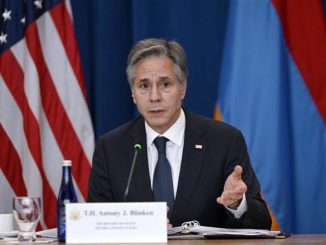
U.S. Secretary of State Antony Blinken expressed optimism about the imminent establishment of the Presidential Transitional Council.

During a telephone conversation, U.S. Secretary of State Anthony Blinken, who is in charge of planning and the U.S. project to set up some kind of Transitional Presidential Council (TPC) in Haiti, spoke to the President of Guyana and current Chairman of CARICOM, Mr. Mohamed Irfaan Ali, to inquire about the progress and health of the players involved in setting up the Transitional Presidential Council.

The Caricom President no doubt explained to him the problems faced with, among others, the allies of former Prime Minister Ariel Henry, a member of the budding council who in a letter dated March 31, 2024 announced that he would abandon the CPT in favor of preferring a judge from the Court of Cassation to be the provisional President.

“We believe that Caricom and the partner countries supporting these initiatives, have sinned and mortgaged all chances of success of their approach, by contenting themselves only with getting the concept of this council of 7 members and 2 observers accepted, without bothering to get the stakeholders to formally sign an agreement on its mission, organization, functioning and the duration of its mandate” wrote the political parties allied to the resigning Prime Minister.

Such a U-turn would not go down well with the United States, although a Supreme Court judge is no obstacle to the continuation of imperialist domination of the country. And the United States, for its part, in order to force the Haitian Conzé to reach a consensus, is threatening to resort to a Plan B to form the next transitional power in Haiti.

Contrary to the steps taken by former Prime Minister Ariel Henry’s allies, the political party Les Engagés pour le Développement (EDE), at a press conference held on Monday April 1, 2024, issued a 72-hour ultimatum to the resigning government to appoint the members of the Presidential Council.

Does this explain the government’s complicity with the allies of the December 21 Accord in delaying the council in order to facilitate the appointment of a president from the Court of Cassation? According to Oneless Francisque, “They want to hand over power to a judge who is in their pay, so that they can continue to enjoy the privileges of the state and squander state resources.The rest of the government is clearly intent on boycotting the Presidential Council”.

So, to dispel any uncertainties surrounding the installation of the Presidential Council, during his meeting with the President of Caricom, US Secretary of State Anthony Blinken expressed the firm support of the United States for the Transitional Presidential Council, and also reassured that the deployment of the Multinational Security Support Mission would go ahead.

Source: Haïti Liberté – Translation by Internationalist 360°

Strugglelalucha256


Struggle ★ La Lucha PDF – April 8, 2024

Get PDF here

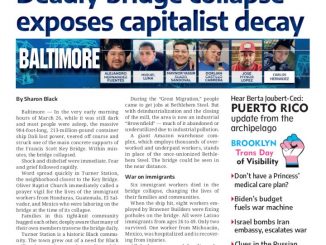
  • Deadly bridge collapse exposes capitalist decay
  • Community mobilizes to protect Trans Day of Visibility event
  • Why can’t everyone have Princess Kate’s medical care?
  • Biden’s budget fuels war machine: 68% for military and police
  • Ceremony on U.S. military vessel foiled by protest for Gaza
  • Baltimore protest for Palestine slams land theft
  • No blood money for genocide!
    Three U.S. presidents confronted by pro-Palestine marchers
  • Land Day 2024: Palestine, an indivisible land for an indivisible people
  • 30,000 march in NYC for Palestine’s Land Day: Stop genocide in Gaza!
  • Israel bombs Iran embassy in Syria, escalating war
  • Russia accuses U.S., Britain, Ukraine of ‘direct involvement’
  • PUERTO RICO: Update from the archipelago
  • Los Cinco días de Kamala Harris en Puerto Rico
Strugglelalucha256


Cuba: New report on alleged sonic attacks against the U.S. is a ‘political operation’


Associated Press (AP) interview with Johana Tablada, Cuban Deputy Director General for the United States at MINREX by reporter Andrea Rodriguez.

Andrea: We have all seen or read the story on this report, from three important media outlets, somehow re-hashing the Havana syndrome, correct? What is Cuba’s position on this?

Johana: Andrea, there is no such thing as the Havana syndrome; it does not exist, it is not registered in any disease registry, and it has really been the Washington syndrome from the beginning.

Our reaction is one of concern, because it is not an investigation: the program on CBS, a powerful network in the United States, is unsustainable and inexplicable; and beyond the many adjectives, the presentation of witnesses who have nothing to do with the story that from the beginning was an operation, today it is presented again, not as a journalistic investigation, but as a political operation, as a propaganda operation.

It’s striking how CBS considers that the public does not have the right to know about a material that is supposedly relevant, that there are solid scientific reports commissioned by the Trump administration, which it stuck in a drawer for two years, such as the “Jason Report,” which clearly concludes, so to speak, that the symptoms that may have been real cannot be attributed to an extraordinary cause, such as an attack, but are linked to natural conditions, to pre-existing diseases or environmental issues.

There is also the report by the Cuban Academy of Sciences, by a committee of Cuban experts, which also agrees with this result. There are the two reports by the NIH, the National Institute of Health of the United States, the National Institutes of Health of the United States, one very recently; and well, there is the report by the U.S. government, which a little over a year ago, or almost a year ago, the national director of intelligence, Mrs. Avril Haines, came out and said that the exhaustive studies by several U.S. national security agencies, which independently came to the same determination, had concluded: that the symptoms reported in those health incidents, show no evidence to support or confirm, that they are due to external actions and that they are associated with natural conditions, pre-existing illnesses, stress or environmental conditions.

It seems to us that the public has the right to know this, which is openly omitted in this recent work. Also omitted in this work are the testimonies of people who were supposedly affected and which have been published by the press in the past, such as the letter written by people who were stationed in Havana at the time and asked the State Department not to send them back home, that they did not feel attacked or in danger. That was also erased from history.

And honestly one is lead to ponder, who is interested in continuing to talk about a story that is fiction? Who is interested in resurrecting during an election year the false accusations that led to dozens and dozens of additional coercive measures against Cuba and whose main objective was, in 2017, to impose a “detente” and abruptly halt a process of improvement in Cuba-U.S. relations? It was definitely not in Cuba’s interest to interrupt that process.

It was in the interest of Senator Marco Rubio at the time, it was in the interest of the incoming Trump administration, the U.S. government, which had no way to stop the enthusiasm in the United States and in Cuba with the advance in bilateral relations, and in the world. So, really, none of those measures taken against Cuba, or almost none of them, have been reversed, except for the travel alert.

Reports of abnormal health incidents were made in a hundred places in the world. No measures were taken against any other country. Here, the U.S. Consulate in Havana was closed, the personnel in both missions was reduced to the minimum, visas were interrupted, Cuba was fraudulently included in the terrorist list; and all this has had an impact in causing suffering among the Cuban people, in separating the people from the U.S. and Cuba and in separating Cuban families.

That is where one needs to look; any serious interested party cannot overlook the real evidence before going to fabricate, as happens in this material, a document that, and I insist, is a fabrication, it’s a political operation that is unfounded and completely undoes the evidence accumulated since 2017 to date.

Andrea: Why does Cuba care if, at the end of the day, they are now accusing Russia? I mean, they don’t mess with Cuba anymore. So, why? Everything you mention is part of a story, but if we are talking about a political operation, we are talking about a political operation now going forward. Nobody is interested in a backward political operation but in waiting for the thing to move forward. So, why is Cuba particularly interested in this situation, or how would it affect Cuba if, at the end of the day, “the guy” is Russia?

Johana: Cuba is interested because it is once again doing the same thing that has been the main objective of many U.S. governments and of the most conservative or fractious or extreme sectors of U.S. society, both those of Cuban origin and the neo-conservatives in the United States. And Cuba is interested because it is trying to present Cuba once again as a threat to the national security of the United States and because, even when Cuba is no longer the supposed main character, Cuban territory is presented as a place where foreign powers or foreign countries can carry out acts against the United States, and Cuba’s tradition of protecting U.S. diplomatic personnel in Havana is well known. The U.S. embassy here in Cuba does not even resemble embassies in other countries because it does not look like a bunker, because there are no real threats, neither of terrorism nor of organized crime nor of any kind of attack.

It matters to Cuba because Cuba continues in play, Cuba who would never lend itself to be a proxy of any other country, and Cuba at no time accepts that our territory be used to attack another sovereign state, be it the United States or any other. Therefore, this fiction and the revival of this fiction is harmful to Cuba; it associates us once again with the conspiracy theories of those sectors that want to justify not only the outrage that today constitutes the U.S. blockade against Cuba, which has been tightened with additional measures of asphyxiation and pressure, and a medieval siege against the Cuban population that is being suffered by all Cubans, and that it is no longer possible to hide the direct link that exists between the impact of these measures, which have their origin in theories such as this one, or in this very theory, that Cuba was either the protagonist or the accomplice or the territory that was used to attack, something that hasn’t even been proven; so far, what science has shown is that there was no attack whatsoever; and to bring that up again is to try to present Cuba as the threat that it is not, it is to try to justify the measures of maximum pressure and suffocation against Cuba’s economy, the destabilization and intervention projects, and to try to justify the measures of maximum pressure and suffocation against Cuba’s economy, the destabilization and intervention projects.

In Cuba’s internal politics, with the ultimate aim of domination, and the actions and communication operations of disinformation and loss of credibility. That is why it is very important for Cuba to once again come out and refute what has already been refuted time and again by Cuba, by foreign governments, by the U.S. government itself and by at least three scientific reports that carry weight.

How are we going to believe a person, who nobody knows who he is, and we are not going to pay attention to or give credibility to reports in which teams of scientists from the academies of science of both countries, from a group of recognized important scientists from the United States, participated?

Today, there is no one in the world who truly believes, with information and a detailed study of the evidence presented, that there was such a thing as the Havana syndrome. It is a syndrome that we have to look for in the office of Senator Marco Rubio, who was the one who initially leaked it when the FBI – I failed to mention that report -when the FBI had already concluded its report saying that there was no evidence whatsoever.

The word “attack” was even a word invented by Tillerson, the then Secretary of State, which did not last long when Trump fired him.  And that of the Havana Syndrome, we know that it was also an invention of a not-very serious news site or with very little respect for itself. So, the real victims here have been the truth, journalism, which was desecrated in this program all the minimum rules of journalism, and respect for the public and the audience of this type of program, and the media that echoes it without looking at everything you did today that proves otherwise.

Thank you very much

Source: Minrex

Strugglelalucha256


Protest Biden’s visit to Baltimore

Strugglelalucha256


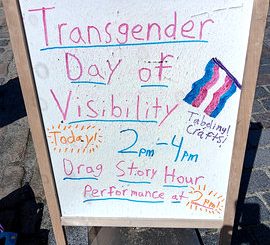
Brooklyn: Community mobilizes to protect Trans Day of Visibility event

Trans and queer activists and allies mobilized to defend a family Trans Day of Visibility event in Brooklyn, New York, on March 30. The event at Marsha P. Johnson State Park included arts and crafts, informational tabling, and a drag story hour for children and parents. The annual event was targeted for a second year by far-right anti-trans protesters. 

The community response was organized by NYC Queer and Trans Defense. This grassroots movement was created by activists in response to the growing number of fascist threats against queer events and venues, including drag story hour and Pride events at libraries, museums, and other public facilities in New York City.

Eight bigots showed up to protest the trans event, making hateful chants and waving signs like “God save our children” and a large U.S. flag. The goons would have been quickly dispersed and chased off by the defenders but were protected behind metal fencing by at least 12 armed New York State Troopers and parks police inside, as well as several NYPD cops stationed outside the park gate.

Outrageously, State Troopers and parks police brutally attacked a community defender, using the excuse that he briefly sat on the grass. The defender was jumped and wrestled to the ground by several of the armed goons, then handcuffed and handed over to the NYPD. He was taken to the 19th Precinct and released afterward with a violation – the kind of charge that would normally warrant a ticket, at most, not a violent arrest.

Despite this, community defenders successfully created a barrier of safety between the fascists and the families and performers who came out to the TDOV event. They held trans and other queer community flags and rainbow umbrellas, shook noisemakers, cheered, and sang to drown out the far right. 

Thanks to their efforts and the discipline of the parks’ workers and performers, the event went forward without any major disruptions.

The park that sponsors the annual TDOV event is named after Stonewall combatant Marsha P. Johnson, a Black trans woman who played a historic role in founding the modern LGBTQ+ liberation struggle. Together with Sylvia Rivera, Johnson founded Street Transvestite Action Revolutionaries (STAR) to protect trans street youth and fight for their voice within the early gay-lesbian rights movement.

International Trans Day of Visibility is marked every year on March 31. 

To get involved and learn about future actions, follow NYC Queer and Trans Defense on Instagram.

Strugglelalucha256


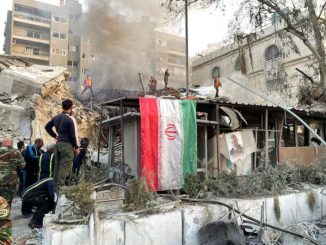
Israel bombs Iran embassy in Syria, escalating war

Israeli warplanes bombed Iran’s embassy in Syria on April 1. The strike, carried out by Israeli F-35 fighter jets, killed senior commander Brig. Gen. Mohammad Reza Zahedi, his deputy, Gen. Mohammad Hadi Haj Rahimi, Gen. Hossein Amirollah, and four other officers.

Other casualties included diplomats, military advisers, and Syrian police guarding the embassy.

Israel’s bombing of the Iranian embassy in Damascus, Syria, is the first time in modern history in which a state has directly targeted another state’s diplomatic facility in a third country (with the possible exception of the 1999 U.S. bombing of China’s embassy in Belgrade, Yugoslavia). 

The Israeli attack is a significant violation of international law.  Embassies are sovereign territories of the nation they represent under the 1961 Vienna Convention on Diplomatic Relations.

Israel has conducted numerous attacks in Syria and Lebanon. This strike marks the first Israeli attack on Iranian diplomatic territory.

The attack comes as the U.S. authorized a new arms shipment to Israel, including powerful bombs.

On March 29, the Washington Post reported: “The Biden administration in recent days quietly authorized the transfer of billions of dollars in bombs and fighter jets to Israel. … The new arms packages include more than 1,800 MK84 2,000-pound bombs and 500 MK82 500-pound bombs, according to Pentagon and State Department officials familiar with the matter. 

“The 2,000-pound bombs have been linked to previous mass-casualty events throughout Israel’s military campaign in Gaza.”

In addition, Politico reported on April 1 that the Biden administration is preparing a deal for another 50 new F-15 fighter jets for Israel along with 30 AIM-120 Advanced Medium-Range Air-to-Air Missiles and several Joint Direct Attack Munition kits, which turn dumb bombs into precision-guided weapons.

Israel has received more U.S. military aid — and more U.S. aid of any type — than any other country since World War II.

The Israeli airstrike on the Iranian consulate in Damascus appears to be a deliberate escalation. The U.S., along with Israel, is already engaged in a military campaign against Yemen as well as Syria, conducting airstrikes in Syria and Iraq in February.

Yemen is part of the Axis of Resistance to imperialism in West Asia that includes the Islamic government of Iran, the secular government of Syria, the Hezbollah movement in Lebanon, and popular militias in Iraq. 

Yemen’s military announced that it would block any ships bound for Israel from passing through the Red Sea. In response, on Jan. 11, the United States began conducting airstrikes against Yemen.

Strugglelalucha256
https://www.struggle-la-lucha.org/2024/04/page/6/