Russia: After the mutiny

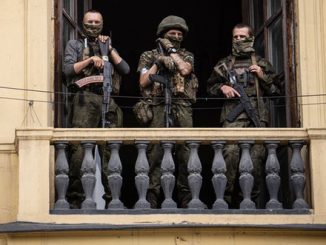
Wagner soldiers in the city of Rostov-on-Don, Russia, June 24, 2023.

June 27 — The armed mutiny carried out by a part of the private army of Evgeny Prigozhin, which for practically a full day allowed Ukrainian and Western experts and propagandists to present an image of Russia facing a coup, civil war, and the state in the process of implosion, continues to focus political debate in Moscow, Kiev and even in Western capitals. 

The events have also caused all kinds of speculations that have been fueled by the few details that are available so far, especially how the negotiation process that finally put an end to the rebellion took place and, above all, the actual terms of the agreement between the owner of Wagner and the Russian and Belarusian states. 

Throughout the last three days, all kinds of theories or desires have been heard that, from the Western side, have wanted to see in the Prigozhin rebellion the beginning of the end of President Vladimir Putin’s mandate or the collapse of the Russian war effort in Ukraine and, on the other, an operation planned by the Russian authorities, either to justify the dismissal of Minister of Defense Sergei Shoigu and/or Chief of the General Staff Valery Gerasimov or, even more improbable, to send Wagner’s army to Belarus without causing suspicion, perhaps even for an attack on Kiev.

It goes without saying that the dismissal of the defense minister or the chief of the general staff – both severely questioned for months due to the operational, logistical, and intelligence deficiencies that have weighed down Russian troops in the war – as the result of a mutiny organized by a private military company would have been a sign of weakness for Russia that it cannot afford. Last weekend showed the danger of privatizing the monopoly of violence and its delegation to private groups with their own economic and political interests and the risk implied by the dependence on external structures to compensate for the reduction in the number of troops in the professional army that has resulted from the reforms of the last three decades. 

This weakness manifested in the insistence of the Russian authorities, from the first moment of the rebellion, to guarantee soldiers’ immunity precisely to ensure that they could count on these troops at the front when Moscow could not afford to lose a large number of troops. The dismissal of Shoigu or Gerasimov, whose errors during the planning of the Special Military Operation and the development of the war could well justify their dismissals, would have further undermined the already battered image of the Russian state after an armed mutiny with a military convoy advancing on the capital. 

Hence, there was no mention of Shoigu or Gerasimov in the announcement of the de-escalation agreement, whose visible face was Belarus President Alexander Lukashenko, but in which other people participated, it has been learned, including the Tula Governor Alexey Diumin, whose name is one of the favorites to replace the minister of defense.

Lacked political support

In the hours after the agreement that put an end to an armed mutiny that has revealed the contradictions of a Russian state little prepared to deal with the political consequences of the war, a person with clear economic and political aspirations, Evgeny Prigozhin, has sought to bring the discourse into his territory. It is there, in the media field, where Prigozhin has managed to gain a presence and prominence, that he has subsequently tried to translate into control and levers of power. 

In his first communication after the end of the armed episode, the owner of Wagner insisted on the main points he had maintained last Saturday and fell back into the same contradictions. 

The speech by Vladimir Putin, who did not even want to mention Prigozhin’s name, in which he called the events that were unfolding treason, eliminated any possibility that the owner of Wagner could obtain relevant political support. Winning Putin’s support may have been the goal of Prigozhin, who has been seen in the past as close to the Russian president. 

However, this mutiny caused a rapid alignment of all the relevant political forces on the part of the state and its commander-in-chief. Without political support and amidst the disbelief and even apathy of the population, only explicit support from a part of the regular army could allow Wagner to achieve its objectives. 

Prigozhin insisted yesterday that his actions did not constitute a coup, nor was his objective the overthrow of the political regime. It is not difficult to see that the movement was not seeking to do away with Vladimir Putin, to whom Wagner’s owner had repeatedly sworn allegiance, but rather against the defense ministry and general staff. Putin’s speech and the complete absence of any show of solidarity with Wagner from the regular army or even the Donetsk and Lugansk People’s Republics leaves no room for Prigozhin to now insist on that failed goal. 

Hence, Wagner returns to the idea of a “march for justice” and insists on using arguments of doubtful credibility. In his communication yesterday, Prigozhin claimed to have given “a master class on what Feb. 24 [2022] should have been like,” a questionable argument considering that his troops fell into similar mistakes. 

Hoping for social and political support and backing from part of the Ukrainian army that never came, the Russian troops advanced towards Kiev without the necessary air cover and were exposed to the enemy. The apparently rapid initial advance, even with practically no resistance, did not bear fruit, and without achieving their objectives, the Russian troops had to turn around and return to their bases, just as Wagner’s troops did some 200 kilometers away from the Russian capital – at least in Prigozhin’s version. 

As Shoigu did at that time, Prigozhin also tries to claim to have fulfilled his objectives, something obviously false as long as there are no changes in the defense ministry and general staff.

What happened on Saturday, the movement of a significant amount of troops and equipment, apparently orchestrated by Dmitry Utkin, a figure even more obscure and politically even more to the right than Prigozhin, requires planning that directly conflicts with the motive alleged by the owner of Wagner to begin the rebellion. 

To justify the mutiny, Prigozhin alleges a bombing [by the Russian army against Wagner]  that, he says, took place on Friday and cost 30 lives, a fallacious argument considering that Western intelligence agencies had detected the preparation of the mutiny several days before. Why Russian intelligence did not detect it is another question that remains in the air. 

Wagner’s owner, who also alleges massive support from the population that simply did not exist, insists on blaming the Russian Air Force for the blood spilled. Prigozhin claims that his troops shot down several Russian VKS helicopters due to their shelling. Wagner’s owner lies: A large part of the destroyed planes were attacked on the ground, something that has caused enormous anger in Russian aviation, which wonders who will have to pay for the destroyed planes.

Bargaining power

The fog of war of this grotesque spectacle has not yet dissipated, and many speculations persist. One of them, the fate of Wagner’s foreign missions, was revealed yesterday. Although the Russian legislature has stalled the study of the law that was intended to regulate the operation of private security companies until further notice, Foreign Minister Sergey Lavrov affirmed yesterday that the services that Wagner’s mercenaries provided in countries such as Mali or the Central African Republic will continue. 

In these cases, security services provided by soldiers of Russian origin are both a support to those states in their attempt to stabilize complex situations – in which Wagner has been accused, in many cases with evidence, of serious crimes – and as a form of Russian presence on the continent. Both aspects make Wagner’s soldiers necessary to the Russian state, especially as it tries to win allies far from the West. However, it must also be remembered that Wagner’s operations in Africa are limited, as shown by the number of troops stationed there: about 400 in Mali or 1,400 in the Central African Republic. 

The importance of the company in these missions is an ace up Prigozhin’s sleeve that he will now try to use to his benefit as he tries to maintain control, direct or via proxy, over this lucrative foreign business. 

In his statement, Prigozhin also claimed to have saved Wagner from being liquidated, not only by imaginary bombing but also administratively. However, as expected based on the words and actions of the Russian representatives, Wagner’s future as a group in Russia has been put on hold. In a speech late in the evening, his first appearance since his nervous speech on Saturday, Vladimir Putin gave Wagner’s soldiers three options: Sign a contract with the defense ministry, return home, or move to Belarus. Everything indicates that Wagner will thus be dispersed among different units of the Russian regular troops or sent abroad.

Prigozhin is aware that the shortage of troops to maintain his war effort in Ukraine and Syria and the presence in Africa make his company necessary, an argument that has given him some bargaining power even despite his mutiny. However, it is also significant that, despite what was stated on Sunday, the case initiated by the Federal Security Service against Prigozhin has not been closed. This open case means the possibility of an immediate arrest and extradition to Russia if the businessman doesn’t comply with his part of the agreement.

Translated by Melinda Butterfield

Source: Slavyandgrad.es

Strugglelalucha256


Why Europe, U.S., China and Russia are not the same for Latin America

For some time, I have been listening to a sector, supposedly on the left, say that they do not want European, U.S., Chinese, or Russian empires.

And, to this, I reply that I don’t see the relationship between the four of them. We Latin Americans have a very well-documented history of colonization, exploitation, and occupation with Europeans and North Americans, but not with China and Russia.

It was not the Russians or the Chinese who invaded the continent and began the colonization process from 1492 that produced one of the largest genocides of Indigenous peoples in history, but rather the Europeans: Spanish, English, French, Portuguese and others who also joined in the distribution of the spoils.

It was not the Chinese or the Russians, but rather the European colonizers who, starting in the 1600s, established the transatlantic triangle of the slave trade between Africa, Europe and the Americas, through which millions of Black Africans were hunted and transported to our continent in chains, subhuman conditions and true savagery, to sell them as recyclable products throughout our continent.

It was not the Chinese or the Russians who, in 1823, established the Monroe Doctrine, which states that the U.S. will not allow any occupation of American territory by Europeans after its independence and that America is for the Americans; but what it really means is that Latin America and the Caribbean are the backyard of the North Americans and belongs to them by the grace of Manifest Destiny, which is an extension of the Monroe Doctrine.

It wasn’t the Russians or the Chinese who stole half of Mexican territory. It was the U.S.

It was not the Russians or the Chinese who destroyed and economically seized Haiti, but rather the Europeans and the North Americans, since they have never forgiven that dignified country for having been the first Republic of Black slaves to become independent from a powerful empire like the French.

It was not the Russians or the Chinese who imposed the economic, diplomatic, and genocidal blockade against the socialist people of Cuba since 1960.

It was not the Russians or the Chinese who turned our countries into banana republics and who overthrew popular and socialist governments, such as that of President Jacobo Árbenz in Guatemala in 1954.

It was not the Russians or the Chinese who implemented Plan Condor in South America, which left more than 30,000 missing, nor was it the KGB that assassinated President Salvador Allende, but rather the CIA.

It was not the Russians or the Chinese who implemented the Contra plan in Central America to put an end to the Sandinista and FMLN revolution.

It was not the Russians or the Chinese who imposed on us the School of the Americas that trained the worst military dictators in history, such as Pinochet, Trujillo, Ríos Montt, and the Honduran coup general.

It is not the Russians or the Chinese who have more than 800 military bases around the world. They do not participate in NATO. Nor are they the ones who control the Southern Command. 

Neither the Chinese nor the Russians imposed on us the Soto Cano or Palmerola air bases in Honduras, which are the largest in Central America, as well as 12 additional military bases scattered throughout the country.

It is not the Russians or the Chinese who practice the doctrine of the stick, who remove constitutionally-elected presidents at their convenience and impose dictatorships on us at will to steal the land and natural resources such as gold, silver, oil, lithium, gas, etc.

It is not the Russians or the Chinese who impose unilateral, coercive, and illegal economic measures, also known as economic sanctions, on sovereign countries and those that resist, such as Venezuela, Nicaragua, and other countries of the world.

It is not the socialist system of the Chinese, and it was not the socialist system of the USSR that turned us into exploited and impoverished countries. Rather it was the capitalist, imperialist, colonialist, and neoliberal system of privatization that favors banks, private companies, transnationals and capital over human beings, their basic needs and nature.

So when you hear someone who calls themself a leftist say nonsense like in Latin America we don’t want empires, neither Europeans, nor North Americans, nor Russians nor Chinese, please send them to review the history and foreign policy of Europe and the United States in our continent and also the foreign policy of Russia and China with Latin America so they can see the difference.

It is time for that part of the left that repeats the media propaganda of the right to learn its history so that it stops playing the enemy’s game.

The writer is coordinator of Partido Libre D19 USA-Canada.

Translated by Melinda Butterfield

Strugglelalucha256


New York: Queer Liberation March defends trans lives

Thousands of people flooded the streets of lower Manhattan on Pride Sunday, June 25, for the fifth annual Queer Liberation March. This year’s theme was “Trans and Queer, Forever Here,” in defiance of the more than 500 anti-trans, anti-LGBTQ+ bills and growing street violence targeting the community coast-to-coast.

Chants of “Queers don’t deny it! Stonewall was a riot!” and “Bottoms and tops, we all hate cops!” rang out as the marchers wound their way from Foley Square up Sixth Avenue to Washington Square Park. The Reclaim Pride Coalition launched this “No Cops, No Corporations” alternative to the traditional New York Heritage of Pride Parade five years ago to honor the 50th anniversary of the Stonewall Rebellion.

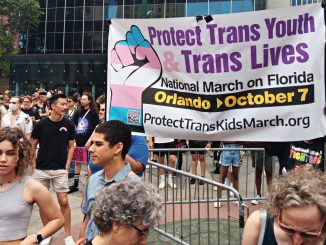
Activists from Women in Struggle-Mujeres en Lucha held a banner and gave out hundreds of leaflets for the Oct. 7 National March to Protect Trans Youth and Speakout for Trans Lives in Orlando, Florida. Socialist Unity Party members also distributed hundreds of Struggle-La Lucha newspapers with the headline, “March on Florida: Resist the ban on trans lives.”

The Reclaim Pride Coalition is an endorser of the Oct. 7 National March. For more information, to add your endorsement and get involved, go to ProtectTransKidsMarch.org.


Strugglelalucha256


Organizers assemble conference to resist DeSantis, establish Emergency Committee to Defend the Tampa 5

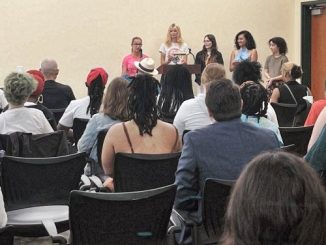
Tampa, Florida — On June 24, over 130 people packed the Maureen Gauzza Library in Tampa early Saturday morning to join in the fight to defend the Tampa 5, activists charged with felonies, some facing up to ten years in prison for exercising their free speech rights.

An aim of the conference was uniting progressive people and movements to fight for civil liberties in Florida and against the reactionary agenda of Governor Ron DeSantis.

Attendees joined three panel discussions titled: “Florida Students Fight to Save Public Education,” “Unions: A Worker’s Last Defense Against DeSantis,” and “Civil Liberties in the Age of Ron DeSantis.” These panels featured students, workers, union leaders, community activists, and members of the legal community, who urged resistance to attacks by Ron DeSantis and his reactionary cronies.

Frank Chapman, executive director of the National Alliance Against Racist and Political Repression, keynote speaker of the conference, and political prisoner himself, made the point about the Tampa 5 defending themselves from a police assault, saying, “that’s what you’re supposed to do when someone attacks you – fight back.” He also vowed, “We’re gonna make the case of the Tampa 5 a national priority.” Summing up the theme of the conference, he explained, “We say the power of the people is greater than the people in power.”

The case of the Tampa 5 stems from a protest held on March 6, when a few dozen people led by Students for a Democratic Society at the University of South Florida held a protest against House Bill 999, which, among other things, is set to dismantle ethnic studies and mandate discrimination in higher education. Intending to meet with the president of the school, as is their right, they were instead met with police brutality, and lethal chokeholds. Four protesters were initially charged with felonies, and one retroactively charged later. Most of the Tampa 5 are facing up to ten years in prison.

Chants of “Down with DeSantis!” and “Protesting is not a crime, justice for the Tampa 5!” electrified the crowd and exemplified the unity and resistance that these attacks on civil liberties have sparked.

Student panelists spoke about the attacks on educators and educational freedom, through political appointments at institutions like New College of Florida, as well as LGBTQ students and teachers, through both iterations of Florida’s “don’t say gay” bill, the firing of LGBTQ educators, and the whitewashing of history of the crimes of national oppression and slavery.

Panelist Isis Mack, of Black Lives Matter Grassroots, put it simply, “We’re going to get this education whether he [DeSantis] wants it or not.”

The labor panel struck a militant tone, emphasizing the interconnection of the student, progressive and labor movements, as president of the West Central AFL Labor Council Jim Junecko stated, “Political activism and labor activism go hand in hand.” He went on to say of workers’ rights, “Nothing was ever given, it was taken,” through that activism. Speaking of DeSantis himself, he pointed ouot, “He’s afraid of regular people uniting – he’s a coward.” Panelist Chrisley Carpio, one of the Tampa 5 herself and AFSCME member who was unjustly fired, said that the university tried to cut her off from speaking with her union, hoping to isolate her, and that if she hadn’t known her Weingarten Rights, she would not have known what options she had to fight back against the school’s attacks.

DeSantis, through his attacks on students, educators, workers, LGBT folks, reproductive rights, the Black Liberation Movement and immigrants, among others, had brought together this diverse coalition to oppose him and join the movement.

James Shaw, with the American Civil Liberties Union, spoke about how the restriction of voting rights against felons dates back to the Reconstruction era, where African Americans were slapped with bogus charges and disenfranchised as a matter of course. Alice Moore of community group Florida Rising then pointed out that today, voting precincts are regularly moved around to make it harder for African Americans to vote, while Laura Rodriguez of Tampa Bay Community Action Committee talked about the ballot measure to restore voting rights to felons that passed in Florida, “We voted those rights back, and then a year later, the state turned around and said you have to pay every fine.” Emphasizing other methods of struggle, Rodriguez also said, “Our main way of fighting back is by getting on the streets.”

After the panels, solidarity statements from 27 different groups were read, many detailing other cases of political repression, from the case of USF Professor Sami Al-Arian given bogus terrorism charges, to the raid against the African People’s Socialist Party and the pending case against the Uhuru Three, to the attacks on Tally 19 protesters, Minnesota abortion rights activists investigated by the FBI, charges against cop city protesters in Atlanta, the FBI investigation into anti-war activist Joe Lombardo, and grand jury and FBI raids directed against the Antiwar 23.

It was clear from these statements that the ruling class of the United States uses political repression regularly to try and crush peoples demands, but that people across the country have the backs of the Tampa 5.

Closing out the conference were resolutions, to demand freedom for and an end to all bogus political charges against protesters and activists, and to launch the Emergency Committee to Defend the Tampa 5, to make court dates for the Tampa 5 days of protest, starting with July 12 (the five’s next court date), and to organize a speaking tour of the Tampa 5 to raise the profile of the case to drop the charges.

The battle against political repression might seem daunting, but in the words of Duval Coalition of Rank and File Educators member Monique Sampson, “The flames of the peoples’ movement burn brighter than the fires of repression!”

Source: FightBack! News

Strugglelalucha256


State sponsor of peace: Cuba and the Colombia ceasefire

The bipartisan nature of imperialist aggression toward Cuba has never been more evident as President Joe Biden carries forward the Trumpist assault on Cuba via the U.S. State Sponsors of Terrorism (SSOT) list. 

In the closing weeks of his term, Donald Trump shut down what seemed to be the beginning of a U.S. rapprochement with Cuba started by the Obama-Biden administration. Obama removed Cuba from the SSOT list, but Trump reversed that decision and added 243 more economic sanctions. 

While campaigning for the White House, Biden had promised to “promptly reverse the failed Trump policies” against Cuba. Nearly three years later, Cuba is still suffering under the weight of the U.S. trade blockade, now worsened by the SSOT.  Some 70 international banks cut ties with Cuba within weeks of Trump’s actions, making it all but impossible for Cuba to buy badly needed goods on the international market.

Joe Biden taking no action to separate his administration’s policy toward Cuba from Trump’s is an affront to the sentiment of the entire world. UN votes have condemned the U.S. trade blockade thirty times in annual lopsided votes in which the U.S. has never mustered more supporters in favor of the blockade than in the single digits while the rest of the world voted to end it. 

Likewise, polls taken a few days after Obama’s 2014 visit to Cuba showed that a majority of people in the U.S. support normalization of relations and an end to the failed campaign of economic punishment.

Cuba hosted talks

Cuba has been hosting talks to bring an end to the bloodshed in Colombia since 2012. In the twisted line by the White House, Havana is accused of supporting terrorism because it rejected attempts to sabotage the process that offers hope for the people of Colombia. 

Cuba refused to extradite ELN (National Liberation Army) peace negotiators to their home country. Former Colombian President Ivan Duque — a right-wing, pro-imperialist politician — had demanded the extradition. His demand and Cuba’s refusal provided the Trump-Biden bogus justification for having Cuba on the SSOT list. The lie was exposed on June 9 when the ELN and the government of Colombia agreed to a ceasefire.

In 2022, former guerilla fighter Gustavo Petro was elected president of Colombia. Within days he canceled arrest warrants against ELN fighters and resumed negotiations. He traveled to Cuba this week to participate in the ceremony announcing the important breakthrough.

This follows previous agreements between the Colombian government and the Revolutionary Armed Forces of Colombia (FARC.) Each of these guerilla armies has fought a long struggle to end the aggression and domination of the U.S. and build a new Colombia that would eradicate the deep, widespread poverty in Colombia. 

Their forces have numbered at times in many tens of thousands of fighters, and they have held wide swaths of Colombia’s territory. In exchange for the cessation of armed struggle, the agreements have yielded concessions that offer hope for the needs of 40 million Colombians.

It was the U.S. that had been funding, training, and providing arms to the Colombian military and death squad paramilitary forces for decades. The U.S. aimed to pacify the powerful people’s struggle in Colombia and transform the country into a U.S. watchdog in Latin America. Under previous pro-imperialist administrations, Colombia launched failed attacks to sabotage the revolutionary process in Venezuela and sent troops to Ecuador to attack ELN combatants. Colombia’s continued alignment with the U.S. meant more sabotage, clandestine actions, and warfare against neighbors.

With the election of President Petro, and the supportive role played by Cuba, the peace negotiations in Havana are a threat to U.S. designs on Colombia. Keeping Cuba on the SSOT list serves two purposes for the U.S. – to strangle the Cuban economy and to try to salvage their campaign to destroy peoples’ resistance and turn Colombia into the Israel of Latin America.

Reagan, Clinton funded right-wing paramilitaries

Cuba was initially added to the SSOT by the Reagan administration as tens of thousands of workers, peasants, religious activists, and guerilla fighters were murdered in Nicaragua, El Salvador, Guatemala, and Bolivia during the 1980s. In 1994 U.S. President Bill Clinton launched “Plan Colombia,” which was hyped as a mission to eradicate the drug trade. 

Officially it ended in 2015. Billions of dollars that could have housed people or repaired schools, or provided medical care at home, financed this campaign of terrorism. U.S.-funded, right-wing Colombian paramilitaries murdered homeless people on the streets and Colombia led the world in the murder rate of trade unionists. The UN reported that 260,000 Colombians were killed, 88% were killed by the Colombian military and paramilitaries. They also reported absolutely no change in the drug market. The CIA has been pegged in scandals involving the import of cocaine.

Plan Colombia is only one episode in the long history of U.S. terror against Latin America and others worldwide. Cuba’s refusal to extradite peace negotiators to face the wrath of a U.S.-funded client government was righteous. Cuba is not a terrorist state.

Activists across the U.S. are taking action to demand that Biden pick up a pen and write a letter instructing Congress to take Cuba off the State Sponsors of Terrorism list. Check out NNOC.org to find out where, when, and how you can get involved. 

Strugglelalucha256


New York City says NO! to the U.S. blockade of Cuba

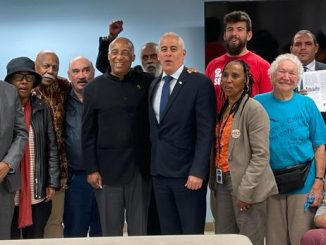
The New York City Council unanimously approved a resolution on June 22 calling for an end to the cruel U.S. economic blockade of Cuba. The next day a news conference was held in front of City Hall to celebrate this victory.

Omowale Clay of the December 12th Movement and Chief of Staff to Council member Charles Barron chaired the briefing. He called it an “important victory” that the Council representing 8.5 million people came out against the blockade.

“This blockade must stop,” declared Council member Charles Barron, who was the resolution’s prime sponsor. Other elected officials who spoke included Council members Alexa Avilés and Julie Won.

Barron pointed out that resolution 0825-A also demanded that Cuba be taken off the bogus U.S. State Department list of “State Sponsors of Terrorism.” Barron said that the apartheid state of Israel should be on the terrorism list instead

It’s Cuba that’s been the victim of U.S. government-sponsored terror. Among the thousands of Cubans killed were the 73 Cubana de Aviación Flight 455 passengers, who were murdered by a bomb on Oct. 6, 1976.

The CIA director at the time was future President George H.W. Bush. The bombing was retaliation for Cuban soldiers helping to defend Angola against the neo-Nazi armies of then apartheid South Africa.

Barron told of meeting two of his constituents from the Brooklyn neighborhood of East New York who are being trained as doctors in Cuba for free. 

Rosemari Mealy, Ph.D., JD, who worked tirelessly as a member of the New York / New Jersey Cuba Sí Committee to get the resolution passed, said that we were in “for the long haul.” She said the U.S. government “was intent on starving the people of Cuba.”

The more than 60-year-long blockade not only curbs U.S. trade with Cuba. It also penalizes other countries trading with Cuba, hindering imports of food and medical supplies, including syringes used in vaccinations.

Coast-to-coast movement defending Cuba

Ninety-one cities have come out against Washington’s cruel blockade of Cuba, including the city council of Washington, D.C.

Unions have also come out in defense of Cuba. The Professional Staff Congress, representing thousands of workers at the City University of New York, has demanded the blockade be lifted. A PSC representative spoke at the news conference.

Brother Shep McDaniel, an original Black Panther, described Cuba as a Pan-African nation. He saluted Cuba for giving refuge to fellow Panther Assata Shakur. The FBI has placed a two-million-dollar bounty on this freedom fighter who became a medical doctor in Cuba.

Attorney Joan Gibbs announced that Gail Walker, the executive director of the Interreligious Foundation for Community Organization (IFCO), had been arrested in Senator Robert Menendez’s office.

Walker and two other activists, who were also detained, were simply trying to meet with Menendez, who wants to strangle Cuba.

Roger Wareham of the December 12th Movement praised the role of Cuba in the international arena, always standing on the side of poor people. “Cuba exports solidarity,” said Jacob Buckner of the Young Communist League.

A representative of the Democratic Socialists of America spoke. Two DSA  members of the City Council supported the resolution.

Bill Dores of Struggle-La Lucha newspaper praised all those who worked to get the resolution passed. He thanked Charles Barron “as the only elected official who had the courage to go to Gaza and break the Israeli blockade.”

Dores said President Biden “should stop following in the footsteps of Trump … and in the footsteps of Thomas Jefferson who sanctioned Haiti when they overthrew slavery …

“The sanctions on Cuba are sanctions on low rent housing, they are sanctions on free health care, they are sanctions on free college education. … [Cuba] has no rent guideline board that raises the rent for corporate landlords in Cuba.”

Afterward, a delegation from the Cuban Mission to the United Nations, including Deputy Foreign Minister Gerardo Penalver Portal and Ambassador Yuri Gala Lopez, gathered with Council member Barron and solidarity activists in the City Council offices at 250 Broadway. 

Hands off Cuba! End the blockade!

Strugglelalucha256


Seattle longshore worker on the meaning of Juneteenth

The morning of June 19, 2023, Local 19 led a Stop Work action in honor of Juneteenth. June 19, 1865, the calvary rolled into Galveston, Texas, and freed those slaves after 2 1⁄2 years of the employer refusing to abide by the Emancipation Proclamation. This is a day long celebrated by African Americans, but only recently became a federal holiday and popular to celebrate in the mainstream. Local 19 has had an action every year since 2020.

Video: https://www.instagram.com/tv/CtsABS6K_He/?igshid=MTc4MmM1YmI2Ng%3D%3D

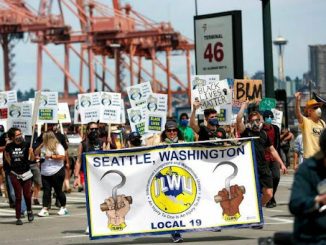
The march left the Local 19 hall at 10 a.m., 120 strong, a dozen of which were children. Various unions and organizations brought their banners to follow behind ILWU Local 19’s: OWLs, Transit Union Local 587, and UAW 4121. Various others brought their signs and swag, including the IBU, Freedom Socialist Party, Reproductive Justice, UFCW 3000, UFCW 21, and NW Carpenters Union. We walked about 1.4 miles while chanting, “Jeff Berry, say his name, Anthony Lemon, say his name, Ronnie Thomas, say his name! PMA say their names!” These are the names of three Black men from Local 19 that died from COVID during the pandemic. We worked valiantly through the pandemic and took heavy losses. We will not forget.

After marching for about 40 minutes, participants were greeted with the sounds of C.T. Thompson and the Classic Soul Band crooning “A Change is Gonna Come,” along with water and refreshments. Those already at the rally bumped the number of participants up to about 200. After two more songs from the band, the 2-hour program began, which would include 16 speakers with song breaks in between.

Speakers climbed handcrafted stairs onto a secure flat rack with a banner below that read in big orange letters, “ALL WORKERS WIN WHEN SLAVERY ENDS.” Ricky Reyes spoke from WA NA WARI, an organization that promotes Black ownership of the preservation of their culture. Ricky said, “When we look at all the people who do this work a lot of the time none of them really look like us. They don’t come from our own communities … we want to look at how Black folks can take history keeping into our own hands and collect stories about us for us and archive them in our own communities.” I include this quote because there I was, sitting in the front row being reminded of my whiteness as a lead organizer of this Juneteenth event. I think we need to constantly remind ourselves, those of us that are white, to uplift Black folks and people of color, let them lead, and continue to educate ourselves.

The Black Prisoners Caucus, formed over 50 years ago inside Washington State prisons, spoke, “They created the 13th amendment, which supposedly freed people, but they slid in that clause that allowed prisoners to work for free. Does anyone know how much a prisoner makes in Washington state? $0.30/hr. After six months, you get a raise. You know how much the raise is? $0.06 … and you top out at $0.42” They requested help from the labor movement. Incarcerated people making pennies an hour is a labor issue.

A professor from the University of Washington Department of Labor Studies Moon-Ho Jung said, “Every fall I ask my students at UW this question: Who was the most responsible for the abolition of slavery? Usually more than half write down the answer that we are taught to believe and that answer is Abraham Lincoln. He supposedly freed the slaves by signing the Emancipation Proclamation on Jan. 1, 1863. The answer that generations of American historians have tried to ignore and dismiss is — the people most responsible for the abolition of slavery were the enslaved Black people themselves.” He called it one of the greatest slave rebellions in world history and quoted W. E. B. Du Bois, who said it was the general strike of a half million Black workers.

Thanks to the different unions and organizations who showed up for this event. Along with all the wonderful speakers and the band. To be successful in our labor movement, we need to incorporate community and other organizations in addition to other unions. The Juneteenth Committee to Stop Police Terror and End Systemic Racism is longshoreman-led but comprised of different unions and organizations, and that is what made this event possible. Thanks to our committee members and chair, Gabriel Prawl – Vice President of Local 52, who has been an invaluable resource to me personally and who has taught me what a good leader is. He is extremely well qualified and has a decades-long record of passion and experience in the labor movement. These Juneteenth events would not be possible without a leader of his caliber. The full video of the march and rally can be found on our Instagram @stoppoliceterrorseattle

Alia Lighter, from ILWU Local 19, is a member of the Seattle Juneteenth Committee to Stop Police Terror and End Systemic Racism organizing committee.


View this profile on Instagram


Stop Police Terror Seattle (@stoppoliceterrorseattle) • Instagram photos and videos

Strugglelalucha256


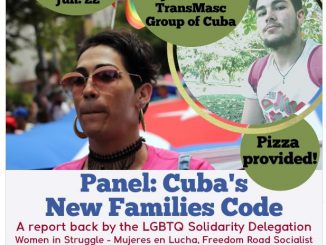
LGBTQ+ Cuba delegation report back forum

June 22, New Orleans – NOLA participants of the Cuba delegation, U.S. Friends Against Homophobia and Transphobia, gave a report back on their recent experiences in Havana. This forum was part of the National Network on Cuba’s Off the List Action Weekend. Verde Gil Jímenez — a young communist, transmasculine organizer from Cuba — joined the panel live and gave the following presentation.

Video:

RealNameCampaign on Instagram: “LGBTQ Cuba delegation report back forum”

Hello colleagues. My name is Verde. I am a Cuban trans activist and a member of the Union of Young Communists. I’m 25 years old. I am a graduate of social communication. I currently work at the Central University of Las Villas as a social researcher. I live in a city in the center of the island called Santa Clara. I was regional vice coordinator of the Transcuba Network for a year and currently coordinate the Grupo Trans Masculino de Cuba (GTMC).

Transmasculine activism is a fairly recent development in my country. We are quite few and inexperienced. So we are slowly taking steps.

We created our Group at the beginning of the year [2023] with the intention of it being a place of support and learning for the transmasculine community because although there was a National Network of trans people for 20 years, its agenda focused almost exclusively on the demands and experiences of transfeminine people.

In less than a year with our group, we have achieved the following:

  • Participated in: workshop on liberating masculinities with a feminist approach; in the conference against homophobia and transphobia (Cenesex); in the conference on maternity and paternity in equity (Cenesex); in a theological workshop on gender and diversity (Movimiento Estudiantil Cristiano); in a photographic exhibition on non-hegemonic masculinities, in a course on sexual education with second-year students of the medical school.
  • We have created spaces for the art of male drag.
  • We have held forums on various topics in our WhatsApp chat.
  • We have held exchanges with different official and alternative media to visualize trans issues.
  • On March 31, we held a film debate on trans childhoods.
  • We have delivered donations of binders and clothing to trans from the three regions of the country.
  • We have organized recreational activities for familiarization.
  • We have designed educational products on how to accompany trans students and practice the cytological test on trans people AFAB [assigned female at birth].
  • Permanently offer counseling and personalized advice to face difficult situations, effective support, legal guidance, and medical guidance on the transition process.
  • We are currently organizing a community sale fair to raise funds to help the most needy people in the group.

For the short time that our group has been in existence, we believe that we are achieving good results and that, most importantly, we no longer feel alone.

Regarding the problems of trans people in Cuba, they are similar to those that most trans people face in Latin American countries.

It is true that the project of the Cuban Revolution, from its beginnings, sought to vindicate the role of women in society and supported the historically oppressed and marginalized sectors. However, it is still a very young project to banish all machismo, homophobia, transphobia, and sexism from our culture. They are very deep cultural roots from the colonial era.

It is worth celebrating that in recent times, after the constitutional reform of 2019, our country has generated a normative production that recognizes a series of rights for the benefit of trans populations (despite the fact that the term trans people is not expressly mentioned in any text).

It is of special importance the recognition from the constitution of the right to equality and non-discrimination based on gender identity and the right to the free development of personality.

The family code is also outstanding, which allowed equal marriage and recognized parental responsibility and the progressive autonomy of childhood. This progressive code grants an arsenal of protections in the family environment that favors affective, safe, and respectful environments for all people and family models.

In addition, there are pending reform laws that have also announced that they will recognize more guarantees for the trans community: Identity Law, Labor Code, Education Law, Health Law.

But we know that political will and written laws are one thing, and  the materialization of those rights is another. Unfortunately, there is still a lot of transphobia in our country, based on a high level of ignorance about trans identities and naturalized machismo.

On the other hand, the economic crisis generates serious infrastructural obstacles for these rights to be effective. This crisis has been aggravated by phenomena such as the COVID-19 pandemic, in which our country devoted its greatest efforts and resources to saving people’s lives by producing three excellent vaccines that are a lesson in humanism for the entire world.

Another of our permanent obstacles, and in recent years strengthened by the resurgence of neo-fascist governments, is the genocidal blockade of the U.S. government towards Cuba that causes losses of unquantifiable figures and hundreds of limitations for our free technological, commercial, scientific, and cultural development.

I take this opportunity to request the end of the blockade and denounce the cruel policy of the North American government towards our country. Their aggressions also fall on the lives of LGBTIQ+ populations. Trans people are also victims of North American politics.

One of the fundamental demands of trans people is access to comprehensive medical coverage for the transition process. I am referring to specialized consultations and access to hormonal therapies and gender reaffirmation surgeries.

In Cuba, for decades, there has been a commission of experts for these issues led by Cenesex. But the economic crisis has greatly affected our public health and has generated a serious lack of medical supplies and human resources. We are living in very difficult times because one of the most important achievements of the Revolution is being affected.

Currently trans people:

  • We cannot attend to the specialized psychological consultation because there are no mental health specialists to attend to us.
  • We cannot perform endocrinological medical check-ups to start or sustain hormone therapy because there is a lack of reagents for blood tests.
  • There has been no sale of hormones in pharmacies for more than three years because, apparently, Cuba lost its trading partner to import hormones.
  • Access to gender reaffirmation surgeries is practically impossible. In the case of transmasculine people, for nine years, mastectomies have not been performed because there are no doctors trained in this type of surgery.
  • In addition, services are still centralized in the capital. That is, a person from any region must travel to Havana to receive these attentions.

One of the consequences of all this is that trans people buy hormones on the black market from unreliable suppliers and at costs that triple the average salary. And that people consume these drugs without medical supervision.

The saddest thing is knowing (firsthand) that before the Donald Trump government and the COVID-19 pandemic, several of these obstacles did not exist. At that time, there were sales of hormones in the pharmacy at insignificant prices, and we had psychological and endocrinological care, perfectible but systematic.

We are clear that it is very difficult for our government and our institutions to worry about issues of social minorities when they have to invest in urgent issues that affect the vast majority, such as food sovereignty (food production). It is very difficult to advance in the midst of a multidimensional crisis and a constant imperialist siege. Because it would be unfair not to warn that although all the problems are traversed by our economic barriers, some of them could be solved more easily, and this is not the case due to a lack of awareness and will.

To name a few:

  • Lack of training and awareness about trans people by legal operators (jurists, notaries, lawyers, judges, mediators). Here we highlight the persistent barriers to legal name change for trans people. Bureaucratism, corruption, and ineptitude of civil status registrars.
  • The still non-permission to wear a school/work uniform according to the gender identity of the student/worker.
  • The lack of a Comprehensive Sexuality Education in which the various sexual orientations and gender identities are discussed from an early age. As well as the lack of protocols to accompany the trans student.
  • Provisional shelters for victims of gender-based violence in the family.
  • Scarce and stereotyped representation in the national cultural industry (film, television, theater, cartoons, etc.)
  • Lack of updated regulations that clarify how trans people entering compulsory military service or sports teams or prisons will be integrated and respected.

Due to all these problems, we believe that it is fundamental to be united and articulate initiatives that promote a humanist culture, peace, and equity, in favor of the social integration of sex-diverse populations.

As communist militants, my sources of inspiration are in the ideals of Marx, Fidel, Che, Rosa Luxemburg. Those who, beyond their contexts, always advocated for a world where people were increasingly emancipated from the mechanisms of oppression that the colonial-capitalist society has imposed on us.

I am clear about the dangers of carrying out a fight of this nature. There are not a few questions that from conservative and dogmatic positions (even amongst militants) are exercised to dismiss the validity of our activism.

I also understand that fears are not unjustified. It is true that social denunciations in Cuba are frequently used by the hate industry of the enemies of the Revolution (citizen movements manipulated by subversive organizations at the service of Washington’s interests). It is also true that LGBTQ+ activism is being instrumentalized and fetishized for neoliberal, commercial, and political purposes.

And we, as a socialist project, cannot reproduce these formulas, but we must take advantage of the contradictions of capitalism that are revealed with our struggles to dismantle with more force that enslaving value scheme and those logics of privatization for an alternative society.

I defend the need to nurture communist militancy with a gender approach, as well as to address the problems of the trans community from a socio-class and Marxist analysis that allows us to understand where inequalities arise from and how the capitalist system perpetuates them. I believe that achieving this would make it possible to overcome prejudices and at the same time strengthen the common struggle that must put an end to the division of social classes, the social and sexist division of labor and, above all, the different hegemonies with their macro and micro powers to exercise violence against minorities.

As Rosa Luxemburg said: to build a world where we are socially equal, humanly different, and totally free.

The road is long, but we trust that we will not advance alone. We have the advantage that the Cuban Revolution has founded a very valuable fabric of social and mass organizations and public institutions, with which we can articulate to design new projects and find solutions. It is a matter of knocking on doors and mobilizing consciences. We have forged ourselves in a country where something that has not been lost is the spirit of resistance and solidarity.

I have tried not to go on too long, but it is always very difficult for me because there are many edges. I thank you from the bottom of my heart for the attention you have given me. I am going to post some messages in case you want to show solidarity with our Group. Any questions you have, you can ask me!

Strugglelalucha256


Puerto Rican organizations testify before UN Decolonization Committee

This past week, the UN Decolonization Committee held a hearing on what has been called the Puerto Rico case on Puerto Rico’s inalienable right to self-determination and independence.

Since the UN passed Resolution 1514 (XV) in 1960 for the eradication of colonies, recognizing independence as a fundamental human right, and in accordance with the UN Charter, 41 hearings have already been held on our case.

Recall that the U.S. disguised the colonial state of PR by naming it a Commonwealth in 1952 so as not to have to report to the United Nations. But this farce was unmasked in 2016 when the U.S. Supreme Court concluded, in a double exposure case, that it is the U.S. Congress who rules in PR. Since then, in PR, it is no longer only independence that speaks of colony.

Over 60 organizations from PR and its diaspora read papers opposing the colonial state. Even annexationist representatives who stubbornly remain lackeys of the U.S. government and think that integration into the U.S. would give PR sovereignty.

However, the pro-independence presentations were clear and forceful in illustrating the urgent need for self-determination and independence because, through the Fiscal Control Board and the privatization of essential services, an unsustainable intensification of colonial power is taking place that is destroying the Puerto Rican population.

Cuba, Bolivia, Nicaragua, Russia, Syria, and Venezuela were the proponents of the resolution which was supported by the CELAC countries and the Non-Aligned Movement.

It remains for the UN to decide to take this claim to the General Assembly once and for all and not to leave it as a simple oratory exercise every June.

Translation: Resumen

Strugglelalucha256


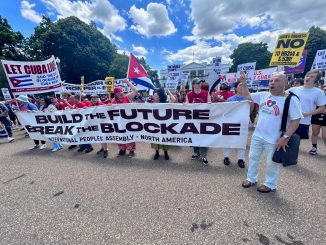
March to the White House demands Biden end the blockade of Cuba

Washington, D.C., June 25 — Culminating a week of activism in support of the Cuban people, 500 people gathered here today in the plaza that holds the statue of the Argentinian liberator General José de San Martín, that ironically is located next to the U.S. State Department where offices work overtime to come up with ways and methods to punish Cuba for insisting on its sovereignty.  The majority of the protestors came from the cities on the East Coast, including New York, Boston, Philadelphia, Baltimore, Virginia, South Carolina, and a delegation from Puentes de Amor from Florida.

Prior to the march, a large art mosaic made up of 100 panels was assembled and meticulously held up by activists conjuring a temporary image that referenced Cuba be taken off the List of State Sponsors of Terrorism (SSOT).

This preliminary action set a tone of collaboration for the spirited and determined march that followed, making its way past the statue of Simon Bolivar, another liberator of Latin America, and then the Organization of  American States (OAS) that is increasingly referred to as the Ministry of Colonies for its servitude to U.S. imperialism. The protest then made its way up 17th Street, turning onto Pennsylvania Avenue to its destination; Joe Biden’s White House, where the mainly youthful demonstrators left no doubt about their determination to end the blockade of the island in a loud 90-minute rally that included speeches, chanting and music.

Many who were there today had just visited Cuba for the first time in May on solidarity delegations and had come back with inspiration and love by what they had seen. They also came back committed to work against a cruel, sadistic policy that has gone on way too long and does not represent the great majority of people in this country.


The activities were called by the National Network on Cuba (NNOC), an organization that has been in existence since 1991 and is made up of 57 groups advocating for an end to Washington’s hostility towards Cuba.

The week had a remarkable uptick in solidarity events, with over 30 cities holding events around the country. It is apparent that there is a new willingness amongst organizations working on Cuba and Latin America to work more closely together while putting aside some of the divisions of the past. This is key because without unity we have no chance of ending the blockade of Cuba or bringing about any fundamental change here in the U.S. either, where the contradictions are painfully revealing like never before.

Source: Resumen Latinoamericano – English

Strugglelalucha256
https://www.struggle-la-lucha.org/2023/page/39/