Conmemoran Levantamiento en Puerto Rico solidarizándose con la lucha Palestina
written by Struggle – La Lucha
November 6, 2023
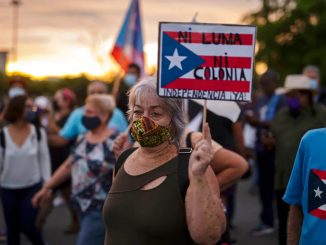
Protesta en solidaridad con Palestina en San Juan, Puerto Rico, 17 de octubre.
Este pasado lunes 30 de octubre, el movimiento de independencia de Puerto Rico conmemoró como todos los años en esta fecha, la Insurrección de Jayuya del 1950 liderada por el Partido Nacionalista.
Si bien es más conocido fuera de Puerto Rico el Grito de Lares del 1868, la importancia del Levantamiento de Jayuya, es que fue el primer alzamiento armado en contra del invasor yanqui. Los hombres y mujeres nacionalistas combatieron en varios pueblos de la isla, pero fue en Jayuya donde se proclamó la República de Puerto Rico, libre del dominio gringo. Allí las fuerzas independentistas lucharon y mantuvieron el combate, aún con armas rudimentarias, por tres por días antes de que les reprimieran las fuerzas militares estadounidenses junto a la policía local.
Los actos de conmemoración este año fueron muy especiales, porque se daban en un contexto mundial muy doloroso. El genocidio por Israel y Estados Unidos del pueblo palestino. Y para nosotros y nosotras en Puerto Rico, la lucha palestina siempre ha sido una lucha hermana. Ambos somos colonia y a nuestros pueblos se les ha querido desplazar de nuestras tierras, en Puerto Rico con un carácter menos cruento, pero con el mismo fin de adueñarse de nuestra patria.
Por eso este año la conmemoración de la insurrección de Jayuya fue no solo la expresión de un pueblo que sigue luchando de diversas formas por nuestra liberación, sino un acto de solidaridad también con esas hermanas y hermanos que están siendo masacrados por la misma mano criminal que intenta robarnos de nuestro futuro. Solidarizándose con la lucha y resistencia palestina. Así lo demostraron los discursos y hasta una canción escrita por nuestro cantor Tony Mapeyé en honor al pueblo palestino.
¡Viva Puerto Rico Libre! ¡Viva Palestina Libre!
Desde Puerto Rico para Radio Clarín de Colombia, les habló Berta Joubert-Ceci.
Once again the great majority of nations of the world stand with Cuba calling for an end to the blockade
written by Struggle – La Lucha
November 6, 2023
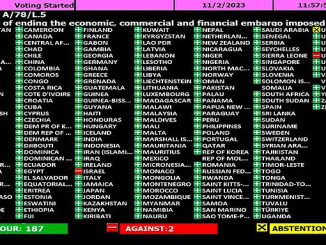
Havana, Nov. 2 — Today, as happens at the beginning of November every year, the resolution presented by Cuba to call for the end of the economic, commercial, and financial blockade imposed by the United States was overwhelmingly approved Thursday by the General Assembly with 187 votes in favor. There were two votes against that were not a surprise: the U.S. and Israel, with Ukraine abstaining.
The resolution recognizes the blockade as the central element of U.S. policy towards Cuba for more than six decades. In all that time, its effects have not ceased for a single day; 80% of the Cuban population have never known their country free of the blockade.
Speaking at the plenary of the 78th session of the General Assembly in New York, Cuban Foreign Minister Bruno Rodríguez Parrilla denounced the violations against the right to life, education, progress, and well-being of Cubans caused by the U.S. blockade.
“Families in the country feel it in the shortages, excessive prices and devalued salaries,” said the foreign minister, and recalled the efforts that the Government of Havana must go through to guarantee the basic food basket to the population despite the obstacles imposed.
“Only with one third of the cost of the effects of the blockade from March 2022 to February 2023 would it have been possible to cover the expenses for that concept”, he asserted.
At the same time, he pointed out that sectors such as agriculture and energy face serious obstacles in acquiring spare parts or new machinery.
Under strict licenses, some agricultural products in the United States travel to the island while subject to draconian and discriminatory laws that violate international trade regulations, he recalled. “These products,” he added, “arrive in U.S. ships that have to return empty because of the blockade itself.”
Rodríguez Parrilla pointed out the intensification of harassment policies during the hardest years of the pandemic when the exemption of sanctions was promoted for humanitarian reasons for some countries but not Cuba. Instead, the blockade was tightened up even further by Trump with 243 new sanctions that continue under Biden; in fact, it has gotten even worse under this Democratic president.
“Why was Cuba excluded from that temporary relief?” questioned Rodríguez Parrilla in rejection of the use of the pandemic as an ally in Washington’s policy of hostility towards Cuba.
Today is one of those days when the support and love we get from the entire world is on display, and we appreciate it. Since 1992, there have been 31 consecutive years of votes with resounding support to end the blockade in the General Assembly, and our question to our arrogant neighbor to the North is how many more will it take for you to get in stride with the humanitarian sentiment of the world.
The U.S. steps up its ‘chip war’ against socialist China
written by Struggle – La Lucha
November 6, 2023
On October 17, Commerce Secretary Gina Raimondo announced new bans on the giant tech company Nvidia from sales of its advanced computer chips, particularly its advanced H800 and A800 products.
Raimondo claimed that this move was directed solely against the Chinese military. According to an October 18 CNN report, she said in August on her visit to China: “the administration was “laser-focused” on slowing the advancement of China’s military. She emphasized that Washington had opted not to go further in restricting chips for other applications.”
But on October 17, Raimondo made clear that the target of these sanctions against socialist China is much wider:
“The goal was to limit China’s ‘access to advanced semiconductors that could fuel breakthroughs in artificial intelligence and sophisticated computers’.”
China’s Foreign Ministry quickly responded:
“The US needs to stop politicizing and weaponizing trade and tech issues and stop destabilizing global industrial and supply chains,” spokesperson Mao Ning told a press briefing. “We will closely follow the developments and firmly safeguard our rights and interests.”
China has decided to cut off the U.S. from supplies of germanium and gallium, essential for manufacturing semiconductors.
At a Senate hearing on October 5, Commerce Secretary Raimondo called the Chinese firm Huawei’s new cellphone and its 7nm computer chip “incredibly disturbing.” Why? It’s because that chip was produced by the Chinese state-owned Semiconductor Manufacturing International Corporation (SMIC).
Both companies, Huawei and SMIC, have been “blacklisted” by both the Trump and Biden administrations to prevent them from developing advanced semiconductors and other computer technologies.
In 2018, Trump had gone so far as to have a top Huawei executive placed under house arrest in Canada for three years for supposedly violating U.S. sanctions against Iran.
The Biden administration has escalated its economic war with China, prohibiting not only U.S. companies from selling advanced computer technologies to Chinese companies but also other countries from doing so, such as South Korea, the Netherlands, and the computer companies based in Taiwan. U.S. “experts” had predicted that this move would take decades for China to overcome if it ever did.
An October 4 opinion piece in the New York Times details how the U.S. establishment uses international digital financial tools to bend their “junior partners” to their will over the sentiments of the populace in their own countries. The article discusses a recently published book: “Underground Empire: How America Weaponized the Global Economy,” by Henry Farrell of Johns Hopkins and Abraham Newman of Georgetown:
“These institutions include the dollar and the bank-messaging system known as Swift (the Society for Worldwide Interbank Financial Telecommunication), which is based in Belgium and run by an international board but vulnerable to American pressure. It helps that the rise of the internet has made the United States home to much of the wired world’s circuitry and infrastructure, including, in our time, some of the major cloud computing centers of Amazon Web Services, Microsoft, and Google.
”The United States now has the ability to survey and influence the world’s communications and supply chains, should it choose to. After the Sept. 11 [2001] attacks, it chose to. It bent the institutions to which it had access into a defensive (as it then saw things) weapon in the war on terror. ‘To protect America,’ Mr. Farrell and Mr. Newman write, ‘Washington has slowly but surely turned thriving economic networks into tools of domination.’
“A study this past summer by the European Council on Foreign Relations found large majorities, 62 percent continent wide, would wish for Europe to remain neutral should the United States and China ever enter into conflict over Taiwan. Yet last April, when President Emmanuel Macron of France urged his fellow Europeans to preserve their ‘strategic autonomy’ in Sino-American matters and avoid getting swept up in ‘a logic of bloc against bloc,’ he was rebuffed, not just by American politicians but also by certain of his European allies.“
Up until these imperialist sanctions, socialist China had obtained its semiconductor and other tech designs from a complex global network. Facing this U.S. blockade, the Chinese government began a robust campaign to develop its own semiconductor design capabilities. With this new Huawei success, it appears that socialist China has made a massive breakthrough.
Of course, in an example of extraordinary arrogance, the U.S. accused China’s SMIC, a company that it had already sanctioned, of violating those sanctions by not asking the U.S. Commerce Department for “permission” to develop its own new computer chip and sell it to another Chinese company, Huawei.
Not only is the U.S. placing stricter requirements on computer chip sales by its own companies and its Western subordinates, but it has demanded that Taiwan rulers stop its companies from engaging with tech companies on the mainland.
An October 5 Benzinga article stated that a probe by the Bloomberg business website revealed that four companies based in Taiwan were helping to build semiconductor plants in the mainland. The linchpin of the entire U.S. strategy to counter China is Taiwan and the Trump/Biden threat to wage war to defend the island’s “independence,” breaking with the “One China” policy that the U.S. had agreed to in 1979.
Biden’s much-touted anti-China “Chips and Science Act” program has hit a snag with the most important of Taiwan’s tech companies – the Taiwan Semiconductor Manufacturing Company (TSMC). An August 28 article from the Guardian indicates that the company is eager to get the U.S. government money but is in no hurry to actually build the plant in Arizona or hire union workers:
Eight months on, the Phoenix microchip plant – the centerpiece of Biden’s $52.7bn US hi-tech manufacturing agenda – is struggling to get online.
The plant’s owner Taiwan Semiconductor Manufacturing Company (TSMC), the largest chip maker in the world, has pushed back plans to start manufacturing to 2025, blaming a lack of skilled labor. It is trying to fast-track visas for 500 Taiwanese workers. Unions, meanwhile, are accusing TSMC of inventing the skills shortage as an excuse to hire cheaper, foreign labor. Others point to safety issues at the plant.
A “presidential” election is slated in Taiwan in January 2024. Polls indicate that the pro-independence ruling party’s candidate has only 33 percent popular support, while the three opposition candidates who oppose independence garner more than 50 percent support. They have yet to come up with a way to unify their opposition, but it still indicates that Taiwan’s residents reject the Ukraine-style proxy war scenario that the Pentagon and the Biden White House are pushing.
Artificial Intelligence – the next front
Now, the U.S. is scrambling to prevent China from developing even more powerful semiconductors and other advanced technologies that would power Artificial Intelligence (AI) systems.
Of course, AI presents opportunities for greater profits in a capitalist society. Each worker becomes more “productive”; that is, she or he can produce more goods or services in less time. But since the value of each commodity or service is measured by the amount of “average” labor time to produce it, this same technical development drives down that value, forcing companies to “overproduce” to try to maintain their level of profits. This leads to the “bust” part of the capitalist cycle – recessions and depressions.
But this is not a problem in a socialist system, where production is socially owned and is driven by scientific planning, not profit. China has virtually eliminated poverty. President Johnson declared his “War on Poverty” in 1964, but just like his war against socialist Vietnam, poverty won and is still widespread here among the workers and oppressed communities.
And the capitalist class fears that artificial intelligence could be used under socialism to greatly enhance the coordination and accuracy of that scientific planning. The workers, through their Communist Party, could use it to far more capably direct their economy to meet the people’s needs rather than fill the coffers of the banks and corporations.
The imperialist ruling class is keenly aware of the danger of this, not only in its economic competition with socialist China but also with the example of a powerful and prosperous socialist China lighting a revolutionary beacon to the global working class as to the possibilities with a new social system.
The fight for our sovereignty and independence, although increasingly uphill, is carried out every day from different scenarios: in agriculture, where young people try to rescue the land to ensure a future with food sovereignty; in communities fighting against forced displacement by large foreign millionaire interests that receive benefits from local government; in the environmental defenders who fight incessantly against the dispossession and destruction of our coasts and natural reserves; in the fight against privatization that the neoliberal process has intensified, making each public service a source of million-dollar profits for mafia companies, mostly foreign, which, while profiting, deteriorate the services necessary for the population, services such as energy, health, education, public transportation.
In addition, there are the left-wing and pro-independence political parties and organizations that fight from their various ideological platforms against colonialism and the new government imposed by the US Congress, the Fiscal Control Board, which came with the excuse of “fixing the finances”. ”, and it has become a true center that has encouraged foreign money laundering.
On the other hand, there is the fight at the international level, where representatives of our organizations raise the protest, especially in United Nations organizations.
And it is here, in its Geneva office, that this week, the true face of the United States at the UN was shown to the world.
The American Civil Liberties Union in Puerto Rico and the Puerto Rican Institute of International Relations presented two detailed reports on the need for decolonization of Puerto Rico and the incompatibility of colonialism with Human Rights.
Mr. Fermín Arraíza, director of the ACLU-PR, went on to say that “Puerto Rico is not simply a territory; is a nation with the full right to self-determination”, and that the UN has the obligation to address it, and “the United States could face the International Court of Human Rights and the UN general assembly for misinterpreting the colonial status of Puerto Rico” .
In response, the representative of the USA refused to answer. So in the face of this refusal, the Puerto Rican delegation and delegations from other countries stood in silent protest and turned their backs in solidarity with Puerto Rico.
The fight will have to continue at all levels, and if the UN and its courts refuse to consider it, it will be the united peoples who will finally achieve victory.
From Puerto Rico, for Radio Clarín of Colombia, Berta Joubert-Ceci spoke to you.
Translated by Walter Lippmann for CubaNews
Revolutionary movements in Africa – an untold story
written by Struggle – La Lucha
November 6, 2023
While revolutionary movements of the 1960s and 1970s in Europe, the United States, and Latin America have been the subject of abundant literature, similar movements that emerged in Africa have received comparatively little attention. In an extract from their forthcoming book, the editors, Pascal Bianchini, Ndongo Sylla, and Leo Zeilig shed new light on these political movements. They argue that Africa’s revolutionary left was extremely active in these years and forms a vital part of global history.
By Pascal Bianchini, Ndongo Sylla, and Leo Zeilig
The history of revolutionary left movements in Africa is largely ignored and disregarded among political scientists, historians, and across the academic literature on Africa. Most of the existing literature consists of memoirs from former activists. However, most of the rank-and-file activists and even some of the leaders of these movements went to their graves without having an opportunity to tell their own stories.
The invisibility of the African revolutionary left in the existing literature contrasts with the situation prevailing on other continents, where we find a rich collection of books on the subject. In place of serious research on this issue, we find research and writing on related issues such as African revolutions and uprisings, invariably guerrilla warfare launched by liberation movements against colonial or neocolonial armies.[1] Other publications have focused on revolutionary regimes.[2] Still, more research can be found on prominent figures, not to say tragic revolutionary heroes, such as Amílcar Cabral or Thomas Sankara, who lost their lives in the struggle (and those like Patrice Lumumba, who lost their lives at the start of independence). [3] Finally, some contributions have shed light on the relations developed between African activists and revolutionaries and the former state socialist countries and the attraction exerted by this model of socialism, and more recently, on the relations between African liberation movements and Western communist parties.[4]
The obstacles to understanding the history of Africa’s revolutionary movements
In contrast to the rest of the world, where essays, monographs and histories have been written on radical left movements during their heyday, this is not the case for their African counterparts. [5] At first glance, the history of African revolutionary movements seems less epic. Compared to the Cuban revolution in Latin America or to the Vietnamese popular war that inspired revolutionary movements during the 1960s and 1970s, the African continent might appear unfavorable terrain for revolutionary struggles. [6]
Che Guevara, the most iconic figure of the 1960s, himself expressed reservations about the prospects of revolutionary victories in Africa. After his unsuccessful attempt in Congo, he wrote: ‘Africa had a long way to go before it achieved real revolutionary maturity.’[7]
However, many revolutionary movements around the world during the 1960s and the 1970s, even if they have been able to challenge the state, were finally defeated – for example, the Naxalites in India and the Tupamaros in Uruguay, not to mention the Black Panthers in the USA.[8] Yet their experience influenced revolutionaries from other countries. The idea of a ‘lack of maturity of the African people’ imbued with localist traditional values is still an underlying prejudice about the revolutionary perspectives in Africa among many commentators, though it is a terrible misconception, especially when it is expressed in general for a whole continent.
Moreover, the extraordinary anti-colonial struggles and the creation of new independent states occurred during the Cold War. Anti-colonial movements and radical organizations within these movements were considered by mainstream observers as Soviet proxies rather than independent actors. In this way, a well-known American commentator could write:
“The Soviet Union has supported nationalist development in Africa as part of its global strategy to create situations of instability and weakness within the Western world, to train and indoctrinate Communist leadership cadres with the expectation that by manipulating mass discontent and nationalist symbols they could seize power in African Soviet Republics, and, in general, to carry out Lenin’s dictum to attack the West through its dependent territories.”[9]
For several decades, the reference to Marxism in these liberation movements was still considered as fundamental, and according to this view, radical movements and politics could not survive the collapse of the Eastern Bloc.[10] However, such conceptions ignore the ability of African activists and intellectuals to embrace, create and adapt revolutionary doctrines for their own sake. The idea that activists and revolutionaries simply imported ready-made doctrines from a Marxist-Leninist blueprint is at best a narrow point of view, at worst a deeply patronizing and colonial idea.
Of course, this position of principle must not lead us to ignore the numerous hurdles faced by left movements in Africa, whether from external or internal causes. During the twentieth century, the penetration of communist ideas in the contemporary sense of the word was linked to the establishment of colonial institutions and the labour force necessary for the colonial economy. Then, the major issue raised for the development of left-wing organizations (mainly communist) was the relationship with the emerging nationalist movements, though even when the colonial period came to an end, many areas remained out of reach for communist-inspired organizations.
If we go back to Karl Marx himself, we know that he was among the few European theorists of his generation who did not try to conceal his ‘debt’ to Africa, but celebrated such knowledge as foundational. Recent work by the Nigerian scholar Biko Agozino shows how people of African descent were central to the theory, practice and writings of Marx, including in Capital.[11] In addition to his major writings were the letters he wrote from Algeria at the end of his life, or more significantly, the articles on African-Americans during the Civil War in the United States.[12] Although it has been considered Eurocentric, his work was inspirational for many African-American and African thinkers, so that Marxist ideas have deeply influenced the ‘making of a Black radical tradition.’[13]
Even more unexpected, if we take a closer look at such an iconic figure as Cheikh Anta Diop, often associated with ‘Afro-centricity’, we note that his writings did not ignore Marxist analysis and that his own involvement in Senegalese politics with the Rassemblement national démocratique (National Democratic Rally) during the late 1970s occurred in relation with Marxist activists from the Parti Africain de l’Indépendance (PAI, African Independence Party) and from Maoist groups which joined the party he had created.[14]
In Africa, the ‘boom’ of Marxist revolutionary ideas occurred, especially during the decades examined in this book. Later on, these ideas retreated from the continent, which can give the utterly false impression that it was mainly a Western fad. However, this ideological decline of Marxism is not unique to Africa, rather it was a more general and global phenomenon that goes beyond the scope of this introduction and volume.
A chronological framework for the history of the revolutionary left in Africa
In order to give an outline of the historical development of revolutionary movements in Africa, we propose a division into three periods. First, we identify pioneers who challenged triumphant colonialism in calling for Pan-Africanist solidarity (from London in 1900 to Manchester in 1944) and also for some of them in developing connections with Communist organizations during the interwar period, especially since the creation of the Soviet Union and the Third International. This early period of the revolutionary left embodied by activists often based in Europe, in the colonial metropolis, such as Lamine Senghor or Tiemoko Garang Kouyate for the French colonies or Wallace Johnson for the British colonies, is not within the scope of this book. However, these figures have been rediscovered and celebrated by the generations that followed, especially in the 1970s. The main debate for this generation was ‘Panafricanism or Communism?’, as suggested by a famous book written in the late 1950s as a reassessment of this period.[15] However, if tension has existed between the two orientations, they were not always in contradiction.[16]
We then identify a second period, which is shorter and more difficult to delineate, during the late colonial era and the aftermath of the struggle for independent states. During this time, anti-colonial movements became more radicalized, especially when confronted with delaying tactics from colonial powers. In parallel, during this period, the influence of communist and progressive forces grew to the point that the center of gravity shifted from the diaspora to African territories, even when they were not yet mass parties. At the same time, the Union of Soviet Socialist Republics (USSR) and the People’s Republic of China began to appear as attractive counter-models to Western capitalism.
Finally, we see in the 1960s and the 1970s a third wave of activism sweeping across Africa, as it did throughout the whole world and the Global South. These ‘anti-systemic’ movements were not only directed against Western imperialist domination but also against ‘bureaucratized’ states claiming to stand for socialism.[17] In Africa, this New Left developed during and after 1968 and jostled with the ‘old left,’ still aligned with the USSR. Clandestine movements were burgeoning in every part of the continent, and a spirit of rebellion was challenging the political order.[18] This historical development has remained largely ignored for decades. However, recent publications have emphasized the role played during these years by certain ‘capitals of the revolution’ where emblematic revolutionary figures such as Che Guevara, Stokely Carmichael, Elridge Cleaver, and others traveled or settled, for example, in Algiers, Brazzaville, Conakry or Dar es Salaam.[19]
These countries became new bases or refuge sanctuaries for freedom fighters against the apartheid system, counter-insurgency campaigns and assassinations launched against the Black Power movement in the United States, Portuguese colonialism, and exiled nationalist activists and revolutionaries from struggles in Southern Africa. This solidarity frequently exposed these states to attacks from the South African or Portuguese armies or secret services, which were waging a dirty war against their opponents, as was shown with the assassination of Eduardo Mondlane in Tanzania in 1969 and of Amílcar Cabral in Conakry in 1973.[20]
However, beside these ‘spectacular’ headline developments, less noticeable radical experiences are to be found in every African country. This book will shed light on these forgotten realities, with most of our chapters centered on this third revolutionary age.
Pascal Bianchini is a sociologist and independent researcher based in Senegal. Ndongo Samba Sylla is a Senegalese development economist and co-author of Africa’s Last Colonial Currency: The CFA Franc Story and author of The Fair Trade Scandal. Leo Zeilig is an editor of the Review of African Political Economy.
Featured Photograph: The mass of assembled strikers from Coronation Brick works, during the Durban Strikes in 1973 (David Hemson, David Hemson Collection, UCT Libraries).
Notes
[1] Françoise Blum, Révolutions africaines: Congo-Brazzaville, Sénégal, Madagascar, années 1960–1970, Rennes: Presses universitaires de Rennes, 2014; Willow J. Berridge, Civil Uprisings in Modern Sudan: The ‘Khartoum Springs’ of 1964 and1985, London: Bloomsbury Press, 2015. Gérard Chaliand, Armed Struggle in Africa: With the Guerrillas in ‘Portuguese’ Guinea, New York: Monthly Review Press, 1969; Basil Davidson, No Fist Is Big Enough to Hide the Sky: The Liberation of Guinea-Bissau and Cape Verde, 1963–74, London: Zed Books, 1974.
[2] David Ottaway and Marina Ottaway, Afrocommunism, New York: Africana Publishing House, 1981.
[3] Patrick Chabal, Amilcar Cabral: Revolutionary Leadership and People’s War, Trenton, NJ: Africa World Press, 2003. For a broader scope than Chabal’s views, see Antonio Tomas, Amílcar Cabral: The Life of a Reluctant Nationalist, London: Hurst, 2021. Bruno Jaffré, Biographie de Thomas Sankara: la patrie ou la mort …, Paris: L’Harmattan, 2007; Ernest Harsch, Thomas Sankara: An African Revolutionary, Athens, OH: Ohio University Press, 2014.
[4] Maxim Matusevich, ‘Revisiting the Soviet Moment in Sub-Saharan Africa’, History Compass, 7(5), 2009, 1,259–1,268. Eric Burton and Constantin Katsakioris, ‘Africans and the Socialist World: Aspirations, Experiences, and Trajectories: An Introduction’, International Journal of African Historical Studies, 54(3), 2021, 269–278. Françoise Blum, Marco Di Maggio, Gabriele Siracusano and Serge Wolikow (eds), Les partis communistes occidentaux et l’Afrique: une histoire mineure?, Paris: Hémisphères, 2021.
[5] For the United States, see Max Elbaum, Revolution in the Air: Sixties Radicals turn to Lenin, Mao and Che, London: Verso, 2002, and for a synthetic view on the revolutionary left in Latin America, see Verónica Oikión, Solano Eduardo Rey and Tristán Martín López ávalos (eds), El Estudio de las Luchas Revolucionarias en América Latina (1959–1996), Estado de la Cuestión, Zamora: El Colegio de Michoacan, 2013.
[6] Two books in particular were bedtime reading for the generation of the 1960s: Che Guevara, Che Guevara on Guerrilla Warfare, New York: Praeger, 1961, and Nguyen Vo Giap, People’s War People’s Army: The Viet Cong Insurrection Manualfor Underdeveloped Countries, New York: Praeger, 1962.
[7] Che Guevara, The Congo Diary: Episodes of the Revolutionary War in Congo, Melbourne: Ocean Press, 2011.
[8] Prakash Singh, The Naxalite Movement in India, New Delhi: Rupa, 2006. Lindsey Churchill, Becoming the Tupamaros: Solidarity and Transnational Revolutionaries in Uruguay and the United States, Nashville, TN: Vanderbilt University Press, 2014.
[9] James S. Coleman,‘Contemporary Africa Trends and Issues’ , Annals of the American Academy of Political and Social Science, 298, 1955, 96.
[10] Allison Drew, ‘Comparing African Experiences of Communism’, in Norman Naimark, Silvio Pons and Sophie Quinn-Judge, The Cambridge History of Communism, Vol. II: The Socialist Camp and World Power, 1941–1960s, Cambridge: Cambridge University Press, 2017, 519.
[11] Biko Agozino, ‘ The Africana Paradigm in Capital: The Debts of Karl Marx to People of African Descent’‘, Review of African Political Economy, 41(140), 2014, 172–184.
[12] Kevin B. Anderson, Marx at the Margins: On Nationalism, Ethnicity, and Non-Western Societies, Chicago, IL: Chicago University Press, 1992.
[13] Cedric J. Robinson, Black Marxism: The Making of the Black Radical Tradition, London: Zed Books, 1983.
[14] Thierno Diop, ‘Cheikh Anta Diop et le matérialisme historique’, in Marxisme et critique de la modernité en Afrique, Paris, L’Harmattan, 2007, 145–175. Pascal Bianchini, ‘Cheikh Anta Diop et les marxistes au Sénégal: des relations ambivalentes entre démarcations et rapprochements, entre intégrations et scissions’,, Revue d’histoire contemporaine de l’Afrique, 4, forthcoming, 2023.
[15] George Padmore, Panafricanisme ou communisme? La prochaine lutte pour l’Afrique, Paris: Présence africaine, 1962.
[16] On this period and the relation between Pan-Africanism, Pan-Negrism and communism in the African diasporas, see: Philippe Dewitte, Les mouvementsnègres en France, 1919–1939, Paris: L’Harmattan, 1985; Jonathan Derrick, Africa’s ‘Agitators’: Militant Anti-Colonialism, London: Hurst, 2008; Hakim Adi, Panafricanism and Communism: The Communist International and the AfricanDiaspora, Trenton, NJ: Africa World Press, 2013.
[17] Immanuel Wallerstein, ‘New Revolts against the System’‘, New Left Review, 18, 2002, 33–34.
[19] Elaine Mokhtefi, Algiers, Third World Capital: Black Panthers, Freedom Fighters, Revolutionaries, London: Verso, 2018. See Chapter 8. Amandla Thomas-Johnson, Becoming Kwame Ture, Cape Town: Chimurenganyana Series, 2020. George Roberts, Revolutionary State-Making in Dar es Salaam: African Liberation and the Global Cold War, 1961–1974, Cambridge: Cambridge University Press, 2022. See also Chapters 12 and 13.
[20] George Roberts, ‘The Assassination of Eduardo Mondlane: Mozambican Revolutionaries in Dar es Salaam’, in Revolutionary State-Making in Dar es Salaam, 135–172. Peter Karibe Mendy, ‘The “Cancer of Betrayal”: The Assassination of Amílcar Cabral, 20 January 1973’, in Amílcar Cabral: A Nationalist and Pan-AfricanistRevolutionary, Athens, OH: Ohio University Press, 2019, 166–182.
La lucha por nuestra soberanía e independencia, aunque cada vez más cuesta arriba, se hace cada día desde diferentes escenarios: en la agricultura donde jóvenes intentan rescatar la tierra para asegurarnos de un futuro con soberanía alimentaria; en las comunidades que pelean contra el desplazamiento forzado por grandes intereses millonarios extranjeros que reciben beneficios del gobierno local; en los defensores del medioambiente que luchan sin cesar contra el despojo y destrucción de nuestras costas y reservas naturales; en la lucha contra la privatización que el proceso neoliberal ha intensificado, haciendo de cada servicio público una fuente de ganancias millonarias para compañías mafiosas, mayormente extranjeras que a la vez que se lucran, deterioran los servicios necesarios para la población, servicios como la energía, la salud, la educación, la transportación pública.
Además, están los partidos y organizaciones políticas de izquierda e independentistas que luchan desde sus diversas plataformas ideológicas en contra del coloniaje y el nuevo gobierno impuesto por el Congreso estadounidense, la Junta de Control Fiscal, que vino, con la excusa de “arreglar las finanzas”, y se ha convertido en un verdadero centro que ha propiciado el de lavado de dinero extranjero.
Por otro lado, está la lucha a nivel internacional, donde representantes de nuestras organizaciones elevan la protesta, sobre todo en los organismos de las Naciones Unidas.
Y es en ésta, en su oficina de Ginebra, que esta semana se mostró al mundo la verdadera cara de los Estados Unidos en la ONU.
La Unión de Libertades Civiles Americanas en Puerto Rico y el Instituto Puertorriqueño de Relaciones Internacionales presentaron dos informes detallados sobre la necesidad de descolonización de Puerto Rico y la incompatibilidad del colonialismo con los Derechos Humanos.
El Licenciado Fermín Arraíza, director de la ACLU-PR fue a decir que “Puerto Rico no es simplemente un territorio; es una nación con pleno derecho a la autodeterminación”, y que la ONU tiene la obligación de atenderlo, y “Estados Unidos podría enfrentarse ante la Corte Internacional de Derechos Humanos y la asamblea general de la ONU por malinterpretar el estatus colonial de Puerto Rico”.
Como respuesta, la representante de los EUA, se negó a contestar. Así que ante esa negativa, la delegación boricua y delegaciones de otros países, se pararon en protesta silente y le dieron la espalda en solidaridad con Puerto Rico.
La lucha tendrá que continuar en todos los niveles, y si la ONU y sus tribunales se niegan a considerarla, serán los pueblos unidos quienes logremos al fin la victoria.
Desde Puerto Rico, para Radio Clarín de Colombia, les habló, Berta Joubert-Ceci.
Joint statement of Palestinian resistance: ‘We hold U.S. fully responsible’
written by Struggle – La Lucha
November 6, 2023
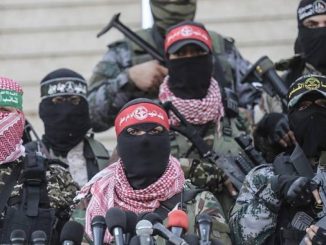
Statement issued by the Palestinian resistance forces: Hamas (Islamic Resistance Movement), Palestinian Islamic Jihad, Popular Front for the Liberation of Palestine (PFLP), Democratic Front for the Liberation of Palestine (DFLP), and Popular Front for the Liberation of Palestine – General Command (PFLP-GC):
The five Palestinian powers held a leadership meeting in Beirut today, Saturday, October 28, 2023, to discuss the course of the Al-Aqsa Flood Battle with the zionist enemy and its brutal aggression against the Gaza Strip.
In their statement, the five powers saluted the martyrs of our Palestinian people and our steadfast and proud people in the Gaza Strip who are facing an organized campaign of extermination, stressing that they are the people of pride, dignity and steadfastness and that they are the people of victory who are loyal to their cause and their homeland, and [the Palestinian forces] pledged to them to continue on the path of resistance until victory is achieved over the zionist enemy.
The attendees affirmed the following:
This heroic epic is the battle of the entire Palestinian people, which they are waging in defense of their land, their sanctities, their existence, and their right to freedom against a barbaric enemy that does not spare any of our people from its crimes. It targets hospitals, mosques, churches, universities, and ambulances and cuts off electricity, water, fuel, the Internet, and cellular communications for our besieged people.
Adhering to national unity is a main pillar in confronting the zionist war of genocide against our people, as well as rejecting the enemy’s attempts to divide our people or monopolize any part of it. We stress unifying efforts and closing ranks in this fateful battle.
We call on the masses of our Arab and Islamic nation and the free people of the world to continue their movements to stop the American-zionist aggression, open the border crossings, bring in humanitarian aid and fuel, and remove the wounded from the Gaza Strip.
We salute the resistance forces in our nation, especially in Lebanon, Syria, Iraq, Yemen, and Iran, and we affirm that our Palestinian people are not alone in this battle.
We hold the United States of America fully responsible for the war of genocide against our people as it chose to support, escalate, and participate in the war of genocide against our people, which requires a strong response from the Arab and Islamic countries as well as countries friendly to our people to stop this ongoing massacre of our Palestinian people.
We demand the opening of the Rafah crossing and the entry of aid, humanitarian needs, fuel, and medical and relief teams to our people without delay, allowing the wounded to be transported to Egypt and the Arab and Islamic countries without interference from the occupation or any of the aggression countries.
We call on the masses of our people throughout occupied Palestine to escalate all forms of resistance and struggle against the zionist enemy, targeting its soldiers and settlers and strengthening popular initiatives of struggle in the face of settler attacks and the encroachment of enemy forces.
The enemy’s cutting off all access to Gaza, besieging it, and cutting off communications and the Internet completely is a cover for a major crime of genocide that the enemy does not want witnesses to, and we stress breaking this siege with an “official and popular” Arab position.
We adhere to the right of our people to resist and its confidence in the victory of our people in this battle, as we fight this battle in defense of our land, our people, and our sanctities, and for the sake of liberation, return, self-determination, and the establishment of the Palestinian state with Jerusalem as its capital.
Glory to the martyrs. Healing for the wounded. Freedom for the prisoners. Victory to our people and their valiant resistance.
Statement issued by the Office of Martyrs, Prisoners, and Wounded for the Popular Front for the Liberation of Palestine (PFLP):
Our prisoners are in the crosshairs.
O masses of our Palestinian people,
Since the 7th of October 2023, during the Al-Aqsa Flood battle, the zionist occupation has proceeded to transfer prisoners and detainees to an unknown location, notably including the Secretary-General of the Popular Front for the Liberation of Palestine, Comrade Leader Ahmad Sa’adat and his comrades, as well as the prisoner leader and intellectual Walid Daqqah, who is suffering from a severe health condition. Moreover, the occupation forces are carrying out an arbitrary arrest campaign targeting released prisoners and resistance fighters from among our people in the West Bank.
In this context, the Office of Martyrs, Prisoners, and Wounded for the Popular Front for the Liberation of Palestine issues a call through the media, all social media platforms, international human rights and humanitarian institutions to break this silence which makes them a fundamental partner in all these crimes. It is inconceivable that the lives of prisoners remain constantly threatened by these fascist and Nazi gangs. We fear that our prisoners may become martyrs due to the torture and deprivation inflicted by the zionist prison services, depriving the prisoners of their most basic rights guaranteed by all international and humanitarian laws and conventions.
We call upon the International Committee of the Red Cross and the World Health Organization to fulfill their humanitarian duties, exert efforts to visit the prisoners, learn about their conditions, and provide all necessary medicine and treatment.
We, in the Office of Martyrs, Prisoners, and Wounded for the Popular Front for the Liberation of Palestine, closely follow the conditions of the prisoners and exert great effort to determine their fate, including children, women, elderly, and the sick suffering from heart diseases, diabetes, blood pressure, and kidney issues.
We demand the formation of a swift investigative committee to investigate all the details that led to the martyrdom of a number of prisoners due to torture, beating, and deliberate medical negligence.
We also call upon our Palestinian people to engage in the widest campaign of mobilization and solidarity with the prisoners and detainees in the zionist prisons.
Furthermore, the Office of Martyrs, Prisoners, and Wounded for the Popular Front for the Liberation of Palestine condemns the barbaric and brutal zionist aggression against the Gaza Strip, targeting hospitals, innocent citizens, medical and media crews, and committing massacres against our Palestinian people.
Glory and eternity to the martyrs, Freedom for the prisoners, Healing for the wounded, And victory for our people.
Office of Martyrs, Prisoners, and Wounded for the Popular Front for the Liberation of Palestine Saturday, October 28, 2023
From Lidice, 1942 to Gaza, 2023: What Hitler taught Netanyahu
written by Struggle – La Lucha
November 6, 2023
On May 27, 1942, in the midst of World War II, anti-Nazi resistance fighters wounded a high-ranking Nazi official, Reinhard Heydrich, while he drove through the city of Prague. He died a week later, on June 4. A furious Adolph Hitler at first ordered the murder of 10,000 Czech people in retaliation. Cooler heads in Berlin prevailed. On June 9, Hitler changed his plan. He now ordered the destruction of the town of Lidice, although there was no evidence that it had anything to do with Heydrich’s assassination.
From June 9 to 10, Nazi troops occupied Lidice. They gathered 500 residents in the town square, and the Nazis executed all 173 men and boys and a few women. The other women were sent to concentration camps, where many were exterminated. The small children were screened by the Nazi “SS Race and Settlement Main Office,” where those who were deemed racially pure enough were later sent to live and be raised by German parents. Eighty other children were gassed to death at the Chelmno extermination camp.
The Nazis then totally destroyed the entire town of Lidice, vowing to wipe it from the face of the earth. Two weeks later, the village of Lezaiky’s adult residents were all shot dead, and the children were sent to a death camp. Over 3,000 Czechs were arrested, with 1,327 executed in further reprisals. Thousands of Jewish people in Prague were also rounded up and deported to the Lublin concentration camp to be exterminated.
The Nazis were open about what they had done. Propaganda films and radio broadcasts proudly proclaimed the destruction of Lidice as a warning to others who might offer resistance to their oppressive rule. Source:Holocaust Encyclopedia
On May 22, 1946, the high-ranking Nazi who oversaw the murders and destruction of Lidice, Karl Hermann Frank, was executed by hanging after being convicted of war crimes. Many other Nazis also received the death sentence for this and many more crimes against humanity.
What the Israeli government headed by Benjamin Netanyahu is doing to Gaza, fully supported by President Joe Biden, is Lidice on a greater scale. It is a war crime to carry out collective punishment. It is a war crime to retaliate and carry out retribution against a civilian population. It is a war crime to cut off food, water, power, and medical supplies to the Palestinian people living in Gaza.
Israel, of course, was built on the murder of Palestinians and the destruction of over 400 Palestinian villages from 1947 to 1948. Since that time, Palestinian people have had their lands and water resources taken from them by the growth of armed Zionist settlements and military coercion.
At the same time, U.S. immigration policy excluded thousands of Holocaust victims from emigrating to the U.S., in effect forcing them to go to Palestine instead. This is a continuation of the historic anti-Jewish bigotry of the U.S. ruling class and their government minions. (See the three-part PBS Ken Burns series: “The U.S. and the Holocaust.”)
These same bigots now proclaim their solidarity with Zionism based on their cold machinations to control the oil-rich Middle East region. Their aim was to turn unwanted Jewish refugees into soldiers for neocolonialism and imperialism against the rising tide of Arab nationalism, including Palestine.
Hence, Israel joined England and France in 1956 to attack Egypt and “take back” from it the Suez Canal, which Egypt had dared to seize control of and nationalized under Nasser.
Hence, the 1967 Israeli “preemptive” war against all its Arab neighbors, who had just emerged from European colonial control and domination.
To the quite anti-Semitic Wall Street wizards and Big Oil tycoons, Zionist Israel is the perfect tool to maintain their domination against Arab revolutions that would threaten their interests.
The October 7 Palestinian fighters who broke out of the Gaza “open-air prison” have been called animals, senseless and pure evil, by Western politicians and compliant media outlets. Yet, is it really surprising that decades of anger and suffering should be directed upon the Israeli soldiers and colonizing settlers and their U.S. patrons? Remember that Gaza has been under siege for 16 years by the Zionist government and military.
The Israeli carpet bombing of Gaza has, so far, caused the death of over 6,000 Palestinians, about half of them children, with no end in sight. Will Netanyahu continue to exact his retaliation and revenge by slaughtering thousands more and trying to destroy the very existence of Gaza? This is on a scale many times greater than Hitler’s destruction of Lidice. Hopefully, people around the world will be able to force an end to this slaughter. But both Netanyahu and Biden will certainly be judged by history as guilty of the war crime of collective punishment and genocide.
The class character and political origins of Zionism
written by Struggle – La Lucha
November 6, 2023
On Oct. 28, as the Israeli occupation forces began their brutal ground offensive into Gaza, Defence Minister Yoav Gallant declared in earnest, “This is a war where there is no choice: either them or us.”
Translated as: We are justified in our genocide of the Palestinian people.
This sort of false paradigm has been at the core of Zionism ever since its inception in Europe around the turn of the 20th century: Palestine is the true Jewish homeland; only we Israelis have the right to it, and anyone who dares thwart our genocidal aspirations will be deemed an anti-Semite and terrorist.
As Israel intensifies its genocidal war against Palestine, now is as good a time as ever to examine the true nature of Zionist ideology, its class character, and its benefit to imperialist powers. By understanding Zionism’s origins, we can better challenge the mythology that leads to the sort of fascist lunacy that Gallant and many like him consistently spew.
According to the Zionist narrative, Palestine is the long-lost homeland of the Jewish people. Under this fallacy, because one community of Jews was predominant in the land called Palestine several thousand years ago, my community now has the right to colonize this land on behalf of the Western powers. Now, if you ask a Zionist, they will tell you that Israeli apartheid isn’t colonial but the only way to guarantee Jewish survival.
However, revolutionary socialist Jews and anti-Zionists polemicized against this mythology before Israel even existed. In particular, one of these Jewish revolutionaries, Abram Leon, wrote prolifically about the state of the Jewish community in the mid-20th century. As European Jewry faced pogroms, exile, and eventually, the Holocaust, Leon hoped to direct his community toward building socialism as the main method for the defeat of Nazism and the liberation of not just Jews but all oppressed people.
A Marxist interpretation
At that time, Leon could not write on this topic without addressing a fringe, but growing, petit bourgeois ideology at the time, known as Zionism. After the outbreak of World War II, Leon was forced to flee his homeland of Poland for Belgium, where he helped found the Belgian communist party. While participating in the Belgian underground and on the run from Nazi forces, Leon wrote “The Jewish Question: a Marxist Interpretation.” In this piece, he details the history of the Jewish community, the need for Jewish support of socialism, and the dangers of embracing Zionism.
To adequately understand the threat Zionism posed to the entire Middle East, as well as the Jewish people, Leon analyzed the origins of the ideology that eventually grew into the fascist state of Israel.
At the core of Zionist ideology is the assertion that Palestine has always been the ancestral Jewish homeland. Zionist history asserts that return to this homeland has been the sole focus of the Jewish community since the Babylonian expulsion of the vast majority of Jews from Palestine in the 6th century BCE and the destruction of the Second Temple of Jerusalem by the Romans several hundred years later.
This narrative also pushes the idea that the only way to guarantee Jewish security and safety is not only to return to this supposed homeland but also to establish a secular Jewish state.
The problem is, this narrative is almost entirely based on a false version of history. In fact, Zionism is a particularly young ideology. While there was always a certain romanticization of the Holy Land within the Jewish community, the idea that the only way to secure a Jewish future was to build a colonizer government in Palestine did not crystallize as a political tendency and school of thought until the late 19th century.
In 1896, Theodore Herzl wrote his Zionist treatise, “The Jewish State,” where he argued that the only reasonable response to mounting pogroms and anti-Semitism in Europe was a mass migration of Jews to Palestine. Herzl’s crowning fascist work came only two years removed from the anti-Semitism of theDreyfus Affair, where a French army officer was prosecuted for his Judaism.
Required backing of European powers
Herzl didn’t stop with Jewish emigration to Palestine. He openly asserted that the key to achieving this dream would be backing from European powers. This sentiment is at the core of the growth of the Zionist movement over time. Herzl was not the only affluent Jew in Europe who was concerned about growing anti-Semitism.
Across Europe, Jewish tradespeople, business owners, and academics were tired of living under the specter of anti-Semitism. For Jewish businesspeople, Zionist ideology presented an opportunity for rapid investment from the West and their own share of imperialist profits. For this reason, the Zionist ideology grew rapidly among the wealthier portion of the Jewish community between 1896 and 1918, when Abram Leon was born into an affluent zionist Polish Jewish family.
As Leon grew and delved deeper into socialism and the struggle against all forms of oppression, he grew to reject his parents’ Zionist ideology based on the same history and analysis reviewed above. At this same time, Nazism was also growing in Europe. Fascism and anti-Semitism spread like wildfire, deepening the crisis for the Jewish community and Leon himself.
However, even with the rise of fascist movements and governments throughout Europe in the 1930s, Zionism still did not become the predominant ideology in the Jewish community until after the horrors of the Holocaust. During the political struggles of the 1930s and World War II, most of the Jewish community lined up with the international left. Jews were labor union leaders,Red Army soldiers, andanti-fascist organizers.
One such anti-fascist organizer was Abram Leon. In 1940s Nazi-occupied Belgium, Abram was a leader in the Belgian communist party and the militant Belgian resistance. Leon never stopped fighting. This is exactly why, in 1944, Nazi forces raided an anti-fascist meeting and captured Leon. Several months later, he died after prolonged torture while interned at Auschwitz concentration camp.
It is unknown when Leon wrote “The Jewish Question: a Marxist Interpretation,” but it was presumably while he was on the run in the late 1930s and early 1940s. Even though Leon died before the horror of Israel began, he condemned Zionism as an ideology of the few and the oppressive. He wrote that a Western-backed Jewish state in Palestine “would do nothing to improve the situation of international Jewry.”
Today, he is more right than ever.
As Leon did, all Jews must reject the poisonous ideology that has turned us against our Palestinian siblings. Zionism is an ideology meant to benefit the United States and its partners in imperialism. It will never benefit the Jewish people.