Lenin 150: What he can teach us about this historic moment

‘Comrade Lenin cleans the world of filth’ by Viktor Nikolayevich Deni (1920).

For a major anniversary like the 150th birthday of V.I. Lenin on April 22, 2020, it’s tempting to try and write some overarching summary of his enormous revolutionary contributions: building a revolutionary party, imperialism and national oppression, the state and revolution, the construction of a socialist society, and more.

But what is it that we most need from Lenin right now — amidst a global pandemic, rapid economic and climate collapse, fascist demonstrations encouraged by a sitting U.S. president, the precipitous end of the Bernie Sanders election campaign?

Today, the validity of Lenin’s revolutionary outlook is confirmed by the success of countries with revolutionary socialist foundations like Cuba, Vietnam and China in combating the coronavirus pandemic among their own populations, and sending internationalist medical support around the world. This, even after long decades of setbacks to the socialist camp and the world revolutionary process have forced these countries to take backward steps in order to survive. 

This can’t help but open the eyes of many working-class and oppressed people to the alternative that Lenin’s revolutionary socialism represents to decaying world capitalism.

“The name of Lenin is a kind of synonym for revolutionary class struggle. The failure to agree on that is, in reality, a line of demarcation between communism and social democracy, with its various hues.” So said Sam Marcy, an accomplished student of Lenin and the Russian Revolution, at an international communist conference in Belgium in 1994.

Marcy’s co-thinker and fellow organizer Vince Copeland (writing under the pen name David Grey) noted: “Lenin’s leadership, contrary to the theses of his enemies and detractors, was not primarily in the force of his personality and the acquisition of ‘power,’ but in the educating of a party of revolutionaries with the understanding of the Russian and world revolution and in the nature of the struggle dictated by this understanding. 

“While he had unusual talents and was much more intense about his objectives than most — if not all — of his contemporaries, everything about him was rational and understandable and therefore the revolutionaries of today have the possibility of learning just how he did it in his time as in a handbook, if not a blueprint, for doing it themselves in their time.”

Rich and varied experience

Perhaps the most important thing Lenin has to teach us right now is that new social and economic conditions — including abrupt and dramatic changes like those we are living through — offer revolutionaries new challenges and new opportunities to advance the struggle for socialism.

In his book Left-Wing Communism: An Infantile Disorder,” written in 1920 to help educate the international communist movement on the lessons of the Russian Revolution, Lenin described The Principal Stages in the History of Bolshevism: the years of preparation for revolution (1903-1905), the years of revolution (1905–1907), the years of reaction (1907–1910), the years of revival (1910–1914), the First Imperialist World War (1914–1917), the second revolution in Russia (February to October 1917), and the third, triumphant socialist revolution (October to November 1917). 

Each of these periods offered unique experiences and challenges to the revolutionaries and their party (the Bolsheviks, as the communists in Russia were known), from setting up a newspaper and participating in bourgeois elections to street protests and armed struggle. Each required different tactics and strategies to educate and mobilize the workers and oppressed to fight for their own interests against the exploiting ruling class and its repressive state. 

Without this rich and varied experience, Lenin explained, without these ups and downs in the struggle, filtered through an organized, disciplined, revolutionary party guided by a Marxist world outlook, the victory of the revolution in October-November 1917 and the construction of socialism in the Soviet Union would not have been possible.

Lenin continued: “The fundamental law of revolution, which has been confirmed by all revolutions and especially by all three Russian revolutions in the twentieth century, is as follows: for a revolution to take place it is not enough for the exploited and oppressed masses to realise the impossibility of living in the old way, and demand changes; for a revolution to take place it is essential that the exploiters should not be able to live and rule in the old way. It is only when the ‘lower classes’ do not want to live in the old way and the ‘upper classes’ cannot carry on in the old way that the revolution can triumph. 

“This truth can be expressed in other words: revolution is impossible without a nationwide crisis (affecting both the exploited and the exploiters). It follows that, for a revolution to take place, it is essential, first, that a majority of the workers (or at least a majority of the class-conscious, thinking, and politically active workers) should fully realise that revolution is necessary, and that they should be prepared to die for it; second, that the ruling classes should be going through a governmental crisis, which draws even the most backward masses into politics (symptomatic of any genuine revolution is a rapid, tenfold and even hundredfold increase in the size of the working and oppressed masses — hitherto apathetic — who are capable of waging the political struggle), weakens the government, and makes it possible for the revolutionaries to rapidly overthrow it.”

The tasks ahead

It’s obvious from the above that some of these revolutionary prerequisites already exist in the U.S. today, while the potential exists for the others to develop — perhaps very quickly. 

There is an unprecedented national and global capitalist crisis. It wasn’t created by the coronavirus; but the pandemic acted as a catalyst, accelerating the inevitable collapse created by worldwide capitalist overproduction and exposing the hollowness of the U.S. economy in particular. As a result, workers in the U.S. and across the earth face a painful, prolonged period of misery and dislocation.

The governing bodies of the capitalist state are in crisis and conflict, while millions of workers who avoided politics in the past, especially youth, recently supported the reformist-socialist presidential campaign of Bernie Sanders, and are now expressing the feeling that things cannot go on in the old way. 

Yet there is much work to be done in uniting existing revolutionary socialists and communists, scattered by the historic setbacks of the 1980s and 1990s and by old ideological disputes, and training a new generation of revolutionaries to take advantage of the opportunities that are rapidly developing.

At that 1994 communist gathering in Belgium, Sam Marcy said: “The need is for all revolutionary communists to unite on the basis of a common struggle against capitalist exploitation and imperialist oppression. It is not necessary for any grouping to abandon its propaganda in support of the views of individual leaders.

“What is needed is the broadest united front of revolutionary communist groupings, as long as they adhere to the spirit of revolutionary class struggle as generally promoted by Lenin in his writings on admission to the Communist International.”

This task has perhaps never been more urgent than it is today. 

Strugglelalucha256


A George Washington he wasn’t: Why Leninism still lives

Originally published in the Jan./Feb. 1991 issue (#8) of Liberation and Marxism magazine. “David Grey” was a shared pen name for editors Vince Copeland and David Perez.

Right now, it’s hard to find any pro-capitalist intellectual who will say a good word for Lenin, the founder of the Soviet state, the leader of the first successful socialist revolution in history. But it used to be that every once in a while some reporter with nothing much else in mind would write, perhaps with good intentions, that Lenin was “the George Washington of the Soviet Union.”

Comparing Lenin to that 18th century revolutionist could be a little unfair to the latter since he was limited by the historical period in which he found himself. Nevertheless, it may help to see Lenin’s own place in history if we think for a moment of the similarities and differences between the two men. While it is pretty much the fate of all great leaders to become plaster saints after their death, Lenin’s memory has been encased in more mud than plaster within the United States, and to some degree lately, in the Soviet Union itself. A brief historical reminder will correct this for our purpose here.

Both men are regarded as “fathers” of their respective republics. Each was the first president or chief of state. Washington was a slaveholder while Lenin was the leader of the greatest and most successful slave revolt in history — if we view the serf-like peasants and the often barefoot factory workers as the slaves they really were.

Washington was one of the five or six wealthiest persons in the whole 13 colonies. He was a land-grabber and a swindler of the Native people. Lenin was a passionate defender of oppressed nations and the chief expropriator of the Russian land-grabbers, giving the land to those who worked it. He was born into a middle-class family, became a professional revolutionary in his early youth, went to prison, then to Siberian and later European exile. And he spent all his adult life before the revolution organizing, writing and planning strikes, demonstrations and a wide variety of struggle against Czarism, for democracy and for socialism.

Washington didn’t even consider himself a revolutionary before 1775. He was a rich man who had occupied himself with getting richer, not even forgetting this personal preoccupation during the armed conflict with England.

It is true, of course, that Washington was a genuine leader of the Revolution of 1776 as far as that revolution went — although his main contribution was in his military generalship rather than his political leadership. He had military experience as a commander in the so-called French and Indian War of 1754-1763. His election as first U.S. president after the revolution was basically a recognition of his military services and, to a lesser degree, of his ability as an arbiter between the ruling factions, albeit he himself belonged to the right-wing faction of the revolution.

Lifetime fighter

Lenin’s leadership, while not military, was a unique and in fact crucial one. Besides representing the working class and oppressed peoples, where Washington represented the merchant-capitalists, northern landlords and southern slave lords,* Lenin was the one who guided his revolution to success at moments more difficult and more complex than those of Valley Forge and Yorktown. He was the founder and leader of a fighting political party over a period of many years, a party whose experience included participation in a previous revolution (that of 1905). But there is no question on anyone’s part that the party consciously sought and prepared the revolution along with Lenin.

In Washington’s case, as in the case of John Adams, Benjamin Franklin, Alexander Hamilton and many others, the revolution was forced on him. It was forced on him and most of the other notables in the sense that they had made certain demands on the British Crown which did not appear to them to be revolutionary at the time, but the Crown refused to grant them. The demands being vital to the continued freedom and prosperity they had already enjoyed and vital to the prosperity of the colonies themselves, they began a rebellion. And because of British intransigence, the rebellion became a revolution.

The main leaders did not even “declare independence” until July 4, 1776, fourteen months after the “embattled farmers” had already taken to the field (in Lexington and Concord). This was only partially because some Northern leaders wanted to delay the vote in order to get the laggard Southern slave masters into the struggle. It was also because they themselves were still hoping for a compromise with the British monarchy. The New York delegates, for example, even waited until several days after July 4 to join in the Declaration.

Difference in revolutions

But the biggest difference between Washington and Lenin — and the most important one for the present generation — arises from the difference between the two revolutions and the historical periods in which they took place.

On assuming office, the two faced widely different problems. Lenin presided over a country of 150 million people, exhausted by over three years of the First World War, whereas Washington took office in 1788, seven years after the Revolution with the country basically at peace. Shortly after the October Revolution, the Lenin government had to cede 140,000 square miles of territory and many millions of people to Germany. Soon after that, a bloody civil war began. The counterrevolution was financed by England and France with some troops supplied by a dozen other countries, including the United States. The U.S. was by then already a nation of 100 million people and infinitely wealthier than the Soviet country, free of invasion by a foreign power for over a century.

The civil war and war of intervention lasted for over two years. After having lost two million lives in World War I and at least an equal number in the civil war, the factories were emptied, with the workers going out to defend their new country. As a result, industry and transport, already sadly overburdened, were now almost completely broken down. And in some areas, famine, disease and starvation ruled. 

Lenin did not deal primarily with the questions of Free Trade and George III (although the Czar was, if anything, more absolutist and more medieval than that British king). He dealt with the questions of unemployment, poverty, homelessness, the question of war and peace and the real question of the equality of humankind rather than its mere propagandist statement in a literary Declaration. In doing this, he addressed nearly a century ago exactly the same questions that confront us now.

Even if one disagrees with his answers to these questions, even if they were not, in fact, all answered even to Lenin’s own satisfaction, the fact that he raised them and raised them to a national and international level is a feat of magnificent proportions.

True, this feat would have been impossible without the mass uprising of millions of people and the self-sacrifice and long struggle of thousands of revolutionaries like himself over a period of three decades from the founding of the first Marxist party in Russia — and the struggle of thousands of other revolutionaries in three-quarters of a century of democratic and anarchistic defiance before that.

The bourgeois nation

Washington lived in a different age and it would have been all but impossible for him to have been an internationalist and still lead the bourgeois slaveholding state. The essence of the system he led was nationalist and competition with every other nation, including revolutionary nations, was inherent and inevitable.** Indeed, Washington had to be a nationalist in those days in order to create a nation out of a colony or group of colonies, and in order to assert nationhood against the “mother country” which was denying it. Nevertheless, his limitations have to be noted.

Lenin lived in an age in which internationalism had become a realistic possibility on the basis of the tremendous advance in science, technology, and the great number of people — the great majority in every big industrialized country — who now had no material interest in warring with other countries and every objective reason to ally themselves to the working people of all those countries and the super-slaves of the colonial world.

But having said this and granting that Lenin could be an internationalist and Washington couldn’t be — that did not make Lenin’s task an easy one. And in fact, had had to oppose many who had considered themselves internationalists in his time, but couldn’t measure up when their own time came.

In 1914, three years before the Russian Revolution, still an outcast in his own country, Lenin opposed the First World War, calling upon the troops of his country as well as the other warring countries to oppose it too. He said: “Turn the imperialist war into civil war!” At first, he was almost alone in this position. But the great masses of Russia and most of Europe were doing exactly that within three to four years.

While it took the genius and Promethean courage of a Lenin to make this position clear in the middle of the First World War, it should also be clear that any such course would have been impossible for Washington even if he had been more leftist and less pro-slavery than he was.

Coming into power late in 1917, Lenin was the first to lead his country out of the war. There was a storm of criticism in the United States against the Soviets signing “a separate peace” to get out of this “holy war.” They repeatedly called the Bolsheviks “German agents.” Lenin was accused of taking orders from Berlin in what was probably the first big international witch-hunt against the Bolsheviks.

Of course, Lenin’s quitting the war did not stem from any pacifism on his part. It flowed from his and the Russian people’s opinion that the war was not their war, that it was a war for trade, for profits, for colonies and economic influence over other countries. Washington’s war of 1776 was an infinitely more just one than Russia’s of 1914-1917, even though it didn’t free the slaves or make the lot of the Indigenous people any easier. The colonies’ struggle was against the imperialist domination of Great Britain.

But Washington, after getting vital help from thousands of French troops led by Lafayette, was unenthusiastic about helping Lafayette or any other leader of the French Revolution of 1789. He certainly did not want to spread the U.S. revolution and its new “democracy” to other countries. Of course, he didn’t have the material means to do this even if he had wanted to — but neither did Lenin. 

However, Lenin had international ideas, ideology, program, a new tradition — and international supporters and co-thinkers. Lenin and his comrades established an international communist organization (the Third International) for the express purpose of bringing their soviet system to whatever other countries possible. Lenin and the Bolsheviks wanted to extend the system they fought for, even at the expense of hurting their own country’s immediate progress, whereas Washington and his associates (with a very few exceptions, such as Thomas Paine) did not have such a viewpoint and were, in fact, opposed to extending their own revolution abroad.

Lenin had a diametrically opposite position. He said, in effect, “We would give up the Russian Revolution for a successful German Revolution, if we could.”

This, too, was a concept that couldn’t even have been formulated a century earlier. He said this and meant it because German industry could bring about a socialist society much more quickly than backward Russia could do, and a German socialist revolution would give a much greater impulse to the European and world socialist revolution.

But the fact that he could be so startlingly internationalist was not so much a result of his own indisputable talents and socialist convictions as it was due to the new world he lived in. This new world, in spite of the terrible breakdown of civilization in the First World War, was the culmination of more than a century of material, social and intellectual development since the time of Washington. 

And what a century! It brought the industrial and scientific revolution, the cultural and intellectual advance of many geniuses and along with that, the education of millions of people who had formerly been mere extras or “supers” on the stage of history. It brought whole new sciences, the discovery of oil and electricity, the railroad, the automobile and the airplane, the telephone, the telegraph and the production of material goods on a scale absolutely unheard of in previous centuries.

It was also the century that brought the birth of Karl Marx, who showed that all humanity could enjoy these things and end its “prehistory” with modern socialism.

Lenin was motivated by this concept as millions of other Europeans were in his day, but he more intensely and more effectively utilized it.

Lenin is a world figure, not merely in his considerable accomplishments, which include giving inspiration to the still developing Asian, African, Arab and Latin American revolutions, but also in the world perspective with which he operated and his recognition of the worldwide social and political framework which made the Russian Revolution possible and within which it took place.

The social movement and the historical forces acting upon him and upon his revolution were — and are — world forces and no account of his ideas and actions should leave them out. In fact, the true role of the individual in this case, the true function of this particular leader and his relation to his time should be that much better understood if we understand these forces.

History is not a continuum or a flow of time; it is a sequence of events made by people. The present and the future are being shaped by different people than those of Lenin’s country or his generation. But the same problems that confronted Lenin are continually arising, although in somewhat different form now than then. His solutions to these problems are thus so relevant that they cry out for our attention and emulation. 

In spite of the ups and downs of life and the ebbs and flows of history, the broad movement of society to more advanced positions is guaranteed by the great advance in human technology as mentioned above. But this is only in general. In particular and in essence, this movement is achieved only by social upheaval. And this upheaval can only be successful, especially because of the previous advances and the complexity of modern life, with strong and able leadership.

Lenin’s leadership, contrary to the theses of his enemies and detractors, was not primarily in the force of his personality and the acquisition of “power,” but in the educating of a party of revolutionaries with the understanding of the Russian and world revolution and in the nature of the struggle dictated by this understanding. While he had unusual talents and was much more intense about his objectives than most — if not all — of his contemporaries, everything about him was rational and understandable and, therefore, the revolutionaries of today have the possibility of learning just how he did it in his time as in a handbook, if not a blueprint, for doing it themselves in their time.

In this, too, he differed markedly from Washington. The leaders of 1776 were basically religious, mystical and removed from the masses (in spite of a certain freedom from “fundamentalism”). On the whole, they believed in the “great man theory” of history. They believed that leaders actually make history and generally speaking that people had been ignorant until the Age of Enlightenment (which they confused with the age of the rise of the capitalist class) and that leaders such as themselves were the motive force of change rather than the conditions and struggle of classes over their respective rights to live and rule.

Lenin and his comrades were leaders, to be sure. But they understood thoroughly that the struggle of oppressed against oppressor — the class struggle — was the motive force of history. Washington was an aristocratic, even autocratic individual.

In discussing Lenin’s struggle, it is necessary at all times to remember the kind of revolution he led and the kind of revolution he and his party began — that is, the socialist revolution in the Czarist empire and the emancipation of the proletariat and oppressed nations of the world. Whatever setbacks this ongoing revolution has had, it is still, relatively speaking, rushing onto the stage of the present and future and by the very nature of things, doing so with occasionally unique features, grim defeats, brilliant victories and sudden surprises.

Lenin was a master at the understanding of these things. And this was one reason he did so well as a person of action, too.

A study of Lenin, like the study of Marx, can give us this gift of understanding and, with a little more effort, can prepare us for leadership in the inevitable struggle for the emancipation of the human race.

*Where Lenin united two oppressed classes — the poor peasants and the workers — Washington was noted for uniting the various ruling classes — at least in the Revolutionary period. He was partly motivated by patriotism, but he was personally involved (through speculation) in the money economy of the North as well as the slave economy of the South. He had considerably more interest in banking, for instance, than the wealthy Bostonian John Adams, who in fact hated banks.

**The nationalism of the oppressed country of modern, imperialist times (which all Leninists support) is similar to this, but only in form. That is, it is often directed against the “democratic” United States itself as the oppressor, it tends to solidarize with socialist countries and, in fact, to orient in a socialist direction because of the ambivalence of its own capitalist class, which is usually at least half-controlled by the capitalists of the oppressor nation.

Strugglelalucha256


Baltimore caravan demands protection for prisoners

On April 18, progressive working-class activists in Baltimore held a car caravan in solidarity with those currently incarcerated in Maryland jails and prisons. The caravan, organized by the Prisoners Solidarity Committee and the Peoples Power Assembly, demanded that Gov. Larry Hogan immediately begin to release prisoners from facilities that have become Covid-19 hotspots. 

The situation developed even though local news outlets warned for over a month that prisons were prime candidates for severe corona virus outbreaks. Since that time, over 100 cases of the virus have been reported in Maryland prisons. One prisoner has died. In all likelihood, those reported are far lower than the actual number of cases. 

Individuals inside Maryland prisons have described terrible conditions and a complete lack of preparedness. Prisoners have been denied soap, showers, any personal protective equipment (PPE) and medical care. Prisoners with symptoms have been left to their own devices inside solitary cells. 

For these reasons, the Baltimore caravan demanded proper care for prisoners during the coronavirus pandemic. Cars were covered with signs demanding “Free them all!” and “No bars but soap bars!” 

One car had the names of prisoners currently being denied PPE and medical treatment in a prison in Cumberland, Md.: James Young III, Alfred Shinard, Tracy Skinner and Terrance Mahogany. 

Members of the caravan chanted out their windows against institutions that are simply concentration camps for working-class and oppressed people. 

As the caravan passed the Baltimore prisons, hundreds of prisoners could be heard out of their cell windows chanting, whistling and whooping in support. At one point, prisoners even started chanting along with the caravan. This included a chant decrying the lack of action taken by Baltimore Mayor Jack Young. The moment was powerful and filled with solidarity. 

The United States prison system is based on racism and exploitation. 

Simultaneously, another car caravan took place in Annapolis, Maryland’s state capital. However, this caravan was neither progressive nor pro-worker. Various right-wing, white supremacist and frankly fascist organizations held this caravan to demand that Gov. Hogan “reopen” the Maryland economy.  

The fascist caravan echoed the words of demagogue Donald Trump. The leaders of the caravan were business owners and petty capitalists. Their message was clear — they would be more than willing to sacrifice thousands of workers’ lives to the virus as long as they were profiting. 

The contrast between these two caravans was dramatic. One called for human rights for prisoners and all workers. The other would have workers believe they should sacrifice themselves for Trump and the bosses. 

Baltimore stands firmly in solidarity with all prisoners during this pandemic and against those who would put millions of workers at risk for profits. 

Video: https://www.facebook.com/PeoplesPowerAssembly/videos/226570578562064/

SLL photos by Miranda Etel

Strugglelalucha256


Coronavirus central in Queens, N.Y.

As of April 19, some 8,798 people in five adjoining zip codes in the Queens borough of New York City have the coronavirus. About 350,000 people live there. One out of 40 has the virus.

This writer lives in one of these zip codes, 11372, the Jackson Heights neighborhood. Within its 475 acres are 1,732 people who’ve tested positive for Covid-19.  

People line up, sometimes for an hour, to enter supermarkets and drugstores. They wear masks or other face coverings and try to stand six feet apart.

I can’t recall seeing anyone wearing a Trump hat. Some “essential” stores, like bodegas and even Dunkin Donuts franchises, have closed because the owners are worried about catching the virus.

Just about every Chinese restaurant has shut down, even for take-out and delivery orders. Was this due to health concerns or because of the danger of racist attacks fueled by Trump and Fox News?

The 545-bed Elmhurst Hospital is the closest hospital for almost all of the third of a million people who live in these five zip codes. Refrigerator trucks there hold the dead. A line of people wraps around the building to get tested.

In the richest city on earth, there are less than two hospital beds per thousand people in the borough of Queens with its 2.3 million people.

Despite the vicious U.S. economic blockade of socialist Cuba, that country has almost three times as many beds per person. 

Overcrowded housing = death

Next to Jackson Heights is the Corona neighborhood where Louis Armstrong lived. Its 11368 zip code has 2,817 cases of Covid-19, the most of any zip code in New York City.

A block from Armstrong’s house, Manuel “Manny” Mayi was beaten to death by a white racist mob with baseball bats and a fire extinguisher on March 29, 1991. None of the lynchers of the 18-year-old Dominican honor student were even indicted. 

Across Northern Boulevard from Corona is East Elmhurst, zip code 11369, which has 1,055 cases. Malcolm X and his family lived in East Elmhurst at 23-11 97th Street.

Northern Boulevard is still a death strip for pedestrians attempting to cross. The local chapter of the Black Panther Party helped lead a struggle to get stop lights installed on this busy thoroughfare.

Elmhurst, zip code 11373, has 2,196 people who’ve tested positive for the coronavirus. Zip code 11370, which includes the Rikers Island jail complex, has 998 cases.

New York City is a densely populated metropolis. But the reason this seven-square-mile area in Queens has so many people who are ill is because of overcrowding.

The five zip codes have an average of over 48,000 people per square mile. That’s high and may seem to be unbelievably so to most people living in the U.S. 

But there are some pretty ritzy Manhattan neighborhoods that are even more dense. A lot of people can fit comfortably in a luxury high-rise.

Manhattan, of course, has many neighborhoods with poor and working people, including Harlem, El Barrio (East Harlem), Washington Heights, Loisaida (the Lower East Side) and Chinatown. 

Black and Latinx communities in the Bronx and Brooklyn have also been hard hit.  

What sets neighborhoods like Corona and Elmhurst apart is the number of families and individuals who are forced to live in just a few rooms or just one room. 

These are largely immigrant communities with people from all over the planet. From the notices taped, sometimes one on top of another, on almost every light pole, the cheapest monthly rent for a single room is $600. That’s with a shared bathroom.

The least expensive one-bedroom apartment might be $1,400. That is a big increase from 2011, when $1,100 was the going rate for renting a one-bedroom apartment.

Meanwhile, there are at least 200,000 apartments in New York City that landlords keep empty in order to maintain high rents. 

It isn’t just overcrowding that helps transmit the virus. Many of the people living here are considered to be “essential workers” and have to continue to go to work.

Sixty New York City transit workers have already died from the coronavirus. The Number 7 train that goes through Corona, Elmhurst and Jackson Heights continues to take thousands of hospital and supermarket workers to their jobs. 

Trump spits on these workers, many of whom are Asian, Black, Latinx and immigrants.

Inequality spurring reaction

If the entire U.S. had the same infection rate as these zip codes in Queens, it would have 8 million cases of Covid-19. Thirty-three states have fewer cases than this slice of Queens. 

The fascist organizers of the white mobs protesting in Lansing, Mich., and other state capitals to “Reopen America” are taking advantage of this unevenness.  

New York City isn’t the only place that’s been devastated by the pandemic. Seven thousand people have died in nursing homes.

Thousands of meatpacking and poultry workers across the country have fallen ill. So have incarcerated workers at Chicago’s Cook County jail and hundreds of other prisons.

Covid-19 has swept through Black communities in Detroit, Chicago, St. Louis and New Orleans. Over a thousand members of the Navajo Nation have the virus. Forty-one have died. 

Trump supporters use the concentration of deaths among Black, Indigenous and Latinx peoples to spread the lying message that it’s just a disease for “them.” Forty percent of Michigan’s deaths from the disease are of African Americans while only 14 percent of the state’s population are Black.

The reactionary rallies against the necessary public health measures needed to contain the virus are not grassroots efforts. These astroturf events are funded by billionaires like Michigan’s DeVos family. They’re attempts to divert attention from the wholesale failure of the capitalist state to protect people against pandemics.

South Dakota Gov. Kristi Noem is one of those who wants to lift the health restrictions. She ignores over 500 workers, largely immigrants, who have fallen ill at the Smithfield Foods pork plant in Sioux Falls. 

Not all white workers believe the garbage spewed out by Trump and Fox News. The tragic progression of the coronavirus, spreading to largely white suburbs and rural areas, will challenge the belief that it’s just an inner city problem.

Nurses and their unions will serve as a political connecting rod between the oppressed communities and many of the segregated white neighborhoods. The people united will defeat the Trump virus.

Strugglelalucha256


Friday April 24th Teach-in – Rise Up Resist – Mumia’s 66th Birthday

Long Distance Revolutionary Mumia Abu- Jamal’s 66th Birthday
Teach-In – Friday, April 24, 2020  6 to 9 PM
Rise Up & Resist!
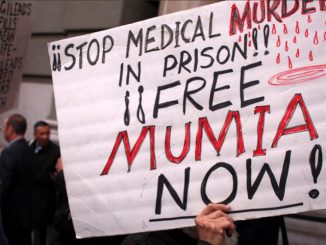
Release Mumia Abu Jamal and All Political Prisoners, NOW!

To register to view the teach-in: https://www.eventbrite.com/e/teach-in-us-empire-v-political-prisoners-tickets-102522325034

Strugglelalucha256


As Sanders ends campaign, ‘Don’t mourn, organize’: Build a movement to fight for socialism!

On April 8, Sen. Bernie Sanders suspended his presidential campaign. More recently, in a move that was widely expected, Sanders endorsed Joe Biden as the presumed Democratic nominee. While this moment is very painful for Sanders’ campaign supporters, it’s important to examine the larger developments to determine which way the movement should go next.

Let’s recognize the Sanders campaign, not for what didn’t happen, but for what it did accomplish. It was unprecedented in bringing the issues of health care and education as human rights into the mainstream; and it began to open the discussion on socialism. It tackled issues like mass incarceration and the climate crisis. It energized a large, multinational, working-class movement of mostly young people who are fed up with the status quo. 

No one should forget that the Democratic Party establishment connived, conspired and worked overtime to undermine the Sanders campaign, along with the big business media and every conceivable mouthpiece for the bankers and capitalists. The idea that workers are entitled to even the most basic rights like health care, food, a job, a home or even the right to live was considered heretical.  

What these agents for the billionaires and bankers feared was not so much Sanders the candidate, but rather the campaign’s potential for raising working-class expectations — expectations that could have gone beyond the narrow confines of the electoral arena.  

Several months ago, we took the position of critically supporting the Sanders campaign, not based on the candidate, with whom we certainly have differences, especially on imperialist foreign policy, but based on supporting the working-class movement, especially younger workers, whose aspirations found expression in this electoral arena.  

The question is: what’s the next step?

“There are decades where nothing happens; and there are weeks when decades happen.” These words, attributed to V.I. Lenin, the architect of the Russian Revolution, aptly describe the upheaval the world is experiencing during the coronavirus pandemic, the changes that have already taken place and those that are still to come. 

The capitalist economic downturn, precipitated by the overproduction of oil and gas, percolating prior to the coronavirus pandemic, is now in full swing. It is a crisis that is global in character, and when the coronavirus pandemic eases, it will be all the more apparent.

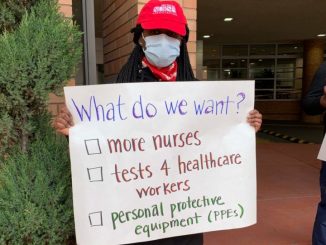
Over 22 million people in the U.S. are newly unemployed. The inability of capitalism to provide even the most basic measures for public health has been exposed to the entire world. In the so-called richest country in the world, health care workers are not provided personal protective equipment (PPE). Testing kits are few and far between.  

It is the unplanned anarchy of the so-called free market as much as any government policy that is overwhelmingly responsible for the lack of necessary equipment.  It was the closing of hospitals because they were considered insufficiently profitable that has resulted in doctors and nurses having to make unthinkable choices as beds and ventilators run out.   

The staggeringly disproportionate rate of deaths and the resultant suffering in Black, Brown and other oppressed communities has shown once again the brutal, white supremacist nature of capitalism. Millions of poor and oppressed people locked in prisons and detention camps are facing a virtual death sentence.

Hunger is sweeping the country. In both cities and rural areas, it is becoming increasingly hard for people to afford or obtain food. On April 9, some 10,000 families in San Antonio, Texas, lined up for food.

Revolutionary socialists have found themselves in a completely changed situation, dealing with stay-at-home orders that prevent mass demonstrations, but at the same time rising working-class consciousness and anger at capitalist failures.  

It has also changed the electoral arena in a way that weighed against the Sanders campaign, and perhaps most electoral campaigns, at least for now.  It is hard and perhaps foolhardy to predict what this will mean for November’s election.

This was fully demonstrated in Wisconsin’s April 7 primary, when voters were forced to go to the polls, risking health and safety. In a brutally cynical move, in-person elections in Wisconsin were ordered to go ahead. In Milwaukee, which has the state’s largest population of Black and Latinx people, only five polling sites out of 180 were open.  

Exploiting fear and instability

The Democratic Party has been conducting a campaign to exploit fear, fostering the slogan of “return to normalcy” and fueling the argument that Sanders was unelectable and too radical. Its message is aimed at suffocating the entire workers’ movement.   

Younger activists have roundly rejected this. In a #YouthVote Letter to Joe Biden penned by a number of groups, including the Sunrise Movement, the signers explained that normalcy meant going back to “endless war, skyrocketing inequality, crushing student loan debt, mass deportations, police murders of Black Americans and mass incarceration.”

If there is one urgent message to the movement at this juncture, it is this: not to be squelched, muffled or herded into the Biden campaign — a path that is as deadly as the virus.  

If the movement  disbands or follows the Democratic Party establishment, it will become disarmed in the face of bigger crises that cannot be addressed or resolved by the capitalist electoral parties.  

Recent events in Lansing, Mich., and other state capitals illustrate the dangerous side of the equation. Hundreds of rowdy, right-wing extremists, waving flags (including the confederate flag of slavery), toting guns and posturing for Donald Trump, marched on the Michigan Capitol calling for an end to stay-at-home orders. Similar protests took place in Kentucky, Minnesota, Ohio, North Carolina, Texas and Virginia, and more are planned.

There is a deeply racist and anti-working class character to these protests that should not be ignored. The fact that Michigan is home to Detroit, a majority Black city which has suffered a disproportionate number of Covid-19 deaths, should not be lost on anyone. 

It will take a vibrant, independent and militant working-class movement to answer the right-wing threat; and more importantly, to take us in a brand new direction if we are to save not only ourselves but the planet.  

Sanders’ role as the head of this movement has reached an impasse. The next step calls for shifting the struggle away from the Democratic Party straightjacket and fighting for working-class power.

We should remind ourselves how deeply undemocratic the U.S. electoral system is. In other countries, even capitalist ones, the Sanders movement would have had proportional representation.  

There are millions of people who cannot even vote, including immigrant workers — documented and undocumented — whose superexploited labor supersizes capitalist profits. Black, Brown and poor prisoners populating the ever-growing, for-profit, prison-industrial complex are stripped of voting rights. Add the overpowering influence of billionaires and fraud aimed at depriving the oppressed of their voting rights, and you get a system that is rigged from top to bottom.

Capitalism has no solutions

The capitalist system by definition depends on exploiting labor. It must expand for its very survival. There is a deep contradiction between this need and the health needs of the world’s people. Donald Trump may be the crude and at times ludicrous spokesperson for this compulsion to get the capitalist economy running, but bigger systemic forces are driving it.  

Regardless of whether it is prudent or safe, there will be a push to get workers back on the job — not because there isn’t already accumulated wealth within our society that can feed and support every human being while they shelter in place, but because the present system cannot prioritize human needs. 

Capitalists are awash in money, whether it’s sheltered in offshore bank accounts or possessions because it currently can’t be profitably invested, or channeled into the Pentagon death machine. 

The idea of a guaranteed national income no longer seems so radical given the changed circumstances of everyone’s lives, which will likely last far longer than the coronavirus pandemic. If anything, the capitalist crisis will tend toward the expansion of the exploitative gig economy, continued high unemployment, and intensification of the globalization of low-wage work. 

At this moment, there are dozens of halfway emergency measures, such as temporarily halting some evictions, mortgage foreclosures and utility shutoffs. They are sporadic and vary by state and city. But what happens when they are lifted?  

We’ve already seen workers’ actions and strikes all across the country, from Amazon to McDonalds, at hospitals and groceries, by delivery drivers, transportation and postal workers. The lack of regard and planning to defend workers’ lives has fueled workers’ solidarity.

May Day and the Democratic Convention

May Day — International Workers’ Day — is just around the corner. Cooperation Jackson, based in Jackson, Miss., and many other groups have been agitating for a general strike on May 1.  The Peoples Power Assembly in Baltimore and the Harriet Tubman Center for Social Justice in Los Angeles are actively organizing in both the community and at workplaces.

We urge the entire movement to embrace these calls and to organize and promote “No work! No shopping! No rent!” on May Day. 

The Democratic Party Convention has been rescheduled from July to the week of Aug. 17 in Milwaukee. So have the planned protests. We have endorsed the Coalition to March on the DNC and are calling on the largest number of people to participate.  

Struggle-La Lucha newspaper and the Socialist Unity Party/Partido de Socialismo Unido are planning caravans from the West Coast, East Coast, the South, Southwest and Midwest. We urge the Sanders movement, particularly the youth, to join with the protests at the DNC. 

Danger of imperialist war

There is an ever-present danger of imperialist war — but that danger is multiplied during a capitalist economic crisis. Any widening of war will intensify racism, jingoism, anti-immigrant violence, misogyny and bigotry against LGBTQ2S people. The Democratic Party, with few exceptions, is a party of war like the Republican Party. It cannot offer a solution. 

The pandemic has revealed that global cooperation and solidarity is a necessity for everyone’s survival. But instead, the U.S. rulers and the Pentagon continue to inflict sanctions on countless countries, including Iran, Venezuela, Cuba, Zimbabwe, Yemen and the Democratic People’s Republic of Korea. These sanctions have prevented badly needed supplies to fight the coronavirus from reaching these countries.  

Bernie Sanders is not a revolutionary.  But as an insider, he understood the power of the billionaires, and that to realize even a part of his program, it would take a mass movement in the streets, one that included mass resistance in workplaces and communities.  

It’s time we take the torch and build a movement that can move all of humanity forward toward socialism, not backward toward the corrupt capitalist system. We will make mistakes along the way, but we must embark on that road, sooner rather than later. ¡Sí, se puede!

Sharon Black is a national spokesperson for the Socialist Unity Party/Partido de Socialismo Unido.

Strugglelalucha256


Miranda Etel interview: Palestinian Prisoners Day

On April 17, Palestinian Prisoners Day, Struggle-La Lucha interviewed Miranda Etel, a young Jewish activist who organized a car caravan from Baltimore to Washington, D.C., to support Palestinian-led protests against the American Israel Public Affairs Committee (AIPAC) conference this year. 

Etel is one of the founders of Youth Against War and Racism. She is currently helping the Peoples Power Assembly and Prisoners Solidarity Committee organize a car caravan protest in support of Maryland prisoners and ICE detainees.

According to Samidoun Palestinian Prisoners Solidarity Network, “Today, there are approximately 5,000 Palestinians jailed by Zionist colonialism, including over 180 children, 430 administrative detainees jailed without charge or trial, and 700 sick and ill prisoners, 200 with chronic and serious diseases that place them at even greater risk should Covid-19 spread throughout the prisons.”

Strugglelalucha256


Locked up and locked down

April 10 — For nearly a month now, all prisoners in Pennsylvania state prisons — over 40,000 men and women — have been locked down. What does “locked down” mean?

When I was on death row, all of us were locked down, as the saying went, “23 and 1.” Or for 23 hours a day, with one hour for out-of-cell exercise in a cage. After over a decade, it went to 22 and 2.

But this lockdown is occasioned by the coronavirus. Meals in the chow hall, visits with family and friends, religious services, classes, prison jobs — all are offline.

On the rare occasion a prisoner leaves the cell, he or she wears a paper or cloth face mask. Several states, like New Jersey, for example, have followed suit. And then there are county prisons where the sheer overcrowding leads to chaos.

In Philadelphia county prisons, an estimated 18 prisoners have the virus. Then comes Cook County, Ill., where over 400 men have tested positive for Covid-19. That’s a county joint.

For some men and women, being in prison in county jails isn’t just something that resembles death row. For them it will be a new death row. For that jail cell will be the place they die.

Mass incarceration is so much a part of U.S. life that the opposite idea — decarceration — begins to sound crazy. But the truth is, it wasn’t always this way.

This scourge is the product of neoliberal politics. And if neoliberalism caused this problem, how can it ever solve the problem?

From imprisoned nation, this is Mumia Abu-Jamal.

Listen to Mumia’s commentary at PrisonRadio.org.

Strugglelalucha256


Cuba’s victory at Bay of Pigs made medical solidarity possible

Fifty-nine years ago, on April 17, 1961, Cuba defeated a U.S-backed invasion at the Bay of Pigs (Playa Girón). The invasion’s purpose was to destroy the Cuban Revolution. The CIA armed, trained and transported the right-wing Cuban force to Playa Girón. Because of the Cubans’ strong political will and powerful leadership, the U.S. effort suffered a massive defeat. Fidel himself directed the military and worked alongside Cuban combatants to protect the Revolution.

I visited Playa Girón in 2019. While there, I learned that the U.S. supplied an advanced and deadly arsenal of weapons for the invasion. At the historical museum, a worker pointed out a Fortune 500 corporation’s logo on a U.S. artillery piece. Imperialist war lines the pockets of all big business. 

The accomplishments of the Cuban government and people should not be understated. The revolutionary leadership of Cuba drastically reduced illiteracy, homelessness and joblessness in less than a decade. Cuba nationalized all U.S. properties on the island in 1960 to provide for its people. Fidel initiated the Latin America School of Medicine (ELAM), which has trained doctors from all over the world. 

Cuba has sent medical brigades to at least 59 countries to fight disease and poverty worldwide. There may be no better example of heroic medical internationalism than Cuba’s. Every person in Cuba receives free medical care for their entire life. Despite the brutal U.S. blockade that prevents Cuba from trading with many foreign partners, the island has made important contributions to global health care. 

Right now, Covid-19 is ravaging Black, Brown and Indigenous communities across the United States. Meanwhile the U.S. government refuses to protect the people and instead prioritizes bailing out massive corporations. The wealthy have near-unlimited access to testing and other health care resources. All the while, tens of thousands of working-class people with symptoms cannot get access to testing or proper care. 

While the U.S. is letting its people die and spreading racist myths about China’s response to Covid-19, Cuba has made heroic efforts to fight the virus all around the world. The Cuban government has dispatched medical brigades to more than 37 countries to fight Covid-19. During the pandemic’s peak in Italy, Cuban doctors arrived on the scene immediately. 

Over 40 countries have requested use of an antiviral drug that Cuba has been using to treat Covid-19. Cuban doctors developed the drug, interferon alfa-2b, working with a Texas doctor in 1981. Combined with other antivirals, alfa-2b has proven to be an effective treatment when given at the beginning of an infection and as a prevention method. Both China and Cuba have been using it to fight the virus, and it is produced by a joint Cuban-Chinese venture, Changheber. The U.S. Food and Drug Administration should immediately approve distribution of alfa-2b in the U.S. to save peoples’ lives during this crisis.

Fifty-nine years after the revolutionary victory at the Bay of Pigs, U.S. aggression toward Cuba continues. The U.S. has relentlessly tried to destroy socialism and progress in Cuba. Yet Cuba continues to prioritize improving the lives of its people and of people around the world. 

There is no better example of this than Cuba’s heroic efforts during the Covid-19 crisis. It’s time to end the blockade on Cuba and start using interferon alfa-2b in the U.S. to save peoples’ lives.

Strugglelalucha256


Coronavirus pandemic: Remove prisoners from these death cells!

It appears that the U.S. government — headed by Donald Trump and enabled by Democrats who refuse to seriously check the most egregious actions of this fascist-minded, racist and sexist president — is using the coronavirus crisis to erode any democratic rights under capitalism that haven’t already been wiped out by law.

In addition to the economic and health insecurity that Covid-19 is exacerbating for working and poor people, the Department of Justice has already asked Congress to allow indefinite incarceration without trial. And to deny asylum to any immigrant testing positive for the virus — a death threat to many immigrants escaping the chaos produced by the devastation of their countries of origin and the hijacking of their country’s political process by Washington and Wall Street.

According to Politico, this request from Attorney General William Barr referred to “any statutes or rules of procedure otherwise affecting pre-arrest, post-arrest, pre-trial, trial, and post-trial procedures in criminal and juvenile proceedings and all civil processes and proceedings.”

This is the exact opposite of what the scientific community, human and civil rights organizations and public defenders are saying is needed to help fight the spread of the virus. Prisons and detention centers are incubators for disease. These institutions have now been transformed into death rows for all incarcerated or detained people.

Prison conditions in the U.S. have always been inhumane, with hygiene facilities and medical care dangerously lacking, encouraging sickness and death. However, these conditions are now far more dangerous — with facilities refusing soap and running water, and no possibility for social distancing during this crisis.

Crisis in Cumberland prison

Calling for solidarity and support, many of those incarcerated at North Branch Correctional Facility in Cumberland, Md., have contacted activists with the Peoples Power Assembly in Baltimore regarding conditions within the prison amidst the deadly pandemic. 

One prisoner, James Young III, who has been incarcerated at NBCI for almost seven years, has been experiencing severe symptoms typical of confirmed Covid-19 cases for over a week. James suffers from fever, chills and respiratory distress. Correctional officers stationed at the prison have consistently denied James entrance to the prison’s infirmary. 

Through a friend inside the prison, James communicated: “Yeah man, I haven’t been given any medicine or treatment. They won’t even let me have soap. They have just been keeping me in my cell as I feel worse and worse.” 

Attorney and PPA organizer Alec Summerfeld spoke by phone with Terrance Mahogany, who is in the cell next to James. He stated: “I am experiencing the same symptoms as James. It is getting real bad in here. The prison is making sure the guards have masks, soap, hand sanitizer and everything else … but not us.” 

Mahogany continued: “They don’t care about the inmates. We can’t get any treatment. No handwashing stations, no shower access, no nothing. We are just being left in our cells to suffer.”

‘Land of the free’: the prisonhouse of nations

Prisoners and detainees in the U.S. remain isolated and invisible. The inhumane conditions of animals in zoos are covered much more by the corporate media than the conditions of human beings in a country that has, by far, the greatest number of residents behind bars. 

As of 2015, over 2 million people are incarcerated. That’s nearly 1 percent of the U.S. population. By comparison, China, with a population three times larger than the U.S., not only holds a much lower percentage of its population as prisoners — less than .2 percent — but the actual number is nearly 650,000 less than in the U.S. 

Most pertinent to the dangers of Covid-19 is the overcrowding or occupancy level in U.S. prisons. That rate is also much higher than most countries. U.S. prisoners are crammed into cells at over 100 percent capacity.

On April 7, the American Civil Liberties Union sued the Oakdale Federal Detention Center in Louisiana after five people died there. The ACLU is demanding that the Federal Bureau of Prisons release prisoners who are at high risk from the virus.

So far, Attorney General Barr has ignored countless requests that he begin depopulating prisons in earnest to prevent the mass killing of prisoners and detainees through neglect during this viral crisis.

This is why Lisa Freeland, federal public defender for the Western District of Pennsylvania and co-chair of the Defender Services Advisory Group to the U.S. courts; David Patton, executive director and attorney in chief of the Federal Defenders of New York; and Jon Sands, federal public defender for the District of Arizona, wrote an opinion piece in the Washington Post on April 6 warning Barr of the life-and-death consequences of his continued inaction.

They point out: “The number of Covid-19 cases in the Bureau of Prisons are rising exponentially, at a pace far surpassing the U.S. population at large. On March 20, the bureau’s website reported just two Covid-19-positive inmates and staff; two weeks later, it reported 174 confirmed cases. That’s an increase of 8,600 percent [my emphasis – jp], a much steeper rate of increase than has been recorded among the general population. And because testing has been grossly insufficient, these numbers are almost certainly an undercount.”

Refuting the argument that prisoners would be better off staying in prison, they argue that not only is this a death sentence for the incarcerated, but the ramifications of incubating the virus in this huge population will adversely affect the general population, far more than if the number of prisoners was drastically reduced.

Freeland, Patton and Sands go on to mention the obstruction to releasing prisoners by prosecutors, judges and Barr himself:

“It is too late for the crisis to be entirely averted, but the worst can be prevented if Congress and Attorney General William P. Barr act with urgency. So far, however, Barr and federal prosecutors have opposed even modest efforts to reduce the prison population. In courtrooms across the country, when lawyers seek bail or compassionate release for vulnerable people accused or convicted of nonviolent offenses, federal prosecutors have vigorously opposed the requests — even in cases where people’s sentences are near completion. In nearly every case, prosecutors are making the same argument that Barr advanced in a recent statement: that inmates are safer in prison than they would be at home.

“It is an absurd claim, contradicted by science and fact. The CDC’s guidance is unequivocal: social distancing, hand-washing and cleanliness are key to reducing spread of the coronavirus. Numerous credible public health experts have observed that overcrowded prisons with communal living; shared toilets, showers, and sinks; poor sanitation; and wholly inadequate medical care would allow Covid-19 to sweep through the prison population far more quickly than the general public — with devastating consequences.” 

Free them all!

According to public defenders, Barr has the authority to do what is necessary with the additional powers given to him by the passage of the CARES Act (Coronavirus Aid, Relief, and Economic Security) in March.

The solution of the problem does not require rocket science or resources that the U.S. lacks. However, this capitalist government and politicians bought and paid for by the monopolies would rather commit mass murder in the prisons than use the trillions of dollars earmarked for the military or to bail out Big Business.

Iran has already released over 85,000 prisoners to save them from the virus. Instead of following Iran’s example, the U.S. continues to enforce sanctions that greatly limit the Iranian government’s ability to deal with the pandemic. U.S. sanctions apply to Cuba, Zimbabwe, Venezuela and many other countries trying to deal with this crisis, In the case of Cuba, Venezuela and China, these countries are also actively engaged in assisting many other countries in combating this threat to humanity.

There’s not much to figure out here. Of course, housing, health care and other facilities to house those who are a danger to themselves or others will have to be provided to those who are released. The U.S. has the resources and ability to do that — if only profits were not priority number one. 

The details of care for released prisoners cannot be used as an excuse today to delay or refuse their release, which amounts to practicing genocide against our human family members who are now being further tortured and falling as casualties in the war on working-class, poor and oppressed people here in the belly of the beast.

It will take a united and militant movement to change this deadly direction of inaction.

Strugglelalucha256
https://www.struggle-la-lucha.org/2020/04/page/4/