Stop murder of activists in Colombia

Struggle-La Lucha is sharing this July 10 message from the Aurora Women’s Club and Red Carnation anti-fascist group in the Donetsk People’s Republic. Translation by SLL’s Greg Butterfield.

In Colombia, where leftist FARC guerrillas signed a peace agreement with the government in 2016, far-right terror is now raging. One by one, leaders of social movements, defenders of the rights of peasants and Indigenous people, human rights defenders and civilians are being killed.

Last week, Tatiana Paola Posso Espitia was killed – the 727th victim of the terror. She helped people affected by the civil war. In total, about 1,000 leaders of social movements in Colombia have been threatened with death. Fifty percent of them are women.

It’s time to say “Enough!” to terror and impunity. We join all those who express solidarity with the social movement of Colombia. 

No more deaths! #NiUnMuertoMas 

Strugglelalucha256


Pride rings out in New York streets: ‘Stonewall still means fight back!’

What a weekend! From Friday, June 28 — the 50th anniversary of the Stonewall Rebellion against police terror — through Sunday, June 30, protests, parades, meetings, festivals and celebrations took place in New York to mark the dawn of the modern movement for lesbian, gay, bisexual, transgender, queer and Two-Spirit (LGBTQ2S) liberation.

Like any movement that has survived for half a century, experiencing both tremendous victories and tragic setbacks, the 50th anniversary of Stonewall was messy, challenging and full of contradictions.

But what stood out above all the noise was the sense that the tide of struggle is rising again.

Despite the takeover of New York’s large annual Pride Parade and other celebrations by corporations and capitalist politicians, and in the face of a hostile national political climate of intensified terror by white supremacists and bigots in both official and unofficial capacities, LGBTQ2S people declared: “We will not go back!”

And many of those who came out under hot, sunny, late June skies understood that solidarity with the most oppressed, inside and outside the LGBTQ2S community, is not only desirable. It is essential.

You could read it on the signs that said “Fuck ICE” and “Black Lives Matter” and “Unite to Stop the Murders of Trans Women.” You could see it in the multinational, multigender and multigenerational crowds that flooded the streets and parks and subways.

Thousands of people from across the U.S. and around the world came here to celebrate five decades of fightback and renew their commitment to continue the struggle for liberation. Among them were members and friends of Struggle-La Lucha newspaper and the Socialist Unity Party from Atlanta, Baltimore and San Diego, who made the journey to speak and march alongside their New York comrades.

They had a message to share, one both simple and profound: Stonewall still means fight back!

Lifting voices of most oppressed

On June 29, Struggle-La Lucha sponsored a panel discussion featuring revolutionary veterans and young organizers of the LGBTQ2S struggle. The theme was “Lifting the Voices of the Most Oppressed.”

This powerful meeting, held at the offices of Project REACH, a multinational youth organizing center in the heart of Chinatown, was also live-streamed around the world. It was chaired by Miranda Bachman of Youth Against War and Racism.

Opening the event, Baltimore organizer Andre Powell, a retired AFSCME delegate and founder of Labor for Reparations, declared that, “We are light years away from the days of the Stonewall Rebellion. However, all is not perfect. Employment discrimination, along with discrimination in housing and health care, is too common in the LGBTQ2S community.

“LGBTQ2S immigrants crossing the border have found themselves held in detention centers for long periods of time, in unsafe conditions, and are at a far greater risk of sexual violence than the general population in those concentration camps.”

Powell added: “ICE has shown disrespect and utter contempt for the transgender community. They are housing transgender immigrants in unsafe conditions. Trans women have been forcibly housed in the men’s housing units. Many have been denied their hormone treatments and have been kept in solitary confinement, which the United Nations says is a form of torture.

“It is crucial that the LGBTQ2S community continues to show its solidarity with its immigrant siblings,” he concluded.

Reece Evans, a revolutionary youth organizer from Los Angeles and producer of Struggle-La Lucha Radio, spoke via pre-recorded video. Evans discussed the early LGBTQ2S movement’s links with the anti-imperialist struggles against the Vietnam War and for women’s, Black, Latinx, Native, Asian and Arab liberation.

Evans also emphasized the special contributions of two queer internationalists: Marielle Franco and Chelsea Manning. Franco, an Afro-Brazilian lesbian and socialist, fought against racist police terror and the growing power of the U.S.-backed ultraright in her country. She was assassinated in early 2018 by police linked to current Brazilian President Jair Bolsonaro.

Manning, a trans woman who spent seven years in military prison for sharing evidence of U.S. war crimes with WikiLeaks, is back in jail today for refusing to testify before a grand jury targeting Julian Assange.

“It’s in the interest of all working and oppressed peoples to unite and fight for a better world — without wars for oil and other resources, without racism, sexism and anti-LGBTQ2S bigotry. International solidarity is key to building the struggle against capitalism, imperialism and all forms of oppression,” said Evans.

On the shoulders of giants

Lizz Toledo from Atlanta, a queer Latinx communist and anti-police brutality organizer, spoke about the lives of Stonewall participants Sylvia Rivera and Marsha P. Johnson. “The leaders of our movement come from the most oppressed. They come from communities of color. They come from the poorest of communities.

“At every turn in the story of our movement, poor LGBTQ2S people like Sylvia and Marsha have been in the front lines of all fights for liberation,” Toledo explained. “From the women’s movement to unions to any fight for working people here or anywhere in the world, it has been poor, queer people of color in the front lines, before Stonewall, during Stonewall and today.

“We have thrown the first brick and the first bottle in the fight against police terror and racism, defending migrants from the brutality of ICE, fighting for reproductive health for all women, for our trans sisters, for equal pay in unions across the country, and against imperialist wars, from Iraq and Afghanistan to the ones these warmongers are itching to start right now against China, Venezuela and Iran,” declared Toledo.

“We threw the first stone in saving the planet from climate change, to stop the destruction of Native land — and we stand on stolen land right now. We continue to fight on the front lines of these movements,” she said.

“We have never wavered, but we have been silenced and pushed to the side. The first Pride parade refused to let our trans siblings march, even though they threw the first bricks.

“We stand on the shoulders of giants. But our best is yet to come,” Toledo said. “When all of us — men, women, trans, Black, white, Brown, gay, straight, working and poor, united — throw the first brick to bring this rotten capitalist system to its inevitable death.”

Solidarity opens path to liberation

Bob McCubbin of San Diego, author of “The Roots of Lesbian and Gay Oppression: A Marxist View” and formerly an activist with the San Francisco Gay Liberation Front, stated that “Solidarity opens the path to liberation and justice for all the workers and oppressed.”

McCubbin used the life of Leslie Feinberg, author of the acclaimed novel “Stone Butch Blues” and groundbreaking nonfiction works on transgender liberation, to illustrate his point.

“Leslie was a communist activist and a fierce opponent of racism, a transgender warrior. But Leslie entered adulthood in the late 1960s as a somewhat forlorn, profoundly oppressed factory worker in Buffalo, who asked, ‘Why am I so hated for being different?’ This was a very difficult question with no existing reasonable answer. Leslie would only find the answer years later, using the tool of Marxist analysis,” said McCubbin.

Over the years, McCubbin explained, Feinberg “amassed an impressive amount of the anthropoligical and historical evidence that makes clear the ubiquitous existence of trans and nonbinary people and their acceptance and special contributions to society” prior to the development of class society.

“Leslie found that prior to the development of society into distinct classes of rich and poor, hatred of transgender, gender-nonconforming, nonbinary people didn’t exist,” said McCubbin.

“But that discovery came later. What came first” and what laid the basis for those later achievements, he insisted, was Feinberg’s “introduction to and enthusiastic embrace of a revolutionary organization, where Leslie was given every opportunity and much assistance to develop as an extremely skillful and supremely articulate activist, talented journalist and novelist.”

45,000-strong Queer Liberation March

McCubbin added: “We believe that collaboration with the racist police and promotion of commercial enterprises at our sacred march is wrong. This is not what Stonewall is all about. The message our contingent will bring to the Queer Liberation March will affirm the need to struggle, in solidarity with the most oppressed, both in this country and around the world.”

And what a powerful march it was — 45,000 strong, one of the largest political protests on the streets of New York in recent memory.

The Queer Liberation March stepped off from Sheridan Square, just south of the Stonewall Inn, in the early morning of June 30, and marched uptown to Central Park. Organized by the Reclaim Pride Coalition, the march was in the spirit of early Pride parades — a protest against social injustice and a celebration of the fight for LGBTQ2S liberation.

There were no corporate-sponsored floats and police were not welcomed. Along the route, the AIDS Coalition to Unleash Power (ACT UP) held a “die-in” to protest the deaths of at least 17 HIV+ people in ICE custody.

The Marielle Franco and Chelsea Manning contingent organized by Struggle-La Lucha and the Socialist Unity Party was in the thick of it with beautiful banners and signs. Activists led chants like “Migrant rights are under attack! Shut down concentration camps!” and “No war for big oil profits! Free Chelsea Manning!” Along the way, contingent members distributed hundreds of copies of a special Pride issue of Struggle-La Lucha newspaper.

Several times along the 4-mile march, members of the Brazilian LGBTQ2S community stopped to pose for photos with signs and banners of Marielle Franco and thanked the contingent for honoring her. A message from Chelsea Manning was read at the closing rally on the Great Lawn in Central Park.

“As I marched it felt like the early years in the 1970s — everyone marching proudly without floats or cops. It was so alive and filled with energy.” Andre Powell told Struggle-La Lucha, adding: “Our strength as a new revolutionary party came through loud and clear.”

SLL photos: Greg Butterfield and Leon Kofax

Watch livestream of “Lifting the Voices of the Most Oppressed” panel

https://www.facebook.com/strugglelalucha/videos/2361541347468964/


Strugglelalucha256


Defending migrants and refugees: from protest to resistance

In its latest attempt to sow terror among migrants and refugees, the Trump administration has announced plans to arrest thousands of family members in a series of Immigration and Customs Enforcement (ICE) raids starting on the weekend of July 13-14.

“The raids, which will be conducted by ICE over multiple days, will include ‘collateral’ deportations,” reported the New York Times when it broke the story on July 11, citing government officials who spoke on condition of anonymity. “In those deportations, the authorities might detain immigrants who happened to be on the scene, even though they were not targets of the raids.”

The Times continued: “The officials said ICE agents were targeting at least 2,000 immigrants who have been ordered deported – some as a result of their failure to appear in court – but who remain in the country illegally. The operation is expected to take place in at least 10 major cities.”

President Donald Trump originally planned the raids in June, then pulled back at the last minute, saying he would wait to see if congressional Democrats would back his “border security” bill, despite mass outrage over torturous conditions of children caged in detention centers and the deaths of desperate asylum seekers trying to cross the U.S.-Mexico border.

Democratic Party leaders did support the $4.6 billion bill. Rep. Ilhan Omar of Minnesota, who came to the U.S. as a refugee from Somalia, denounced their cave-in, saying “What we did today is continue to allow the atrocity to take place.”

Now the raids are to go ahead anyway. This is typical of Trump’s gangster-capitalist negotiating style – in other words, blatantly lying to get his way.

But the Democratic leadership, like House Speaker Nancy Pelosi and Senate Minority leader Chuck Schumer – who like to call themselves “The Resistance” when it suits them – don’t really oppose Trump’s war on migrants any more than they oppose his warmongering threats to Iran, Venezuela, Korea and other countries.

They all serve the same masters – the ruling class of bosses, bankers and landlords, from Wall Street and Big Oil to Amazon, Walmart and the prison profiteers.

Shut down concentration camps!

Racist outrage piled upon racist outrage, especially targeting families and children, has stoked a new wave of solidarity. Protests led by the Japanese American and Jewish communities have denounced the detention centers run by ICE and the Department of Homeland Security for what they really are: concentration camps.

On June 22, Japanese Americans travelled to Fort Sill, Okla., to protest Trump’s plan to have at least 1,400 children imprisoned on the military base.

Fort Sill was the site of one of the World War II concentration camps for detained Japanese Americans, and before that, people from Indigenous nations. Some of those who protested had been detained at Fort Sill as children themselves in the 1940s.

“Met by uniformed military police, the protesters, some in their 80s, were told they did not have permission to congregate and might face arrest,” the Los Angeles Times reported. “‘You need to move right now!’ one of the officers shouted. ‘What don’t you understand? It’s English: Get out.’

“But the survivors, carrying thousands of origami cranes as a symbol of solidarity, refused to leave until police from adjacent Lawton, Okla., arrived and let them speak. They then moved to a park where a crowd of about 200 was waiting.”

On June 30, 36 Jewish activists were arrested blocking the ICE detention center in Elizabeth, N.J. They chanted, “Never again is now!”

“As Jews, we’ve been taught to never let anything like the Holocaust happen again,” said a statement from the organizers. “Now, with children detained in unacceptable conditions, ICE raids targeting our communities, and people dying at the border while seeking safety in the U.S., we are seeing the signs of a mass atrocity. We refuse to wait and see what happens next.”

And then there was the historic political strike at online furniture seller Wayfair on June 26, when hundreds of workers walked off the job and were joined by thousands of supporters in Boston’s Copley Square, to protest the company’s $200,000 sale of beds and other furniture to detention centers.

“The United States government and its contractors are responsible for the detention and mistreatment of hundreds of thousands of migrants seeking asylum in our country — we want that to end,” the employees said in their letter protesting the company’s profiteering on torture. “We also want to be sure that Wayfair has no part in enabling, supporting or profiting from this practice.”

These powerful expressions of working-class and human solidarity have been echoed in cities and towns across the U.S. in protests and direct actions targeting ICE and DHS facilities, as well as Amazon and other companies aiding and abetting the Trump regime.

Hundreds of actions are planned as part of a national and worldwide day of action against the concentration camps on July 12.

From protest to resistance

Now the struggle to defend our migrant class siblings must move from protest to resistance – genuine workers’ resistance, not the phony “Resistance” epitomized by the Democratic Party, which will try to divert the people’s struggle into support for its 2020 electoral ambitions.

Los Angeles news conference announcing Comités de Resistencia

https://www.facebook.com/udblosangeles/videos/873952002962852/

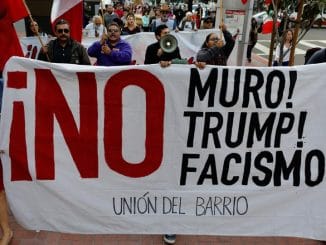
Another important development has taken place recently in San Diego, where Unión del Barrio, a revolutionary organization based in the Chicano community, has established community patrols to protect migrant communities from ICE raids.

These people’s self-defense patrols, staffed by volunteers, drive vehicles with large decals declaring, “Protecting Communities. No ICE & Police Terror.”

When they spot a likely ICE vehicle and verify that it belongs to an immigration agent, the volunteers livestream on social media and send out teams to alert local residents about their presence. “The goal is to keep undocumented immigrants whom ICE may be targeting away from the area,” the San Diego Union Tribune reported.

“We have to defend our families because the nucleus of our society is being destroyed systematically by state policy,” volunteer Benjamin Prado explained.

Unión del Barrio’s initiative is taking a further step forward with the establishment of Comités de Resistencia (Resistance Committees) in Los Angeles. “Protests and marches are important,” says the group’s call for a July 13 organizing meeting, “but they are not enough. We must organize ourselves and be ready to defend our people!

“We will discuss how we can organize in our schools, churches, apartment buildings or anywhere else to defend ourselves. The goal is to set up these Comités in different areas of our city and beyond.”

Unión del Barrio and allies held a news conference about the initiative on July 8. Speaking there, Struggle-La Lucha’s John Parker said, “The only way we’re going to get out of this stormy sea is with a compass. What we’re talking about with these Comités de Resistencia is exactly the direction we need to be going in.

“It reminds me of how the Black Panthers inspired people to say, ‘We can protect ourselves,’” Parker said. “We know that the LAPD, ICE, DHS and all these white supremacist and fascist organizations don’t care. But we care about each other. Actions like this unify our communities – Latinx communities, Black communities, poor white communities and all working-class communities.

“There’s another compass we can look to: the Wayfair workers. Those workers took the bold step of deciding that they were not going to let this company sell furniture to detention centers. They risked their livelihoods and showed the power of labor. It’s a big company but our power as workers is even greater.”

Strugglelalucha256


Wayfair walkout says no to concentration camps

On the afternoon of June 26, hundreds of Wayfair workers walked off their jobs at the company’s Boston headquarters. They took united action to protest the company’s sale of beds to a detention camp for migrant children in Carrizo Springs, Texas. 

Carrying homemade signs that read, “A cage is not a home” and “We won’t be complicit in childhood incarceration,” workers marched to nearby Copley Square. Several thousand union and nonunion supporters greeted them, including UNITE/HERE Local 26, Movimiento Cosecha, Uber Guild drivers, the Boston Teachers Union’s immigrant rights action committee, Mijente, Pride at Work, 32BJ SEIU and Harvard Graduate Student Union-UAW.

For many of the largely youthful Wayfair workers, it was the first time they had participated in any political or protest activity. The fact that they are not represented or protected by a union makes their actions all the more courageous.

Workers at the Brunswick, Maine, Wayfair offices participated in their own solidarity walkout that also received community support.

Background to walkout

The organizing for the walkout took a little over a week after Wayfair’s detention camp business was leaked. A $200,000 order by federal contractor Baptist Children’s Family Services was for its children’s detention camp in Texas. 

Workers discussed the issue, then drafted a petition signed by 547 workers demanding that Wayfair reject profiting from detention camps. When Wayfair workers learned the bed sale was final, they demanded: 1) don’t do business with the contractor again; 2) donate proceeds to the Refugee and Immigrant Center for Education and Legal Services (RAICES), a non-profit that helps reunite families at the border; and 3) institute a code of ethics. The workers clearly understood that a prison with a bed is still a prison.

Instead of responding affirmatively to the workers’ demands, the company donated $100,000 to the Red Cross. After a June 25 in-house meeting, CEO Steve Conine made it clear that the company was not budging. In response, workers spun on a dime and organized the walkout for the next day.

Who are the Wayfair workers?

Wayfair is an ecommerce company headquartered in Boston and Berlin, similar to Amazon but on a much smaller and limited scale.  It sells home goods such as furniture, rugs, lamps and decorations.

The company has fulfillment center warehouses and call centers around the U.S. in places like Springfield, Ohio; Big Flats, N.Y.; Bryan, Texas; Hebron, Ky.; and Parris, Calif.  

In 2018, Wayfair made a reported $6.8 billion in revenue and is ranked number 446 on the Fortune 500 list. The company employs over 12,000 workers worldwide, with 7,000 working at the Boston headquarters.

The type of labor done by these workers varies from customer service representatives and call center workers to artists and engineers to product managers to warehouse workers. On the lower end of the pay scale, Glassdoor lists the average base wage for a warehouse associate at $13 an hour.

Wayfair was given one of the largest tax breaks in Massachusetts history when it was awarded $31.4 million in tax incentives in December 2018 to benefit expansion in the cities of Boston and Pittsfield.

Political work stoppage

Aside from the youthfulness of the participants and the fact that they have no union protection, a factor that caught the attention of many working-class advocates was the walkout’s political character. This work stoppage was based on an anti-racist demand in solidarity with migrant and refugee children, families and workers — not on wages or working conditions in the shop.

The cruel and inhuman conditions imposed by the U.S. government and its for-profit private prisons and nonprofit detention centers are widely protested. What if workers’ power interrupted every link of the supply chain that enables these concentration camps and prisons?

The Wayfair workers’ walkout serves as an important example and a critical tactic in the working-class struggle.

This type of disruption is not new in recent U.S. labor history. The International Longshore and Warehouse Union (ILWU) has contributed rich examples.

On Sept. 27, 2014, ILWU Local 10 honored a Zim Action Committee picket at the Port of Oakland in California by refusing to work a ship with Israeli cargo. The action was in protest of the Israeli government’s genocidal bombings of Palestinians in Gaza that killed over 2,100 people, mostly civilians.

Previously, as the December 2013 Dispatcher remembered: “ILWU Local 10 members helped put the anti-apartheid struggle in the national spotlight in 1984, when they refused to unload South African cargo from the Dutch ship, Nedlloyd Kimberly, at San Francisco’s Pier 80.

“Although they unloaded the rest of the ship, the South African ‘bloody’ cargo of steel, auto parts and wine remained in the ship’s hold for 10 days while community supporters held daily demonstrations outside protesting South Africa’s apartheid regime. At its peak, the demonstration grew to an estimated 700 participants. Employers tried to find another West Coast port to take the ship, but because of solidarity from other ILWU locals, no port was willing to accept the Nedlloyd Kimberly.”

The April 6, 1974, issue of the Black Panther newspaper reported on the International Longshore Association (ILA) support for the Black liberation struggle in Zimbabwe (then called “Rhodesia”). In December 1973, the African Sun ship was “forced to return to Mozambique with 56 crates of Rhodesian nickel ore because dockworkers refused to unload it.”

Baltimore’s Ray Ceci, ILA Local 333 member and founding member of the All Peoples Congress, a precursor of the Peoples Power Assembly, participated in that action.

Critical community support and mass strike

The Wayfair workers’ action illustrates the importance of working-class-wide support. As a number of the workers who left their jobs to walk out remarked, the encouragement of the hundreds of people who had gathered in Copley Square buoyed them and made their sacrifice both possible and worth it. 

The broader movement made it possible for the workers to act, and the actions of the workers ignited the movement.

Fighting as a class has never been more important. June 26 is a tiny example of what is possible and what can win workers’ power with mass strikes. A mass strike, with everyone in the working class uniting to shut down business as usual because of the refugee crisis, could turn the situation around very quickly. A mass strike could abolish Immigration and Customs Enforcement (ICE) and shut down the detention/concentration camps permanently. 

It’s the kind of action that can prevent racist police terror, end imperialist war and force action to stop the capitalist climate crisis.  

Strugglelalucha256


U.S. Hands Off Iran Webinar, July 14

Sunday, July 14, 2019 at 3:00 PM – 5:00 PM UTC+02

Sponsored by Struggle – La Lucha

U.S. Hands Off Iran Webinar

Struggle – La Lucha is holding a national webinar as part of the UNAC weekend with three excellent speakers with questions and dialogue following their presentations The speakers are writers for Struggle -La Lucha who have contributed articles and perspectives on U.S. imperialism. Please sign up so that you can get information on how to be a part of this webinar.

Hear: John Parker; Cheryl La Bash; and Bill Dores
Sunday, July 14, 3 pm to 5 pm on the West Coast and 6 pm to 8 pm on the East Coast
Group viewings:
Los Angeles – 5278 Pico Blvd., Los Angeles, CA 90019 – 3 pm
Baltimore – 2011 N. Charles St., Baltimore, MD 21218 (doors open at 5:30 pm – refreshments)

John Parker from Los Angeles, has traveled to Iran, he will give an account of what the impact of a U.S. war on Iran will mean; Cheryl La Bash, is a pro-Cuba activist who has advocated tirelessly against the U.S. blockade of Cuba and will describe what sanctions are and why they are war; and Bill Dores who has written on the economic aspects of U.S. imperialism will deepen our understanding of what imperialism is. Dores is based in NYC and has participated in the pro-Palestine movement.

Strugglelalucha256


Los Angeles: Community Self-Defense! Comites de Resistencia against ICE Raids

Saturday, July 13, 2019 at 10:00 AM – 12:00 PM PDT

4301 S Central Ave, Los Angeles, CA 90011-3524, United States

Hosted by Union del Barrio – Los Angeles

Our community is under attack so we call on the community to join the resistance against Trump, the migra, the police or anyone else who is threatening our community!

Protests and marches are important but they are NOT enough. We must organize ourselves and be ready to defend our people! Come to this first meeting to join our Comites de Resistencia. We will discuss how we can organize in our schools, churches, apartment buildings or anywhere else to defend ourselves.

The Comites de Resistencia are being organized in LA by Union del Barrio, Base Tierra y Libertad. The goal is to set up these Comites in different areas of our cities and beyond.
==========================

¡Nuestra comunidad está bajo ataque, así que hacemos un llamado a la comunidad para unirse a la resistencia contra Trump, la migra, la policía o cualquier otra persona que esté amenazando a nuestra comunidad!

Las protestas y marchas son importantes pero NO son suficientes. ¡Debemos organizarnos y estar listos para defender a nuestra gente! Ven a este primer encuentro para unirte a nuestros Comites de Resistencia. Discutiremos cómo podemos organizarnos en nuestras escuelas, iglesias, edificios de apartamentos o en cualquier otro lugar para defendernos.

Los Comites de Resistencia están siendo organizados por la base Tierra y Libertad de Unión del Barrio en Los Angeles. El objetivo es configurar estos Comites en diferentes áreas de nuestras ciudades y más allá.

Strugglelalucha256


U.S. Hands Off Iran – Baltimore action, July 15

Monday, July 15, 2019 at 5:00 PM – 8:00 PM EDT

Bottom of Washington Monument, Centre and N. Charles Street

Hosted by Peoples Power Assembly

Educational and protest event on U.S. War on Iran!

Baltimore groups including Peoples Power Assembly, Youth Against War & Racism are joining with the national call by UNAC (United National Anti-War Coalition) for local protests on or around the weekend of July 13 – 14 calling for No War on Iran, No U.S. Coup in Venezuela, End Sanctions Now, Bring all the Troops Home Now.

The U.S. now spends almost 64% of every discretionary tax dollar on the military. It has about 20 times the number of foreign military bases as all other countries combined. Both major parties support ever increasing military spending and war, so it is up to the people to build a strong, independent movement to stop U.S. military aggression around the world. Join us!

With the recent drone attack and false flag incidences with on oil tankers off the coat of Iran, the prospects of another regime change war seem ever more probable. Let July 13 – 14 action be an answer from the antiwar movement. Join us!

On Facebook

Strugglelalucha256


Kim Il Sung: Anti-imperialist fighter, socialist hero

Kim Il Sung, leader of the Korean Revolution and founding president of the Democratic People’s Republic of Korea (DPRK), died 25 years ago on July 8, 1994. The Korean people are commemorating the anniversary with mass political meetings, performances and commemorations. The following appreciation of Kim Il Sung by Marxist leader Sam Marcy is abridged from an article originally published in the July 21, 1994, issue of Workers World newspaper.

By Sam Marcy 

Comrade Kim Il Sung devoted his whole life to the Korean people’s struggle for national self-determination and the international working-class struggle for socialist emancipation. With his leadership, the Korean people defeated the Japanese colonial occupation and soon after brought about the first defeat of the U.S. imperialist military machine.

For over 40 years since the armistice, the U.S. military has continued to occupy the south of Korea with troops and nuclear weapons. This occupation has been the chief obstacle to peaceful reunification of Korea and poses the chief danger of a new war on the peninsula.

The recent nuclear crisis is the latest episode in a long history of Pentagon threats and provocation against Korea. At a time when the people of the United States are suffering from unemployment, racism and a general decline in living standards, another U.S. war against Korea would be a terrible crime against the poor and working people of the U.S. as well as against the people of Korea.

Comrade Kim Il Sung worked tirelessly to bring about the peaceful reunification of Korea and to forge a lasting peace on the peninsula. … Comrade Kim Il Sung’s great efforts to achieve peace and reunification met the aspirations of the Korean people and also benefited the poor and working people of the U.S.

It is Kim Il Sung’s remarkable achievement that in his own lifetime he became a symbol of national liberation and reunification for the Korean people, and a symbol of the anti-imperialist and socialist struggles of all the world’s peoples. Although U.S. imperialism tried at every opportunity to blockade, threaten and sabotage the construction of socialism in the north, the Democratic People’s Republic of Korea stands strong. The accomplishments of socialist construction will be a lasting monument to the leadership of Comrade Kim Il Sung.

International developments in the last few years have created great difficulties for the working class and oppressed peoples of the world. And in the face of these difficulties some have wavered or even abandoned the struggle. But Comrade Kim Il Sung and the Workers’ Party of Korea refused to let go of the principles of revolutionary socialist internationalism.

Leadership in times of great difficulties is what makes a leader truly great.

We are proud to have known Kim Il Sung as a great leader and a comrade in the international communist movement. And it is with the most profound sense of loss that we mark his passing. Yet it is also with the greatest revolutionary optimism that we are confident that Comrade Kim Il Sung’s legacy will live on with your efforts to win new victories for the Korean people. His contributions and achievements for the cause of international socialism for all humanity will never be forgotten.

Strugglelalucha256


People’s SONA: Class clarity is crucial for solidarity with people of Philippines

In the Philippines, the State of the Nation Address, popularly abbreviated as SONA, is traditionally held on the fourth Monday of every July. This year, it will be Monday, July 22, on which day President Rodrigo Duterte will stand before a joint session of Congress and report to the people of the Philippines and to the people of the world what he wants us to believe about what’s going on in his country. 

If Duterte’s previous three SONAs are any indication, we should expect to hear about the rousing success of his “war on drugs.” He will conveniently leave out any mention of the mounting death tolls, the use of police, military and mercenary forces used to carry them out, and the U.S. tax dollars being used to fund them. He will certainly not mention that drug abuse has not lessened.

We should expect to hear about the growing strength of the Philippines economy. We should not expect, however, to hear how this growth is calculated or measured. Any report that claims the economy of the Philippines is expanding simply does not account for the growing poverty, landlessness, contractualization or forced migration. 

The peasant class of the Philippines is forced to till land that does not belong to it to produce food that it will not get to eat. And the working class is forced into unemployment because of the import-dependent economy. This means that everyday goods must be bought from overseas, even though the raw materials used to make them are produced right there in the Philippines, which leads to superprofits for the giant monopolies. 

Because there is such a small industrial economy, the lack of jobs forces Filipino workers out of the Philippines so they can send home remittances to support their families. 

In other words, Duterte will continue to regurgitate the lies fed to him by the U.S.-backed government of landlords and comprador capitalists — the facilitators for the imperialists.

The people’s response

Luckily, the people of the Philippines will not take this sitting down. All across the Philippines and the world, fighters for national liberation will respond with the People’s State of the Nation Address, or PSONA. This is where we should expect to hear everything Duterte will not say — about the pain and grief of losing a loved one to Duterte’s “drug war,” about the migrant workers longing to be reunited with their families, about the razing of Indigenous communities.

But the PSONA will not be just about the problems — it will also be about solutions. The Philippines movement for national liberation has a clearly articulated plan for fixing the main problems in the Philippines. This includes genuine land reform — redistributing land to the landless — and national industrialization — developing heavy industry in order to curtail dependence on imports. 

There are two demands for the short term as well: 1) Stop the killings, and 2) oust Duterte from the presidency. The call for Duterte’s ouster demands special attention, from seasoned activists to budding anti-imperialists alike. It is something the anti-war movement in the U.S. needs to get right and analyze with absolute clarity in order to build a movement that properly strikes at the heart of imperialism. 

Specifically, we must pay attention to the class character of this call for Duterte’s ouster — what class forces are demanding it? What class interests does it serve? Of course, most who know about the situation in the Philippines know that this demand was raised by the oppressed classes of the Philippines, in the service of the oppressed classes of the Philippines. So what is confusing about this?

Class analysis: Getting it right

A clear way to illustrate the importance of class character is to compare the calls for Duterte’s ouster with the calls for the ouster of the president of Bolivarian Venezuela, Nicolás Maduro. Who wants Maduro gone? Which forces do they rely on to try to make it happen? 

People who follow Struggle-La Lucha newspaper surely know about the U.S. government’s takeover of the Venezuelan Embassy in Washington, D.C. What class forces carried that out? On the orders of the U.S. State Department — the same department that has carried out massacres and right-wing coups and funded death squads in Africa, Asia and Latin America — the Secret Service, the DC Metro Police and the Federal Police stormed the embassy and arrested the embassy protectors. In this case, the armed goons of the ruling capitalist class carried out the embassy takeover. 

And most people know that the calls to overthrow the Bolivarian government of Venezuela began long before that, starting with the election of Hugo Chávez two decades ago. Of course, this resulted in a failed coup in 2002. The corporate media — the mouthpieces of the U.S. elite — shouted much louder about the coup than the people of Venezuela did. The ruling class cheered for Chávez’s overthrow.

It is an eerily similar situation with the presidency that Maduro inherited. The Venezuelan capitalists, for fear of their industries being nationalized and missing out on profits, actively sabotaged the Venezuelan economy and blamed it on “socialism.” But who were the loudest doomsayers, calling for the downfall of President Maduro? 

One of them was none other than Marco Rubio, U.S. senator from Florida, son of rich Cubans who fled the Cuban Revolution for fear of losing their privileged lifestyles. Rubio had tweeted Maduro’s name 380 times as of March 2019. As for Florida, the state he represents in the U.S. Senate? Seventeen. 

Rubio uses his platform to call Maduro an “illegitimate tyrant” and position himself as champion of the Venezuelan people. At the same time, he uses his Senate position to support sanctions on Cuba and Venezuela, which hurt (guess who?) the Cuban and Venezuelan people. 

Rubio, supposed champion of the people, pushed for legislation that would lower the corporate income tax rate for the richest business owners from 38 percent to 25 percent, while doing away with food stamps and Earned Income Tax Credits, both of which benefit low- to moderate-income workers. Turns out a bourgeois stooge cannot help but be a bourgeois stooge. 

But Rubio is only one of many corporate talking heads clamoring for the overthrow of President Maduro. And what interesting timing it is that Venezuela and Iran are under attack, when oil profits are dropping

Clarity makes the difference

In this context, we can see how important it is to understand the class character of a movement or demand. It is also important for the anti-war movement in the U.S. to understand that many anti-war, anti-imperialist activists come to consciousness after they learn of the lies the U.S. told about “evil dictators” — lies about Fidel Castro, Muammar Gaddafi or Mao Zedong. So when a studied anti-imperialist hears a demand to oust a particular leader of a country oppressed by imperialism, alarms go off. After all, does overturning an individual really change a system?

But the Filipino people are not naive on this point. They do not fool themselves that ousting Duterte will overturn the class rule of the landlords and comprador capitalists. But they also know that the movement for national liberation cannot grow while Duterte uses his “war on drugs” to justify mass murders of activists, workers and peasants. Additionally, ousting Duterte would be a huge victory for the movement, earning the confidence of the masses, and making the landlords and imperialists tremble in their boots. 

This is why class analysis is so crucial for anti-imperialists in the United States. Not being able to analyze the class character of a given movement or demand can lead to serious confusion about whether to support it or not. If we were fooled by the ruling-class demands for Maduro’s ouster, we would become cheerleaders for imperialism. If we were too hesitant to support the calls for Duterte’s ouster, we would miss out on the chance to gain allies by showing solidarity with the Filipino masses, and possibly contributing to a material victory.

To avoid serious errors like these, we need to take seriously the role of political education in the anti-imperialist movement. Even as we persistently and consistently raise our positions in public via demonstrations, rallies and other mass actions, we have to also be providing thorough and comprehensive political education. We must view political education as one way that we arm the movement and give it teeth. 

Historical materialism, dialectical materialism, class analysis — these are all weapons, and they empower dedicated anti-imperialist fighters to provide clarity and direction on any new political crisis. If we are able to grasp these weapons firmly, we will never lose sight of our goals — to smash imperialism and capitalism, to build socialism and to provide the material basis for self-determination for the peoples of the world.

Armed with the confidence that Duterte’s ouster is a genuine demand of the oppressed classes of the Philippines, anti-imperialists should support this call and find any way possible to contribute to its realization. We should start by being on the lookout for the organizing of PSONAs in our cities and towns, or even by organizing them independently. The People’s State of the Nation Address is a powerful way not only to counter ruling class lies, but to educate the masses on the truth. 

Details on PSONA events:

Washington, D.C. (7/22)
11 a.m. rally at the White House; 1600 Pennsylvania Ave. NW; then march to the Philippine Embassy
12:30 p.m. rally at the Philippine Embassy; 1600 Massachusetts Ave. NW

New York, N.Y. (7/22)
6 p.m. rally at the Philippine Consulate; 556 5th Ave.

Houston, Texas
(7/21) 2 p.m. Community Forum; Location TBA
(7/22) 6 p.m. Vigil at the Philippine Consulate; 9990 Richmond Ave.

Chicago, Ill. (7/22)
6 p.m. rally at the Philippine Consulate; 122 South Michigan Ave.

San Francisco, Calif. (7/22)
12 p.m. rally at the Philippine Consulate; 447 Sutter St.

Los Angeles, Calif. (7/22)
4 p.m. rally at the Philippine Consulate; 3435 Wilshire Blvd.

Strugglelalucha256


Imperialism and Sudan, Part 1: What is the U.S. role in Sudan’s crisis?

On Aug. 20, 1998, then-U.S. President Bill Clinton bombed the Al Shifa Pharmaceutical Plant in Sudan with 16 cruise missiles. I was part of a delegation, headed by former U.S. Attorney General Ramsey Clark, that traveled to Khartoum after that attack to expose the lies that were used to justify this horrendous and genocidal action against the Sudanese people.

Walking amongst the rubble of that cruise missile attack, with the knowledge that this plant was supplying some of the most vital medicines fighting malaria and other deadly diseases to one of the poorest countries in the world, demands something from you. 

While in Sudan, we also visited a displaced persons’ camp. Walking through a field full of mud huts sheltering families of refugees enduring over 106-degree heat with not even a fan, nor refrigerators, nor pediatric or general hospitals nearby for toddlers — nothing but oppressive heat — is also an experience that demands something from you.  

What these experiences demand is solidarity. And today the world must be in solidarity with the people of Sudan who, following the military ouster of elected former President Omar Hassan al-Bashir, face increased repression and continue to demand a just economy that does not deny them basic necessities like wheat and fuel.

According to data from the International Monetary Fund (IMF) and reported by Business Insider, 21 of the 28 poorest countries in the world reside on the continent of Africa. The criteria used included any Gross Domestic Product (GDP) of less than $1,000 per year per capita. The list starts with Sudan, where the average person makes $992 per year, and ends with South Sudan, where the average is $246 per year.

It’s no coincidence that, on the flip side, France, Britain and the U.S. fall in the category of the top 29 richest countries in the world — despite the fact that these countries also have many people living in poverty.

It begs the question: Where did these highly developed capitalist countries get their wealth from?

Western imperialism and Sudan

The grip of Western imperialism that robbed the Sudanese people of their right to self-determination began long ago with colonial takeovers by France and Britain. And, in more recent history, that dictatorial role was passed on primarily to the U.S. and its Saudi Arabian client state, with Washington’s approval. 

Unfortunately, in the reporting of the corporate media around the crisis in Sudan today, and in the messages we’re allowed to hear coming from inside Sudan, that reality is lost. But in order for real change to reverse the denial of self-determination for the people of Sudan, the essence of the crisis in Sudan must be exposed.

Last year, increased fuel and food prices were the last straw for many Sudanese, reflected by a coalition representing students, professionals, trade unions, community groups and various political organizations demanding a new government. 

Last April this alliance, the Forces of the Declaration of Freedom and Change (FDFC) coalition, whose leading force is the Sudanese Professionals Association, was successful in forcing President Omar al-Bashir out of office, though his removal took the form of a military coup. Afterward, a coalition of military and paramilitary forces took over as the Transitional Military Council (TMC), promising to facilitate a gradual move to civilian rule.

Negotiations between the military council and the coalition broke down. This was followed by the shooting of coalition protesters in early June while they were, by most accounts, peacefully assembled outside of the TMC’s headquarters in the capital. Those who carried out the attack were security forces that are part of the military council. 

Most of the reports from protesters, both in Sudan and those here in the U.S. that this reporter spoke to recently, put the number killed at between 100 and 300. That number includes killings by security forces in other parts of the country where a crackdown occurred simultaneously. The government claims 61 were killed but has not denied the shooting of unarmed civilians.

On June 27, a joint proposal from the African Union and the government of Ethiopia was presented to the FDFC and TMC, reflecting past negotiations and allowing for a leadership panel of mostly civilians with military representation as a path toward civilian rule. A previous Ethiopian proposal was accepted by the coalition; however, the military had rejected it.

On the basis of this proposal, the military council and protest groups reportedly reached an agreement on July 5. The agreement calls for a three-year transition period before elections. The New York Times reported: “The protest leaders involved in the negotiations did have to make a significant concession: An army general will run Sudan for the first 21 months of the transition, followed by a civilian for the next 18 months. But many had been skeptical the military would share power at all. Now, the ruling council will have five civilians, five military leaders and an 11th member jointly agreed on.

“The agreement started to take shape at a secret meeting,” the Times added. “Diplomats from the United States, Britain, Saudi Arabia and the United Arab Emirates convened Sudan’s military and protest leaders.” 

How protesters view imperialism’s role

Although Omar al-Bashir was not president at the time of the June 3 crackdown — he has been held in Khartoum’s Kobar jail since he was deposed in April — he remains the political target of the protesters, who cite his leadership as the reason for the inflated prices for food and fuel and the country’s economic collapse, especially after 2011, when South Sudan, containing most of the country’s oil resources, became independent from the north.

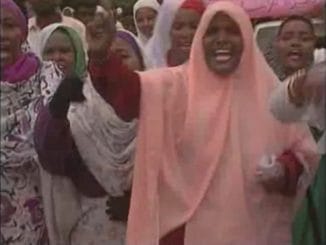
On June 20 in Los Angeles, at a protest outside the Consulate General of the United Arab Emirates, which I attended, protesters echoed that sentiment, blaming the TMC and former President al-Bashir. The demonstration was organized by the Sudanese Information Center located in Southern California.

“For the past 30 years we’ve been trying to get rid of this guy [al-Bashir] because there have been a lot of killings. He has killed 300,000 in Darfur alone with the Rapid Support Forces,” said one of the protesters leading the action, a Sudanese student visiting on vacation. The Rapid Support Forces are the group mainly cited for the recent killings by the military government in June. They are a paramilitary arm of the government and part of the TMC.

For security reasons, this person did not want to be identified, since he still lives in Sudan. He said he’s experienced beatings, been run out of his university with teargas and witnessed horrors like rape by the Rapid Support Forces. 

When asked who is to blame for the economic crisis and if he was concerned about the involvement of the Troika of the U.S., Britain and Norway (and now Canada) in the current negotiations with Sudan, he said: “We blame mainly the UAE and Saudi Arabia because of weapons, cash and exchange of money for child soldiers by Saudi Arabia.”

Another leading protester spelled out the damage done by Saudi Arabia and others, but failed to include the U.S. in that mix. “We’re out here in front of the United Arab Emirates Consulate because the UAE, along with Saudi Arabia and Egypt, all have lots of interest in Sudan. They were allowed to invest in Sudan by the Sudanese government, to invest in our land, in our children. They have bought child soldiers to fight in wars in Yemen. …  We want other Arab countries to stop infiltrating our country.”

When I asked this person and others at the protest if they had any concerns regarding Western interference or the role of longstanding U.S. sanctions and IMF policies in contributing to Sudan’s economic problems, those I spoke with were either not aware of any interference or sanctions, or called for the Western governments to help. In fact, the lead banner of the protest had a Sudanese flag on one side and a U.S. flag on the other.

The lack of knowledge about or dismissal of the negative U.S. and IMF influence on Sudan was surprising, especially given the 1998 bombing by the Clinton administration, which sparked mass protests in Khartoum and other cities. However, all of the youth and others I spoke to at the demonstration seemed well educated and very knowledgeable about the role played by Saudi Arabia and the UAE. This probably reflects how the news media are dominated by corporate interests that have a stake in Western investments, and which conveniently leave out any traces of the negative fallout from Western imperialist intervention, past and present. 

U.S. supplies weapons to Saudi Arabia

Although this was just one demonstration, the narrative of Omar al-Bashir being solely responsible, along with Saudi Arabia and the UAE, is echoed by most of the coalition forces’ statements — even by the most progressive amongst them, like the Sudanese Communist Party (SCP), an organization with a long history of political struggle in Sudan and a leading member of the FDFC coalition. 

The SCP issued a statement welcoming the participation of the imperialist Troika, with no qualifications about past Western interference, and criticizing only the UAE, Saudi Arabia and China, which has competing interests with the U.S. in Sudan.

Even when leaving out the history of colonialism in Sudan, the role of U.S. sanctions and Washington’s covert arming of various factions in southern Sudan, one would still expect to find blame with the U.S. for supplying weapons to Saudi Arabia. 

One activist voice sharing a view not heard often was quoted in The Globe Post: “The weapons that are being used to massacre innocent, non-violent, unarmed protestors in Sudan are American weapons that were sold to the Emirates and Saudi Arabia,” stated Dimah Mahmoud, a Sudanese activist with a doctorate in Sudanese foreign policy. 

Next: Imperialist roots of Sudan’s economic woes


Imperialism and Sudan

Part 1: What is the U.S. role in Sudan’s crisis?

Part 2: Roots of Sudan’s economic woes

Part 3: The true architects of terror and poverty


Strugglelalucha256
https://www.struggle-la-lucha.org/2019/07/page/5/