National Days of Action Feb. 4-12, 2022: No war on Russia and Donbass! U.S./NATO out of Ukraine!

U.S. tanks arrive in Estonia as part of the NATO buildup on Russia’s borders.

The Biden administration has put 8,500 U.S. troops on standby for deployment, on top of 64,000 already stationed in Europe. Millions of dollars in U.S. “lethal aid” (weapons) is arriving daily in Ukraine. Biden claims that there is an imminent threat of a Russian invasion. But the real invasion threat stems from U.S.-allied Ukraine against the independent Donbass republics of Donetsk and Lugansk, near Russia’s western border. 

Washington and its NATO partners have been pushing Ukraine’s government to invade Donbass, hoping to provoke a response from Russia that can cover further NATO expansion. Ukraine has deployed 125,000 troops to the ceasefire zone, including battalions of neo-Nazis, armed with NATO weapons. Donbass residents have already suffered eight years of Ukrainian war and Western blockade. More than 14,000 people have perished in that conflict.

Despite a U.S. promise not to expand NATO eastward at the end of the Cold War, the alliance has added 14 members since. Russia has made it clear that a NATO takeover of Ukraine – the largest country on its European border – is an unacceptable threat to its national security. Biden has continued Trump’s war drive worldwide, from Yemen to Syria, Venezuela to Palestine, Iraq to the South China Sea.

Why is Washington provoking Russia? The U.S. under both Democrats and Republicans has long sought to dominate and plunder the entire former Soviet Union economically, politically and militarily. Today U.S. Big Oil companies and banks urgently want to stop the flow of Russian gas and oil to Western Europe, including the new NordStream2 pipeline, so U.S. allies will be forced to buy from them. Biden, who has betrayed the urgent needs of workers and oppressed communities that elected him, is desperate to funnel people’s anger at a foreign enemy.

We say no! Poor and working people are wracked with crisis after crisis here at home: rampant spread of COVID; deliberate dismantling of public health measures to control the pandemic; wages slashed by inflation; capitalism’s climate destruction intensifying; the end of eviction moratoriums; racist police terror; bans on anti-racist education in schools; far-right attacks from the streets to the Supreme Court on people’s basic democratic rights. 

We need a struggle to end racism and poverty at home, not another criminal war abroad!

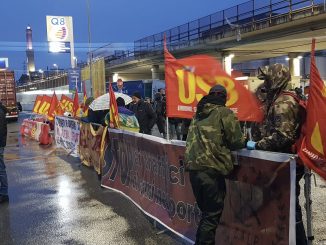
We call for antiwar, workers’ and people’s organizations across the U.S. to hold rallies, pickets, mass leafleting, banner drops and other activities from Feb. 4-12. We must act now to stop another war before it starts.

Tell Biden and Congress: 

  • No war on Russia and Donbass
  • Stop military aid to Ukraine – withdraw all U.S./NATO advisers, trainers and mercenaries
  • Sign Russia’s draft statement on European security – end NATO’s eastward expansion.
  • No new deployment of U.S. troops – bring all the troops home
  • Disband NATO

Called by (list in formation):

Solidarity with Novorossiya & Antifascists in Ukraine
Women Against Military Madness (WAMM)
Alan Dale, Minnesota Peace Action Coalition*
Communist Workers League
Anti-War Committee
Socialist Unity Party / Struggle-La Lucha newspaper
Youth Against War & Racism
Harriet Tubman Center for Social Justice (Los Angeles)
Peoples Power Assembly (Baltimore)
Workers Voice Socialist Movement (New Orleans)
Women in Struggle / Mujeres en Lucha
Alberto Lovera Bolivarian Circle (New York)
Moratorium NOW! Coalition (Detroit)
Freedom Road Socialist Organization
New York Community Action Project (NYCAP)
Samidoun Palestinian Prisoner Solidarity Network
International League of Peoples’ Struggle (ILPS) – U.S. Chapter

*For identification only

To endorse:

solidarityukraineantifa@gmail.com
Facebook: facebook.com/events/1257146674792435

Strugglelalucha256


‘We have a common cause’: Anti-war appeals from Donbass activists

As the U.S. and NATO threaten war with Russia and push Ukraine to invade the Donbass republics of Donetsk and Lugansk, Struggle-La Lucha shares these messages to the anti-war movement from activists living in the Donbass. 

Alexey Albu is a coordinator of Borotba (Struggle) of Ukraine and Donbass, a Marxist and anti-fascist organization banned by the Ukrainian regime. Albu is a survivor of the May 2, 2014, Odessa massacre, when Ukrainian neo-Nazis set fire to the House of Trade Unions, killing nearly 50 people. Albu was then forced into exile under threat of death.

Hello dear friends!

Western countries are whipping up hysteria in the media, evacuating diplomats, sending military instructors, weapons and ammunition to the Ukrainian neo-Nazi government.

Now right-wing radical groups have announced mobilization all over Ukraine – they are gathering volunteers for the front.

In addition, we are receiving disturbing news from Transnistria – Moldova is also transferring military equipment, and negotiations between Tiraspol and Chisinau have reached an impasse.

All this is happening against the backdrop of an unprecedented impoverishment of the people, rising utility costs and prices, an infrastructure crisis, and a lack of heat in many homes in Ukraine.

For President Zelensky, the war can be a salvation – he will say that Russia is to blame for everything.

We will be grateful if you, together with other comrades at your actions, demand that your government not send aid to the neo-fascist regime of Ukraine, because this money can be used to solve social problems at home.

I also want all comrades to know that the Donbass is no longer as weak as before. And anti-fascists from Odessa, Kharkov, Zaporozhye, Nikolaev and other cities of Ukraine are not sitting idly by – they are also preparing very hard.

We sincerely thank you for your solidarity! We really hope that peace, equality and progress will come to the planet Earth!

Red salute!

Alexey Albu, Borotba 

————-

Message from Communist Party of the Donetsk People’s Republic 

Dear comrades!

On behalf of the Communist Party of the Donetsk People’s Republic, we sincerely thank you for your solidarity with the people of Donbass. 

Today, the irresponsible actions of the U.S. imperialists, their allies and satellites have once again brought the world to the brink of a global armed conflict. The progressive forces of all countries must unite their efforts to prevent a catastrophe. 

The key elements of the international anti-imperialist front – the people’s republics of Donbass, Syria, Venezuela, North Korea, Cuba – are now in a particularly difficult situation. Each of these states may at any moment be subjected to a full-scale attack on the part of the imperialists. 

Today, it is especially important to strengthen the international solidarity of the working people and use the current difficult situation to move towards a more just society. We greatly appreciate your support and will do our best to live up to the expectations that foreign comrades place on our struggle. 

We have a common cause. The most acute problems of our time can be solved only on a worldwide basis, only through global socialist transformations.

Long live international anti-imperialist solidarity!

Sincerely,

Central Committee of the Communist Party of the Donetsk People’s Republic

Strugglelalucha256


Long March begins for Turkish revolutionaries imprisoned in Greece

We want a fair trial for the 11 revolutionaries from Turkey imprisoned in Greece

The fascist oligarchy in Turkey and U.S. imperialism ordered and the lackey Greek state carried out the arrests.

Eleven revolutionaries from Turkey were sentenced to a total of 333 years of imprisonment without any evidence against them. The decision was made on behalf of the fascist oligarchy in Turkey and U.S. imperialism.

We will not bow our heads before injustice and unlawfulness!

Our Long March for Justice and Freedom for the 11 revolutionary captives in Greece will commence on Jan. 27, 2022, starting from Germany and then to Ireland, England, Belgium, France, Austria, Switzerland and Italy, and will end in Greece.

Revolutionaries cannot be tried and punished under the pretext of “terrorism.” Being a revolutionary is a historical duty. The real terrorists are imperialists and the fascist states collaborating with them.

With our Long March, we will show that revolutionaries, who have undertaken the most historical and honorable duty in the world, are not alone. We will condemn imperialism and fascism that turned the world into a bloodbath, exploiting the people of the world and condemning them to starvation and poverty.

We are looking forward to the utmost internationalist solidarity of our people and friends and all oppressed-exploited people of the world who live in every country we will pass through.

Internationalism is the most powerful weapon of the peoples against the imperialist looters!

Internationalism is the brotherhood and friendship of peoples!

Let us strengthen international solidarity and common struggle to demand freedom and justice for the 11 revolutionaries in Turkey. Let’s join the Long March and support it.

Committee for Justice

Source: New Solution

Strugglelalucha256


Youth movement organized for social change in Honduras

Tegucigalpa, Honduras, Jan. 27 — Hector Ulloea — a former student leader and member of the Libre Party — spoke at the College of Middle Education Professors in Honduras (COPEMH) to an international delegation that had been invited by President-elect Xiomara Castro to witness her inauguration.

Ulloea spoke of the overwhelming support that Castro has, especially amongst the youth of today and those who were youth when the coup of 2009 occurred. In fact, he said, much of the anger of those youth who witnessed the denial of elected former President Manuel Zelaya to remain in office in 2009 fueled their passionate support for Castro.

Those youth and the youth of today, he said, have organized into a powerful force for social change. That change Ulloea spoke of had to overcome the U.S.-supported coup leaders and their collaborators and, in spite of that, successfully made way for the will of the people. Xiomara Castro is the first woman and the first pro-socialist elected in Honduran history and also the first candidate to receive 1.7 million votes in an election, the biggest victory ever. 

“A large amount of the youth who were shaped by events of the coup are now a formalized alliance and now a continuation of the process that was started in 2009,” said Ulloea.

The University Student Movement (MEU), which Ulloea belonged to, is not new to the struggles against the coup leaders of 2009 and waged a powerful campaign to keep the National Autonomous University from being privatized, like much of industry in the years after the coup. The students faced massive repression but remained steadfast and determined. Because of the repression, Ulloea said he was forced to leave Honduras in 2019 and just returned three weeks ago to continue his work here on the new government transition.

“These groupings absolutely trust Xiomara and make up those that wanted retribution against the narco dictatorship. The 1.7 million votes shows Xiomara’s ability to unify the opposition against reactionaries,” said Ulloea.

Ulloea mentioned three areas of concentration for the government now as a result of the debt that Honduras is in and the destruction of the economy by the leadership of the government after Zelaya, which sabotaged public industries, destroyed water sources for the people and increased poverty with austerity programs.

“We can’t trust the statistics and reporting of the outgoing government,” said Ulloea. As a result, he said they are forced to gather that information regarding issues like national debt and relative health of various sectors of the economy in order to make budget decisions.

In addition to questions of the budget, they also must consider the needs and demands of the people with the understanding that “we are a socialist government so we cannot cut social services to balance the budget, we must find other means,” declared Ulloea. This refreshing unwillingness to use austerity against the people should help any honest critiques of Xiomara Castro take into consideration the difference between those governments keeping their economies tied to capitalist economics with further privatization and depletion of social welfare programs and those moving toward socialist economics, as Castro has promised in continuing the programs like wage increases and expanded social programs that Manuel Zelaya began shortly after becoming president.

Finally, Ulloea said, the functioning of the government is another one of the three priorities to ensure that people begin to get their lives back and counter the last 12 years of dysfunction, poverty and repression.


Strugglelalucha256


Honduras prepares to celebrate inauguration of Xiomara Castro of the Libre Party

Tegucigalpa, Honduras, Jan. 26 — A delegation of activists representing organizations from various countries arrived in Tegucigalpa yesterday, at the invitation of the Libre Party, to celebrate with them the inauguration of President-elect Xiomara Castro, who is also a member of the Libre Party.

President Castro’s overwhelming victory follows the rapid deterioration of life for the people of Honduras after the 2009 coup that kidnapped and overthrew the elected government of self-described pro-socialist President Manuel Zelaya. That coup — with technical, logistical and monetary support from the U.S. — was led by two Honduran military officers who had trained at the Pentagon’s notorious “School of the Americas.” The school made headlines in 1996 when the Pentagon released training manuals used at the school that advocated torture, extortion and execution. 

After the coup, fraudulent elections were imposed on the country, seeking to give legitimacy to the coup regime. But the economy and social well-being of Honduras was destroyed by rapid privatizations, environmental destruction and brutal repression and torture targeting any supporters of Zelaya, especially those in the National Front of Popular Resistance (FNRP) which formed after the coup to bring back the legitimate presidency of Zelaya. Women and LGBTQ2S members were also severely targeted and tortured.

In spite of the repression, the courageous people of Honduras continued to grow their resistance. In the presidential election held in November 2021, the popular resistance overwhelmed the vote, with a 53% vs. 34% victory for President Xiomara Castro. And, as our delegation witnessed in arriving at the airport, her win and the movement’s growth go far beyond the elections or electoral battles only.

Some in the international delegation had previously witnessed the brutal repression in 2009 by the military after the coup and had faced dangerous situations, forcing them to flee because of the repression. Now the delegates were met at the airport by escorts from the presidency who whisked us through customs and had us on our way to do interviews, meet with local Libre Party cultural activists and more.

The inauguration on Jan. 27 is sure to also be a qualitative change from the ceremony after the November 2013 election of coup supporter Juan Orlando Hernandez whose government continued the policies of privatization, militarization and added drug corruption. On Jan. 27, 2014, the city saw protests and boycotts, not celebrations.

The mood today can be seen on some walls in Tegucigalpa with graffiti cheering the end of Hernandez as president.

Strugglelalucha256


Struggle-La Lucha correspondents land in Honduras for presidential inauguration

Two correspondents for Struggle-La Lucha have travelled to Honduras to be part of the U.S. delegation attending the inauguration of newly-elected President Xiomara Castro of Libertad y Refundación, referred to as the Libre Party. 

One of the correspondents, John Parker, is himself a candidate for the U.S. Senate on the Peace and Freedom Party ticket in California. He is also a founder of the Harriet Tubman Center for Social Justice and active in his neighborhood with the Harvard Blvd Block Club in Los Angeles.

The other correspondent is Berta Joubert-Ceci, who was an initiator of the historic October 2018 “International Tribunal on U.S. Colonial Crimes Against Puerto Rico.” Joubert-Ceci writes regularly on struggles in Puerto Rico and the Global South and is also a regular commentator on Radio Clarin of Colombia from her home in Puerto Rico. Joubert-Ceci is a founding member of Women In Struggle/Mujeres En Lucha. 

Both are organizers with the Socialist Unity Party.

They are traveling to Honduras in the midst of a struggle that  has broken out between the left forces of the Libre Party and more conservative elements who are attempting to stand in the way of substantial reforms promised by President Xiomara Castro and Libre. 

For an up-to-date description see the report in the Orinoco Tribune. 

Please support people’s reporters!  Your donations help to provide independent socialist news and analysis.  DONATE HERE .

Most importantly check the coverage on Struggle-La-Lucha.org, facebook.com/strugglelalucha and Twitter @StruggleLaLucha

Strugglelalucha256


Morocco drives a war in Western Sahara for its phosphates

In November 2020, the Moroccan government sent its military to the Guerguerat area, a buffer zone between the territory claimed by the Kingdom of Morocco and the Sahrawi Arab Democratic Republic (SADR). The Guerguerat border post is at the very southern edge of Western Sahara along the road that goes to Mauritania. The presence of Moroccan troops “in the Buffer Strip in the Guerguerat area” violated the 1991 ceasefire agreed upon by the Moroccan monarchy and the Polisario Front of the Sahrawi. That ceasefire deal was crafted with the assumption that the United Nations would hold a referendum in Western Sahara to decide on its fate; no such referendum has been held, and the region has existed in stasis for three decades now.

In mid-January 2022, the United Nations sent its Personal Envoy for Western Sahara Staffan de Mistura to Morocco, Algeria, and Mauritania to begin a new dialogue “toward a constructive resumption of the political process on Western Sahara.” De Mistura was previously deputed to solve the crises of U.S. wars in Afghanistan, Iraq, and Syria; none of his missions have ended well and have mostly been lost causes. The UN has appointed five personal envoys for Western Sahara so far—including Mistura—beginning with former U.S. Secretary of State James Baker III, who served from 1997 to 2004. De Mistura, meanwhile, succeeded former German President Horst Köhler, who resigned in 2019. Köhler’s main achievement was to bring the four main parties—Morocco, the Polisario Front, Algeria, and Mauritania—to a first roundtable discussion in Geneva in December 2018: this roundtable process resulted in a few gains, where all participants agreed on “cooperation and regional integration,” but no further progress seems to have been made to resolve the issues in the region since then. When the UN initially put forward De Mistura’s nomination to this post, Morocco had initially resisted his appointment, but under pressure from the West, Morocco finally accepted his appointment in October 2021, with Moroccan Foreign Minister Nasser Bourita welcoming him to Rabat on January 14. De Mistura also met the Polisario Front representative to the UN in New York on November 6, 2021, before meeting other representatives in Tindouf, Algeria, at Sahrawi refugee camps in January. There is very little expectation that these meetings will result in any productive solution in the region.

Abraham Accords

In August 2020, the United States government engineered a major diplomatic feat called the Abraham Accords. The U.S. secured a deal with Morocco and the United Arab Emirates to agree to a rapprochement with Israel in return for the U.S. making arms sales to these countries as well as for the United States legitimizing Morocco’s annexation of Western Sahara. The arms deals were of considerable amounts—$23 billion worth of weapons to the UAE and $1 billion worth of drones and munitions to Morocco. For Morocco, the main prize was that the United States—breaking decades of precedent—decided to back its claim to the vast territory of Western Sahara. The United States is now the only Western country to recognize Morocco’s claim to sovereignty over Western Sahara.

When President Joe Biden took office in January 2021, it was expected that he might review parts of the Abraham Accords. However, U.S. Secretary of State Antony Blinken made it clear during his meeting with Bourita in November 2021 that the U.S. government would continue to maintain the position taken by the previous Trump administration that Morocco has sovereignty over Western Sahara. The U.S., meanwhile, has continued with its arms sales to Morocco but has suspended weapons sales to the United Arab Emirates.

Phosphates

By the end of November 2021, the government of Morocco announced that it had earned $6.45 billion from the export of phosphate from the kingdom and from the occupied territory of Western Sahara. If you add up the phosphate reserves in this entire region, it amounts to 72 percent of the entire phosphate reserves in the world (the second-highest percentage of these reserves is in China, which has around 6 percent). Phosphate, along with nitrogen, makes synthetic fertilizer, a key element in modern food production. While nitrogen is recoverable from the air, phosphates, found in the soil, are a finite reserve. This gives Morocco a tight grip over world food production. There is no doubt that the occupation of Western Sahara is not merely about national pride, but it is largely about the presence of a vast number of resources—especially phosphates—that can be found in the territory.

In 1975, a UN delegation that visited Western Sahara noted that “eventually the territory will be among the largest exporters of phosphate in the world.” While Western Sahara’s phosphate reserves are less than those of Morocco, the Moroccan state-owned firm OCP SA has been mining the phosphate in Western Sahara and manufacturing phosphate fertilizer for great profit. The most spectacular mine in Western Sahara is in Bou Craa, from which 10 percent of OCP SA’s profits come; Bou Craa, which is known as “the world’s longest conveyor belt system,” carries the phosphate rock more than 60 miles to the port at El Aaiún. In 2002, the UN’s Under-Secretary General for Legal Affairs at that time, Hans Corell, noted in a letter to the president of the UN Security Council that “if further exploration and exploitation activities were to proceed in disregard of the interests and wishes of the people of Western Sahara, they would be in violation of the principles of international law applicable to mineral resource activities in Non-Self-Governing Territories.” An international campaign to prevent the extraction of the “conflict phosphate from Western Sahara by Morocco has led many firms around the world to stop buying phosphate from OCP SA. Nutrien, the largest fertilizer manufacturer in the United States that used Moroccan phosphates, decided to stop imports from Morocco in 2018. That same year, the South African court challenged the right of ships carrying phosphate from the region to dock in their ports, ruling that “the Moroccan shippers of the product had no legal right to it.”

Only three known companies continue to buy conflict phosphate mined in Western Sahara: two from New Zealand (Ballance Agri-Nutrients Limited and Ravensdown) and one from India (Paradeep Phosphates Limited).

Human Rights

After the 1991 ceasefire, the UN set up a Mission for the Referendum in Western Sahara (MINURSO). This is the only UN peacekeeping force that does not have a mandate to report on human rights. The UN made this concession to appease the Kingdom of Morocco. The Moroccan government has tried to intervene several times when the UN team in Western Sahara attempted to make the slightest noise about the human rights violations in the region. In March 2016, the kingdom expelled MINURSO staff because the then UN Secretary-General Ban Ki-moon referred to the Moroccan presence in Western Sahara as an “occupation.”

Pressure from the United States is going to ensure that the only realistic outcome of negotiations is for continued Moroccan control of Western Sahara. All parties involved in the conflict are readying for battle. Far from peace, the Abraham Accords are going to accelerate a return to war in this part of Africa.

Vijay Prashad is an Indian historian, editor and journalist. He is a writing fellow and chief correspondent at Globetrotter. He is the chief editor of LeftWord Books and the director of Tricontinental: Institute for Social Research. He is a senior non-resident fellow at Chongyang Institute for Financial Studies, Renmin University of China. He has written more than 20 books, including The Darker Nations and The Poorer Nations. His latest book is Washington Bullets, with an introduction by Evo Morales Ayma.

This article was produced by Globetrotter.

Strugglelalucha256


Aafia Siddiqui, political prisoner

The media coverage of the hostage-taking at a synagogue in Texas has been predictably hysterical, Islamophobic and inaccurate about Aafia Siddiqui, the apparent political cause of the hostage-taker Malik Faisad Akram.

According to his family in England he has “mental health issues.” He was “said to have” weapons and explosives. He was “said to have” threatened the four hostages but everyone seems to agree no one was harmed. He wanted Siddiqui free from the near-by maximum security Carswell Prison; he wanted to speak to her. Under heavy criticism the FBI has said that his hostage-taking had nothing to do with their being Jews, “not his issue.” But to the press, Siddiqui “has a history of anti-Semitism,” hence the universal media criticism. To the police, FBI, government, killing Akram represented a successful outcome to the crisis.

Siddiqui’s lawyer and family distanced themselves from Akram’s actions, but to say they remain completely frustrated by their thwarted attempts to free a very ill, frail, and innocent Aafia Siddiqui, after repeated pleas to the U.S. government and unfulfilled promises by the Pakistani government, would be to vastly understate the case.

Pakistani-born Boston graduate student Aafia Siddiqui’s crime was to be caught in America’s post 9/11 anti-Muslim hysteria. She had come to America in 1990 to study, earning a biology degree and then a Ph.D in neuroscience from MIT. Her colleagues called her quiet and religious (but not a fundamentalist).

Her marriage to Mohammed Amjad Khan ended in divorce when he proved to be violent and more fundamentalist than Siddiqui. She was mistakenly accused of anti-American Muslim activism initially (partially because of mistaken identity), but the accusations ballooned. In the early War On Terror days, “associations” became much more significant and damning.

Siddiqui ended up on Attorney General John Ashcroft’s “Watchlist.” As the Big Lies of government grew, soon the New York Post was calling her “Lady Al Queda.”

Once the government labeled her a “terrorist,” she had no chance of escaping the Empire’s punishment. When her true story began to emerge, it was necessary to take action. While visiting in Pakistan, helped by Pakistani-American operatives, she was “disappeared.” Her youngest child was killed when she was taken, and her other two children imprisoned separately for years. She was beaten, raped, tortured and kept in solitary in black-site prisons of the American Empire, particularly in Afghanistan. Other prisoners have testified that they saw her at Bagram, a prison from which the Obama administration prevented prisoners’ court appearances because they might talk about the conditions of their imprisonment. Eventually Aafia Siddiqui would be set up for final punishment and disposal.

From my book Women Politicals in America:

At the trial—in January 2010—the soldiers said that Aafia Siddiqui, accused would-be assassin and presumed Al Qaeda terrorist, did, in fact, get hold of an unsecured M-4 automatic rifle and open fire on U.S. soldiers and FBI agents in Ghazni, Afghanistan. The day before, she had been picked up by local policemen as a “possible suicide bomber” because she had been “loitering” in a public square with a young boy [whose identity is not clear]. She carried instructions to create biological weapons, descriptions of U.S. “military assets,” numerous jars containing “chemical substances,” and documents containing words like “Empire State Building” and “Brooklyn Bridge.” The soldiers said that the day after her discovery and arrest, an American army captain, a warrant officer, two army interpreters and two FBI agents came to question Siddiqui at Ghazni police headquarters. The soldiers said that none of those men were “aware that Siddiqui was being held, unsecured, behind [a] curtain.” Oddly, no one looked behind it. And also oddly, the American warrant officer placed his M-4 rifle next to the curtain. What happened next, said the soldiers, was that Siddiqui pulled the rifle to her, unlatched the safety, pointed the gun at the captain, and while one of the interpreters grabbed for the gun, Siddiqui fired the gun twice. The soldiers agreed she had said, “Get the fuck out of here!” She hit no one.

The soldiers said the interpreter knocked her to the ground and the warrant officer fired “approximately two rounds” into Siddiqui’s stomach. She collapsed, unconscious. FBI special Agent Eric Negron testified at her trial that he saw the rifle raised (although he could not see her face behind the curtain). Negron said that after she was shot he helped restrain the struggling Siddiqui. “I had to strike her several times with a closed fist across the face.” Finally she “either fainted or faked that she had fainted” and was handcuffed. The soldiers had successfully restrained the suspected terrorist Siddiqui. Although her prints were not on the rifle, the holes in the police station wall put there by the rifle Siddiqui allegedly fired were proved to have been there before the July 2008 incident, and since, if she had tried to kill the soldiers, she missed and was herself grievously shot in the abdomen, her sentence seemed disproportionate. Aafia Siddiqui was given 86 years in prison. She had been labeled a terrorist enemy of the Empire and its soldiers, and her case was disposed of accordingly.

Siddiqui had been extradited for the offense of attempting to kill soldiers, but she was tried, completely illegally, as a notorious female terrorist. She was not allowed to speak of her torture or the killing of her baby. The trial — then as now — of a “terrorist, as with Julian Assange, allows for only the government/prosecutorial side. The defendant cannot win. Siddiqui was also in very bad shape, physically and mentally during her trial, with a badly dressed stomach wound that the judge had to intervene to have treated. She was forced to undergo strip searches every day and was forced to testify. When she mentioned being in a secret prison, with her children tortured in front of her, the testimony was stricken from the record. She also, and this is arguably something the hostage-taker Malik Faisad Akram was aware of, did not want “Zionists” chosen as jurors and said her guilty verdict came from Israel, not America. Some said she was irrational which was entirely possible, but with the anti-Muslim elements of her trial, perhaps not so irrational.

She has been in prison since 2010 and has, according to her family, suffered unjust punishments within the prison, and her medical problems are not treated. For much of the last 11 years, she has also not been able to communicate with her family. According to the Free Aafia website, maintained by her family and friends, she was attacked last July and suffered serious injuries. After a number of years, she and her family are still waiting for Pakistani Prime Minister Imran Khan to follow through on promises to help free her from the Empire’s prison. For the press to continue to call her a hardened terrorist and to overlook the treatment, the torture she has endured at American hands, echoes the ignorant liberal sentiment that Afghanistan is so much worse off without the American government there to torture and kill. I would like to end this with a 2012 statement from Moazzam Begg, prisoner at U.S. Air Force Base, Bagram, Afghanistan:

Of all the abuses [prisoner Abu Yahya al-Libi] describes in his account, the presence of a woman and her humiliation and degradation were the most inflammatory to all the prisoners [at Bagram]—they would never forget it. He describes how she was regularly stripped naked and manhandled by guards, and how she used to scream incessantly in isolation for two years. He said prisoners protested her treatment, going on hunger strike, feeling ashamed they could do nothing to help. He described her in detail: a Pakistani mother—torn away from her children—in her mid-thirties, who had begun to lose her mind. Her number, he said, was 650.

Linda Ford is a retired history professor, living in Madison, NY.  She is the author of Iron-Jawed Angels: The Suffrage Militancy of the National Woman’s Party, and Women Politicals:  From Mother Jones to Lynne Stewart.

Source: Countercurrents

Strugglelalucha256


Are Western wealthy countries determined to starve the people of Afghanistan?

On January 11, 2022, the United Nations (UN) Emergency Relief Coordinator Martin Griffiths appealed to the international community to help raise $4.4 billion for Afghanistan in humanitarian aid, calling this effort, “the largest ever appeal for a single country for humanitarian assistance.” This amount is required “in the hope of shoring up collapsing basic services there,” said the UN. If this appeal is not met, Griffiths said, then “next year [2023] we’ll be asking for $10 billion.”

The figure of $10 billion is significant. A few days after the Taliban took power in Afghanistan in mid-August 2021, the U.S. government announced the seizure of $9.5 billion in Afghan assets that were being held in the U.S. banking system. Under pressure from the United States government, the International Monetary Fund also denied Afghanistan access to $455 million of its share of special drawing rights, the international reserve asset that the IMF provides to its member countries to supplement their original reserves. These two figures—which constitute Afghanistan’s monetary reserves—amount to around $10 billion, the exact number Griffiths said that the country would need if the United Nations does not immediately get an emergency disbursement for providing humanitarian relief to Afghanistan.

A recent analysis by development economist Dr. William Byrd for the United States Institute of Peace, titled, “How to Mitigate Afghanistan’s Economic and Humanitarian Crises,” noted that the economic and humanitarian crises being faced by the country are a direct result of the cutoff of $8 billion in annual aid to Afghanistan and the freezing of $9.5 billion of the country’s “foreign exchange reserves” by the United States. The analysis further noted that the sanctions relief—given by the U.S. Treasury Department and the United Nations Security Council on December 22, 2021—to provide humanitarian assistance to Afghanistan should also be extended to “private business and commercial transactions.” Byrd also mentioned the need to find ways to pay salaries of health workers, teachers and other essential service providers to prevent an economic collapse in Afghanistan and suggested using “a combination of Afghan revenues and aid funding” for this purpose.

Meanwhile, the idea of paying salaries directly to the teachers came up in an early December 2021 meeting between the UN’s special envoy for Afghanistan Deborah Lyons and Afghanistan’s Deputy Foreign Minister Sher Mohammad Abbas Stanikzai. None of these proposals, however, seem to have been taken seriously in Washington, D.C.

A Humanitarian Crisis

In July 2020, before the pandemic hit the country hard, and long before the Taliban returned to power in Kabul, the Ministry of Economy in Afghanistan had said that 90 percent of the people in the country lived below the international poverty line of $2 a day. Meanwhile, since the beginning of its war in Afghanistan in 2001, the United States government has spent $2.313 trillion on its war efforts, according to figures provided by Watson Institute for International and Public Affairs at Brown University; but despite spending 20 years in the country’s war, the United States government spent only $145 billion on the reconstruction of the country’s institutions, according to its own estimates. In August, before the Taliban defeated the U.S. military forces, the United States government’s Special Inspector General for Afghanistan Reconstruction (SIGAR) published an important report that assessed the money spent by the U.S. on the country’s development. The authors of the report wrote that despite some modest gains, “progress has been elusive and the prospects for sustaining this progress are dubious.” The report pointed to the lack of development of a coherent strategy by the U.S. government, excessive reliance on foreign aid, and pervasive corruption inside the U.S. contracting process as some of the reasons that eventually led to a “troubled reconstruction effort” in Afghanistan. This resulted in an enormous waste of resources for the Afghans, who desperately needed these resources to rebuild their country, which had been destroyed by years of war.

On December 1, 2021, the United Nations Development Program (UNDP) released a vital report on the devastating situation in Afghanistan. In the last decade of the U.S. occupation, the annual per capita income in Afghanistan fell from $650 in 2012 to around $500 in 2020 and is expected to drop to $350 in 2022 if the population increases at the same pace as it has in the recent past. The country’s gross domestic product will contract by 20 percent in 2022, followed by a 30 percent drop in the following years. The following sentences from the UNDP report are worth quoting in full to understand the extent of humanitarian crisis being faced by the people in the country: “According to recent estimates, only 5 percent of the population has enough to eat, while the number of those facing acute hunger is now estimated to have… reached a record 23 million. Almost 14 million children are likely to face crisis or emergency levels of food insecurity this winter, with 3.5 million children under the age of five expected to suffer from acute malnutrition, and 1 million children risk dying from hunger and low temperatures.”

Lifelines

This unraveling humanitarian crisis in Afghanistan is the reason for the January 11 appeal to the international community by the UN. On December 18, 2021, the Council of Foreign Ministers of the Organization of Islamic Cooperation (OIC) held an emergency meeting—called for by Saudi Arabia—on Afghanistan in Islamabad, Pakistan. Outside the meeting room—which merely produced a statement—the various foreign ministers met with Afghanistan’s interim Foreign Minister Amir Khan Muttaqi. While in Islamabad, Muttaqi met with the U.S. Special Representative for Afghanistan Thomas West. A senior official with the U.S. delegation told Kamran Yousaf of the Express Tribune (Pakistan), “We have worked quietly to enable cash… [to come into] the country in larger and larger denominations.” A foreign minister at the OIC meeting told me that the OIC states are already working quietly to send humanitarian aid to Afghanistan.

Four days later, on December 22, the United States introduced a resolution (2615) in the UN Security Council that urged a “humanitarian exception” to the harsh sanctions against Afghanistan. During the meeting, which took place for approximately 40 minutes, nobody raised the matter that the U.S., which proposed the resolution, had decided to freeze the $10 billion that belonged to Afghanistan. Nonetheless, the passage of this resolution was widely celebrated since everyone understands the gravity of Afghanistan’s crisis. Meanwhile, Zhang Jun, China’s permanent representative to the UN, raised problems relating to the far-reaching effects of such sanctions and urged the council to “guide the Taliban to consolidate interim structures, enabling them to maintain security and stability, and to promote reconstruction and recovery.”

A senior member of the Afghan central bank (Da Afghanistan Bank) told me that much-needed resources are expected to enter the country as part of humanitarian aid being provided by Afghanistan’s neighbors, particularly from China, Iran and Pakistan (aid from India will come through Iran). Aid has also come in from other neighboring countries, such as Uzbekistan, which sent 3,700 tons of food, fuel and winter clothes, and Turkmenistan, which sent fuel and food. In early January 2022, Muttaqi traveled to Tehran, Iran, to meet with Iran’s Foreign Minister Hossein Amirabdollahian and Iran’s Special Representative for Afghanistan Hassan Kazemi Qomi. While Iran has not recognized the Taliban government as the official government of Afghanistan, it has been in close contact with the government “to help the deprived people of Afghanistan to reduce their suffering.” Muttaqi has, meanwhile, emphasized that his government wants to engage the major powers over the future of Afghanistan.

On January 10, the day before the UN made its most recent appeal for coming to the aid of Afghanistan, a group of charity groups and NGOs—organized by the Zakat Foundation of America—held an Afghan Peace and Humanitarian Task Force meeting in Washington. The greatest concern is the humanitarian crisis being faced by the people of Afghanistan, notably the imminent question of starvation in the country, with the roads already closed off due to the harsh winter witnessed in the region.

In November 2021, Afghanistan’s Deputy Foreign Minister Sher Mohammad Abbas Stanikzai urged the United States to reopen its embassy in Kabul; a few weeks later, he said that the U.S. is responsible for the crisis in Afghanistan, and it “should play an active role” in repairing the damage it has done to the country. This sums up the present mood in Afghanistan: open to relations with the U.S., but only after it allows the Afghan people access to the nation’s own money in order to save Afghan lives.

This article was produced by Globetrotter. Vijay Prashad is an Indian historian, editor and journalist. He is a writing fellow and chief correspondent at Globetrotter. He is the chief editor of LeftWord Books and the director of Tricontinental: Institute for Social Research. He is a senior non-resident fellow at Chongyang Institute for Financial Studies, Renmin University of China. He has written more than 20 books, including The Darker Nations and The Poorer Nations. His latest book is Washington Bullets, with an introduction by Evo Morales Ayma.

Strugglelalucha256


‘U.S. claims of Russian threat to Ukraine are groundless’


The following interview with Struggle-La Lucha co-editor Greg Butterfield was originally published by the website Ukraina.ru.

Dmitry Strauss: Greg, Russia has raised the issue of nonproliferation of U.S. and NATO missile strike systems near its borders. This topic will be discussed by Russia with NATO and the United States in the coming days. In your opinion, how legitimate is this point of view of Russia? 

Greg Butterfield: I believe Russia’s position is completely valid and correct. The unbridled growth of the U.S.-dominated NATO military alliance over the last three decades is a threat to Russia and its allies, and one of the greatest threats to peace in the world. The growth of NATO has meant not just the spread of Western troops and weaponry in eastern and central Europe. It has also meant the ascension of governments like those in Poland, Hungary, Ukraine and the Baltic States, that look to the fascist collaborators of World War II as their example.

President Putin and the Russian government have consistently spoken about the danger inherent in NATO’s integration of Ukraine – the last major “domino” on Russia’s western border. The situation has been precarious ever since the U.S.-backed coup in 2014 brought a far-right regime to power that nurtures openly fascist elements who eagerly desire war with Russia. 

In the final days of the Soviet Union, when the Gorbachev government withdrew support from the USSR’s socialist European allies, the U.S. pledged not to expand NATO to the east or threaten Russia and other post-Soviet states. Of course, Washington never honored this pledge. Republican and Democratic administrations alike have consistently betrayed that promise and steadily increased the danger of another devastating war in Eurasia.

DS: The U.S. and NATO talk about Russia’s “aggressive plans” with regard to Ukraine as their reason for the placement of missile strike systems. Russia says it has no such plans, and explains that the concentration of its troops near the Ukrainian border coincides with its right to place its troops in its own territory the way it likes. Which argument is more convincing?

GB: The claims by the U.S. and NATO of a threatened Russian “invasion” of Ukraine are completely baseless. They are not taken seriously by any knowledgeable person. Unfortunately, the workers and general population in the West are denied that knowledge. This is the greatest challenge facing the anti-war movement here. U.S. officials expect the lack of objective information and constant beating of war drums in the capitalist media to convince the masses of people that Russia is a threat to people here. They are pursuing the same kind of war propaganda against China.

Since the Maidan coup in 2014, Washington and its puppets in Ukraine have repeatedly tried to provoke a situation where Russia would be forced to intervene to protect the population of the Donetsk and Lugansk republics. In the West, where the legitimacy of the Donbass republics has never been acknowledged, such a defensive and humanitarian action by Russia would be portrayed as an act of aggression that justifies NATO intervention.

So far, the governments and militaries of Russia and the Donbass republics have managed to skillfully deflect these provocations. The current campaign in the West to convince the populace that a Russian invasion of Ukraine is imminent, which started two months ago, is the most dangerous and sustained since 2014.

DS: What do you think is the reason for the conflict between Russia and Ukraine and Russia and the United States? Is it the geopolitical repartition of the world? Is it aggression of Russia? Is it an outdated approach of the United States to current world events? 

GB: The conflict stems directly from the destruction of the Soviet Union 30 years ago. When socialism was overthrown and the Soviet republics split up, Washington and Wall Street expected the entire region to quietly become “banana republics” of the West. For the first decade under Yeltsin, it seemed this would be the case. But the rise of an independent-minded capitalist oligarchy in Russia, represented by the Putin administration, put a wrench into U.S. plans. 

Even today, two decades later, the U.S. ruling class and its political establishment cannot reconcile themselves to the existence of a sovereign Russia, Belarus and Donbass, whether capitalist or socialist. 

DS: Why do you think there is such a tense political situation in the world? How close do you think we are to a war? Or is it just an external impression, but in fact everything is as usual now, with no especially deep troubles?  

GB: The danger of war is growing. The unending drive of the world capitalist economy for greater profits engenders war between nations and states. This is especially true of the U.S., whose global economic and military hegemony is constantly being eroded. To keep their fragile grip on power, the U.S. capitalists are driven to increasingly dangerous actions.

It’s clear that the powers in Washington will never reconcile themselves to Russia’s independent existence. Sooner or later, war will break out – unless there is significant movement toward social change in the West. That means a revolutionary struggle for socialism by the working class and oppressed peoples, in solidarity with the countries that value independence and sovereignty. 

In the meantime, Russia, China and other countries are wise to take strong measures to defend themselves.

Source: Ukraina.ru

Strugglelalucha256
https://www.struggle-la-lucha.org/around-the-world/page/47/