
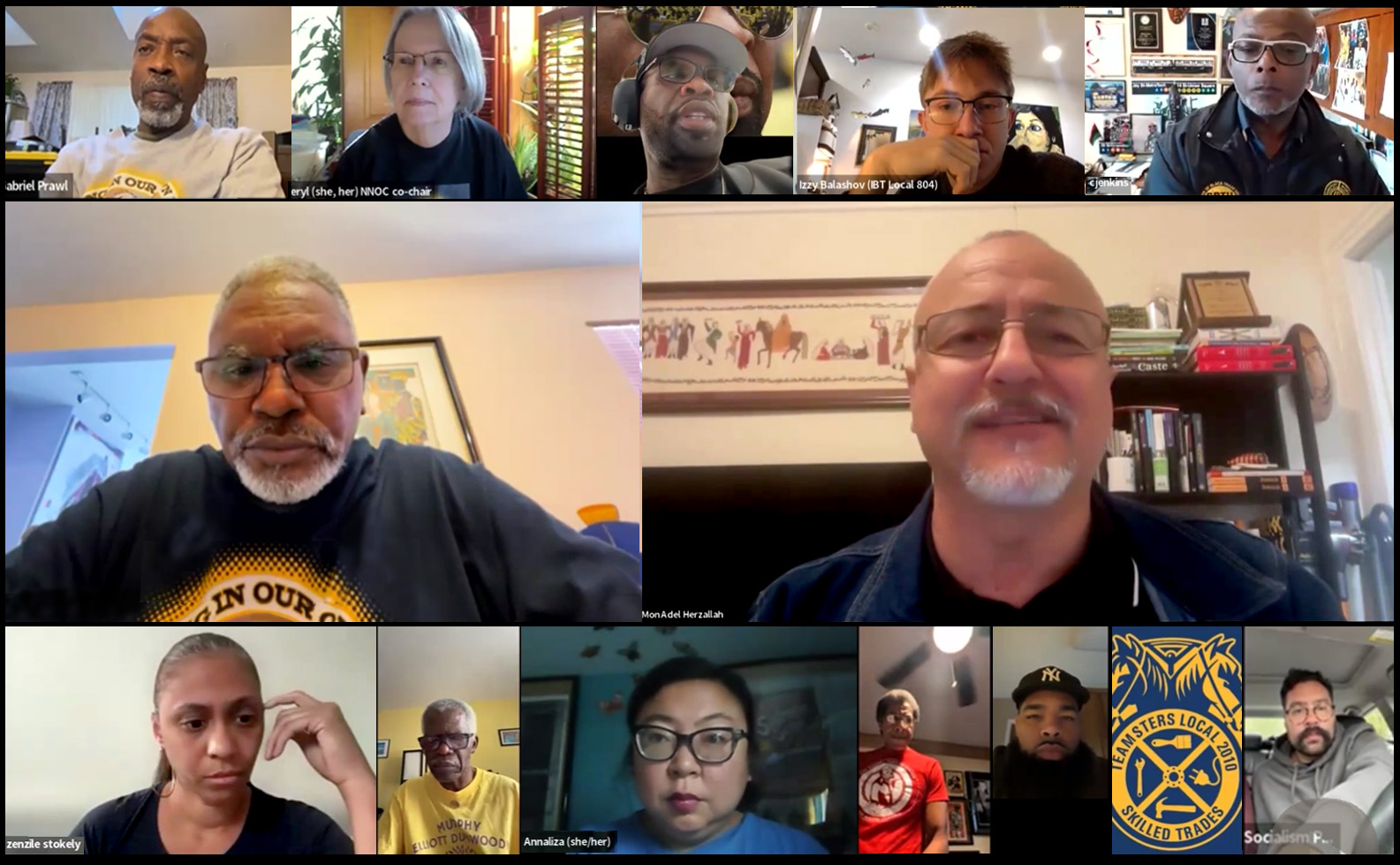
What are the qualities of a working-class leader that make their work endure and infuse labor with power long after we’ve lost them, as we did with Teamster principal officer Chris Silvera when he died unexpectedly on June 12, 2026? This question was addressed in an emotional tribute to Silvera on an Oct. 17 Zoom call, “Mobilizing in Our Own Name,” held on the anniversary of the 2004 Million Worker March (MWM).
Brenda Stokely, another labor leader, was also honored for her enduring impact in the MWM movement on the Oct. 17 call. Stokely spoke about the urgency and possibilities of organizing for May Day 2027, and for a general strike.
The Zoom call moderated by Clarence Thomas was a forum for a working discussion with speakers addressing urgent issues — taking forward the basic labor demands of MWM. The discussion included issues like how workers need to take union control of artificial intelligence (AI) to stop layoffs and speedups, to ban the use of AI for police control, Immigration and Customs Enforcement (ICE) and the military.
A strong focus of the call was about how to get rid of ICE. Gabriel Prawl, a leader of the International Longshore and Warehouse Union (ILWU) and MWM co-convener in the Pacific Northwest, raised the call to “Melt ICE!”
A goal of all speakers was to plan for May Day, May 1, 2027 — to fight for free education, health care, housing, transportation and clean energy — to defend reproductive rights, trans lives and voting rights.
International solidarity was a theme of the event. Monadel Herzallah, a co-founder of the US Palestinian Community Network, who appealed for support to end the genocide in Gaza, was met with unanimous and optimistic support for the liberation of Palestine.
Cheryl LaBash, co-chair of the National Network on Cuba, talked about the United States blockade of Cuba, a medieval siege meant to suffocate the entire population. She said the website nowaroncuba.com has info on the Global Week of Action Against US Genocide in Cuba, Oct. 24-31, with a day of action Oct. 28, when the United Nations General Assembly votes on the blockade.
Speakers on the Zoom call shared their experience of working with Chris Silvera, a co-founder of the 2004 MWM, the longest-serving principal officer in the Teamsters at Local 808 in Long Island City, Queens, in New York City, and the first chairman of the Teamsters National Black Caucus elected by its membership in 1999.
Silvera’s righteous integrity and deep personal charisma characterized a lifetime of organizing all workers with recognition of their most crucial needs. According to Clarence Thomas, a retired member of ILWU Local 10, one of the initiators of the 2004 Million Worker March, an outstanding talent of Silvera was his “ability to get things done.” For example, Silvera played a decisive role in reclaiming May Day in the labor movement.
His ability to win important gains on union contracts and force New York City to provide essential services was well known. Thomas recalled Silvera’s uncanny ability to win the support of then-Teamsters President James P. Hoffa for the Million Worker March at a time when the AFL-CIO leadership was doing its best to crush the initiative of Black rank-and-file leaders and specifically, ILWU Local 10 dockworkers to raise union demands in the march before the 2004 elections.
Charles Jenkins, a transit worker with Transport Workers Union Local 100, New York City’s transit union, spoke about Silvera and about Brenda Stokely, another co-convener of the MWM. Jenkins praised her empathy and wonderful accomplishments not only when she was president of AFSCME District Council 1707, the day care and social service workers union, but during years she organized support for the homeless and incarcerated people.
Stokely’s daughter Zenzile Stokely, a teacher, talked about the strength of a woman raising a family who made time to be politically active with the goal of devoting herself to improving the lives of the most oppressed.
Richard Hooker, a Teamsters Local 623 member in Philadelphia, said Silvera was a mentor who enabled him to find a future as a Black leader in the union movement, in which the top leadership has a nasty history of racist segregation.
Craig Moore, a health care worker with 1199SEIU, shared experiences in union organizing with a view of where we go from here.
The discussion reconvenes Sunday, Oct. 25, at 4 p.m. Eastern (1 p.m. Pacific). On the agenda: support for the Oct. 30 International Day of Strikes and Actions by port workers in Europe and the Mediterranean; defending voting rights; stopping ICE; and organizing for May Day 2027.
Million Worker March at 22: Organizing in our own name
Clarence Thomas prepared these remarks to open the Oct. 17 call.
Solidarity greetings to everyone joining us to mark the 22nd anniversary of the Million Worker March (MWM), held on Oct. 17, 2004, at the Lincoln Memorial in Washington, D.C.
On this anniversary, we pay tribute to Brother F. Christophe “Chris” Silvera, longtime secretary-treasurer of Teamsters Local 808, and Sister Brenda Stokely, former president of AFSCME District Council 1707. Brenda and Chris both served as MWM East Coast co-conveners.
The MWM was initiated by International Longshore and Warehouse Union (ILWU) Local 10 in San Francisco, the only predominantly African American longshore local on the West Coast. Local 10 has a long history of being in the vanguard of the labor movement, fighting for economic and social justice for the working class and oppressed people at home and abroad.
As our sister Angela Davis, an honorary member of ILWU Local 10, declared: “Whenever the ILWU takes a stand, the world feels the reverberations.”
In the 1930s, Local 10 refused to handle shipments to fascist Italy and militarist Japan. It opposed the incarceration of Japanese Americans during World War II and stood with Martin Luther King Jr. and the civil rights movement in the 1960s. In the 1980s, it helped advance the struggle against South African apartheid.
Local 10 has supported the struggle to free Mumia Abu-Jamal and all political prisoners. It supported the anti-capitalist Occupy movement and the Palestinian solidarity movement, including “Block the Boat” actions and the boycott, divestment and sanctions (BDS) movement against Israel’s genocide in Gaza and its occupation of the West Bank and other Palestinian territories.
The MWM was organized because we believed workers could no longer depend on the Democratic Party establishment to address their needs: universal health care, a national living wage, free public education, an end to imperialist wars, workers’ and immigrant rights, taxing corporations and the rich, protecting the environment and enforcing all civil rights.
The MWM called for an independent workers’ agenda to confront the unrestrained class warfare against working people and fight for democracy for the entire working class.
It was a call for working and oppressed people to build a mass movement for fundamental change in society. It called on workers and their organizations to mobilize in their own name, using their collective power to fight for workers’ democracy, self-determination and solidarity with the struggles of working and oppressed people throughout the world.
As Saladin Muhammad of Black Workers for Justice warned, the fragmentation of left and progressive social movements, together with the lack of political independence of the trade unions, poses a grave danger to the democratic rights won through hard-fought struggles over the past two centuries.
The MWM received active support and endorsements from African American and Latine worker organizations, including the Coalition of Black Trade Unionists (CBTU), the Teamsters National Black Caucus (TNBC), immigrant rights organizations and the Farm Labor Organizing Committee (FLOC). Their participation brought some of the most oppressed sectors of the working class to the forefront of the movement.
The Million Worker March, which was broadcast on C-SPAN, attracted thousands of organized and unorganized workers, anti-war activists, immigrant rights groups, community organizations, social movements, youth and trade unionists from around the world, including Canada, Europe, Haiti and Japan.
Twenty-two years later, the need for an independent working-class movement remains as urgent as ever. We honor Brenda Stokely and Chris Silvera by carrying forward the call to organize in our own name, build working-class unity and strengthen international solidarity.
Join the Struggle-La Lucha Telegram channel