
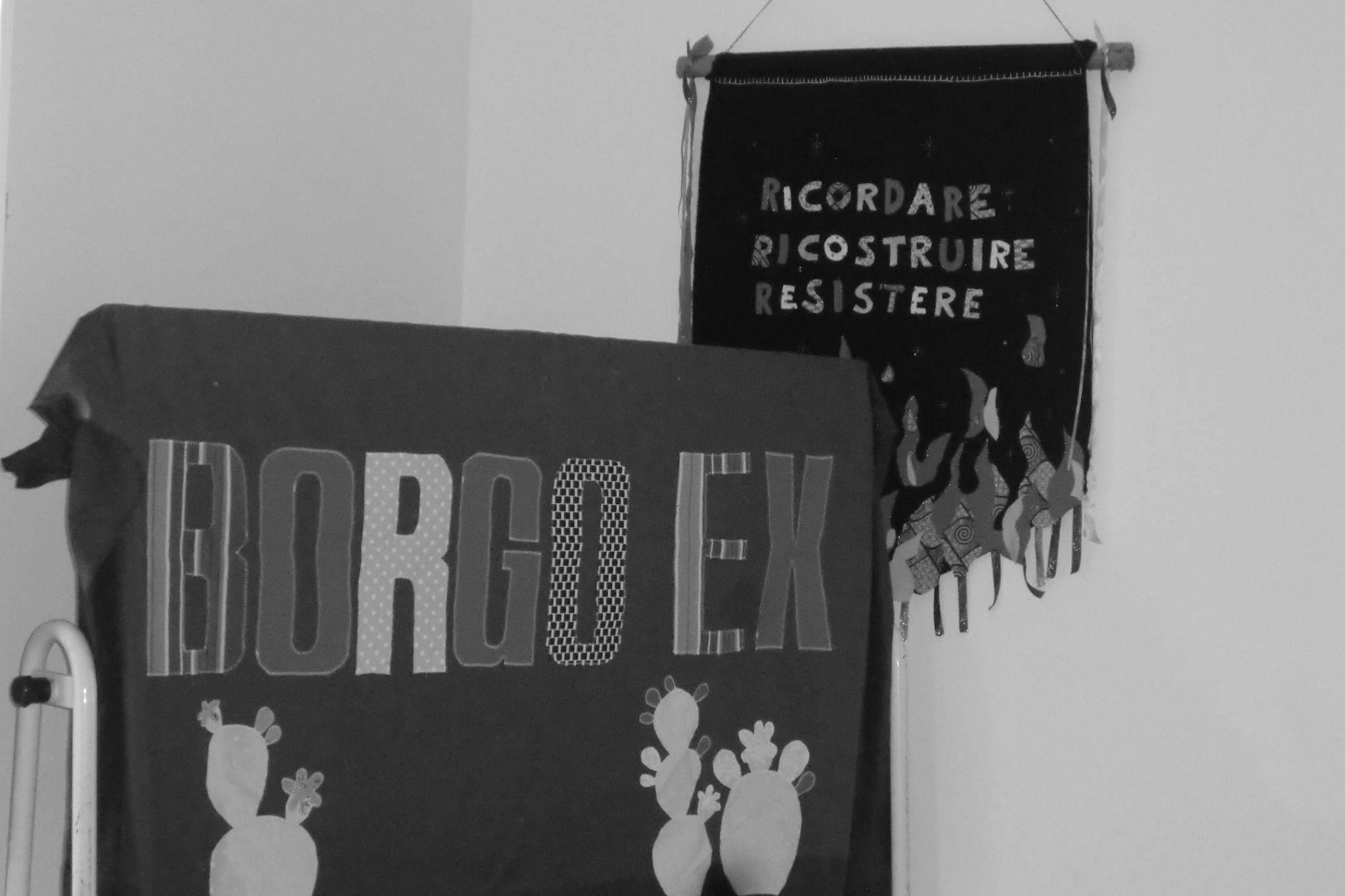
Ente di Decolonizzazione — Borgo Rizza is a project initiated by DAAR (www.decolonizing.ps) that explores the possibility of critically reusing and subverting fascist colonial architecture. It is sustained by the community around Carlentini, university participants, DAAR and everyone engaged with Ente di Decolonizzazione.
Since 2020, Ente di Decolonizzazione has worked to confront the legacy of the Italian colonial period. Through research, artistic interventions, educational programs and public discussions held at the former Ente di Colonizzazione del Latifondo Siciliano in Carlentini (Province of Siracusa), the project has engaged universities, cultural institutions and local associations to initiate the critical reuse of Borgo Rizza and to ask what to do with this difficult heritage. The word borgo derives from the Late Latin burgus, meaning “fortified place,” and carries related meanings such as “hamlet” or “suburb.” But when speaking about the Borghi built in Sicily during fascism, the term refers to a specific type of settlement: planned rural villages built by the Ente di Colonizzazione del Latifondo Siciliano, which was created by law on Jan. 2, 1940, following Mussolini’s announcement of the “assault on the latifundium” in July 1939.
The model drew on colonial settlements in Libya, where rural villages had been built, and on colonial planning in Eritrea, Ethiopia and Somalia. The regime treated southern Italy as a territory in need of modernization and transformation. In 1940–41, the first eight Borghi were built in Sicily, one in each province except Ragusa; more followed later.
They were not villages like those that already existed in Sicily, but settlements designed mainly to provide the political and social services needed to secure the fascist regime’s control over the territory. The complex included buildings such as the Casa del Fascio, the police station, the medical clinic, the school and the church. The architecture was primarily administrative. The Borgo sat at the top of the hill.
With the collapse of the fascist regime, the Borghi lost their purpose, and many across Sicily were left abandoned and empty. While on another research trip, DAAR came across one of these Borghi, which prompted the collective to ask what these places had been, what they had become and what they might become in the future. To the group, the layout felt familiar, echoing patterns of settler organization they knew from Palestine. Their research led them to the mayor of Carlentini, the municipality responsible for Borgo Rizza, also known as Borgo EX.
The mayor shared their wish to reflect critically on its history and to try out what could be done collectively. That meeting led to a partnership: an agreement between the Royal Institute of Art (Kungliga Konsthögskolan) in Stockholm and the municipality of Carlentini that turned Borgo Rizza into part summer school, part gathering space and part ongoing research site.
In Italy, fascist-era architecture is rarely treated as a subject for critical reflection. More often it is simply absorbed into the landscape, sometimes even admired for its style, without much discussion of what it was built to do. In Carlentini, the group found a municipality willing to engage seriously with that history rather than quietly preserving or celebrating it, and one that supported and encouraged them to involve the local population. The town has a history of social and political engagement, and its neighbor, Lentini, has a strong anti-fascist and communist tradition rooted in peasant and labor struggles. The town’s Assessore alla Cultura (councilor for culture) has supported Ente di Decolonizzazione from its earliest days and remains central to the collaboration.
The buildings had already been renovated several times, including once with European Union funds. But renovation alone hadn’t been enough: the local community never really used the space, and it never became a real public space. When the collective arrived, the response was something close to relief: finally, someone wanted to do something with it. “Here are the keys.”
The group therefore began to inhabit the place, and members of the local community brought furniture from home. The fascist buildings had been mere stage sets for public display, with no private dimension. That is why Ente di Decolonizzazione pursued a kind of “domestication”: building on the memory of people coming there in the 1950s to eat watermelon in summer, the group set up a kitchen in the square.
The Difficult Heritage Summer School began when the mayor handed over the keys to Borgo Rizza. Since DAAR’s members were teaching at the Royal Institute of Art at the time, a summer school was a natural starting point.
From that first summer school, an annual gathering of the wider Decolonizing Architecture Advanced Studies (DAAS) community developed. The first three years were more institutionally organized. In 2025, students formed a curatorial team to organize the annual gathering. Participants shared responsibilities through teams for cleaning, cooking, space-making and awareness. Around 50 people eventually took part.
The summer of 2026 marked a moment of transition, as it was the final year of the DAAS course. The decision was made not to create a fixed program. The gathering was smaller, with around 25 to 30 people arriving throughout the week.
The 2026 participants created a radio station, Radio Sfascio. Sprouting from Borgo EX (Carlentini, Sicily), it provides an infrastructure for staying in conversation and remaining close to each other across a vast network of people and geographies. The physical space of the radio hijacks the former Casa del Fascio in Borgo EX and turns it into a broadcasting studio and listening room.
Ente di Decolonizzazione is carried by an association that was founded independently of the municipality. It is a democratic, self-governing body, and it is not limited to former DAAS students: anyone can become a member. Its aim is not to institutionalize Borgo EX, but to sustain it while keeping the collective spirit that shaped it. The next annual gathering is planned for July 2027.
[Editor’s note: DAAR is the Palestinian-Italian collective of architects Sandi Hilal and Alessandro Petti, whose work on decolonization began in Palestine. In 2023, DAAR won the Golden Lion for best participant at the Venice Architecture Biennale for its Ente di Decolonizzazione — Borgo Rizza installation, cited by the jury for its political engagement with decolonization in Palestine and Europe.]
Glossary
Borgo EX: The name used for Borgo Rizza within the Ente di Decolonizzazione initiative, challenging its identity as a former fascist settlement.
Borgo ~~Rizza~~: A planned rural settlement built under the Italian fascist regime in 1940 near Carlentini, Sicily. It is now a site for decolonial research, collective learning and the Difficult Heritage Summer School.
DAAR: Decolonizing Architecture Art Research, the collective that initiated the Ente di Decolonizzazione project.
DAAS: Decolonizing Architecture Advanced Studies is a series of postmaster courses, public seminars, field studies, publications and discursive exhibitions that together form a platform for education and research at the Royal Institute of Art in Stockholm.
Ente di Colonizzazione del Latifondo Siciliano: The fascist state agency established in 1940 to develop rural settlements (Borghi) in Sicily, drawing on models and practices associated with Italian colonialism.
Ente di Decolonizzazione: A project initiated by DAAR in 2020 that critically reuses and reinterprets Borgo Rizza to confront Italy’s colonial legacy.
Join the Struggle-La Lucha Telegram channel