
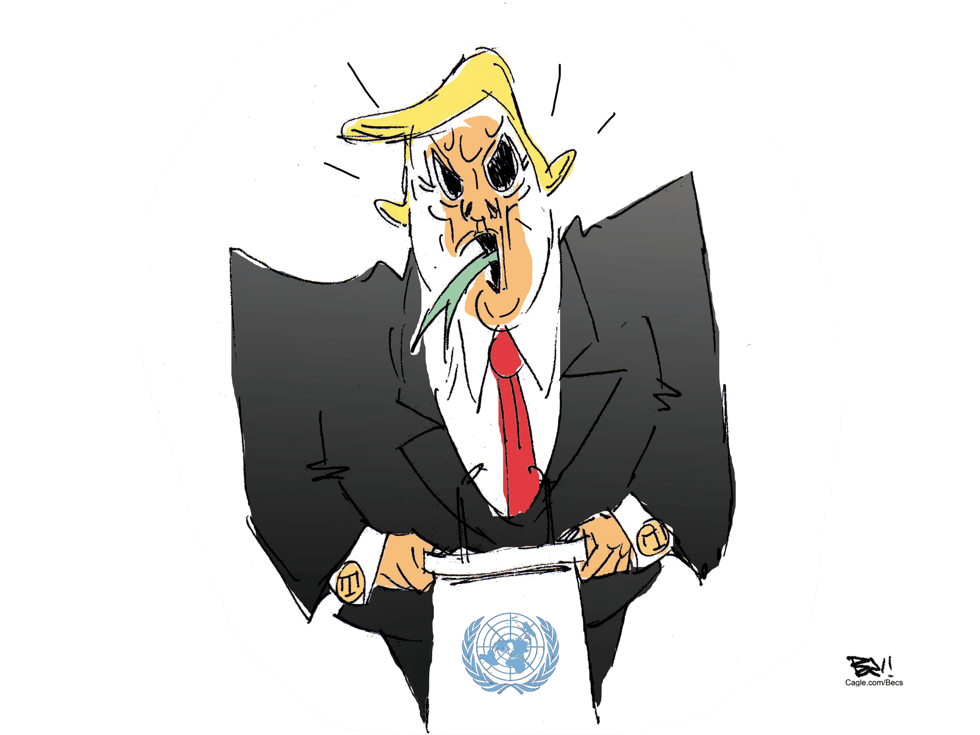
As the host country of the United Nations headquarters, the United States has once again abused its power to deny visas to, among other representatives, the Palestinian Authority—despite Mahmoud Abbas’s acceptance of each and every one of Donald Trump’s proposals, including the Board of Peace — the Russian Federation’s Deputy Foreign Minister, and much of the team of Iranian President Masoud Pezeshkian, who traveled to New York despite the war of aggression that the U.S. president boasted about from the podium.
In one of the many contradictions of the event, and of the world in general, Abbas Araghchi, Iran’s foreign minister, requested security from the United States, the very country that had threatened him with death if he did not accept the proposed agreement. This abuse of power that the United States exercises in diplomacy is a reflection of its actions in international politics, in which it claims to be an actor of peace through force, but takes pride in its wars, and claims to have renounced fighting for hegemony, but congratulates itself on its ability to control countries, resources or trade flows.
His administration, Trump claimed, is “shaping the world stage, solving problems. We have very little time to make this world safer and more prosperous, and as president of the most extraordinary country in the world, I don’t want problems to fester. While others talk about peace, I have made peace; while others ignored threats, I have confronted them. We are solving long-standing problems, such as the number one sponsor of terrorism, Iran. They have ruled bloodily, they were the bullies of the Middle East, but not anymore. I have been unwavering.”
Making a virtue of aggression and a liberty of imperialism, the U.S. president declared, giving an example of what the United Nations would have been like had it existed in the 19th century, that “to the victor belong the spoils.”
The moment Donald Trump took to the most important platform in diplomacy to say, “while others have talked, I have acted,” is especially significant. In Latin America, the United States is on track to control much of the continent in order to isolate its two biggest prizes: Mexico and Brazil. It has done so in Venezuela through military aggression and the kidnapping of its president; the blockade and an economic war increasingly resembling a siege of Cuba; and electoral interference in defense of far-right candidates and governments that define the term sovereignty in the same way as Marco Rubio.
“There is a right to remain a sovereign nation. We want to remain a sovereign nation, and you should too,” the U.S. secretary of state declared, quoting a statement released by the White House in response to a post by Donald Trump about the fight against immigration. Sovereignty, for him, means preventing migrants from reaching the U.S. border.
“The Cuban regime has also been collaborating for decades with left-wing radicals and communist networks here in the United States. As our State Department has detailed, they have forged ties with subversive and radical groups such as the Communist Party USA, Antifa, and the Socialist “Dumocrats” of America. Communism will never come to the United States, but freedom will come to Cuba and security will come to Mexico,” Trump stated, creating an imaginary threat from a small island blockaded for decades and which has never had the aspiration or the possibility of influencing U.S. politics.
Including Mexico in the same sentence is an ominous sign of the submission the White House expects from the Sheinbaum administration, potential violations of Mexican sovereignty in military or intelligence operations, and a harbinger of the electoral interference to be expected in future elections.
In West Asia, Western powers on both sides of the Atlantic condemn Iran’s response, lecture their diplomats instead of offering political support to those facing a war of aggression, and demand a return to the situation prior to February 28.
“We discussed diplomatic prospects for ending the U.S.-Iran war and fully reopening the Strait of Hormuz. Before the war, there were no tolls or fees for passage, and there should be none after the war. Navigation must be free and uninterrupted, both in the Strait of Hormuz and the Bab el-Mandeb Strait. I also raised the issue of internal repression in Iran, including the drastic increase in executions and death sentences,” wrote Kaja Kallas, vice-president of the European Commission, without a word of solidarity for the Iranian people, who have suffered two unprovoked attacks and are now enduring a brutal economic war.
There is talk of the suffering of the population of Gaza, but no action is taken against those who deliberately cause it. “In Gaza, immense human suffering continues. Nearby, Israelis continue to live with existential threats from Hamas, Iran, and their proxies,” Canadian Prime Minister Mark Carney stated, placing more emphasis on the nonexistent danger to the Israeli population than on the slow death to which Tel Aviv and its allies are condemning two million people.
As an area of interest for the United States, which aspires to control the flow of raw materials, West Asia occupied a fundamental part of Trump’s discourse and is essential to his narrative of epic U.S. intervention in defense of world peace through his two wars against Iran. “I will never allow Iran to have a nuclear weapon,” he insisted to justify his actions, to once again threaten Iran, and to use the United Nations to launch a threat with genocidal overtones.
Commenting, almost casually, that he has to make “a big decision,” Donald Trump asked himself, “Will I make a deal with Iran that allows them to rebuild and create a country much greater than it ever was?… Or will I annihilate the Islamic Republic and do it quickly, without ever giving them the opportunity to kill and destroy people and countries again? Will I send them to hell with no possibility of survival or hope of greatness for themselves or for future generations? But I think we’ll make a deal right after the election.”
And although he insists that the United States has no shortage of ammunition—as even the Pentagon admits—nor does it need help from its allies, Trump again appealed to the rest of the world to join his crusade against Tehran. “I ask other countries to help against this terrorist regime. If we are united, we will see a world free from this threat of Iranian terrorism, and the price of oil will be lower,” he declared, deliberately conflating legitimate resistance to an unprovoked attack with terrorism, the argument he has inherited from the last 25 years of U.S. foreign policy ideology.
Europe seems to be approaching an even more dangerous repeat of 1914, with the continent rearming, threatening itself, unable to resolve the only open conflict, and using it to frighten the population with the possibility of an incident—a false flag operation that no one explains—that could ignite a war that the media and irresponsible political representatives present as practically inevitable. “War may be coming. Are we psychologically prepared?” asked a BBC headline last week, one of the many examples of alarmism and the normalization of the possibility of a continental war that can currently be found in the media.
The third priority region for the United States, according to its National Security Strategy, which defines the Americas and West Asia as its areas of interest, influence, and, in reality, control, Europe played a less prominent role in Trump’s speech. As he has made clear on previous occasions, the old continent is, in his worldview, a collection of countries that must respect his vision of civilization—white and Christian—reduce immigration, adhere to the orders of the United States, and be a large market in which Washington can place its technological, industrial, agricultural, and, above all, military products—Donald Trump’s great success.
“NATO is now stronger than ever; they have increased military spending to 5% of GDP. We want to end the war between Russia and Ukraine; it is time to stop the carnage,” he stated in what is the only mention of the armed conflict in Europe.
“There is no world government,” declared Donald Trump, criticizing the United Nations, which he accused of imposing far-left policies and promoting mass migration—common arguments in the conspiracy theories of the U.S. far right from the second half of the 20th century, arguments that Trump has brought to the forefront of his discourse, rather than remaining on the margins. In reality, given its capacity to threaten enemies and allies alike, and its potential for military and political interference, this United States, which claims to have renounced the struggle for global hegemony, is the closest thing to the world government it denounces.
Translated by Melinda Butterfield
Source: Slavyangrad.es
Join the Struggle-La Lucha Telegram channel