
Founded Oct. 1, 1949: People’s China at 77
On Oct. 1, 1949, Mao Zedong proclaimed the People’s Republic of China from Tiananmen Square in Beijing. Days earlier, he had told the assembly that founded the new republic that “the Chinese people, comprising one quarter of humanity, have now stood up.”
Seventy-seven years later, the revolution is still standing, and the ruling class in the United States is still at war with it. The revolution overthrew the landlords and foreign domination. Millions of workers and poor farmers built on that victory and defended it. The United States government has never accepted that revolution and today is escalating its war on China because China is breaking the monopolies that imperialist profits depend on.
What 1949 overthrew
Before the revolution, China had been carved into spheres of control by Britain, Japan, France, the United States and other imperialist powers. Foreign gunboats patrolled the Yangtze River. Landlords took the farmers’ crops and held them in debt. Warlords ruled the countryside, and famine came again and again. About four in five people could not read. Average life expectancy was around 36 years. Girls’ feet were bound, and women were sold into marriage.
The revolution ended landlord and capitalist rule after decades of armed struggle against the Japanese occupation and the Kuomintang, backed by the United States. The land went to those who worked it. The new government outlawed arranged marriage, concubinage and child betrothal. The foreign gunboats left the Yangtze for good.
Building a new society
The new workers’ and farmers’ state began in one of the poorest countries on earth, ringed by hostile powers and cut off from world markets. Within a generation, it built whole branches of heavy industry from nothing. Clinics, schools, electricity and irrigation reached the countryside. Adult literacy, below 20% before the revolution, rose to more than 95%. The communes brought women into social production on an equal footing and provided care from the cradle to the grave.
By the time Mao died in 1976, life expectancy had nearly doubled and the economy was several times larger. The corporate media story that China only started growing when it turned to the market has it backward. The foundation for everything since was laid in these years.
Those gains were never guaranteed. Inside the new state, a layer of officials grew into a privileged stratum that pulled toward the methods and values of the old society. In 1966, the Great Proletarian Cultural Revolution called on workers, farmers and students to challenge them. For a decisive period, millions of people in motion blocked the turn back toward capitalism. The gains of 1949 survived because the masses intervened.
A revolution for the world
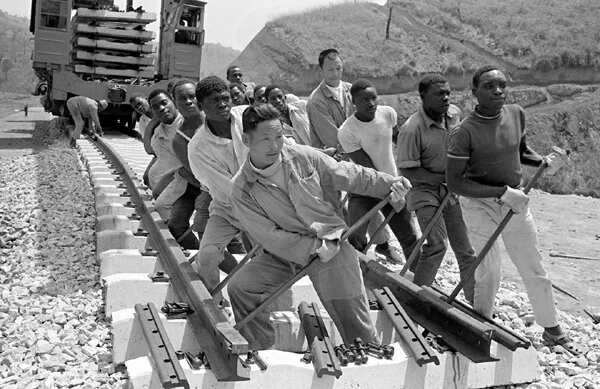
The revolution shifted the balance of class forces worldwide. In October 1950, Chinese volunteers crossed into Korea and drove the United States Army back from the Yalu River. China supplied Vietnam through its long war against United States invasion. It backed liberation movements in Algeria, Guinea-Bissau, Angola, Mozambique and Zimbabwe with arms, training and other aid. It built the Tanzania-Zambia Railway so newly independent African countries could move their goods without passing through apartheid-controlled territory.
The revolution reached the Black liberation struggle here, too. Malcolm X pointed to China as a real revolution, one fought for land. In August 1963, at the request of Robert F. Williams, Mao issued a statement supporting the Black freedom struggle in the United States. Robert and Mabel Williams later found refuge in China from FBI persecution.
Imperialism never let up
The ruling class in the United States never accepted 1949. Mao had warned of exactly that danger days before the new republic was proclaimed: the imperialist powers “will still engage in sabotage and create disturbances in various ways and will try every day and every minute to stage a come-back.”
In June 1950, President Harry Truman sent the Seventh Fleet into the Taiwan Strait to block the liberation of Taiwan province. Through the 1950s, the United States government threatened China with nuclear weapons. It embargoed China’s trade, kept it out of the United Nations for 22 years and ringed it with military bases.
When isolation failed, the ruling class in the United States changed tactics. After President Richard Nixon’s 1972 trip to Beijing and formal diplomatic relations in 1979, capital from the United States poured into China, betting that the market would grow a capitalist class strong enough to take power. That bet has not paid off, and the United States government has returned to open containment. The United States National Security Strategy now calls on United States allies to hold the First Island Chain, the arc of islands running from Japan through Taiwan province to the Philippines. Britain and Australia are locked into AUKUS. Japan is carrying out its largest military buildup since 1945. United States Special Forces are deployed in Taiwan province. Chip bans, export controls and sanctions target Chinese technology.
Why the United States is escalating
The reason is material. United States imperialism rests on monopoly: control of finance, technology, patents and markets, backed by military force. The biggest super-profits come from capturing a new industry first and cornering it before anyone else can compete. Those super-profits pay for the empire’s global reach and give the ruling class room to grant concessions to the best-paid layer of workers at home.
China is closing that window. In solar power, electric vehicles, batteries, telecommunications and high-speed rail, China built these industries at enormous scale. Its solar build-out drove prices so low that Western corporations can no longer control the industry. China has built more high-speed rail than the rest of the world combined. In each of these industries, Western monopolies can no longer dictate prices, hoard the technology or block others from building their own. China can do what no other country tied into the world capitalist market has done because the foundations laid after 1949 survive: public ownership and a planning power that can direct investment where private profit would never go.
The war on China is a fight to save the monopoly foundations of imperialism. Diplomacy cannot remove that drive toward war, because it grows out of the needs of monopoly capital itself.
China against imperialist war
When the United States launched its war on Iran on Feb. 28, 2026, China condemned the aggression. It kept buying Iranian oil in defiance of United States sanctions and vetoed a U.N. Security Council resolution that it said could legitimize unauthorized military operations against Iran. While the United States government strangles Cuba with an energy blockade, China is building solar parks across the island.
China is not an imperialist power. Its currency is not world money, its banks do not dictate policy to other countries, and it does not drain monopoly super-profits from the Global South. Its loans come without the IMF’s demands for austerity and privatization. China spent a century as a target of colonial plunder, and it is developing without stolen wealth.
The struggle inside China
The revolution that stood up to imperialism has also had to fight capitalist pressures inside its own borders. After Mao died on Sept. 9, 1976, the left inside the Party was defeated within weeks, and the masses who had defended the revolution did not mobilize to stop it. From 1978, the new leadership’s market policies built up a large private sector and opened the country to foreign capital. A privileged layer grew rich from land deals, credit and investment. In the 1990s, tens of millions of workers were laid off from state enterprises, and the lifetime security known as the iron rice bowl was stripped away.
Capitalism was not restored. The land is still publicly owned. The big banks, and with them control of credit and investment, remain in government hands, as do major industries such as energy, transportation and telecommunications. The Communist Party controls the state apparatus and the military, and the capitalists do not hold political power. When the Party turned that planning power on poverty, the result was historic.
Millions of cadres went village by village and household by household. Every poor household was guaranteed adequate food and clothing, access to education, basic medical care and safe housing. Roads, power lines and water systems reached places no market would ever serve. Officials were judged by whether poverty fell and living conditions improved, rather than simply by growth figures. By 2021, China had eliminated extreme rural poverty under its national standard. Over the previous four decades, close to 800 million people had risen above the World Bank’s international extreme-poverty line.
That was a socialist mobilization: government-controlled resources directed to human need, against the logic of profit. The conflict between the socialist base built after 1949 and the capitalist pressures of the past four decades remains open.
Workers have a stake
The United States ruling class needs workers here to see China as the enemy. Every week brings a new scare story about Chinese spies, Chinese hackers and Chinese AI. The aim is to turn workers’ anger away from the bosses who close plants and cut wages, and toward the workers of China. Tariffs are foisted on unions in the name of job protection, tying workers to the bosses’ war drive.
It is the same ruling class that bombs Iran, blockades Cuba, kidnapped Venezuelan President Nicolás Maduro and First Combatant Cilia Flores, and attacks migrant workers, oppressed nationalities, women and LGBTQ+ people here at home.
The gains of 1949 were won by millions of workers and poor farmers in motion and defended the same way. Their future will be decided the same way, by the workers and farmers of China, against imperialism from outside and capitalist pressure from within. Workers in the United States have a task of their own: to fight the ruling class’s war on China.
Join the Struggle-La Lucha Telegram channel