
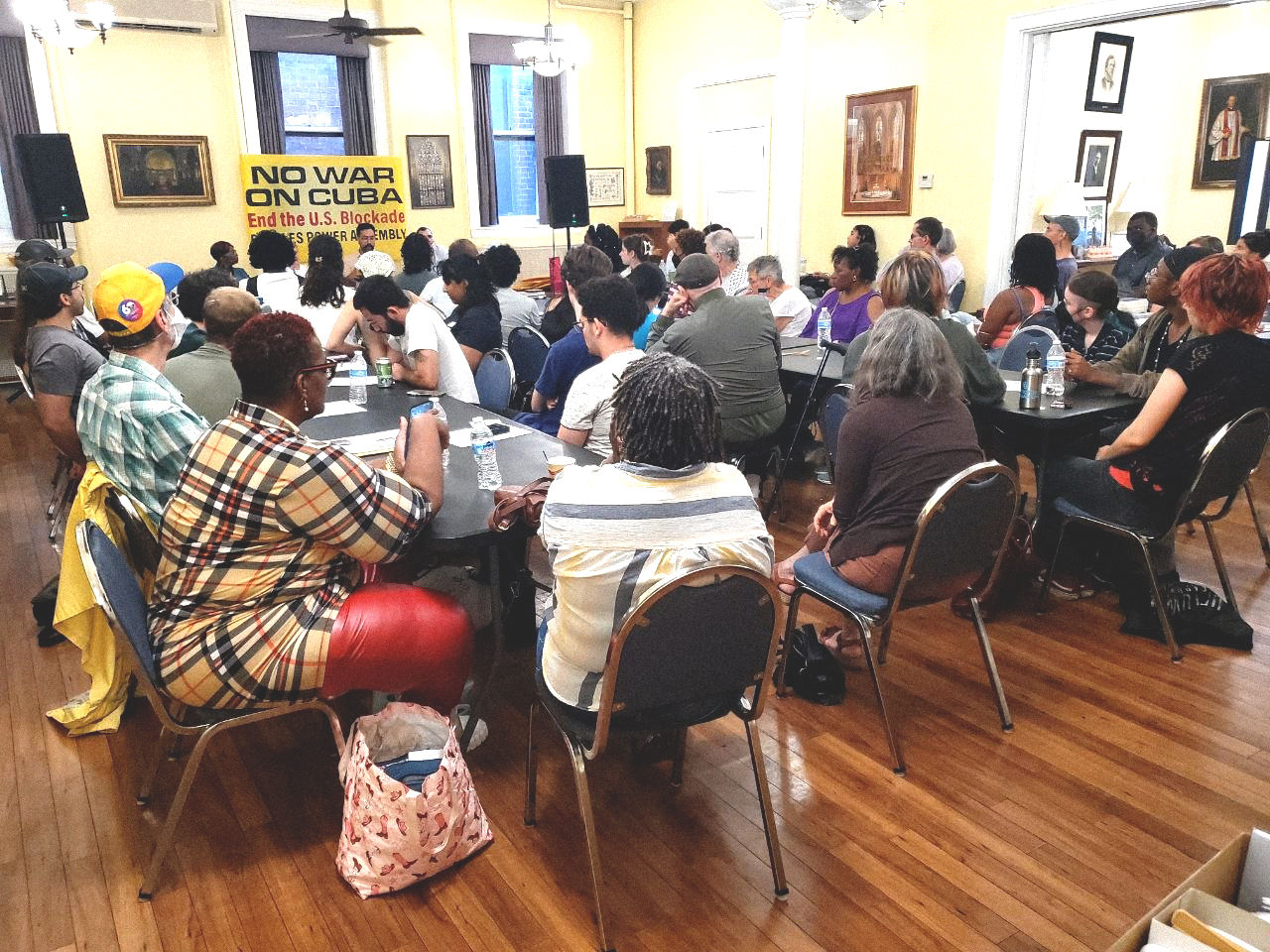
The following talk was given on Sept. 12, 2026, at St. Mark’s Lutheran Church in Baltimore, Maryland, at an event entitled “Eyewitness: Cuba.” It is a short report back from the Centenary of Fidel Brigade, which visited Cuba from Aug. 1 through Aug. 15, 2026.
This was my third time in Cuba. My first brigade, but my third trip.
My first trip was in 2019. The Cuban government invited our party via our publication Struggle-La Lucha to send delegates to a conference entitled the Anti-Imperialist Meeting of Solidarity, for Democracy and against Neoliberalism.
That was a much different trip. Venezuelan President Nicolás Maduro was a special guest at this conference. Today he is being held by the U.S. government as a prisoner of war in a federal prison in Brooklyn, New York.
In 2019, Havana was celebrating the 500th year of its founding. The Malecón, Havana’s 5-mile coastal seawall and roadway, was lit up with stages, dance floors, and temporary bars and restaurants every night we were there. All of them were full of people. Again, a much different trip.
When I first visited, if I hadn’t known Cuba had been under a blockade for over half a century, I genuinely don’t know if I would have ever guessed it.
The only real difference with my everyday life was the toilet problem. You do not flush the toilet paper. One of the very first and most visceral effects of the blockade is an inability to import important infrastructural construction materials. Cuba’s plumbing infrastructure is old, most of it built more than a century ago. It was not built for anything other than human waste.
This had been reiterated to me for weeks leading up to the trip. Do not flush the toilet paper. If you flush the toilet paper, you gotta go get it.
Other than not having cell service, which is going to be the case for me anywhere I go outside the U.S., I’m not sure I would have guessed this place was under a decades-old blockade.
I credit that partly to the power of socialism, that is to say the power of the Cuban working class to genuinely participate in and build their society, and partly to historical context. In 2019, Cuba was still enjoying some of the relief from the Obama era of U.S.-Cuba relations. Trump’s first-term sanctions were only beginning to bite.
This August’s trip was much quieter. The rolling blackouts are real. The food shortages are real. The inflation of the Cuban peso is real. The oil shortage is real. Cuba’s last shipment of oil was in March 2026, a tremendous display of material solidarity from the Russian Federation.
I saw very few gas-powered vehicles driving on Cuba’s roads. Certain vehicles hold priority for fueling. Socialist society as it is, health care and emergency vehicles have first priority. Then public water infrastructure, then infrastructure maintenance, then agriculture and food production, then tourism.
But I did see a lot of new vehicles. Electric bikes. Electric cars. Tricycles with passenger cabs, powered both by pedaling and by a solar panel attached to the roof of the passenger cab.
I want to be clear about one point. When I say quieter, it’s not for lack of activity. Everywhere we went — urban Havana, the rural areas around it — these were not ghost towns. Not like we see more and more in the deindustrialized, disinvested, hyper-exploited, majority-Black port city of Baltimore. Even in the rural areas outside of Havana, people are still there — going to work, going to the market, living their lives. Are there fewer people on average than what I’ve personally witnessed? Of course. But this is a society still functioning, undefeated.
I was in Cuba in November 2025. In January 2025, 200 Cuban entities were added to the restricted trade list. Some conditions had worsened, in a limited way. Only about half of the hotel we stayed in had electricity at any given time. There was always food, but the selection was limited. Gasoline was limited, but not rationed.
But that was just before the U.S. ruling class launched its latest assault. They kidnapped Venezuelan President Nicolás Maduro and First Combatant Cilia Flores, leaders of one of Cuba’s greatest allies. Though technically this is not a sanction, it put Venezuela, a major oil producer in the same hemisphere as Cuba, under the gun. The U.S. is now holding Venezuela hostage, and claiming Venezuela’s oil as its own. This was one of Cuba’s last hopes for importing oil.
This is not a problem created by Cuba’s socialist system. In fact, it is the socialist system that allows Cuba to accomplish what it does. The problem is manufactured by U.S. imperialism. The fuel blockade has been in force since January 2026. Ships filled with food and fuel, already paid for in full, sit miles off Cuba’s shores. All of it is a deliberate, genocidal act by the U.S. ruling class to starve 10 million Cuban people.
And that’s the sentence I want you to take away from this talk. Secretary of State Marco Rubio is trying to murder 10 million people. Their decades-long blockade has failed to break the unity of the Cuban people. So the U.S. ruling class has turned to a different weapon in their arsenal: genocide. They want Cuba to be another Gaza.
In 2024, we hosted Dr. Hina Syed at this very church for an eyewitness account of working in a hospital in Gaza. The stories are the same, and the numbers will bear that out. Stories of hospitals running out of supplies; the overcrowded hospital hallways; the electricity going out in the middle of an operation.
You might ask — wouldn’t a concession, even a small one, help alleviate the suffering? Would it not be an act of harm reduction?
The Cuban people know better. The Cuban people know there is no reality in which surrendering the Cuban Revolution even stops the shutoffs, much less fixes the plumbing.
Look no further than Puerto Rico and the Philippines to understand how the United States treats its colonies, past and present. Look no further than Flint, Michigan, or Gary, Indiana, to understand how the United States treats its own people.
Because of decades of disinvestment and privatization of its public infrastructure, Puerto Rico is entering the second month of its drinking water crisis. Electrical blackouts are still daily. And outside the megamalls, tourist hotels, and military bases, most Filipinos do not have flushing mechanisms for their toilets. I’ve seen it myself.
Flint, Michigan, was without drinking water for five years, arguably longer. The majority-Black city of Gary, Indiana, was without electricity for at least two weeks. And the Cuban people, who are universally educated, know this.
I want to talk about Fidel a little bit. One of the reasons we were there was for the First International Colloquium entitled “Fidel: Legacy and Future.” And what a tremendous event. Thousands from across the world gathered in the same building to honor not just Fidel himself, but the Cuban Revolution, and his contributions to it.
I am always quick to dispel any notion of the “great men of history” fallacy — the idea that history is shaped by exceptional individuals. This is not only an anti-Marxist idea, but an unscientific one. History is shaped by the masses and their influence on social, economic, cultural, and political forces.
The trick is that we experience life, and thus history, as individuals. But none of us can shape the trajectory of history alone. It means we each have a job. This is a job that Fidel took very seriously.
Miguel Díaz-Canel, president of the Republic of Cuba and first secretary of the Communist Party of Cuba, at the opening of the colloquium, described Fidel as a “relentless worker and permanent student.” There is no more apt description of Fidel. And there is no better example of revolutionary leadership.
So many stories told during the colloquium describe not only a leader who guided the building of a revolutionary nation, but one who was deeply involved in every aspect — a relentless worker.
So many stories were of Fidel listening and learning, to profound effect, from the many cadres and workers involved in carrying out that construction of a revolutionary nation — a permanent student.
Fidel’s qualities were not only based on his merits as an individual. They flowed from his understanding of Cuba’s working class and oppressed. He understood them so thoroughly because he genuinely integrated with the masses not only to learn their conditions, but to formulate solutions alongside them.
That is our job. We must become permanent students and relentless workers.
We also have a job as people who live in the United States. It is the United States government that enacted this blockade, and it’s them who can end it. But they will not do it out of their own benevolence. Trump certainly won’t do it. And if there is an election in November 2028, whoever wins will not do it on their own. It is on us to build a fighting mass movement to end the blockade.
Join the Struggle-La Lucha Telegram channel