
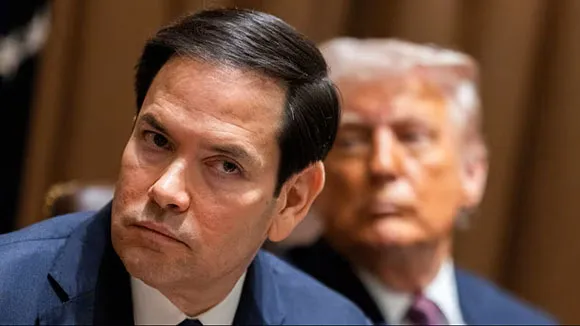
On Sept. 8-10, U.S. Secretary of State Marco Rubio made a whirlwind tour of Colombia, Ecuador, and Peru. He did so as an emissary of the anachronistic Donroe Doctrine, defined in the 2025 National Security Strategy as the “Trump corollary” to the Monroe Doctrine. Two centuries later, in its existential struggle to preserve its hegemony, the new imperialist doctrine seeks to turn the so-called Western Hemisphere into a “Fortress America” against enemies from “outside.”
In its nihilistic phase (as Emmanuel Todd put it), in the face of the emergence of China, Russia, India, and Iran as drivers of a new multipolarity—an alternative to the ideological model of the liberal-Atlanticist West—Trump’s new aggressive policy—as an instrument of the deep state—revives and echoes the “big stick” with which Theodore Roosevelt threatened those who dared to resist U.S. power.
It does so at the helm of a gangster-like state marked by stark, massive corruption, which no longer even pretends to recognize the limited sovereignty of its satellite states in the region (with the exception of Cuba) and deploys its operational capacity as an expansionist hierarchical extension of its own imperialist power.
Within this solar schema, Latin America and the Caribbean—as well as Canada and Greenland—are viewed by the current occupant of the White House and those who control him as distinct zones of expanded strategic jurisdiction; a zone of expansive control whose stability, political orientation, and regulatory architecture must be aligned with U.S. interests, as a supra-state vested with the authority to command, supervise, and correct—through brute force—the behavior of the region’s other political units.
U.S. security today begins “at home” (the Western Hemisphere) and not in Europe, West Asia, or East Asia. This is a new hemispheric defense strategy that integrates military power, industrial capacity, energy dominance, border security, maritime control, and regional alliances into a single defensive architecture. Without this strategic depth, the United States runs the risk of finding itself gradually surrounded by its rivals.
This neo-Monroist interpretation turns the other countries in the region into a functional extension of U.S. political territory, effectively structuring a vertical order of a neo-extractivist, feudal nature (recall former General Laura Richardson of the Southern Command: “the hydrocarbons, lithium, water [etc.] of the hemisphere belong to us”), in which each vassal state’s right to exist is determined by its degree of loyalty, submission, and subservience to the hegemon.
Thus, any attempt at autonomy—whether through national development projects, geopolitical diversification, or cooperation with countries outside the hemisphere (such as China, Russia, India, or Iran)—is recoded as a threat that triggers mechanisms of pressure, punitive discipline, or violent indirect or direct intervention, as in the case of Venezuela.
However, the situation appears complicated for the hegemon. With a simmering process of de-dollarization underway, driven by Russia and China as the engines of the expanded BRICS; the Pentagon having been militarily humiliated in West Asia and the Arabian Peninsula by the doctrine of asymmetric deterrence employed by Iran’s Army and Islamic Revolutionary Guard Corps and the Houthis of Ansar Allah in Yemen, Washington needs to lighten its load.
That is why it has resumed “negotiations” with the Kremlin, on two tracks, to seek a temporary solution to the conflict in Ukraine: the deep state (which views Trump as an interim president) sent CIA Director John Ratcliffe, a representative of the military-industrial complex; while Trump, who does not control certain key levers of imperialist power, dispatched his two trusted “real estate” representatives, his son-in-law Jared Kushner and Steven Witkoff—perhaps with the aim of softening the ultimatum issued by Ratcliffe, a representative of the Atlanticist faction seeking Moscow’s strategic defeat.
It is in this context that, to ensure geopolitical and geoeconomic control of its traditional “backyard”—at a historic moment marked by “the defeat of the West” (again, Todd)—the United States is retreating to the Americas to gather momentum for the decisive battles against China. From this perspective, Marco Rubio’s visit to Colombia, Ecuador, and Peru seeks to tighten the noose of dependence around a new crop of lackeys in ruling circles.
It marks the resurgence of a foreign policy that, throughout the 20th century, produced lackey and sepoy governments at will—symbolized in its most brutal and honest essence by the legendary phrase attributed to Franklin Delano Roosevelt: “Somoza may be a son of a bitch, but he’s our son of a bitch” (literally, according to Sergio Ramírez Mercado, “he’s a son of a great whore, but he’s our son of a whore,” referring indiscriminately to the dictators Anastasio Somoza García and Rafael Leónidas Trujillo).
Following the era of the military “gorillas” came those of the National Security Doctrine, with Operation Condor and the “dirty war” (Pinochet et al.). Now, with Trump, the realpolitik of the “yes men” and “yes women”—unapologetic and unmasked—is resurging, renamed by the head of the Oval Office as “ass-kissers” (“kissing my ass”).
It is cynicism turned into state doctrine under the phantasmagorical Shield of the Americas (with its rusty tools used by “narco-states” and “narco-terrorists”), under which the empire’s new jesters—Abelardo de la Espriella and Keiko Fujimori—will have to fall in line and obey without question, having joined the troupe comprising Bukele, Milei, the Bolsonaros, Kast, Paz, Asfura, and their accomplice, the one resurrected by the grace of the Lord… Juan Orlando Hernández.
Source: Cubadebate, translation Resumen Latinoamericano – English
Join the Struggle-La Lucha Telegram channel