
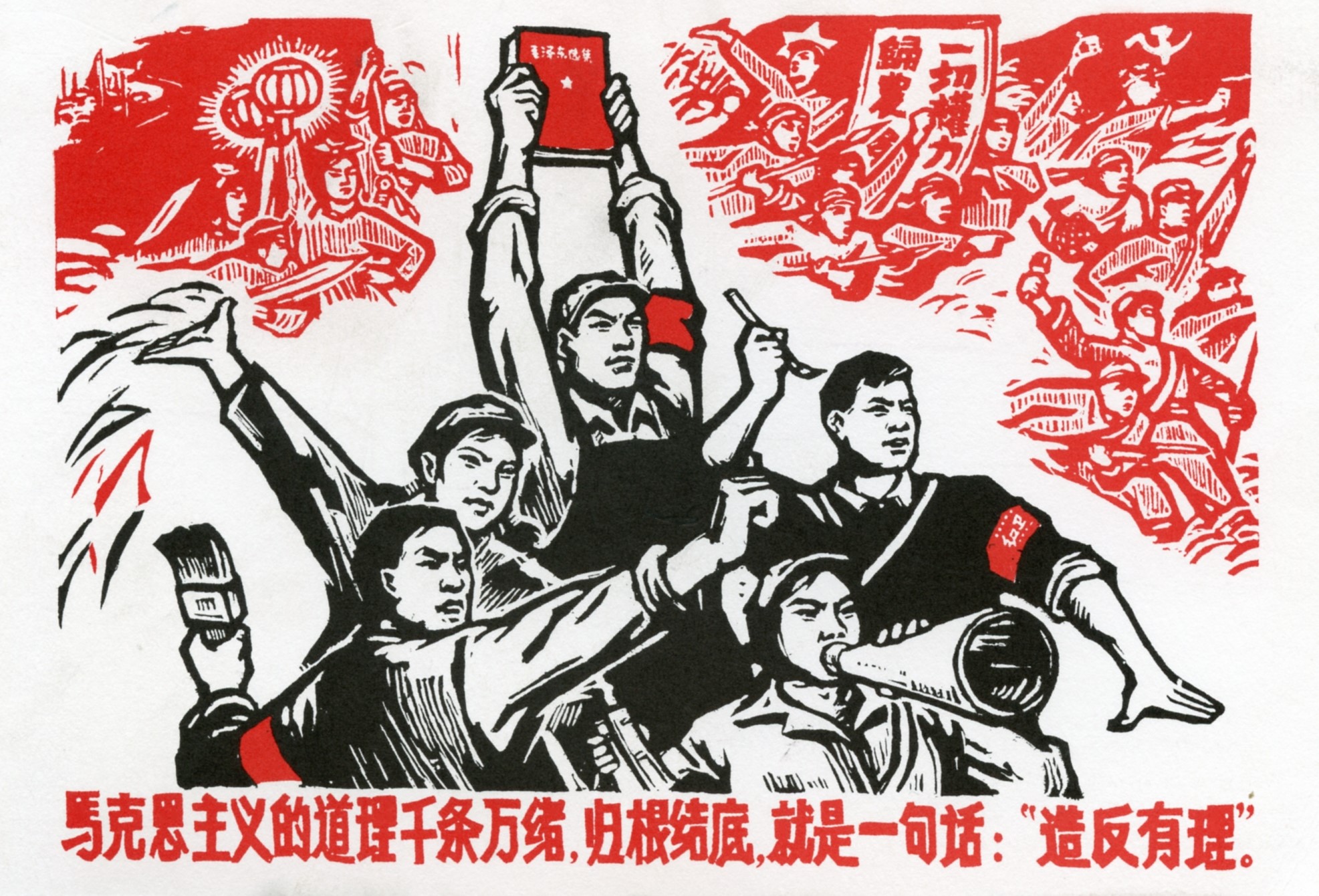
Fifty years ago, on Sept. 9, 1976, Mao Zedong died in Beijing at the age of 82.
Mao had led the Chinese Communist Party through decades of revolutionary struggle and headed the 1949 revolution that ended landlord and capitalist rule and established the People’s Republic of China.
During the last decade of his life, Mao turned increasingly to a problem that had emerged from the experience of the socialist revolutions themselves: What happens after the old ruling class has been overthrown? Could a new privileged layer develop within socialist society and eventually open the road back to capitalism?
That question was at the center of the Great Proletarian Cultural Revolution, which began in 1966.
Mao argued that class struggle did not disappear with the socialist revolution. The new society inherited inequalities, institutions, habits and ideas from the old. Officials within the Communist Party and state could become separated from the masses and push policies that strengthened inequality, private interests and market relations. During the Cultural Revolution, those accused of taking China in that direction were called “capitalist roaders.”
Mao called on the masses themselves to enter the struggle. Millions of young people organized as Red Guards. Workers formed their own organizations. Party and government officials were challenged from below. Established practices in education, culture, management and government were thrown open to mass criticism.
The upheaval took place as an already bitter conflict between China and the Soviet Union had divided the socialist camp.
The Soviet Union, born out of the October Revolution of 1917, had abolished capitalist ownership of the basic means of production and constructed a planned economy. But the Chinese leadership argued that a privileged bureaucratic stratum had developed and that policies introduced under Nikita Khrushchev — including greater reliance on profits, material incentives and decentralization — represented a retreat from socialism.
It was in the midst of this struggle that Sam Marcy wrote “Mao Didn’t Wait for Thermidor,” published March 3, 1967.
“Thermidor” was the name of a month in the calendar adopted during the French Revolution. On 9 Thermidor — July 27, 1794 — the revolutionary government headed by Maximilien Robespierre was overthrown. Robespierre was executed the following day, and a period of political reaction followed.
The revolution’s radical phase had been defeated, but the old feudal social order was not restored. The capitalist property relations created by the revolution survived.
Marxists later used “Thermidor” to refer to a reaction arising within a revolution after the old ruling class had been defeated, without an immediate restoration of the old social system.
Marcy applied that historical analogy to the struggle unfolding in China. He wrote while the Cultural Revolution was still in motion and its outcome was unknown.
The questions raised in that struggle did not disappear with Mao’s death or with the end of the Cultural Revolution.
Decades later, Venezuelan President Hugo Chávez repeatedly expressed his admiration for Mao and the Chinese Revolution. During his first visit to China in 1999, Chávez said he had been “very Maoist” all his life. Later, as the Bolivarian Revolution moved toward what Chávez called socialism for the 21st century, he placed increasing emphasis on communes as organs through which working people could exercise political and economic power.
Chávez urged his ministers and supporters to study “Inside a People’s Commune: Report from Chiliying,” a book published during the Cultural Revolution in which Mao Zedong emphasizes that the commune is a “creation of the masses.” In his last major political address, the 2012 “Strike at the Helm,” he returned to the book while pressing for the development of the Venezuelan communes.
The Venezuelan experience arose under very different historical conditions, but it returned to a problem also raised by Mao’s Cultural Revolution: how to develop forms of popular power that can transform the old social relations.
On the 50th anniversary of Mao Zedong’s death, we reprint Sam Marcy’s article written at the height of that earlier struggle.
Editor’s note: The following article by Sam Marcy was originally published March 3, 1967; it has been lightly edited for spelling, punctuation, capitalization and clarity.
Mao didn’t wait for Thermidor
By Sam Marcy
March 3, 1967
Even if the Cultural Revolution should falter and temporarily come to a halt as a result of considerable resistance from the revisionist and rightist forces, it would still be a significant historical achievement.
For it is the first time since the early days of the Great October Socialist Revolution that the leadership of a socialist country picked up the threads of the Paris Commune and made an earnest effort not only to crush the old state machine but to do away altogether with those elements of the bureaucratic apparatus of the old order.
These are the elements which every socialist state, to one extent or another, has inherited from the past and, in the course of trying to reconstruct society on a new basis, found necessary to utilize for immediate practical purposes. But as time passed, such societies were either unwilling or unable to cast them off.
China’s effort is all the more remarkable because of the tremendous struggle launched to carry this out by projecting the masses onto the political arena and attempting to awaken their creative initiative in completing the revolution.
In none of the socialist countries has there been that kind of clean sweep of what Marx called “the old rubbish.” And wherever efforts were made to get rid of these elements, in the end they cropped up again. By their nature and social makeup, they act as breeders and carriers of the reactionary leftovers of the old order.
It is in this light that the mighty social and political upheaval known as the Cultural Revolution should be viewed.
For what Mao Zedong and his collaborators are trying to do is nothing less than to make a truly heroic and Herculean effort to avoid the advance of Thermidor on the soil of the Chinese Revolution.
Every great revolution in world history has up until now had its period of tempestuous surge forward, followed by a decline that included a partial reaction. This was so in the Russian Revolution, the French Revolution, as well as the Cromwellian Revolution in 17th-century England. In each of these cases, there was a partial reaction in which reactionary groupings took over, but in none of these cases was there ever a restoration to the full previous status quo.
The French Revolution had its Thermidorian period of reaction, which came on the heels of the Jacobin period. But feudalism was destroyed root and branch, and the Thermidorian period was a political reaction with limited regressive social and economic consequences.
(It takes its name from the month of “Thermidor” on the French Revolution’s new calendar, the month during which Robespierre was killed by the reactionaries.)
The old feudal system, as a social system, was destroyed, and the new bourgeois system began to flourish. Much the same happened with the earlier Cromwellian Revolution, except that more substantial concessions were made to the old ruling class.
Whatever one may consider the starting point of Thermidor in the Soviet Union — whether it was under Stalin or Khrushchev — all revolutionary groups are agreed that a period of reaction ensued which is now in full bloom. But the difference between Thermidor on the social foundation — class foundation — of a proletarian revolution and Thermidor in a bourgeois revolution may turn out to be of a very fundamental character.
The bourgeois system of production, which is based upon market relations and exploitation of wage labor by capital, can grow and develop spontaneously under a monarchy, under a Bonapartist dictatorship — even of the most reactionary totalitarian character — as well as under a relatively stable bourgeois democracy.
In spite of the anarchy inherent in capitalist production, the capitalist system develops automatically — spontaneously, because of the market — and the political superstructure merely acts as an accelerator or a brake on its development, as the case may be. This is no small matter of concern, of course! But history has shown no instance whatsoever where a capitalist order of society was restored to the old feudal system.
It may be otherwise with the newly established dictatorship of the proletariat, which has taken possession of the basic means of production. Once it has taken over the basic means of production, it can scarcely develop at all except on the basis of conscious centralized planning. The social relationships can neither be stabilized nor developed, either in the economic or the political sphere, without conscious planning.
That is a basic difference between the bourgeois revolution and the proletarian revolution.
If a reaction takes place in a socialist — that is, a workers’ — state, if a Thermidorian reaction occurs on the foundation of a proletarian dictatorship, it is immensely more dangerous than in a bourgeois revolution.
Thermidor in the French Revolution went as far as it could, but the new bourgeois relations developed, the productive forces developed, commerce and industry flourished, the exploitation of the workers was accelerated, the productivity of labor heightened, and science and industry began to make giant steps forward.
Thermidor on the basis of a socialist state — a workers’ state — especially if the reaction sinks deeper and deeper roots, has the possibility of fully dissolving all the economic relationships newly established by the proletarian dictatorship, unless it is stopped. While a full-scale bourgeois restoration is a theoretical possibility, it is exceedingly improbable. However, only life will prove which will prevail.
Scarcely a day passes without some news of a further development of the so-called economic liberalization and decentralization methods in the Soviet Union and Eastern Europe. Most ominous is the rapid development of the so-called new profit system for various establishments and the further extension of individual material incentives, which undermine the class solidarity not only of the working people but of the general population.
The gulf between the privileges of the new social stratum and the general mass of the population continues to widen. It is becoming so great, and the method of material incentive so extensive, that they pose the greatest danger to the public — socialized — ownership of the means of production.
The Soviet leadership must bear full responsibility for the threatening danger to the social achievements of the October Revolution. It is their political and economic policies which continue and constantly enlarge this danger.
Undoubtedly Mao saw the development of Thermidor in the Soviet Union and its debilitating effects both in the economic field and in the arena of political life in general. All the more remarkable is the effort made to stop the engulfing Thermidorian advance which has enveloped the bulk of the socialist countries.
The lasting significance of the Cultural Revolution will not be in how far and how deep it will eventually advance, but in the fact that it organized a tremendous army which, in effect, made its watchword to Thermidor:
“Thus far they’ve gone and no farther. They shall not pass!”
Join the Struggle-La Lucha Telegram channel