
The West Bank and our responsibility
Across the occupied West Bank, the scene has become grimly familiar.
Armed, often masked Israeli settlers descend from hilltop settlements and outposts toward Palestinian villages, farmland and grazing areas. Palestinians have been beaten, shot, wounded and killed. Homes and vehicles are attacked, livestock stolen, olive trees cut down or burned.
Israeli soldiers are often present. Sometimes they fail to stop settler attacks; at others, soldiers themselves block roads and access to farmland, disperse residents or use force against Palestinians attempting to defend their communities.
The violence does not end when the attackers leave.
A farmer must decide whether it is safe to return to his grove. A shepherd wonders whether he can reach his grazing land. A family whose home has been attacked asks whether its children can remain there.
These are not simply isolated clashes between Palestinians and settlers. They occur within a system of military occupation, expanding settlements and an occupying army on one side and the people it occupies on the other. Their cumulative effect is to make Palestinian life on Palestinian land increasingly difficult to sustain.
It is violence against permanence.
From the United States, we often encounter the West Bank in fragments: a settler attack here, a demolished home there, another village threatened with displacement. Put the fragments together and a pattern emerges.
Displacement does not always arrive in one dramatic act of expulsion. Sometimes it advances incrementally: one family driven away, one inaccessible field, one demolished home, one uprooted tree at a time.
Sometimes, to empty a land, you make life on it unbearable.
The olive tree is not just a tree
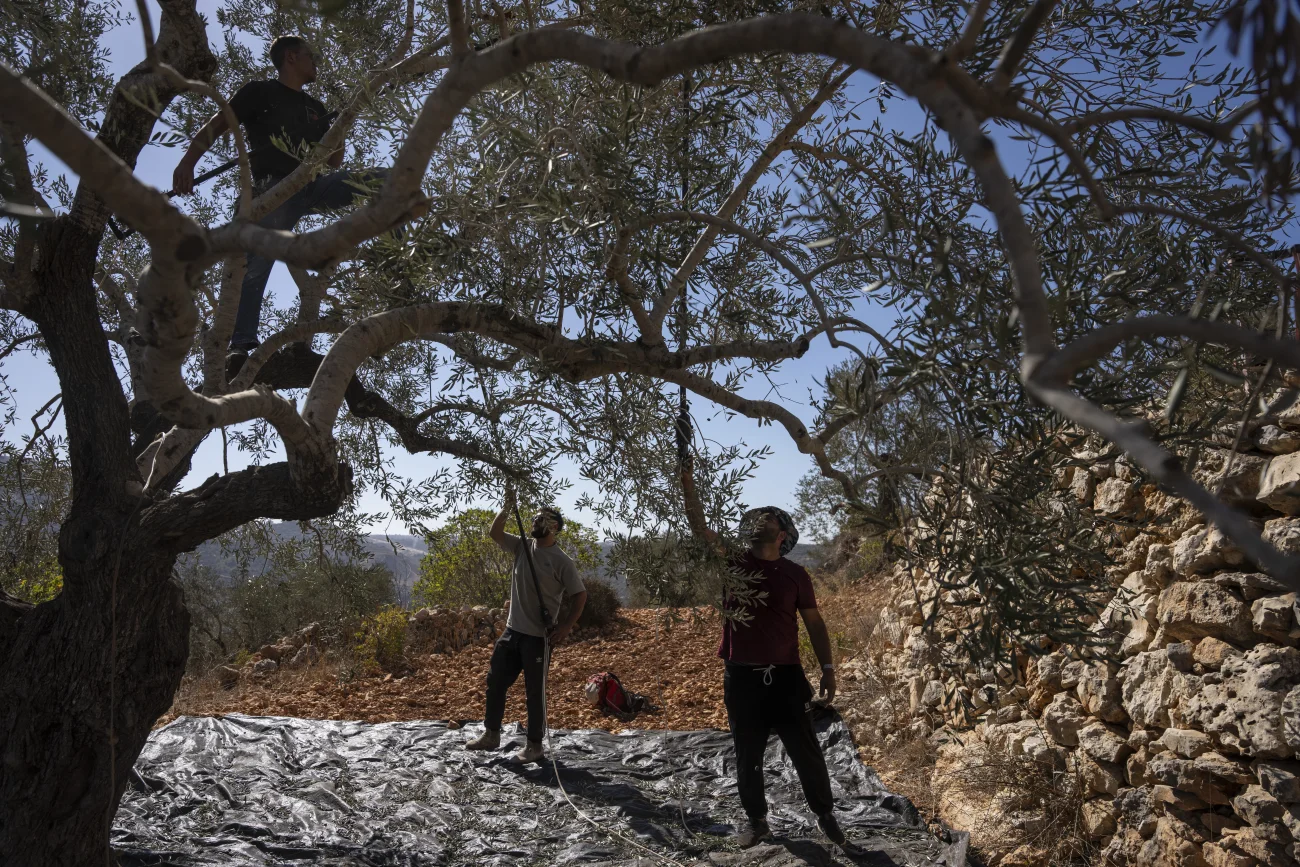
Consider the olive tree.
A Palestinian olive tree may have been planted by a grandfather or great-grandfather and tended by generations. It provides income, but it also carries memory. Families return to the same groves each harvest, renewing a relationship between people and place that reaches beyond any individual life.
Destroying that tree is therefore not simply agricultural vandalism.
It strikes at livelihood, property, memory and belonging.
When farmers fear reaching their groves, harvesters are attacked, grazing lands become inaccessible and agricultural roads are closed, the consequences accumulate. Families lose income. Villages lose parts of their economy. Young people who cannot build homes or imagine livelihoods begin looking elsewhere.
Departure produced by unbearable conditions can then be called voluntary.
This is how land can change hands without the world witnessing a single dramatic moment of expulsion.
Violence with a purpose
Settler violence cannot be separated from occupation.
A Palestinian farmer defending his land does not confront an armed settler as an equal. Behind the settler stands a military system that controls Palestinian movement, restricts access to land and protects expanding settlements. Israeli soldiers are not merely witnesses to this system; they enforce it and, at times, participate directly in repressing Palestinians attempting to defend their homes and fields.
Impunity becomes more than a failure of law enforcement. It becomes part of the machinery of displacement.
When attackers expect few consequences, violence becomes easier to repeat. When military restrictions and settler intimidation make land increasingly inaccessible, families are pushed from vulnerable areas, creating more room for settlement expansion.
Violence produces displacement. Displacement facilitates expansion. Expansion produces more pressure.
And gradually, the map changes.
Beneath it lies a brutally simple question:
Who will ultimately be able to remain on the land?
When protection fails
Palestinians also face a painful internal reality. The Palestinian Authority has demonstrated neither the capacity nor, too often, the political will to protect communities confronting settlement expansion and settler violence. Its leadership has become increasingly detached from the people it claims to represent, while its security apparatus operates within the constraints of occupation.
When institutions fail, responsibility falls increasingly on the people themselves.
Local committees, popular organizations, political movements, medical volunteers and community networks must organize documentation, legal aid, emergency care and physical protection
Palestinians cannot wait for an ideal political order before organizing to remain on their land.
But they should not have to stand alone.
That brings the question across the ocean to us.
The United States is not a spectator
Americans are not outside this story.
Our government is part of it.
For decades, Washington has armed, financed and shielded Israel. The imbalance confronting a Palestinian farmer is sustained by decisions made thousands of miles away — with U.S. weapons and in our name.
That changes the meaning of solidarity.
If our government supplies the power and sets its purpose, Americans have a responsibility to challenge that.
The question is not simply, How do we stand with Palestine?
It is: What are we willing to organize to change?
Start where the weapons are made and moved. Organize port by port and plant by plant. Know which companies fill the contracts and which locals work them. Refuse to build, load or service the shipments and defend the workers who refuse.
Congress will not be persuaded, but it can be exposed. Know how representatives and senators vote. Oppose the weapons transfers — all of them, not only the ones that break Washington’s own rules. Publish politicians’ positions and hold them accountable.
Then organize where we already have power: unions, universities, churches, mosques, synagogues, professional associations and civic organizations. Pass resolutions, break the investments and institutional contracts, defend Palestine advocacy against censorship, and build sustained partnerships with Palestinian organizations.
Do not ask only, What can I do?
Ask: What institution am I part of, what power does it possess, and how can we move it?
Connect that power directly to Palestinians struggling to remain on their land. Community organizations can partner with threatened villages and farming cooperatives, amplify Palestinian voices, send the agricultural, medical and legal support Palestinians themselves ask for, and mobilize rapidly when communities are attacked.
And act carefully. Verify information. Obtain consent before publishing names, photographs or locations that could endanger people. Follow the guidance of Palestinian organizations doing the work on the ground.
Above all, build for the long term. Do not reconstruct the movement after every attack. Train organizers, bring new people into sustained work, and turn outrage into organized power.
Turn the march into a meeting.
Turn the meeting into an organization.
Turn the organization into pressure.
Turn pressure into shipments that never leave the dock.
That is how solidarity becomes power.
Standing beside the olive tree
There is something elemental about the struggle over an olive grove.
On one side stands an armed state with enormous military power.
On the other stands a farmer with a tree, a deed, inherited memory and the determination to return to the same field next season.
That persistence matters because the struggle ultimately comes down to one question:
Can a people remain on their land?
Every uprooted olive tree asks it again.
Will another family leave? Will another hill be emptied? Will another settlement take its place?
And will Americans, whose government sustains the system under which this occurs, simply watch?
Protecting Palestinian agriculture is not charity. Defending communities threatened with displacement is not pity.
It is defending a people’s ability to remain rooted in their homeland.
The distance between an olive grove in the West Bank and a congressional office in the United States may seem enormous.
Politically, it is much shorter than we think.
Our taxes travel that distance.
Our weapons travel that distance.
Our government’s decisions travel that distance.
Our responsibility must travel it too.
The settlers descending from the hills should not find Palestinian villages standing alone.
And solidarity should mean making sure they do not.
Michel Shehadeh is a Palestinian American writer and activist. He immigrated to the U.S. in 1975 and was a defendant in the landmark “Los Angeles Eight” case, a 20-year deportation battle that ended in a major civil rights victory. A former director of the American-Arab Anti-Discrimination Committee (ADC) and the Arab Film Festival, his latest book is “Freedom on Trial: The war against Palestine and the fight for justice in America a memoir of the L.A. Eight and civil rights, and the battle against being branded as ‘Terrorists’.”
Join the Struggle-La Lucha Telegram channel