
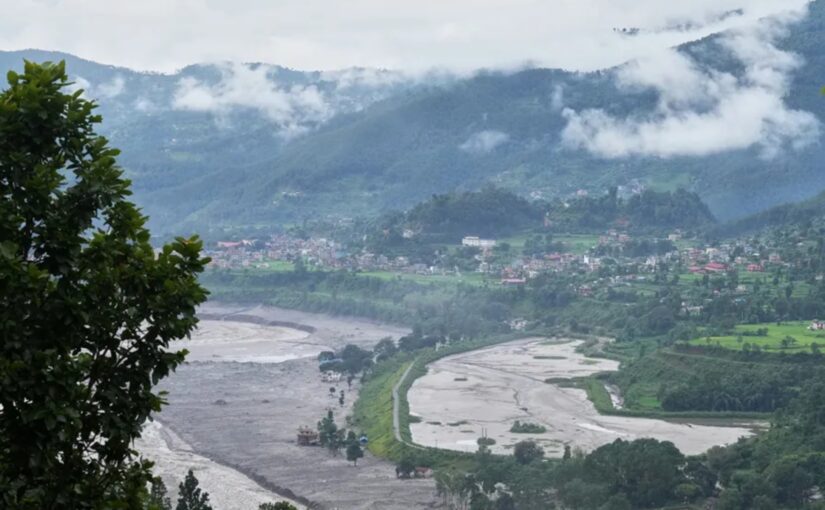
On Aug. 26, a glacier collapsed high on the Nepali side of the Himalayan range, sending a wall of ice, rock, mud and water down the river valleys straddling the border between Nepal and the Tibet Autonomous Region of China. About 26 miles of road were wiped out, leaving helicopters as the only means of reaching survivors. As of Sept. 4, Nepal’s death toll had passed 900, with more than 4,000 people missing; on the Chinese side, 16 have been confirmed dead and 546 are reported missing.
This is the disaster that Laura Bicker, the BBC’s China correspondent, chose to report as follows: “Shocking footage isn’t being shown in China — and we know little about victims there.”
Numerous people in China immediately pointed out that the footage is, in fact, all over Chinese platforms. Indeed, the very video used in the BBC’s own report was released by the Chinese port authorities at Gyirong. So the sequence runs: the Chinese government published the clip; the BBC ran the clip; the BBC then published a story about how the Chinese government is suppressing the clip.
Several commentators have made another significant point: Chinese media does not operate on the principle of “if it bleeds, it leads.” You will not see grieving relatives and footage of bodies looped for 24 hours. The BBC treats the absence of disaster pornography as evidence of a cover-up rather than a different editorial culture.
Heroic rescue
The BBC report concedes that Beijing has launched “a massive rescue operation involving hundreds of emergency workers.” Even the International Campaign for Tibet, a Washington-based lobby group funded by the National Endowment for Democracy, is recorded “praising the work of first responders.” Within days, its president was telling the Guardian that the true casualty figures were “far higher” than Beijing admitted.
President Xi Jinping personally chaired an emergency meeting to coordinate the response. Chinese media has provided “daily updates on the missing and the dead,” along with updates on the rescue operation and on the barrier lake. It has shown rescue teams scaling mountains and cliff faces and crossing raging rivers.
Premier Li Qiang was “quickly dispatched to the region” — a level of responsiveness from the top leadership that those of us in the West can only dream of. Compare the U.S. response to Hurricane Katrina, or the British government’s response to the Grenfell Tower fire in London, where after almost a decade nobody has been held accountable and the families of the victims are still waiting for justice. From all of this, the article somehow arrives at the phrase “muted response.”
The BBC further reports that local Communist Party members have been asked to step up and help with relief efforts, and to provide “emotional guidance or psychological support to affected residents.” This is predictably framed as an operation to “stem any signs of discontent.” A political party instructing its members to help their neighbors in a catastrophe is thus converted into evidence of authoritarian anxiety.
Free Tibet?
Our intrepid reporter finally reveals her motive in a single subordinate clause: “Tibet, which Beijing annexed in the 1950s.” It turns out this is a story about British state media, not Chinese state media.
Tibet has been part of China since the 13th century, when it was incorporated into the Yuan dynasty. Taking advantage of the chaos surrounding the collapse of the Qing dynasty, Britain invaded Tibet in 1904 — the Younghusband expedition, which massacred Tibetan troops armed with matchlocks and swords, as well as civilians, and marched on the capital, Lhasa. That invasion produced the formula by which Britain recognized Chinese “suzerainty” over Tibet while asserting that the region was “independent in internal administration.” This is a distinction with no basis in Chinese or international law — it has never been invoked in any other instance, by Britain or any other country — and it meant in practice that the British could do as they liked there.
Britain did not abandon that formula until 2008. In a written ministerial statement of Oct. 29, 2008, following a visit to China earlier that year, then-British Foreign Secretary David Miliband criticized “the outdated concept of suzerainty,” calling the whole thing “the anachronism of our formal position on whether Tibet is part of China.” He confirmed that the British government “regards Tibet as part of the People’s Republic of China” and does “not support Tibetan independence.”
The BBC’s formulation is not merely contested. It is at odds with the declared position of the British government, arrived at by a foreign secretary who described the alternative as a colonial-era relic.
If the BBC insists on “Tibet, which Beijing annexed,” then for the sake of consistency it should use “Cornwall, which London annexed,” since the incorporation of Cornwall into England occurred at roughly the same time as Tibet’s absorption by the Yuan dynasty.
The article goes on to repeat tired tropes about “the Chinese government oppressing and persecuting Tibetans,” without ever specifying the nature of this oppression. It includes raising literacy from 5% to more than 90%; 15 years of publicly funded education; the highest per capita central government transfers to any region in China; the elimination of absolute poverty; the provision of modern infrastructure, health care and social services; and substantial efforts to protect and promote the Tibetan language, culture and traditional medicine.
Slander or solidarity?
What isn’t mentioned is the disaster’s underlying cause: a flash flood produced by a collapsing glacier in the fastest-warming mountain range on earth. Scientists have not yet established the immediate trigger of the collapse, but the environmental context is not seriously in doubt.
Across the Himalayas and the Tibetan Plateau, glaciers are retreating, permafrost is thawing, and the meltwater lakes left behind are multiplying and bursting. Glacial lake outburst floods of this kind are becoming more frequent, and they threaten the water supply of hundreds of millions of people who live downstream on the Ganges, the Indus, the Brahmaputra, the Mekong and the Yangtze. China is doing more than any other country to develop green energy and thereby slow the global warming that is producing these disasters.
Instead of addressing these issues, the BBC and other Western media choose to spread disinformation and anti-China hysteria. Asked about the allegations of media suppression, Chinese Foreign Ministry spokesperson Guo Jiakun said the release of information had been “transparent and timely,” and that “malicious smear campaigns and hype using the disaster situation does not align with popular sentiment.”
We should express solidarity with the people of Nepal and China affected by this disaster, and with everyone working on the rescue operation. Shame on those Western journalists choosing slander over solidarity.
Source: Friends of Socialist China
Join the Struggle-La Lucha Telegram channel