
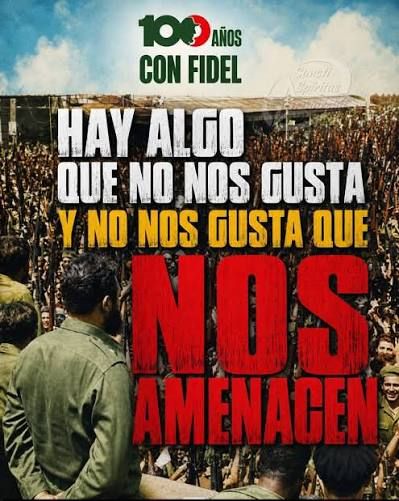
“We do not like being threatened… We do not like being intimidated. We do not like it… Besides, our people long ago lost the idea of what fear is.”
–Fidel Castro Ruz, 12/20/1980
The Cuban Constitution prohibits armed aggression against another country. This is the choice of self-defense, internationalism, and peace that underpins the peaceful transit will of the Cuban Revolution. But our will has been constantly attacked. Today, the life, peace, security, economy, and governance of the country are under strong and constant siege.
Cuba resists a non-conventional war. The genocidal U.S. policy combines the intensification of the commercial, financial, technological, and for the last six months- energy blockade, with a sequence of subversive operations, psychological warfare, cognitive warfare, and ideological-cultural warfare.
Every day, the topic of military aggression appears in the media, and so-called social networks are flooded with the direct military threat. This is done by President Donald Trump, Secretary of State Marco Rubio, generals, and “national security” officials.
The imperialists underestimate the history of the emergence and permanence of a nation like ours, self-aware and self-determined, in constant confrontation since 1510 to the present day, fighting against invasions, occupations, and aggressions from powerful empires.
We are a people of peace, who know how to defend that peace.
A people who have fought for their right to exist as a nation in independence and sovereignty. A people committed to the peace, independence, sovereignty, and happiness of other sister nations.
Recent history
The Cuban nation fought for thirty years for its independence in the 19th century. In the most serious military academies in the world, one cannot study that 19th century without marveling at the campaigns of the Generalissimo Máximo Gómez Báez and his Lieutenant, Major General Antonio Maceo y Grajales. We defeated the largest concentration of forces and resources that Spanish colonialism ever deployed against the independence of all the Americas!
In the War of Liberation, starting with twelve men and seven rifles, Commander in Chief Fidel Castro Ruz founded and organized the Rebel Army as the combat vanguard, which reenacted the feats of Gómez and Maceo, and mobilized a powerful network of clandestine resistance and struggle, armed militias, trade union activists, and peasants to fight in the countryside and cities. We defeated a well-trained and armed army of 30,000 troops, supplied with weapons and on-the-ground advice from the military mission of the United States government. We defeated a repressive network of police forces and paramilitary death squads, created under the direct advice of the Federal Bureau of Investigation (FBI), in coordination with the local station of the Central Intelligence Agency (CIA) in Havana, and in Mexico, Venezuela, and other countries in the region where solidarity and material aid for the Cuban revolutionary cause were mobilized.
Following the victory on January 1, 1959, in a precise application of the Leninist principle that a revolution is worth as much as it is capable of defending itself, the Cuban Revolutionary Government consolidated the popular armed forces. On October 16, 1959, the Council of Ministers, at Fidel’s request, approved Law 600, which created the Ministry of the Revolutionary Armed Forces (Minfar). Then-Commander Raúl Castro Ruz was designated minister. Minfar assumed, as its first major mission, the organization and training of the National Revolutionary Militias (MNR), constituted on October 26, 1959. We forged, from the victorious Rebel Army, a national army with a strong foundation of volunteerism and mass patriotic service.
The victory against the powerful invading brigade that landed in April 1961 at Playa Girón and Playa Larga, consolidated in mass heroism the guerrilla veterans of the Sierra and the Llano with the new militia generation born after January 1, 1959, amidst the confrontation against state terrorism from the Northern country.
Let us never forget that on April 16, 1961, at the burial of the victims in Havana of the attacks on our airbases in the west and on the Santiago de Cuba airport by mercenary planes using Cuban Air Force insignia, hours before the assault on our homeland, with militia weapons raised, Fidel proclaimed the socialist character of the Revolution. Let us never forget that the heroes who sacrificed themselves at Girón and Playa Larga did so for socialism.
In that April of 1961, soldiers and militiamen stood guard for socialism throughout the country. In that April, for socialism, our fighters from the nascent State Security organs, with the decisive support of the revolutionary people, went house to house, farm to farm, and detained and secured the elements of the internal counterrevolution. In 62 hours we defeated the enemy. And the National Literacy Campaign was not halted, as the counterrevolutionaries had hoped.
Spanish internationalists who fought in the Red Army, and qualified Soviet officers who were also veterans of World War II, contributed their experience and knowledge.
We will never forget the Soviet internationalists who remained with us during the October Crisis in 1962, ready to sacrifice themselves alongside our people. For them, Fidel’s order was clear, and after the Commander in Chief announced it, they shot down the first enemy plane that dared to violate our airspace. We know of the rage of these brothers in arms-expressed in the roughest words in Russian!-when they learned from their trenches that their country’s leadership had decided to negotiate and withdraw the missiles behind the Cubans’ backs.
Our popular army of soldiers and militiamen, and the State Security organs, carried out the “cleanup” of the Escambray and other regions where the CIA had sown armed bands of murderers. The young literacy teachers tortured and murdered in 1961 are a measure of the cruelty of those stateless criminals. This internal “low-intensity” war was won by 1965 with the defeat of the last groups of criminals. Dozens of Cuban men and women offered their beautiful lives in that armed battle and in those that followed.
The Cuban State has documented and judicially proven the systematic terrorist aggression against Cuban citizens and properties inside and outside the national territory. Three thousand four hundred and seventy-eight people have died and two thousand ninety-nine have been affected as a consequence of the violent plans of Washington and its henchmen in the Cuban-American terrorist mafia created and financed by the CIA.
Our debt to humanity
The Cuban Revolution repaid the historical debt to humanity, to the movements and internationalist patriots who joined our centuries-old struggles for national liberation, sovereignty, and peace. From 1959 itself, in our American lands, we reenacted a new Bolivarian feat in support of anti-oligarchic and anti-imperialist guerrilla movements.
At the request of friendly governments, our volunteer troops went to fight for the independence and sovereignty of other peoples. The first internationalist mission composed of a combat unit of the Revolutionary Armed Forces (FAR) was in Algeria in 1963, newly freed from French colonialism. The second mission was carried out in Syria in 1973, against the expansionism of the State of Israel.
In October 1966, in the midst of the liberation war against the Yankees (1965-1975), President Osvaldo Dorticós Torrado and the Minfar minister, Commander Raúl Castro, visited Vietnam. In September 1973, Fidel visited the war zone in the south. Our leaders went to express the friendship and solidarity of the Cuban people, to learn from Vietnamese heroism and intelligence, and also to coordinate the support they needed. Cuban engineers and military specialists joined in the construction of the Ho Chi Minh Trail, the network of tunnels and roads that was decisive in the surprising mobility of the armed forces of the National Liberation Front of South Vietnam. Our internationalists created the marvel of bridges “invisible” to Yankee aviation reconnaissance and attack, which guaranteed the passage of forces and resources for the great final offensive against Saigon.
And we returned to the sub-Saharan Africa of our ancestors, led by Commander Ernesto Che Guevara. From Kigoma (on the eastern shore of Lake Tanganyika) on April 24, 1965, Che arrived by boat to the Congolese lands of today’s Democratic Republic of the Congo. Raúl has recounted: “More than fifty combat actions are recorded on the service record of Che’s Column, who, under the pseudonym Tatu, operated in those new battlefields with the mastery and tactical and strategic acumen that made him a true architect of guerrilla warfare.”
The first reserve of Che’s Column was the Patricio Lumumba Battalion of Cuban internationalists, stationed in today’s Republic of the Congo, where military aid had been requested by the country’s government and by the leadership of the Movement for the Liberation of Angola (MPLA), which had its headquarters there.
In Brazzaville, Che’s idea of creating a school for African fighters came to fruition. There, the leaders and the first groups of guerrillas who, together with Cuban advisors, would decide the anti-colonial struggle and independence in Guinea-Bissau (1973) and Angola (1975) were forged.
Operation Carlota was launched in defense of Angola’s independence. With the country invaded by powerful columns of the South African Army, a thousand MPLA fighters, and 60 Cuban advisors, under the command of Commander [Raúl Díaz-Argüelles García, thwarted the Yankee-South African plan to reach Luanda from the south before November 11, 1975, the day set for the declaration of independence and the official assumption of power by the revolutionaries led by António Agostinho Neto Kilamba.
The news of the heroic sacrifice of Cubans and Angolans against the South African invaders, and the MPLA’s request, led to the start of Operation Carlota on November 5, 1975. Carlota, the enslaved heroine martyred on a November 5 in Triunvirato, Matanzas, in 1843, would evoke the roots and historical dimension of “Operation Carlota.”
Four months were enough to expel the invaders from the north and south. On March 27, 1976, the last South African unit left Angola. Cuban forces began their gradual withdrawal from the People’s Republic of Angola, leaving the country’s defense in the hands of the Armed Forces for the Liberation of Angola (FAPLA), but at the request of the Angolan government, new threats to the country’s independence made the presence of Cuban volunteer troops necessary.
Angola would become a bastion of freedom in the Southern Cone: 20,000 guerrillas from Namibia, Zimbabwe, and South Africa trained there, with the collaboration of FAPLA, the FAR, and the armed forces of the USSR. In April 1980, the patriots of Zimbabwe succeeded in defeating the racist white minority regime, allied with South Africa, and secured the country’s definitive independence.
While Operation Carlota was underway, we responded positively in July 1977 to the request of the Ethiopian authorities, whose territory had been attacked by pro-imperialist forces of the Somali regime. In an impressive act of international solidarity, Cuba sent 15,000 volunteer soldiers to fight alongside Ethiopian forces. The Internationalist Operation to support Ethiopia would be named Baraguá, as a worthy tribute to the glorious act of revolutionary intransigence led by General Antonio Maceo, who refused to make a pact with the Spanish crown without independence or the abolition of slavery.
In seven weeks, Ethiopians and Cubans liberated the occupied territory of Ogaden, covering more than 320,000 square kilometers and dozens of towns. The aggressors were forced to withdraw.
In the second half of 1987, the last great invasion against Angola occurred. South Africa and the United States, with the support of the counterrevolutionary forces of the National Union for the Total Independence of Angola (UNITA), launched a dangerous offensive and managed to encircle an important grouping of FAPLA troops and Soviet advisors in the Cuito Cuanavale region. Faced with the seriousness of the military situation, President José Eduardo dos Santos requested the aid of Cuban troops.
As in 1975, the leadership of the Revolution decided to provide the requested aid. The decision, well-considered, firm, and audacious, aimed to rescue the forces on the verge of being annihilated and force the apartheid regime to withdraw from Angola once again. The leadership of the Cuban Revolution set out to inflict such a resounding defeat on the South Africans as to achieve lasting peace on the Angolan border, accelerate the independence of Namibia, and bring closer the victory of the South African people and the African National Congress (ANC) over the racist regime.
Between December 1987 and March 1988, the bloody confrontation of Cuito Cuanavale took place, a battle considered one of the most significant in military history since the combats of World War II (1939-1945). The triumph in that battle on March 23, 1988, was the turning point for the liberation of the continent.
With patriotic pride, we can reaffirm for the 20th century the combat glory of the 19th. And it is that today, too, in the most serious military academies in the world, the military campaigns of Cuban internationalism in Angola-and also in Ethiopia-are studied with astonishment. The battle for Luanda in November 1975, the campaign in Ogaden in 1977, and definitively the battle of Cuito Cuanavale are studied. Operations directed directly by Commander in Chief Fidel, from the Minfar operations room, with the active participation of Army General Raúl Castro. And in the theater of operations, Fidel and Raúl counted on a detachment of brilliant generals, with the command style bequeathed to us by the mambises and their emulators in the Rebel Army, where the leader directs and at the same time fights like any other soldier.
We guaranteed the independence, sovereignty, peace, and development of Angola. We shattered the myth of strength and terror of the white mercenaries in the African Southern Cone, and we defeated the powerful army of racist South Africa-even possessing the atomic weapon and the puppet forces that collaborated with them. The South Africans were forced to accept United Nations Security Council Resolution 435, adopted a decade earlier in 1978, for a ceasefire and the holding of UN-supervised elections in South-West Africa controlled by South Africa, which ultimately led to Namibia’s independence. We dealt a mortal blow to apartheid and contributed to the democratization of the new South Africa.
More than three hundred eighty thousand Cubans fulfilled voluntary military missions in Africa. Adding military and civilian personnel-victims on dozens of occasions of terrorist acts-half a million compatriots offered their solidarity to the brother peoples of the Mother Continent of humanity. This latter figure was the documented and testified account of Jorge Risquet Valdés, one of the heroes of that great Fidelista epic.
“From April 24, 1965-Risquet affirmed to me in one of his precious conversations-when Che and his thirteen comrades of the vanguard of Column One crossed Lake Tanganyika and set foot on the soil of Lumumba’s Homeland, until the day Operation Carlota concluded, a quarter of a century, plus a year, plus a month, plus a day had passed. In those 26 years, there was not a single day in which Cuban combatants stopped holding rifles in Africa.” No fewer than 2,655 Cubans died in this mission.
The non-conventional war waged against us
To Cuba’s inclusion on the infamous list of state sponsors of terrorism was added the accusation that we are an “unusual and extraordinary threat” to the national security of the United States. Punitive measures against institutions, companies, and party and government officials have climaxed with the fabrication of a perverse criminal case against Army General Raúl Castro, and they continue. The latest “executive order” of the fascist president on May 1 extraordinarily reinforced the web of extraterritorial measures to force a terrible siege of isolation and commercial and financial blockade.
Old and new lackeys in the region are being rallied to reenact the isolation they managed to articulate in the 1960s. The pro-Yankee right thunders in Western capitals for governments to join the extraterritoriality of the blockade. In the European Union, the fascist consensus advances to withdraw cooperation agreements with Cuba.
The fascist government of the Northern country has again allowed the preparation of terrorist actions on its territory. As a new and dangerous “novelty,” war propaganda operations have appeared, incorporating a publicized preparation of the empire’s armed forces to attack and intervene militarily within the country. The range of pretexts to attack us is increasing… because of being a Russian military base? Or Chinese? For having one or another weapons system… the latest is the presence of “Iranian drones” in the country?
The territory of the empire may be infested with all types of offensive weapons; its missiles could strike Cuba in minutes; waves of modern planes and drones are ready to destroy and kill… And Cuba cannot have defense systems, one weapon or another? It is the same imperial logic and the same manual used against Iraq, Libya, and recently against Iran. U.S. public opinion is being prepared to support war against Cuba.
Millions of dollars are being mobilized in the financial and logistical support of mercenary dissidence. The agents and henchmen of the paid counterrevolution infest the so-called social networks with hate messages, distortions, slanders, unhealthy gloating over our material deteriorations, and pot-banging protests from a population pushed to its existential limits. They campaign with corruption and the shortcomings and errors not attributable to the blockade. They aim to motivate discouragement, anger, disunity, and cultural and ideological demobilization.
Another new form of aggression is that the Cuban-American mafia and its more recent emulators of hatred and cyberterrorism have taken on the task of recruiting mercenaries from within domestic crime.
It is very clear that the ultimate goal of the Trump administration with the blockade pressure is not only economic collapse. A humanitarian crisis, a social explosion, a mass exodus, and/or the combination of these outbreak variables are sufficient to justify military intervention.
There can be no doubt about the preparations for a probable military aggression, including the unabashed threat to kidnap or assassinate Army General Raúl Castro and the first secretary of the Communist Party of Cuba and president Miguel Díaz-Canel Bermúdez.
National security
Cuba, from peacetime, has had to establish a system of control and protection measures for national security that respond to the challenges of espionage, terrorism, and mercenarism.
Legal and penal instruments have been approved to respond to the Helms-Burton Act, internal subversion, and terrorism. Cuba has put into effect legislative, institutional, administrative, and other measures, aimed at preventing and punishing all terrorist acts and activities and those directly or indirectly related to them, including those linked to the financing of terrorism, border protection and surveillance, illicit arms trafficking, judicial cooperation, adherence to international legal instruments on the prevention and repression of international terrorism, and the adoption of specific legislation on the matter.
The debate on maintaining the death penalty has been on this axis. The punishment of mercenaries and proven collaborators of imperialist aggression has also been. For such measures carried out in strict adherence to the Rule of Law, with all internationally recognized facilities for due process and the exercise of the rights of the accused, we are accused of totalitarianism and dictatorship.
There is total shamelessness in those who try to judge us wrongly: The legislation and actions of law enforcement agencies in the United States, the criminal actions of U.S. police and repressive bodies and their “colleagues” in capitalist countries, seen fully on news programs and networks, leave no room for doubt.
In Cuba, protest is a constitutional right. The non-conventional war we resist and the genocidal intensified blockade that makes it even more criminal may provoke protest incidents; in fact, we sporadically have them. The weight of needs in families, people’s exhaustion, propaganda and cognitive warfare, and also the errors that occur in communication and political attention to communities, account for these incidents, which the same murderers who provoke them interestedly try to magnify.
In my neighborhood, in the humble and proletarian surroundings of El Canal del Cerro, there are no protests, nor have I heard a “pot-banging,” but if it happens, I will be there with my neighbors, banging my pot loudly, and accusing at the top of my lungs and with the language that the occasion would demand-Trump, Marco Rubio, and the cohort of criminals who try to subdue us. In Cuba, the internal counterrevolution, the criminals, and mercenaries paid by the empire will have no opportunity to sow chaos and terror in our streets and squares.
The war of all the people
The Cuban State has been applying measures for decades to protect itself from an armed attack by the United States. Our State and government of peace are perfectly trained to pass in an organized manner to wartime and place their entire structure in function of the supreme task of defending the homeland. We have fortified the entire country; we would have liked to allocate the resources used to build housing and many more social and cultural objectives. But preserving peace by letting the empire know the cost of an invasion has forced us to make these sacrifices.
As a result of studying our combat traditions, new learnings, and evaluating the resistance and victories of heroic peoples like the Vietnamese, we created the Military Doctrine of the War of All the People.
In professional composition, we have a small army of specialist officers and commanders, which is complemented by young soldiers doing military service and young women who voluntarily assume that service. The internal security military structure has a similar composition.
There is fluid cooperation between the defense organs and the political and mass organizations and popular associations of revolutionary civil society.
Those who aspire to take the Revolution from us through the abdication of the younger generation forget that the forces in permanent combat composition are mostly made up of young people who until yesterday were our pre-university and technical students, sons and daughters of our children, grandchildren of those of us who are already in our sixties and seventies.
The armed force multiplies into thousands of combatants: officers, non-commissioned officers, and reservist soldiers, plus militiamen and brigadists at the level of each neighborhood and peasant community organized into defense zones, with weapons and combat means deployed in each territory, cared for and oiled, ready for defense.
We do not possess the sophisticated weapons and technology that the U.S. war machine has today. But what we have, we know how to use very well. “What matters about a weapon is the convictions of the man or woman who carries it,” Fidel reiterated to us. The intelligence developed by the academies, research centers, and the military industry of the FAR has made possible novel innovations and new weapons and systems. Those who attack us will have their surprises on the battlefield of this small and heroic nation.
The Cuban defensive shield is regularly practiced in meetings and military exercises, and on a rotating basis once a month on Defense Days. And it not only guarantees the armed defense and survival of the Revolution. It is a school and pivot of our patriotic tradition; it is the base of the ideology of the Cuban Revolution.
In Cuba, as in most countries, there are laws that oblige fit persons to participate in defense in case of war and invasion of their country. But we live convinced that the defense of the homeland is above a legal duty, it is an honor. Everyone who takes up arms in Cuba, everyone who participates in the armed defense apparatus, will do so out of conviction.
Civil defense
There is international humanitarian law for war situations. We know well that the imperialists do not comply with it. The wars of recent decades undertaken by the United States and the North Atlantic Treaty Organization (NATO) against peoples of the South and even in Europe itself, the 15 continuous months of genocide of the Palestinian people, demonstrate the violation of rights and the impunity practiced by the imperialists.
In revolutionary Cuba, preparation for defense includes measures to protect and care for the lives of the people. The revolutionary State’s occupation is organized through Civil Defense, whose mission is to protect people’s lives in disaster situations and in the exceptional circumstances of terrorist strikes and wartime. Children, the elderly, the sick, and their families constitute a population that must also be trained and drilled to participate and contribute to preserving their own lives and those of their families.
In case of attack, as occurs in all war scenarios, there will be personnel fit even for defense who do not participate for family, religious, or political reasons. And these Cuban men and women will also be protected.
The evacuation and care organs in wartime have updated their concepts and plans based on the study of imperialist military aggressions suffered by civilian populations in recent attacks on cities and rural areas, the latest against the Gaza Strip and Iran. There is a priority occupation for creating conditions in safe places where infants, pregnant women, the elderly, and vulnerable people can be protected, equipping them with essential elements for survival.
There is an exercise regularly practiced on Defense Days for transitioning the network of medical facilities to wartime so that health personnel accompany citizens in protection sites. Popular training in civil defense consists of publicizing and practicing useful measures and rules of conduct necessary to act during attacks on the civilian population, minimizing risks, impacts, and consequences.
Families are prepared so that, from the first alert stage for a possible aggression, they take a series of actions to protect their members (including pets and farm animals) and property. They are urged to have prepared a family bag or backpack with essential survival items, along with a first-aid kit.
They are notified of the protection sites and how their occupation is carried out. There are also rules for acting in a surprise attack: what to do, where to take shelter, how to do it: “do not place yourself under a bridge, do not go to tall buildings, look for a wall and load-bearing structure in a building, lie face down, protect your head, open your mouth to reduce blast wave damage…”
“Protect, resist, survive, and overcome” is the motto with which Cuban Civil Defense works, organizes, and educates.
If we are attacked
It is said in the same press that tries to intimidate us that there are sane voices in the Pentagon that defend not making war on us, due to the human, material, and political costs that an aggression against Cuba would bring them. True, the death technology they possess could destroy our country without having to risk their military personnel, but there is no victory without physical occupation of the country.
U.S. analysts know that, in the face of aggression, within the first 4 hours the Revolutionary Armed Forces are capable of arming and placing in full combat readiness more than 200,000 officers and soldiers, regularly trained: workers, peasants, professionals, and university students.
They have calculated how many more will take up arms in 8 hours, in 16… They know that we will put into combat all patriots capable of fighting-two, three, four million… They know it well.
It would be an invasion to be carried out in a theater of operations that would extend throughout the archipelago, its fields, and cities, a scenario prepared for defense, with a staggered yet simultaneous and massive resistance. A war of an entire people, millimeter by millimeter of land, in each military region, in each defensive system, in each rural or urban defense zone. They know we are prepared to resist and continue the fight even with the country occupied.
Our enemies know that from the first attack, the war would also move to the sea; that to the North, the Florida Strait would become a new “Strait of Hormuz” for them, with the paralysis of the million-dollar shipping business. And to the South, the conflict would also endanger the entire supply and trade chain transiting through the Gulf to and from U.S. coasts…
Pentagon analysts know that some of our weapons inherited from the Soviet era have the capability to strike targets in Florida and on the continental territory. We regret it, but they also know that in the attempt to occupy, that in the territory they manage to occupy, and during the time the occupation extends, many of the soldiers and especially the officers of the U.S. empire will find death on our soil, in our skies, and in our seas.
In addition to officers and soldiers, weapons and technology, defense schools and practices, the vigilant eyes of the patriotic nation remain alert 24 hours a day.
The combat order
Euphoric over their act of war against the Bolivarian Revolution of Venezuela, the fascists of the Trump administration publicize the early morning ride of Delta Force helicopters through Caracas, the kidnapping of President Nicolás Maduro Moro and his wife Cilia Flores, and the simultaneous attacks in the states of Miranda, Aragua, and La Guaira. They forget to say it is already known and documented that the Armed Forces of the sister nation did not receive the order to repel the attack. Those who did fight were the Cuban military stationed at Fuerte Tiuna and in the defense of the Venezuelan president. Of these heroes, 32 offered their lives. “Cubans are tough,” Trump had to acknowledge.
No combatant, no patriot, has to wait in Cuba for an order to repel an act of war, an attack, an infiltration, a counterrevolutionary action. The combat order is given: Fight with all available means, make the living forces of the enemy army and their collaborators pay for their participation in the aggression, and do so constantly, for as long as necessary, until the enemy is defeated, forced to abandon the national territory, and compelled to cease all types of armed aggression against the nation.
A punishment operation, the attempt to kidnap or assassinate Army General Raúl Castro or President Díaz-Canel, will be strongly repelled. It will be considered a declaration of war, and the enemy will receive a response in the places and in all the ways that the leadership of the Revolution.
Source: Cubainformation
Join the Struggle-La Lucha Telegram channel