
Land grabbing, criminalization, and racism!
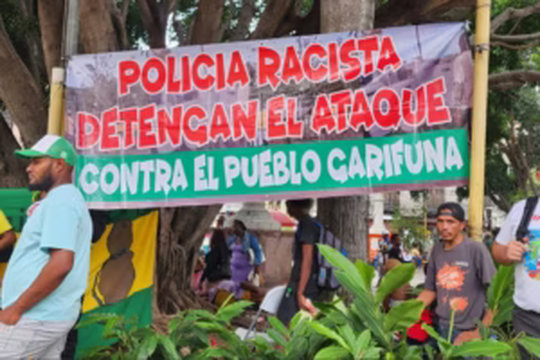
Since early August, members of various Garífuna communities have been gathered in front of the Supreme Court of Justice of Honduras. Organized by the Honduran Black Fraternal Organization (OFRANEH), led by Miriam Miranda, they have set up an indefinite encampment to demand that the case against five land defenders from the community of San Juan, in Tela, be dropped and that the state comply with international rulings recognizing their territorial rights. The protest also targets a campaign of racism and criminalization that, Garífuna organizations say, is meant to legitimize the dispossession of their ancestral territories.
On July 6, more than 200 National Police officers entered San Juan to carry out an eviction. Five community members were arrested and then prosecuted by the Honduran courts. The community says the eviction was unlawful and that the police disregarded territorial rights already recognized by the Inter-American Court of Human Rights.
In early August, members of OFRANEH arrived in Tegucigalpa and set up the Campamento Viva Berta — Viva Berta Camp — in front of the Supreme Court building. Members of various Garífuna communities remain there, including children, youth and community leaders. They are demanding that the proceedings against the five defenders be dropped and that the courts stop treating a territorial conflict as a criminal matter.
Four rulings, no compliance
The dispute over the lands of San Juan did not begin in 2026. The community claims the territory as part of its ancestral lands and says there is a history of possession and records supporting that claim. The conflict reached the Inter-American Court, which in 2023 found the Honduran state responsible for violating the rights of the Garífuna community of San Juan. That was not the first such ruling. The court had already ruled against Honduras in the cases of the Garífuna communities of Triunfo de la Cruz and Punta Piedra, and in 2026 a ruling on Cayos Cochinos was added. In all, the Inter-American Court has issued four rulings against Honduras over violations of the rights of Garífuna communities.
For this reason, OFRANEH says the question is not one of renegotiating rights that have already been recognized. The organization rejected the call by Supreme Court Chief Justice Wagner Vallecillo for a roundtable dialogue on the conflict. It called the offer a false dialogue, one that presents as a dispute between parties an issue the international courts have already settled.
The judiciary defended the call for dialogue and said it seeks solutions to the territorial issue. The U.N. Office of the High Commissioner for Human Rights attended the meeting and repeated that effective compliance with the Inter-American Court’s rulings is essential to guarantee the territorial rights of the Garífuna people. It also warned that criminal law should not be used to settle historical territorial conflicts.
Land grabbing, criminalization and racism
The conflict is not confined to the courts. OFRANEH also denounced a campaign of hate speech against the Garífuna people. Among those the organization named is journalist Amílcar Ulises Aguirre Ramírez of the Televicentro network, who, according to OFRANEH, denied that the Garífuna are an Indigenous people of Honduras and repeated racist stereotypes about their communities.
The debate over who the Garífuna are is also nothing new. They are an Afro-Indigenous people with a history of resistance and forced displacement. Their communities lie mainly along the Caribbean coast of Honduras, and for decades they have demanded protection for their territories, their culture and their ways of life. The Honduran government acknowledged its international obligations by ratifying, among other instruments, International Labor Organization Convention 169.
The territorial question is central. The communities report that lands along the Caribbean coast are under pressure from tourism projects and business interests. In San Juan, the disputed land is claimed by a company linked to the Rosenthal family, according to documentation and complaints gathered by Garífuna organizations.
For OFRANEH, the criminalization of defenders, the land grab and the spread of racist propaganda are not isolated incidents. They are part of the same structure of power, one that turns those who defend their territories into alleged criminals while the economic interests in those lands go untouched. OFRANEH denounced a plan of dispossession and cultural genocide against the Garífuna people and announced that it will again go to international bodies to demand that Honduras comply with the rulings of the Inter-American Court. Meanwhile, the Viva Berta Camp stands in front of the Supreme Court. The community knows the road through the international courts. It is taking that road again because the rulings exist and the dispossession has not stopped.
Source: Página 12. Translation: Resumen Latinoamericano – English.
Join the Struggle-La Lucha Telegram channel