
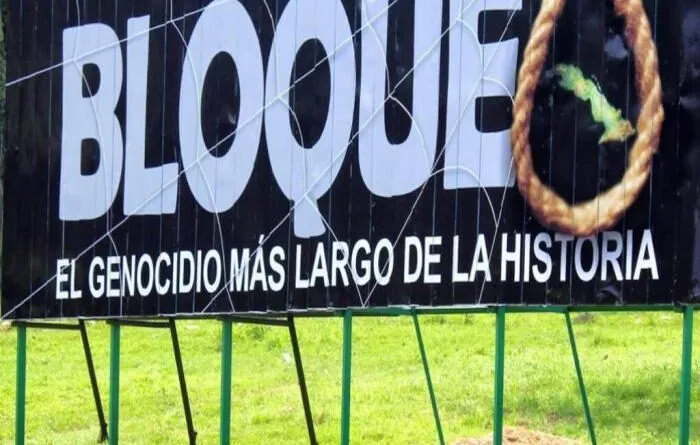
The longest genocide in history. Photo: Prensa Latina
Havana, Aug. 28, 2026
So far in 2026, Cuba has received a single shipment of oil: some 100,000 metric tons of crude donated by Russia, and nothing else.
The sun sets on the horizon and the island seems to be sinking into darkness. Only distant glimmers are visible — fireflies dotting the archipelago — like the navigation lights of a ship struggling on the high seas in the midst of a storm.
Jan. 29, 2026, may seem like a recent date. That was the day U.S. President Donald Trump signed an executive order — 2,207 words declaring Cuba an “unusual and extraordinary threat to the national security and foreign policy” of his country. But those 200 days have subjected an entire people to suffering.
Using that argument — the very same one used to justify interventions in dozens of nations — he authorized tariffs on any country that dared to sell oil to the island. “Cuba will not be able to survive,” Trump told the press that same night.
The energy blockade is tightening the noose around the neck. It is picking at a wound that has been open for more than six decades.
To understand what is new about it, one must distinguish it from the economic, commercial and financial blockade made official on Feb. 3, 1962 — a policy of collective punishment condemned again and again at the U.N. General Assembly.
The energy blockade is the deliberate interruption of the flow of fuel to a nation that depends on it for everything: hospitals, water treatment plants, water pumping, food refrigeration, transportation and schools.
The message on Jan. 29 was clear: No one, under any circumstances, could supply Cuba without facing the U.S. sanctions apparatus.
On May 1, 2026, Trump signed another executive order that internationalized the blockade, extending sanctions to financial institutions and to individuals operating in sectors vital to the Cuban economy. In June 2026, the U.S. government sanctioned the state-owned company Unión Cuba-Petróleo (Cupet), the heart of the island’s energy system.
The result: So far in 2026, Cuba has received only a single shipment of oil, some 100,000 metric tons of crude donated by Russia. More than 1,400 megawatts of installed capacity sit idle for lack of crude. The power grid is sustained by what the island produces itself — domestic crude, associated gas from wells and renewable sources — and it is not enough.
Blackouts have grown longer. In many regions of the country they exceed 22 hours a day. Public transportation has been drastically reduced, and classes are held remotely when electricity permits.
Those under siege
The deepest impact is measured in human lives. More than 32,800 pregnant women face added risk from the energy shortage now hitting the health care system.
In that system — for decades the pride of the island and a model for Latin America — hospitals run on generators burning fuel that isn’t arriving. Intensive care units are operating at capacity. Ambulances are on the road under extreme rationing.
Despair has a face: mothers who cannot cook, patients who cannot refrigerate their medications, elderly people and children enduring the tropical heat without ventilation.
This energy blockade has precedents, but none exactly like it. History records sieges that sought to bring populations to their knees through hunger or cold — the siege of Leningrad, which lasted 872 days and claimed more than a million lives. But those took place in declared wars.
Cuba’s case is different. There are no tanks at the borders, no bombs falling on cities. It is a suffocation administered from a distance, without a shot fired.
U.N. human rights experts have called the measure a serious violation of international law and a grave threat to a democratic and equitable international order.
The Cuban government has brought the issue before the U.N. General Assembly, where it has called the measure an act of genocide and collective punishment.
This is not rhetorical exaggeration. The Convention on the Prevention and Punishment of the Crime of Genocide defines as genocide acts committed with intent to destroy, in whole or in part, a national group.
How many generations must suffer a policy designed to make life in a nation unviable before we can speak of genocide?
Those who resist
The island has not surrendered. Resistance is, for Cubans, a way of life learned over six decades of blockade.
Cuba has drilled new oil wells and reversed the decline in domestic crude production. It has installed more than 50 photovoltaic solar farms that contribute over 1,000 megawatts and generate, during peak sunlight hours, 38% of the energy consumed during the day. It has restored 348 megawatts of thermal generation at plants that had been out of service.
It’s not enough, but it’s what we have. Neighbors share the generator that works, the candle that gives light, the little fuel that remains. Solidarity is not an abstract concept in Cuba. It is the only currency still in circulation.
The world watches, the world knows, and for the most part the world does not act. Airlines have suspended flights to Havana. International companies are pulling out their investments. Fear of secondary sanctions — the punishment for trading with Cuba — has paralyzed the international community, though not the solidarity of the people.
We have reached 200 days, a cold administrative figure that says nothing about the children who have died, children who before this would have survived without difficulty, in a country whose infant mortality rate was under five per 1,000 live births, on par with the wealthiest nations.
It says nothing about the missing medicines to treat cancer, about the elderly man who died of a curable disease, about the children growing up with the hum of generators as the soundtrack of their childhood.
This is a decision made in Washington, with all its consequences and without any assumption of responsibility. Cuba has spent 200 days under the energy blockade out of 66 years under the blockade. It has survived for centuries against all odds, defying the logic of the empires that have sought to subdue it.
The darkness is not the end. The archipelago withstands the onslaught of bad weather and sails on, transformed into those vessels of the expeditionaries who came to free their land from Spanish colonial rule — small boats that, in the light of dawn, merge into a single, immense yacht.
Raúl Antonio Capote is a Cuban researcher and journalist.
Source: Cuba en Resumen
Join the Struggle-La Lucha Telegram channel