
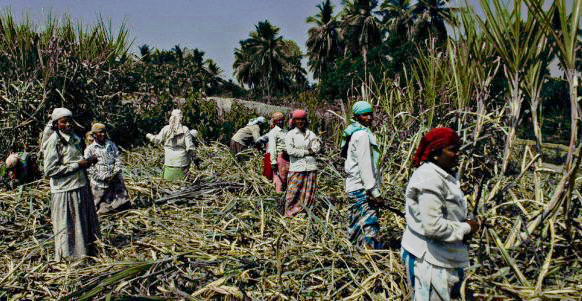
Shortly after Donald Trump’s second inauguration, his administration quietly removed the ban on sugar imports from the Fanjul family-controlled Central Romana company. The ban began in 2022 when it was disclosed that the Fanjuls’ sugar plantation, based in the Dominican Republic, used forced labor and child labor.
In November 2022, the U.S. imposed the import ban citing five key indicators of forced labor — a modern form of debt bondage in which workers are trapped by poverty, isolation, and threats and cannot freely leave. The indicators included abuse of vulnerability, withholding of wages, excessive overtime, isolation, and abusive working conditions.
Research by the Corporate Accountability Lab (CAL) at the Central Romana farms had reported on the vulnerable condition of the sugar workers, mostly undocumented Haitians, as well as elderly workers who had not received retirement benefits. CAL also identified additional forced-labor indicators, including intimidation and threats and debt bondage. It documented other abuses as well, including forced evictions and inadequate housing without potable water or electricity.
The Fanjul family controls American Sugar Refining (ASR), one of the world’s largest sugar monopolies. They acquired C&H Sugar refinery in Crockett, California, in 2005. ASR recently made headlines after the International Longshore and Warehouse Union ILWU Local 6 went on strike to protest ASR’s demands for union-busting concessions, saying, take it or leave it.
On July 27, the ILWU strike forced ASR to withdraw its declaration of impasse and agree to 60 more days of contract negotiations. Local 6 members returned to work July 29 under the existing contract while bargaining continued through at least Sept. 30. According to ILWU sources, “Union solidarity in fighting against concessionary bargaining with our Local 6 sisters and brothers at the bargaining table with C&H Sugar will set the stage for Longshore Division contract negotiations in 2028. Across the country, even internationally, many are calling for support for Local 6 in this key confrontation for labor.”
Rescinding the sugar import ban on Fanjul’s Central Romana company in the Dominican Republic without concrete proof of improved labor conditions and the U.S. government’s dismissal of allegations of forced labor was a historical throwback to acceptance of enforced unpaid labor.
It should be viewed in light of Pepe Fanjul’s close political ties to Trump. In 2024, the Fanjul Corporation donated $1 million to MAGA and $413,000 to the Republican National Committee. Pepe Fanjul also hosted a $50 million fundraiser for the Trump campaign in May 2024, The New Yorker reported.
On Oct. 15, 2025, at a White House dinner for Trump’s ballroom donors, the president praised Fanjul’s contributions.
“Pepe, you were fantastic,” the president said. “He’s got his little sugar business. He has a monopoly on the world’s sugar — I would say that’s a good business.” He added, “He’s been great and a supporter right from the beginning for years.”
The Fanjuls also protected their abusive labor practices with a $1.3 million lobbying drive, from the beginning of 2023 through the end of 2025, according to tracking from OpenSecrets, a nonprofit campaign finance group. The company hired several well-connected lobbying firms, Akin Gump, Barsa Strategies and Patino Brewster & Partners. Those firms employed former officials from the Department of Homeland Security, which oversees Customs and Border Protection (CBP) and the import bans, as well as a former U.S. ambassador to the Dominican Republic.
Before the 1959 Cuban revolution, the Fanjuls ran one of the largest sugar plantations in Cuba, covering 90,000 acres of property. After the 1959 revolution expropriated their holdings, the family relocated to Florida and built a multibillion-dollar empire shielded by U.S. tariffs, import quotas, and federal subsidies. The U.S. government supported inflated prices, some three times higher than those in the rest of the world. The difference was said to cost U.S. consumers billions of dollars a year, earning Big Sugar its label as the “candy-coated cartel.”
For decades, the Fanjuls’ labor, environmental and business practices have been toxic. Environmentalists accused their company, Florida Crystals, of spoiling the Everglades with chemical runoff from their 180,000 acres of cane around Lake Okeechobee.
From the Philippines to the Caribbean, the Fanjuls’ sugar empire has built its profits on exploitation and attacks on workers. Those profits bankroll the right-wing Cuban-exile political machine, pouring millions into political campaigns aimed at attacking socialist Cuba.
Join the Struggle-La Lucha Telegram channel