
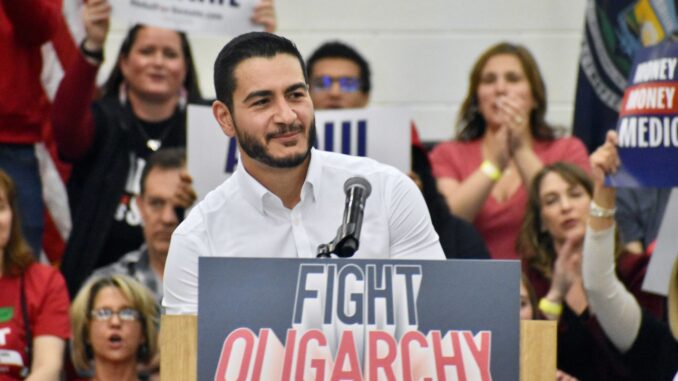
The Aug. 4 primary election victories of progressive Democrats in Michigan has been a cause for consternation among both the Democratic Party establishment and MAGA Republicans. Fox News would have the working class believe that Donavan McKinney and Abdul El-Sayed’s election victories signal an impending doom for all free people. Establishment Democratic leaders would have the working class believe that these candidates are outliers and “radical freaks.”
Both of these groups represent bourgeois society and both of these groups widely miss the mark. To be clear, neither Abdul El-Sayed nor Donavan McKinney are revolutionary socialists. Neither are committed to the downfall of capitalist society. However, both represent the working class’ growing frustration with capitalist austerity and war. This is the same frustration and desire for better lives that propelled Zohran Mamdani to his mayoral victory and made Bernie Sanders a household name.
The importance of these developments is not in the candidates themselves, but the reasons why the candidates galvanized working-class people – from Michigan to Manhattan. One only has to look to the positions of Michigan’s two progressive outsiders to see why they garnered working-class support. The reasons these two Michigan candidates won are very similar to the reasons that Zohran Mamdani prevailed in New York’s mayoral election. Like Mamdani, El-Sayed and McKinney embraced messages of working-class empowerment and anti-racist advocacy.
El-Sayed’s campaign for a Michigan Senate seat championed Medicare for all and called for curtailing U.S. foreign aid to apartheid Israel. He also ran against big money, arguing that grassroots organizing can out maneuver and defeat billionaire one percenters. After the primary, he framed the result as proof that the power of many is greater than the power of the wealthy.
On his way to victory over a well-funded Democratic incumbent in Michigan’s 13th district, Donavan McKinney focused his campaign on fighting climate change, ending mass incarceration, and investment in everyday people. McKinney rightfully critiqued incumbent Shri Thanedar as a multimillionaire who spent millions to buy a seat in Congress, and as someone with more in common with Donald Trump and Elon Musk than with the people of the district.
These Michigan races follow a pattern that has repeated in recent progressive challenges. A clear program helps, but so does a clear opponent. When a campaign names the role of wealth in politics, it gives people language for what they already feel. When it pairs that with concrete promises like universal health care and campaign finance reform, the message is harder to dismiss as mere anger.
This country’s working-class and oppressed communities should be tired of “waiting their turn.” Throughout the entire history of the United States, some obscenely rich racists have called the shots. Every section of the U.S. working class is tired of this. Whether they are Black, Brown, LGBTQIA+, Immigrant, Indigenous, or any other form of oppressed working-class person, they are tired of the same song.
What the working class wants is free health care, guaranteed education, good jobs, and an end to war. They want to enjoy the immense fruits of their labor, currently being stolen by billionaire oligarchs who produce no value themselves. This is why the message of these progressive candidates resonated across Michigan’s multinational working class.
As the general election for both these candidates draws closer, the racist, panicked outcry of the wealthy and powerful will only increase. For the progressive working-class movement, this should mean a response of solidarity and support for candidates like McKinney and El-Sayed. This support should not come from a place of genuine belief in capitalist reform, but from a genuine belief in the working class. Elections can be an arena where the working class develops its own point of view and learns to fight. Such campaigns do not replace the need to organize in unions or to build an independent working-class party.
Ultimately, no election will mean victory or defeat for the working class. That answer only comes from revolution; however, these victories are an important barometer. Working people don’t want war, austerity, and repression. They want education, health care, and jobs. One day, socialist revolution will win exactly that.
Join the Struggle-La Lucha Telegram channel